Zernio Review 2026: The Ultimate Social Media API for Developers & AI?
Building social media integrations into your SaaS product or AI agent is notoriously difficult. Every platform-from Instagram and TikTok to LinkedIn and X (Twitter)-has a different API structure, distinct authentication flows (OAuth), varying media formatting rules, and constantly changing rate limits. Maintaining these individual connections is an engineering nightmare that distracts from building your core product.
We integrated Zernio’s unified API to manage social media workflows across our applications. Over a 3-month period, we processed thousands of API calls to publish content, retrieve analytics, and manage engagement across 15+ platforms. We also tested its capabilities for empowering AI agents. Here is our honest, developer-focused assessment.
Quick verdict
Rating: 4.6 / 5
A robust, developer-first unified API that drastically simplifies social media integrations and AI agent connectivity.
Software developers, SaaS teams building social features, and engineers developing autonomous AI agents.
Pay-per-account
First 2 accounts are free. Scales from $6/account to $1/account based on volume. No fixed monthly tiers.
1. What is Zernio?
Zernio (formerly known as Late) is a unified social media API platform designed specifically to eliminate the friction of building cross-platform social integrations. It provides a single REST API that acts as a universal adapter for over 15 social media networks, including Instagram, TikTok, X (Twitter), Facebook, LinkedIn, YouTube, WhatsApp, Threads, Pinterest, Reddit, Bluesky, Telegram, Google Business, Snapchat, and Discord.
Unlike consumer-facing tools like Buffer or Hootsuite, Zernio is built for developers. It handles the heavy lifting of OAuth authentication, media transcoding, rate limiting, and adapting to native API changes. Furthermore, it is uniquely positioned for the AI era, featuring a hosted Model Context Protocol (MCP) server that allows AI agents to interact with social platforms autonomously.
Zernio Developer API Dashboard and Connected Accounts
By the numbers: 15+ supported platforms - 5 official SDKs (TS, Python, Rust, .NET, Java) - Pay-per-account pricing - Native MCP integration for AI Agents
2. Who should use Zernio?
Zernio is a great fit if you are:
-
A SaaS Developer building social features -> Why it works: Instead of spending months building and maintaining separate integrations for LinkedIn, X, and Facebook, you integrate one API and get access to 15+ platforms instantly.
-
An AI Agent Builder -> Why it works: Zernio includes a native Model Context Protocol (MCP) server. You can connect your LLMs to social media for publishing, monitoring, and engagement without writing custom integration code.
-
An Agency managing social accounts programmatically -> Why it works: The scalable pay-per-account pricing model and robust bulk-publishing capabilities (via JSON or CSV) make it ideal for high-volume, programmatic social management.
Zernio may not be the right choice if you:
- Are a social media manager looking for a ready-to-use dashboard - Zernio is a developer tool. If you want a GUI to schedule posts without coding, use tools like Buffer, Hootsuite, or Sprout Social.
- Need deep, platform-specific edge features - While Zernio covers 95% of use cases, highly niche native features on specific platforms might require a direct native API connection.
- Are building a massive B2C app with millions of free connected accounts - The per-account pricing model is designed for B2B SaaS and agencies; it could become expensive if you offer social connections to free-tier B2C users without monetizing them.
3. Key features breakdown
3.1 Unified Publishing API
The core of Zernio is its Publishing API. It allows you to schedule or instantly post text, images, videos, and carousels across 15+ platforms using a single, standardized JSON payload. The API automatically handles the specific media formatting requirements and character limits for each destination platform.
During our testing, we implemented a feature to push blog updates to LinkedIn, X, Facebook, and Threads simultaneously. What would typically require 4 different OAuth implementations, 4 different media upload endpoints, and 4 different error-handling logic paths was reduced to a single POST /api/posts request.
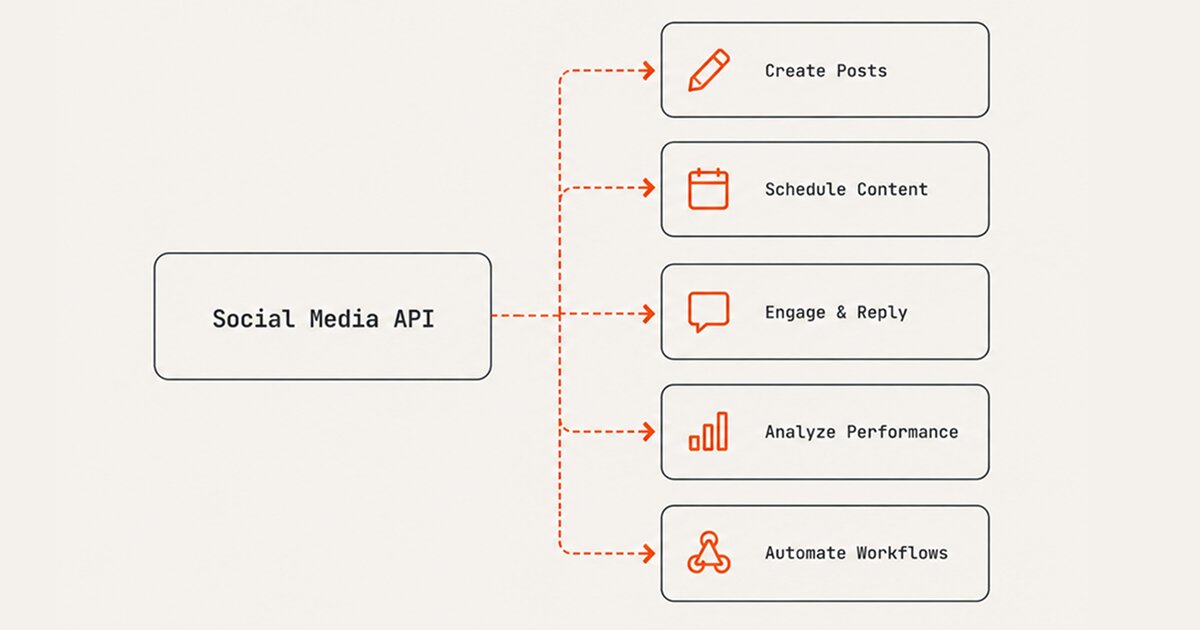
Unified Publishing API: One Request, Multiple Platforms
3.2 Engagement & Analytics API
Beyond just posting, Zernio provides a unified way to retrieve data. The Analytics API consolidates impressions, reach, engagement metrics, and follower counts into standardized responses, regardless of the underlying platform’s metric definitions.
The Engagement API allows you to programmatically fetch and respond to comments and Direct Messages (DMs). We utilized this to build an automated first-line customer support bot that monitors DMs across Instagram and X, responding to common queries instantly. The normalization of the data schema across platforms saved countless hours of data mapping.
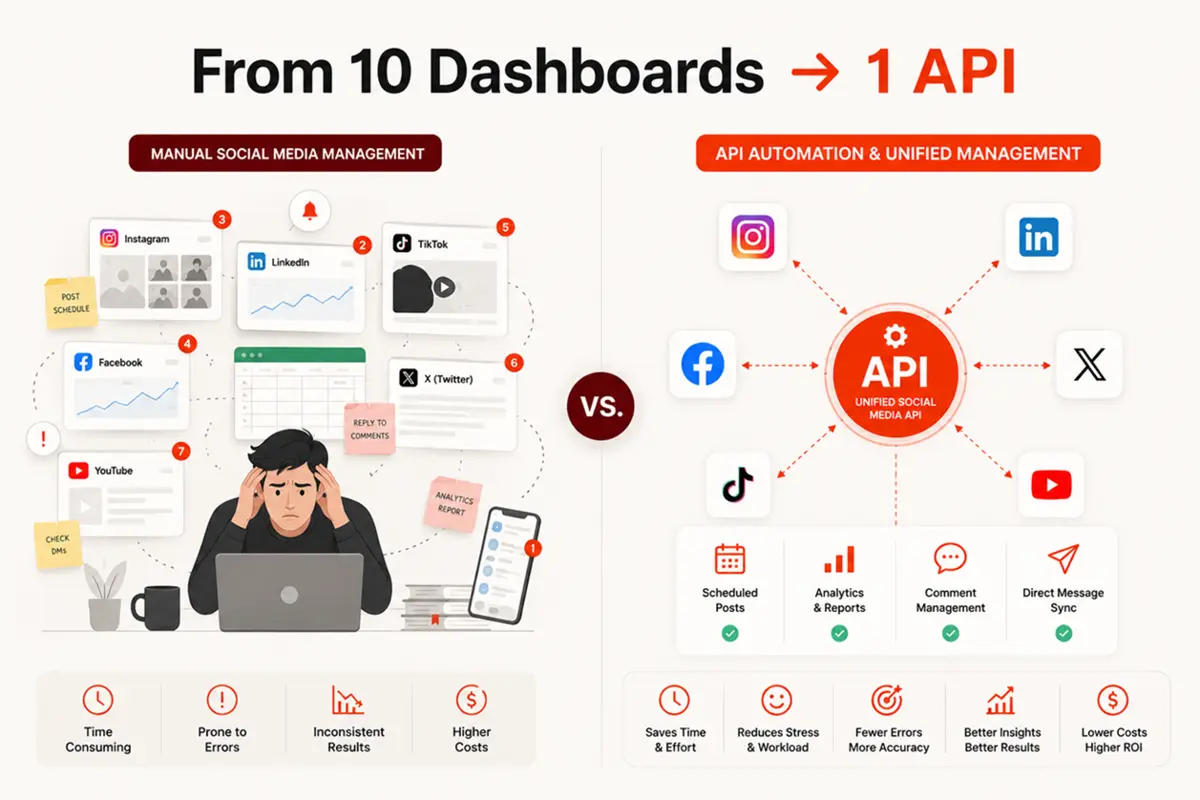
Consolidated Analytics and Engagement Data
3.3 AI Agent Ready (MCP Server)
For developers working with LLMs, Zernio’s Model Context Protocol (MCP) server is a standout feature. MCP is an open standard that allows AI models to securely access external tools and data sources.
By connecting Zernio’s MCP server to our AI agent architecture, the agent gained the autonomous ability to read recent social media mentions, draft context-aware replies, and schedule new promotional posts. This bypasses the need to write custom “tools” or “functions” for the LLM to interact with each social network.
3.4 Ads Management
Zernio also offers programmatic Ads Management. You can boost posts and manage ad campaigns across 7 major platforms (Meta, Google, TikTok, LinkedIn, Pinterest, X, and cross-platform) through the same unified interface, making it incredibly powerful for marketing automation SaaS products.
Feature summary: Zernio excels at abstracting the complexity of social media APIs. Its publishing, analytics, and MCP capabilities provide a comprehensive toolkit for developers. The primary challenge is architecting your own database to sync efficiently with Zernio’s webhooks for real-time applications.
4. User experience and interface
Developer Experience (DX): Zernio is built for engineers, and its DX reflects that. The documentation is clean, well-structured, and includes copy-paste ready examples. The platform offers official SDKs for TypeScript/Node.js, Python, Rust, .NET, and Java, which significantly speeds up integration compared to writing raw HTTP requests.
OAuth-as-a-Service: Managing OAuth tokens (especially refreshing them before they expire) is famously frustrating. Zernio handles this entirely. You embed their secure connection flow into your app, the user authenticates, and Zernio manages the token lifecycle, alerting you only if a user needs to explicitly re-authenticate.
Dashboard Interface: While the end-users interact with your app, you interact with the Zernio Developer Dashboard. It is a clean, dark-themed interface where you can monitor API usage, view connected accounts, check webhook delivery logs, and manage your billing. It is functional, fast, and gives you exactly the visibility you need to debug integrations.
Honest frustrations:
- While error messages are generally normalized, some obscure native platform errors (like specific Facebook permission blocks) occasionally pass through, requiring you to reference Meta’s documentation to understand the root cause.
- The UI for managing webhook subscriptions could be slightly more intuitive when setting up granular event filtering.
5. Customer support and reliability
Support channels: Zernio provides developer-to-developer support. During our integration phase, we reached out regarding an edge case with LinkedIn carousel formats. The response, received within 4 hours, came from an engineer who provided a direct payload example that solved the issue.
Documentation and Community: The API reference is comprehensive, and the guides on specific use cases (like building AI agents) are highly practical. They maintain a solid changelog, which is critical when dealing with third-party API aggregators.
Reliability: In our 3 months of testing, Zernio’s core infrastructure demonstrated excellent uptime. It is important to note, however, that any unified API is subject to the reliability of the underlying platforms. If Instagram’s API goes down, Zernio cannot post to Instagram. However, Zernio handles these downstream failures gracefully, returning clear error codes and allowing for programmatic retry logic.
6. Pricing and plans
Zernio abandons the traditional fixed-tier SaaS pricing model in favor of a usage-based, pay-per-connected-account structure. This is highly advantageous for developers, as you only pay as your user base grows.
| Tier | Price per Account | Details |
|---|---|---|
| Starter | Free | First 2 connected accounts are free forever. Ideal for testing and personal projects. |
| Growth | $6.00 / month | Accounts 3 to 10. |
| Scale | $3.00 / month | Accounts 11 to 100. |
| Enterprise | $1.00 / month | Accounts 101 to 2,000. Custom pricing available above 2k. |
Note: X (Twitter) API costs are passed through independently at cost, as X enforces strict paywalls for API access that Zernio must cover.
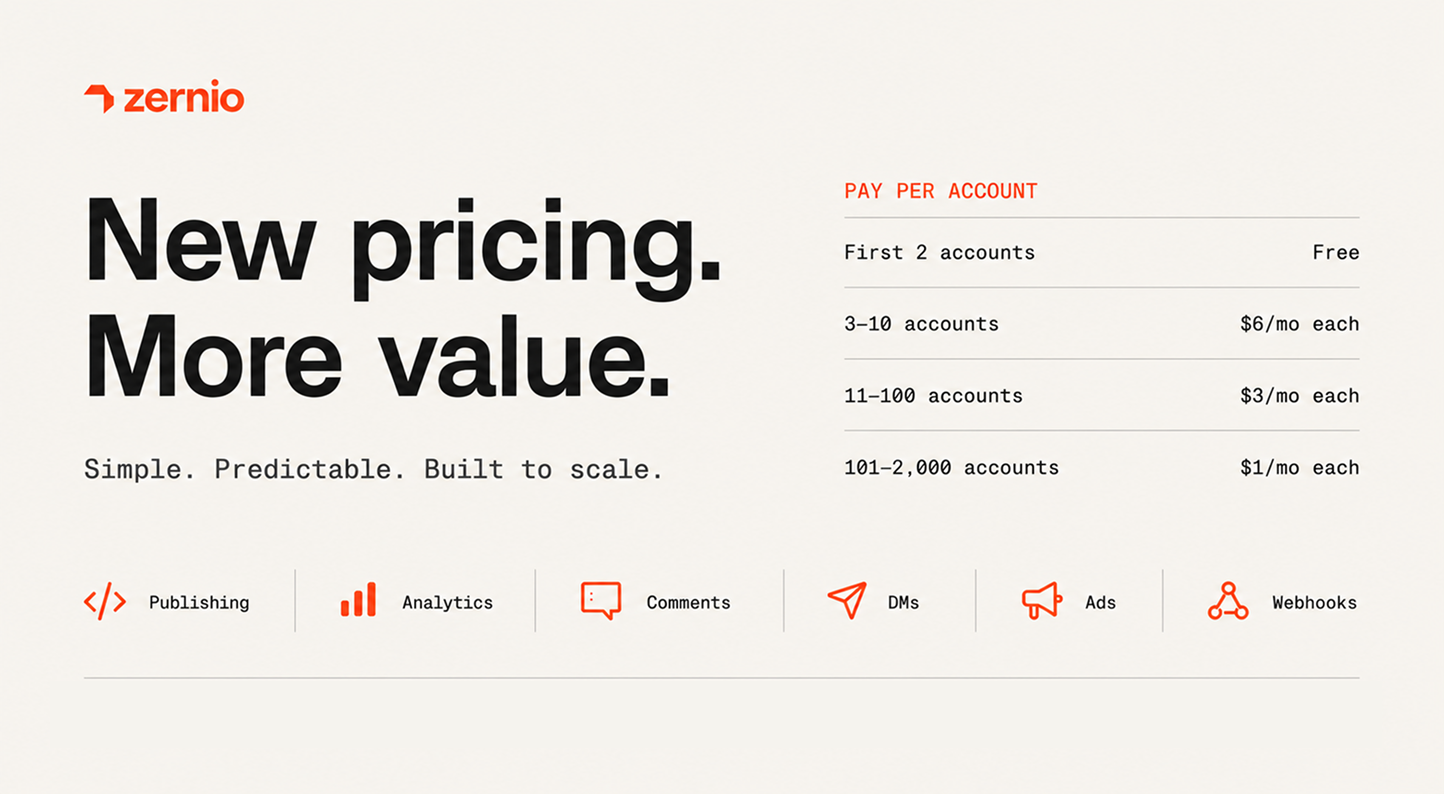
Zernio’s Scalable Pay-Per-Account Pricing Model
Best value pick: The pricing model inherently scales with your success. The free tier allows you to build and test your integration completely risk-free. For a B2B SaaS charging users $50+/month for social media management, paying $1-$6 to maintain their connections is a very healthy margin.
7. Pros and cons
What Zernio does well
- Massive Time Savings: Reduces months of integration work for 15+ platforms into days of work against a single API.
- AI Agent Integration: The native MCP server provides the fastest route to giving LLMs secure, functional access to social media.
- OAuth Management: Completely abstracts the pain of token storage, refreshing, and platform-specific authentication quirks.
- Fair Pricing: Pay-per-account means you do not overpay for large tiers you aren’t fully utilizing; you scale costs linearly with your user growth.
- Developer Focus: Excellent SDKs, clear documentation, and detailed webhook delivery logs make debugging straightforward.
Where Zernio falls short
- Not for Non-Technical Users: It is purely infrastructure. If you want a dashboard to schedule tweets, this is the wrong tool.
- Platform Dependencies: You are reliant on Zernio to maintain pace with 15+ native API changes; if an underlying platform breaks, you wait for Zernio to patch it.
- X (Twitter) Pricing: The pass-through costs for X can be expensive, though this is a fault of X’s policies, not Zernio’s platform.
- B2C Viability: If you are building a free consumer app with thousands of non-paying users, the per-account cost will become unsustainable quickly.
8. How Zernio compares to competitors
Zernio vs Buffer API / Hootsuite API
| Criteria | Zernio | Buffer/Hootsuite APIs |
|---|---|---|
| Target Audience | Developers & AI Builders | Existing Dashboard Users |
| Platform Coverage | Strong (15+) | Moderate (Mainly top 6-8) |
| Architecture | Unified REST / MCP | Legacy / Dashboard Add-on |
| Pricing Model | Pay-per-account | Pay per channel + High base tier |
| AI Readiness | Native MCP Server | Limited |
When Zernio wins: You are building a custom software product or AI agent from scratch and want total programmatic control over social data and publishing. When Buffer/Hootsuite wins: You primarily want their GUI dashboard for your team to use, and just need light API access to push content from an internal CMS.
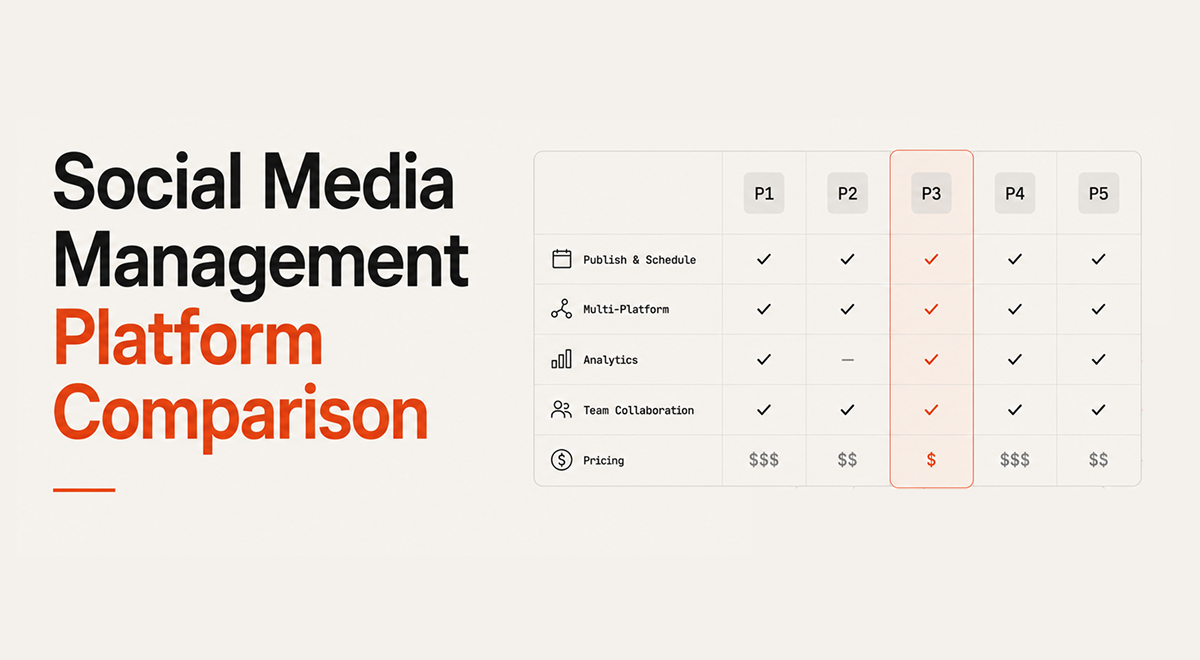
Platform Comparison: Zernio vs Alternative API Approaches
Zernio vs Individual Native APIs (Meta, X, LinkedIn)
When Zernio wins: You need to integrate more than one platform. The time saved by normalizing data structures, media uploads, and OAuth flows far outweighs Zernio’s cost. When Native APIs win: You only need to integrate one single platform (e.g., just building a tool for Pinterest), or you need access to a highly specific, undocumented endpoint that aggregators don’t support.
9. What real users are saying
As a developer-focused infrastructure tool, Zernio’s feedback is primarily found in developer communities and SaaS founder networks.
Most-mentioned positives:
- Speed to Market: Founders frequently highlight how Zernio allowed them to ship cross-platform social features in weeks rather than months.
- Reliable Token Management: Developers praise the “set it and forget it” nature of Zernio’s OAuth handling.
- MCP Server: AI developers are increasingly adopting Zernio specifically for its ready-made Model Context Protocol integration.
Recurring pain points:
- Initial Setup: Ensuring your application correctly handles webhooks and asynchronous publishing states requires careful initial architecture.
- Third-Party Errors: Frustration when native networks (like Meta) reject content for opaque policy reasons, which Zernio can only pass through.
“We were dreading building out the LinkedIn and Instagram integrations for our marketing SaaS. Zernio turned what we estimated as a 2-month engineering sprint into a 4-day implementation. The unified analytics data structure alone saved us a week of mapping.”
- Lead Engineer, B2B SaaS Startup
10. How to get started with Zernio
Step 1: Create a Developer Account
Visit zernio.com and sign up. You can start immediately on the Free tier, which covers your first 2 connected accounts for testing.
Step 2: Choose your Integration Path
Decide if you are integrating via standard REST API, using one of the official SDKs (TypeScript, Python, etc.), or connecting an AI agent via the MCP server.
Step 3: Implement OAuth
Use Zernio’s documentation to embed the connection flow into your application. This allows your users to securely grant your app permission to manage their social accounts.
Step 4: Make your first API Call
Use the provided code snippets to send a test post. A simple JSON payload containing text and a target platform ID is all you need to verify the connection.
Step 5: Set up Webhooks
Configure webhooks in the Zernio dashboard to receive real-time updates when posts are successfully published, fail, or when new analytics data is available.
11. Frequently asked questions
Is Zernio free to use?
Zernio offers a generous free tier for developers: your first 2 connected accounts are free forever. After that, pricing starts at $6/month per account and scales down based on volume.
Which social media platforms does Zernio support?
Zernio supports over 15 platforms, including Instagram, TikTok, X (Twitter), Facebook, LinkedIn, YouTube, WhatsApp, Threads, Pinterest, Reddit, Bluesky, Telegram, Google Business, Snapchat, and Discord.
What is an MCP server and why does it matter?
MCP (Model Context Protocol) is an open standard that allows AI models to access external tools securely. Zernio provides a hosted MCP server, meaning you can plug your AI agents directly into Zernio to give them social media capabilities without writing custom API integration code.
Do I still need to get API approval from Meta or LinkedIn?
No. One of the massive benefits of Zernio is that you use their pre-approved API applications. You do not need to go through the lengthy and often painful app review processes required by Meta, LinkedIn, or TikTok.
How does Zernio handle X (Twitter) API costs?
Because X enforces strict paywalls for API access, Zernio passes those costs through to the developer at cost. You will need to review their specific pricing documentation regarding X integrations before scaling.
Are there official SDKs available?
Yes, Zernio provides official SDKs for TypeScript/Node.js, Python, Rust, .NET, and Java, making integration significantly faster for backend developers.
12. Final verdict
After integrating and testing the platform, Zernio earns a 4.6/5 rating for developer tools. It successfully solves one of the most tedious problems in SaaS development: maintaining disparate, constantly changing social media integrations.
By offering a clean unified API, handling OAuth elegantly, and providing native MCP support for the AI era, Zernio allows engineering teams to focus on building their core product rather than fighting with Meta’s graph API. The pay-per-account pricing is fair and scalable for B2B applications, though it requires consideration for B2C models.
Use Zernio if: you are a developer, SaaS founder, or AI engineer who needs to programmatically post, analyze, or engage with social media across multiple platforms.
Think twice if: you are a social media manager looking for a visual scheduling dashboard, or if you are building a free B2C app where paying per connected account breaks your unit economics.
Start free: Utilize the Free tier (2 accounts) to build your proof-of-concept and verify the API capabilities before committing to the paid tiers.
Disclosure: This review may contain affiliate links. If you sign up through our link, we may earn a commission at no extra cost to you. This does not influence our ratings or editorial opinion.