Comp AI Review 2026: The Open Source Vanta Alternative?
For modern software startups, compliance certifications are no longer optional. Enterprise buyers routinely require a Service Organization Control (SOC 2) report or ISO 27001 certification before they will even sign an evaluation agreement. However, traditional compliance readiness is a slow, manual nightmare of screenshots, spreadsheet tracking, and expensive consultants. Proprietary platforms like Vanta and Drata automated much of this process, but they locked startups into expensive annual contracts ($10,000 to $20,000 per year) and centralized third-party servers.
Comp AI (trycomp.ai) disrupts this landscape by offering an AI-powered, open-source compliance automation platform. Built by Bubba AI, Inc., Comp AI allows developers to self-host their compliance tool for free or subscribe to a managed cloud environment. In this comprehensive review, we dive deep into Comp AI’s architecture, test its evidence collection engine, evaluate its policy builder, check its pricing plans, and compare it directly to traditional SaaS alternatives to see if it stands up to the challenge.
Quick verdict
An impressive open-source alternative to proprietary compliance systems. Ideal for developer-led teams wanting full control over security data.
Tech startups, SaaS companies, and self-hosting enthusiasts who want to automate SOC 2, ISO 27001, HIPAA, or GDPR.
Core platform is free and open-source for self-hosting. Managed Cloud Starter begins around $200/month.
1. Introduction to Comp AI
Comp AI represents the next step in compliance engineering: moving away from locked-down proprietary tools toward open-source transparent standards. It is designed to act as a central hub for all compliance evidence. Rather than sending security logs and access configurations to third-party databases, Comp AI connects locally to your tools and tracks evidence directly.
The platform provides a visual dashboard to monitor the status of all security controls. It performs continuous checks against your software infrastructure, tracking whether your servers are configured securely, your employees have completed security training, and your access controls are correctly enforced. This transparency makes it easier to work with auditors, as they can view the direct configuration of the system rather than relying on manual exports or static spreadsheets.
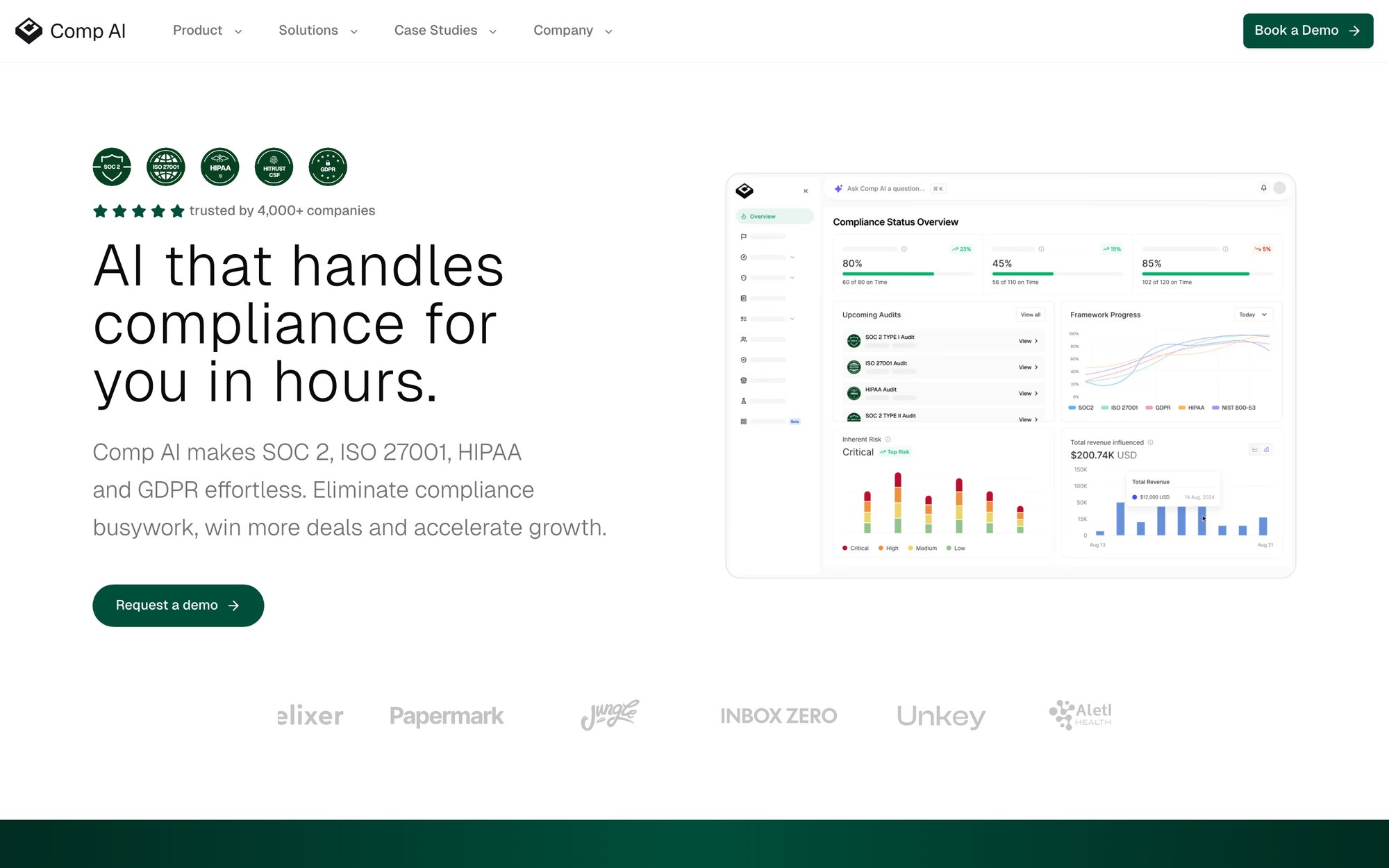
Comp AI Dashboard: Real-time compliance readiness tracking across multiple frameworks in one unified view.
2. Self-Hosted Open Source vs. Managed Cloud
One of Comp AI’s main differentiators is its deployment flexibility. Startups can choose the model that fits their budget and security philosophy:
- Self-Hosted (Open Source): Released under an open license, the core codebase can be hosted on your own virtual machines, Docker containers, or Kubernetes clusters. This ensures that sensitive configurations (like cloud credentials, IAM roles, employee database rosters, and database configuration details) never leave your virtual private cloud (VPC) boundaries. Because the raw data does not sync to external corporate servers, self-hosting makes satisfying security-conscious enterprise buyers significantly simpler. While there are no license fees, your engineering team must take responsibility for system provisioning, database backups, and maintaining platform uptime.
- Managed Cloud (SaaS): For companies that do not want to manage the underlying hosting infrastructure, Bubba AI, Inc. offers a fully managed cloud version. This hosted platform functions like a traditional SaaS tool, receiving automated updates, secure server maintenance, and automated database backups. It also includes access to premium support SLAs (premium support SLAs with faster response times) and simplified OAuth integrations. This option allows early-stage teams without dedicated DevOps bandwidth to start their compliance journey in under 30 minutes.
3. Supported Compliance Frameworks
Comp AI provides out-of-the-box support for the most critical security and privacy frameworks:
- SOC 2 (Type I & II): The gold standard for North American tech buyers, focusing on security, availability, processing integrity, confidentiality, and privacy.
- ISO 27001: The global standard for information security management systems (ISMS), essential for startups targeting international enterprise customers.
- HIPAA: The regulatory requirement for software platforms handling protected health information (PHI) in the United States.
- GDPR: The European Union’s comprehensive data protection and privacy regulation.
Comp AI allows you to activate multiple frameworks simultaneously. The platform maps identical controls across frameworks automatically. For example, enforcing multi-factor authentication (MFA) satisfies requirements in SOC 2, ISO 27001, and HIPAA; Comp AI registers this evidence once and applies it to all relevant dashboards, saving hours of duplicate work.
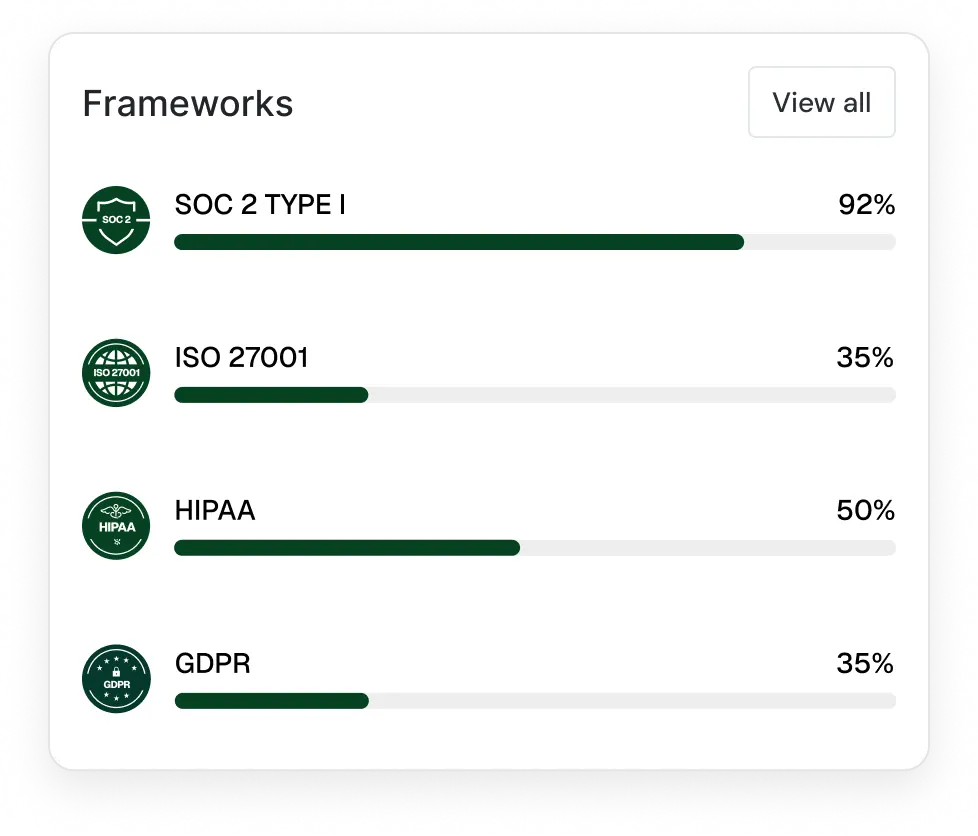
Multi-Framework Support: Activate SOC 2, ISO 27001, HIPAA, GDPR simultaneously - Comp AI maps overlapping controls automatically.
4. Automated Evidence Collection Capabilities
An automated audit tool is only as good as its integrations. Comp AI connects to your company’s tech stack to pull evidence continuously:
- Identity Providers: Integrations with Google Workspace, Microsoft Entra ID (Azure AD), and Okta to track employee rosters, confirm background checks, and verify MFA status.
- Code Repositories: Direct hooks into GitHub and GitLab to verify code branch protection rules, validate that all changes require peer reviews, and check for secret keys pushed in commit logs.
- Developer Infrastructure: Integrations with Linear to prove that access changes, software updates, and vulnerability patches are backed by documented tickets and manager approvals.
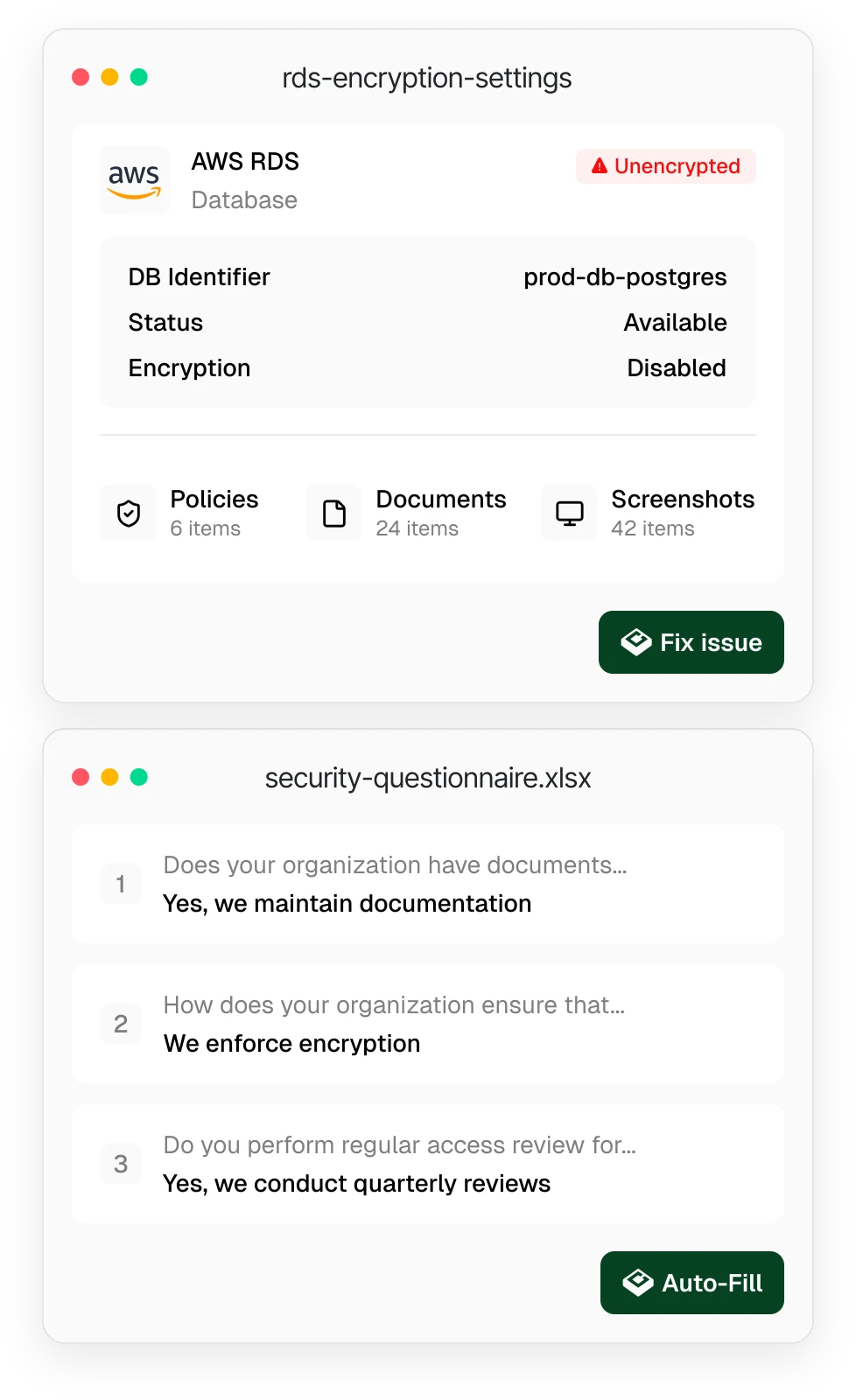
Automated Evidence Collection: Comp AI continuously pulls screenshots, configs, and logs from integrations without manual uploads.
5. Continuous Cloud Security Monitoring
In addition to collecting administrative evidence, Comp AI monitors your cloud infrastructure for active security vulnerabilities and configuration drifts:
- Automated Cloud Tests: The platform connects directly to Amazon Web Services (AWS), Google Cloud Platform (GCP), or Microsoft Azure using read-only API access. It runs hourly tests to verify that resources conform to security standards (like CIS Benchmarks).
- Vulnerability & Configuration Scans: Checks include verifying that production databases are not publicly accessible to the internet, cloud storage buckets (such as S3 or Cloud Storage) have encryption enabled at rest, SSH access is disabled on public ports, and administrative users are using MFA. It also hooks into container registries to scan for vulnerable packages in your deployed images.
- Compliance Drift Alerts: In the weeks between audits, a simple configuration change by a developer (like opening a port temporarily for testing) can break compliance. Comp AI’s hourly checks catch these slips immediately. When a check fails, the system sends alert notifications to the security team via Slack, outlining the specific resource that failed, the exact control it violated, and step-by-step remediation instructions. Many alerts provide step-by-step remediation instructions.
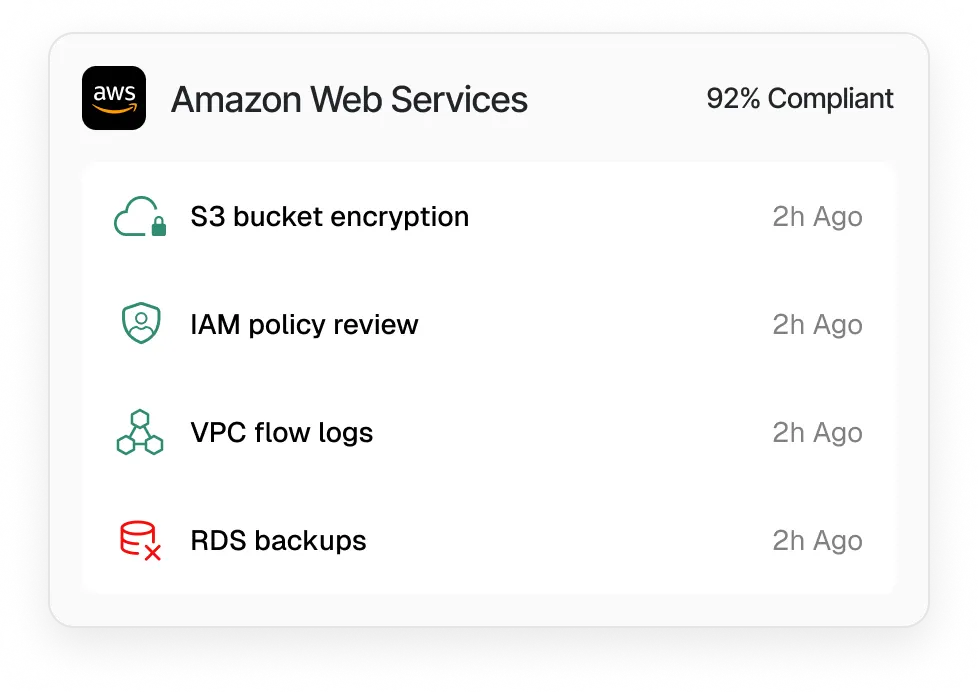
Cloud Monitoring: Automated daily scans across AWS, GCP, and Azure to detect configuration drift before it becomes an audit finding.
6. Compliance Policy Creation and Management
A major part of any compliance framework is establishing formal written policies. Comp AI simplifies this drafting process with its built-in policy generator:
- AI-Powered Policy Templates: The platform includes standard compliance-approved templates for Information Security, Access Control, Incident Response, and Vendor Management.
- In-App Customization Engine: Unlike static PDFs, Comp AI’s editor reads your connected tech stack to auto-fill policy details. If you use Okta and AWS, the AI updates the policies to name these tools specifically rather than leaving generic placeholders.
- Employee Attestation and Tracking: Once policies are finalized, Comp AI distributes them to employees for digital sign-offs. The tool logs these attestations as audit evidence, tracking which staff members have read and agreed to company guidelines.
- Security Training Integrations: You can connect employee training tasks with short security awareness training modules. The system automatically sends reminder pings via Slack or email if an employee has not completed their training before a scheduled audit deadline.
- Annual Policy Reviews: The platform keeps track of version histories and lifecycle dates, prompting administrators annually to review and renew policy drafts to maintain certification currency.
7. Third-Party Vendor and Risk Assessment
Modern compliance audits require companies to evaluate the security posture of their third-party software vendors:
- Vendor Registry: Comp AI maintains a centralized registry of all software services utilized by your company, categorizing them by the sensitivity of data they process (Low, Medium, or High Risk).
- Risk Assessment Surveys: Generates automated vendor risk templates to collect SOC 2 reports or security questionnaires from vendors.
- Unified Risk Register: Tracks custom security risks, outlining their potential impact, likelihood, and mitigation steps. This risk register is a core requirement of ISO 27001 audits and is easily exported during compliance checks.
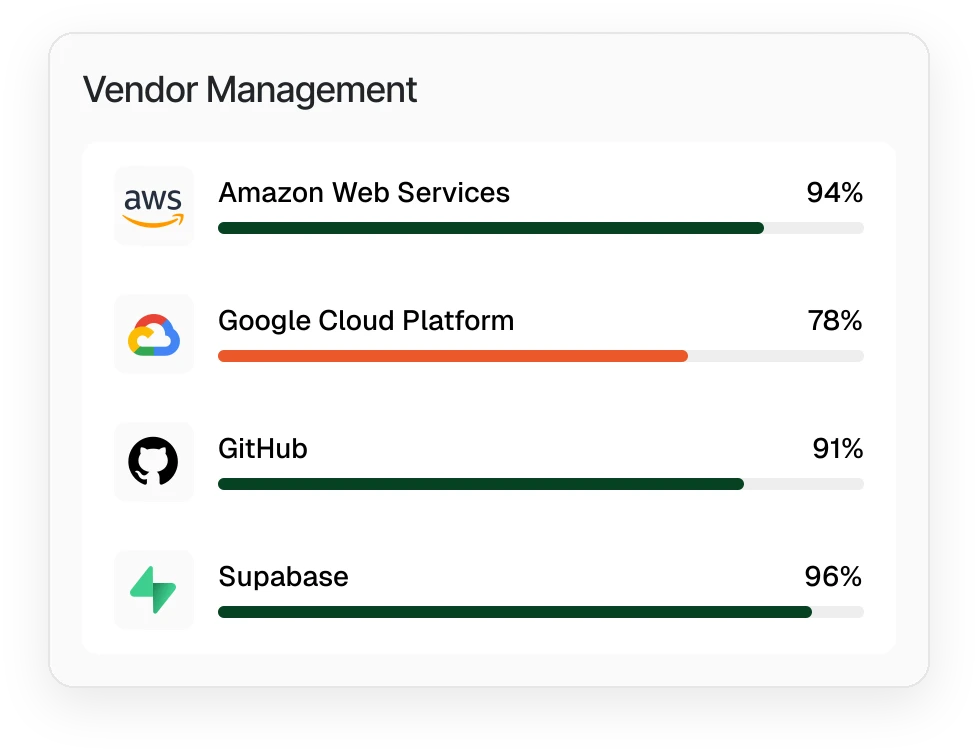
Vendor Risk Management: Centralized vendor registry with automated risk scoring and security questionnaire tracking.
8. Developer-Friendly API and Stack Integrations
As an open-source platform, Comp AI is built from the ground up to fit into developer workflows:
- Rest API and SDKs: Every feature in the dashboard is backed by a fully documented REST API. This allows developers to write custom scripts to import data, trigger test scans, or extract reports.
- Custom Checks SDK: If your company uses a niche database, custom internal tooling, or a specialized server setup, you can write custom integration checks in Python or TypeScript. These custom checks hook into Comp AI’s cron engine, allowing you to run automated compliance scans on proprietary systems.
- Infrastructure as Code (IaC) Configurations: Setup configurations, scopes, and alerting parameters can be defined in YAML files and checked into version control. This allows security teams to manage compliance settings as code.
- CI/CD Pipeline Checks: You can run compliance verification scripts directly within your GitHub Actions or GitLab CI/CD pipelines. This ensures that infrastructure changes (like new Terraform deployment scripts) are verified against your compliance rules before they are merged into production.
9. Audit Readiness and Audit Partner Ecosystem
Preparing evidence is only half the battle; the final step is undergoing an independent audit by a certified CPA firm:
- Audit-Ready Exports: Once Comp AI confirms your dashboard is at 100% readiness, you can generate comprehensive export bundles. These ZIP packages contain all policies, automated test logs, and screenshots formatted for easy auditor inspection.
- Auditor Dashboard: Alternatively, you can invite your auditor directly into the Comp AI platform with read-only access. Auditors can review evidence, check configurations, and log findings directly inside the tool, eliminating back-and-forth emails.
- Partner Network: Bubba AI partners with a network of vetted, startup-friendly CPA firms that are familiar with the Comp AI platform, ensuring a faster, more predictable audit process.
10. Cost and Value Analysis
Evaluating Comp AI’s pricing requires looking at both the self-hosted infrastructure costs and the managed cloud packages:
- Self-Hosted ($0): The software itself is free under an open license. Startups only pay for their own hosting costs (e.g., hosting a Docker container on AWS EC2 or GCP Cloud Run, which typically costs $15 to $50/month depending on traffic).
- Starter Plan ($199/mo): Ideal for early-stage teams under 20 employees. Includes managed cloud hosting, automated integrations, standard policy templates, and basic support.
- Pro Plan ($997/mo): Tailored for scale-ups. Adds premium support, advanced risk registers, custom check API access, and access to the unified audit dashboard. Often bundled with flat-rate audit pricing through CPA partners.
By eliminating massive software licensing markups, Comp AI represents a 75-85% savings compared to legacy platforms, making it an excellent investment for early-stage companies.
11. Comparison with Vanta and Drata
How does Comp AI stack up against the market leaders?
| Feature | Comp AI | Vanta | Drata |
|---|---|---|---|
| Open Source Core | Yes | No (Proprietary SaaS) | No (Proprietary SaaS) |
| Self-Hosting Option | Yes (Full data control) | No | No |
| Base Price | $0 (Self-hosted) / $199/mo | Approx. $8,000+/year | Approx. $8,000+/year |
| AI Policy Builder | Yes | Yes | Yes |
| Integration Depth | Moderate (Core dev/cloud stack) | Extensive (Hundreds of SaaS apps) | Extensive (Hundreds of SaaS apps) |
| Custom Checks API | Yes (Highly developer-friendly) | Yes (Premium custom fields) | Yes (Developer APIs) |
12. Security, Hosting, and Data Privacy
For security leaders, compliance tools present a major risk because they require administrative access to cloud accounts. Comp AI addresses this with strict security practices:
- Local Processing: In the self-hosted model, no API keys or configuration files are ever sent to Bubba AI’s servers. Everything is processed locally within your VPC, maintaining data sovereignty.
- Read-Only Cloud Access: Cloud integrations utilize IAM roles with strict read-only permissions. Comp AI cannot write, modify, or delete any resource in your cloud accounts.
- Security Auditing: Because the codebase is open-source, your security team can inspect the source code to ensure there are no vulnerabilities, backdoors, or telemetry leaks.
13. Frequently Asked Questions
Is the self-hosted version of Comp AI fully free?
Yes. The core platform is open-source, allowing you to self-host and customize it with no licensing fees. You only pay for your own hosting infrastructure (e.g. AWS or GCP costs).
How does Comp AI secure connection credentials to my cloud infrastructure?
For self-hosted instances, all credentials and API keys remain within your local VPC. For managed cloud instances, keys are encrypted using AES-256 at rest, and all integrations run with read-only permissions.
Can I use Comp AI for frameworks other than SOC 2 and ISO 27001?
Yes. Comp AI also natively supports HIPAA compliance for healthcare companies and GDPR for European data privacy compliance, with automatic cross-mapping of controls.
14. Final Verdict and Recommendation
Comp AI is a highly effective solution for developer-led startups. By delivering an open-source, customizable framework, the platform removes the cost barriers of traditional compliance tools.
If you have a strong dev team that can manage a Docker container and wants to save thousands of dollars, the self-hosted option is unbeatable. For companies that want SaaS ease-of-use without Vanta’s enterprise price tag, the managed cloud Starter plan ($199/mo) offers an exceptional value-to-cost ratio.
Use Comp AI if: You are a developer-centric team seeking SOC 2 or ISO 27001 compliance, value open-source software, and want to retain absolute ownership of your security configuration data.
Think twice if: You have no technical engineers to maintain a self-hosted instance, or if you require extensive integrations with hundreds of niche HR and operations tools.
Start testing: Clone their GitHub repository, spin up the Docker compose file locally, and test their automated AWS checks to see how it scans your infrastructure.