
AI Fiesta Review 2026: Does a $12 Bundle Really Replace $110 of AI Subscriptions? (Evidence-Based Deep Dive)
The arithmetic in AI Fiesta’s pitch is hard to argue with. ChatGPT Plus is $20 a month. Google AI Pro is $19.99. Perplexity Pro is $20. Claude Pro is $20. SuperGrok is $30. That is $109.99 a month to have all five, and almost nobody does — most people pick one and wonder what the others would have said.
AI Fiesta sells the alternative for $12: one subscription, one chat window, and the same prompt answered by several models at once in parallel columns. Its homepage headline is “World’s Most Powerful AIs. One Chat. One Subscription.” It launched in August 2025, built by Indian YouTuber Dhruv Rathee together with Mohammad Hasan and Divyanshu Damani, the founders of the creator-monetisation company TagMango.
The comparison workflow is real and genuinely useful. The model catalog behind it is much deeper than the website lets on. But this review will spend considerable time on the gap between what is advertised and what ships — because that gap is wide, and because the most independent evidence available, a 2.5-star rating across 14,700 Google Play reviews, says a lot of buyers have been disappointed.
Quick verdict
Rating: 3.2 / 5
A real and genuinely cheap idea, undercut by undisclosed token tiers, a no-refund policy, and user ratings that are among the worst we have reviewed.
Light users who genuinely want cross-model comparison, and Indian buyers for whom ₹999 replaces subscriptions that would otherwise be unaffordable.
Pricing: $12/mo
Or $120/year. 3 million tokens a month, shared across every model, with frontier models burning them 8× faster. No refunds, ever.
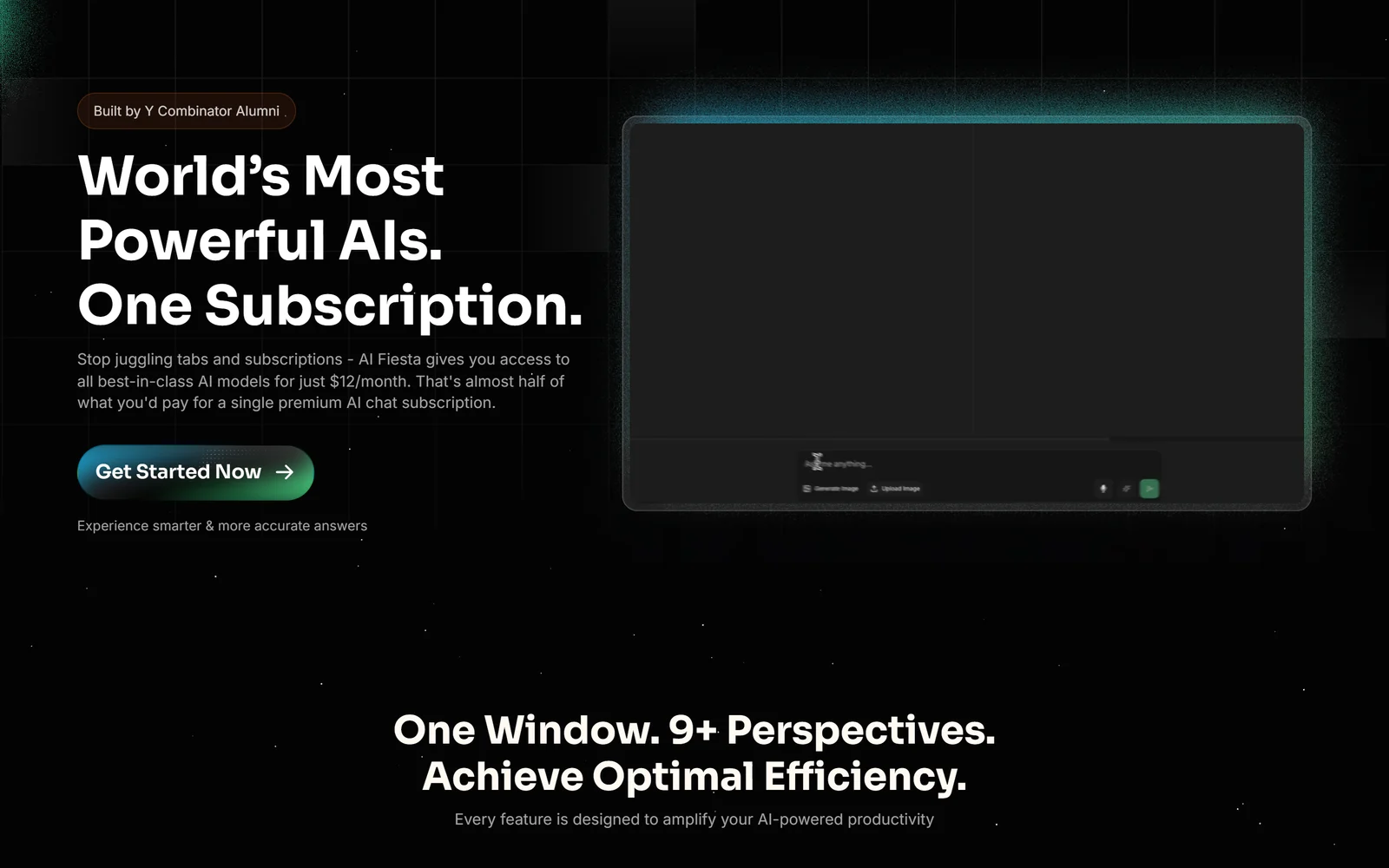
AI Fiesta’s homepage, captured September 2026. The “Built by Y Combinator Alumni” line in the header needs a careful reading — see section 2.
You can see the current plan and model list on the official AI Fiesta website.
1. What AI Fiesta Actually Does
The core mechanic is a column-per-model chat. You type once; the prompt is echoed at the top of every active column; each model streams its answer independently, with per-column on/off toggles you can flip mid-conversation without losing history. The FAQ confirms it: “You can toggle AI models on or off at any time during your chat and turn them back on later without losing your chat history.”
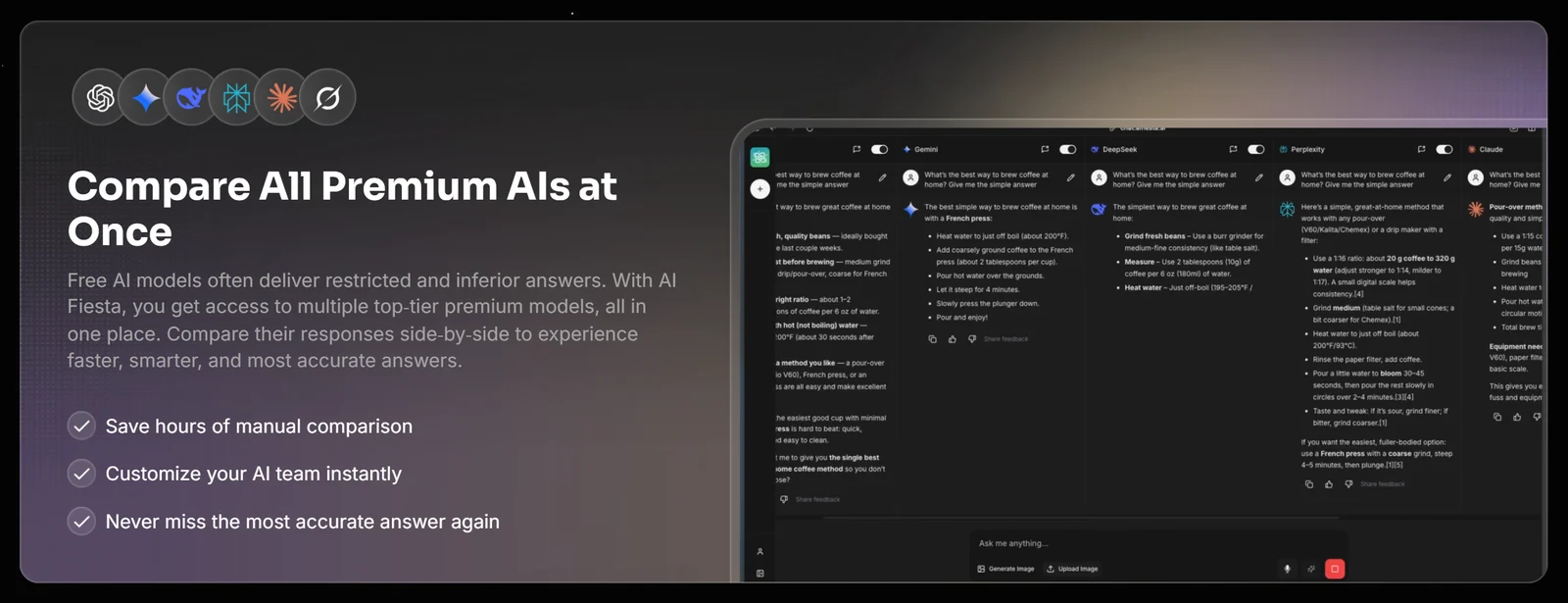
The comparison view is the product’s reason to exist, and the one thing no single-vendor subscription replicates.
Around that sit several bundled extras:
- Super Fiesta — automatic routing that “is designed to automatically select the most suitable AI model for your query” while preserving context and tone. No router model, candidate set or selection criterion is published anywhere; routing happens server-side and is entirely opaque.
- Avatars — personas of historical figures or custom expert advisors. The footer carries an appropriate disclaimer that these are AI simulations, not authentic statements.
- Custom Projects — saved system-instruction presets such as “Marketing Mode” or “Code Review Mode”, applied across every model.
- Image generation, audio transcription, Deep Research, Games and a gated Promptbook at its own subdomain for paid users.
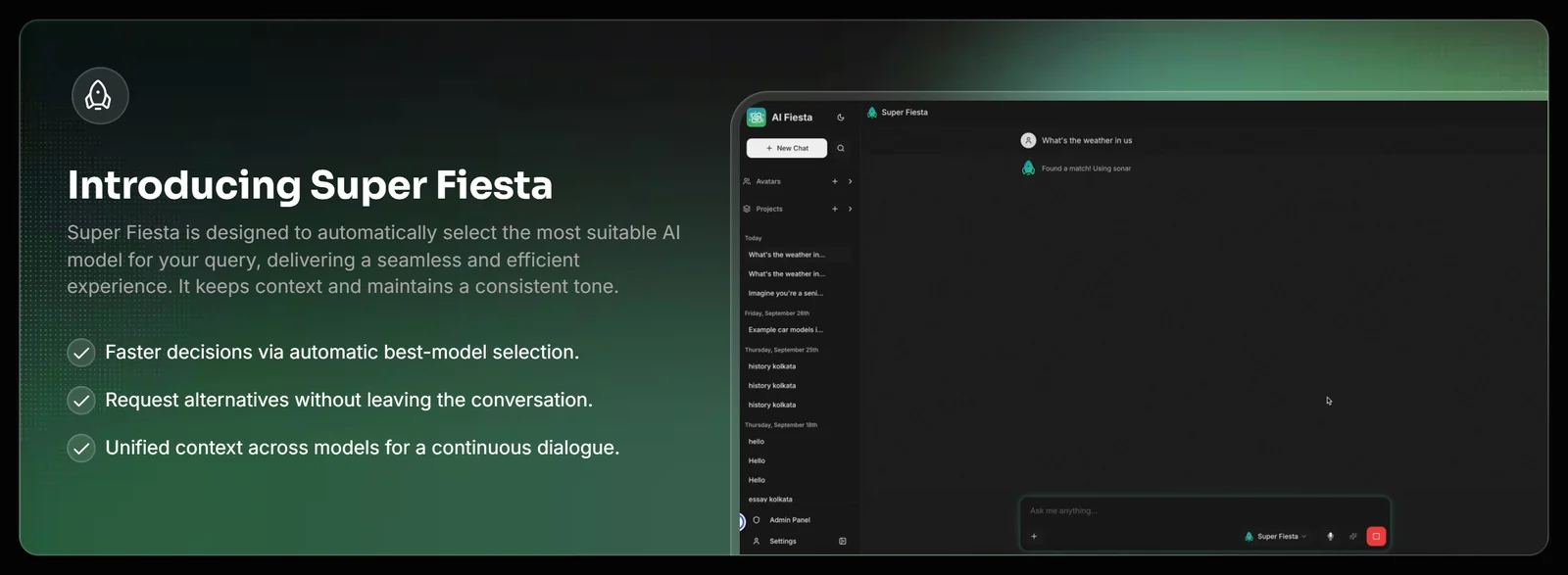
Super Fiesta is also the default: a new chat opens in single-model routing mode, not in comparison mode.
2. The Company: Reading Two Claims Carefully
Two statements around AI Fiesta circulate widely and both need precision, because they concern real people and a real organisation.
”Built by Y Combinator Alumni”
This line appears in AI Fiesta’s own header, and in its narrow sense it is true: Mohammad Hasan and Divyanshu Damani went through Y Combinator in Winter 2020 — with TagMango, a different company, which YC’s directory lists with exactly those two founders.
What it does not mean is that AI Fiesta is a YC company. There is no Y Combinator listing for AI Fiesta or Fiesta Labs, and the corresponding YC directory URL returns a 404. AI Fiesta has never been through YC and has no YC investment. To the company’s credit, its own launch press release worded this correctly — the “YC-backed AI Fiesta” distortion is introduced downstream by aggregators. The claim has drawn public criticism nonetheless, including from Theo, founder of t3.gg.
Dhruv Rathee’s role
Rathee’s involvement is substantive and operational, not a brand endorsement. He gave an on-the-record founder interview to Outlook Business, in which he explained the idea came from his own team’s AI subscription costs running “more than $100 per month”, and he posts company hiring and growth updates in the first person from his own account.
On ownership, the site states that “Fiesta Labs Inc is owned by Dhruv Rathee.” We report that as the company’s own disclosure — it is not confirmed by any public registry we could access, and we make no independent claim about it.
What is and is not documented
- Operator per all five legal documents: Fiesta Labs Inc., Delaware, at a Newark address that is marketed as a virtual-mailbox location.
- Both app stores list the developer and seller as TagMango, Inc — a different entity from the one named in the Terms.
- The company described itself as bootstrapped in 2025; no funding round or outside investor has been disclosed since.
- Independent press is thin: an Outlook Business interview and Storyboard18 reporting. Much of the apparent launch coverage traces to a single company-issued press release republished near-verbatim.
- A LinkedIn page at
linkedin.com/company/ai-fiesta/belongs to an unrelated company — several aggregators conflate the two. Do not read headcount or founding dates from it.
3. The Model Catalog: Much Better Than the Website Says
Here is the review’s most useful finding, and it runs in AI Fiesta’s favour.
The homepage FAQ names nine models — “Grok 4, ChatGPT 5, Gemini 2.5 Pro, DeepSeek, Claude Sonnet 4, Perplexity Sonar Pro, Kimi K2, Qwen 3 Max and Mistral” — and every one of those version labels is a mid-2025 vintage that the providers have long since superseded.
But the marketing page is simply stale. AI Fiesta’s own public model catalog tells a very different story: 88 models across 20 brands, all flagged active, carrying current frontier releases including GPT-5.6 Sol, Claude Opus 5, Claude Sonnet 5, Gemini 3.1 Pro and Grok 4.5. The product is current; the website is a year out of date. If you evaluated AI Fiesta from its homepage alone you would badly undersell it.
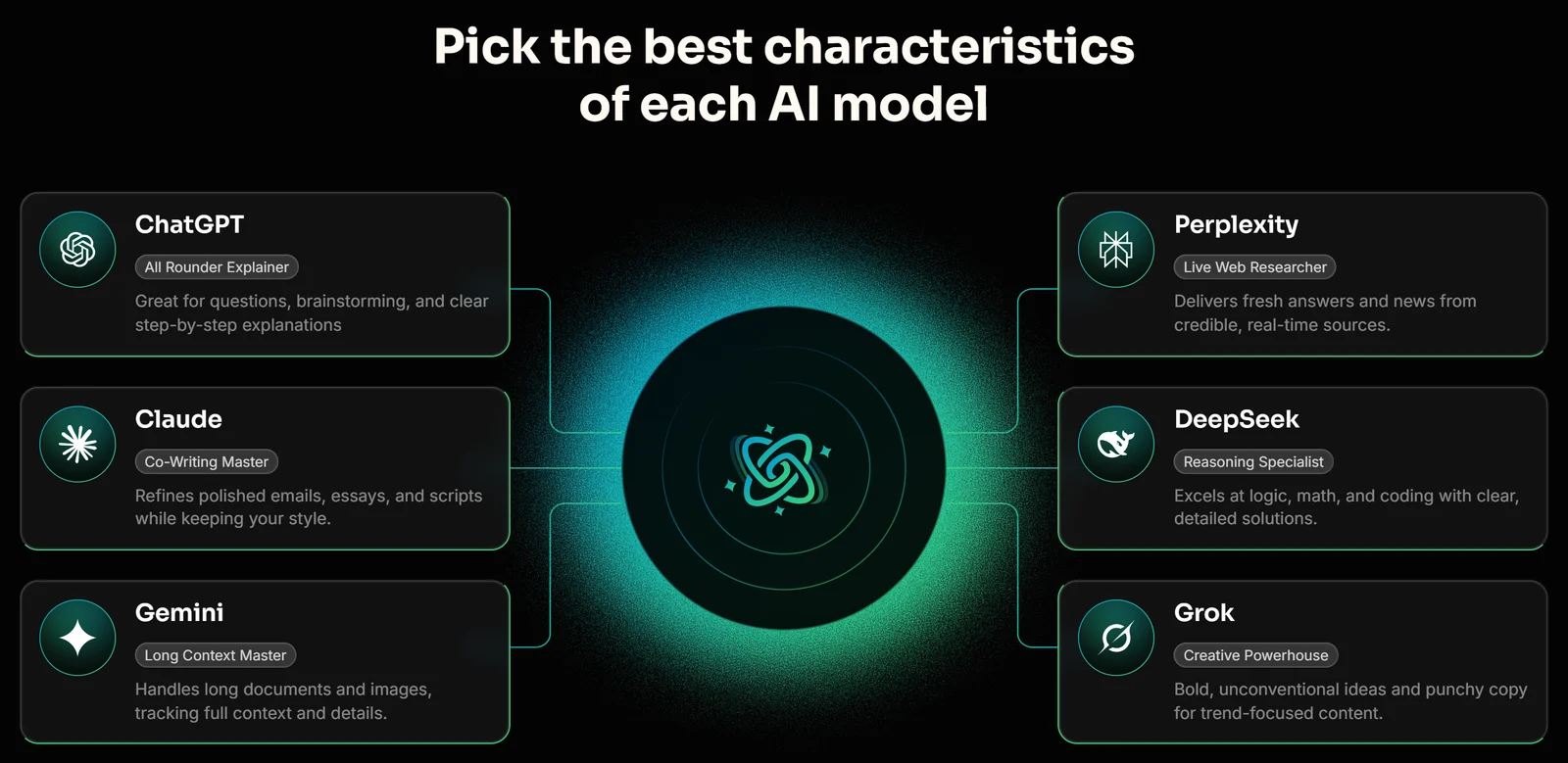
The homepage names six brands here and nine models in its FAQ, while the live catalog carries 88 models across 20 brands. Three surfaces, three numbers.
The three-tier structure nobody advertises
The catalog splits models into three billing tiers, not the two the site discloses:
| Tier | Count | Token rate | Disclosed where |
|---|---|---|---|
| Standard | 36 models | 1× | Homepage FAQ and in-app |
| Premium | 48 models | 4× | Homepage FAQ and in-app |
| Pro | 4 models | 8× | In-app tooltip only |
That four-model Pro tier is precisely Claude Opus 5, Claude Opus 4.8, GPT 5.5 and GPT 5.6 Sol — the genuine frontier models. They burn your allowance eight times faster than a standard model, and the 8× rate appears nowhere on the marketing site and nowhere in the Terms. The in-app explainer itself stops after listing 1× and 4×.
Two more limits the headline does not mention
- A single prompt is capped at five models. The client pre-selects three and hard-refuses additions beyond five. The headline reads “One Window. 9+ Perspectives.” — nine or more are available in the picker, but five is the ceiling on any one question.
- The defaults are not flagships. Eleven models are flagged as defaults and not one is a frontier model: Claude Haiku 4.5, DeepSeek Chat, Qwen Flash, Perplexity Sonar, GPT-5.4 nano, Gemini 3.1 Flash Lite, Grok 3 Mini and similar. Out of the box you are comparing nano, lite, mini and haiku-class models. The flagships must be selected manually, every time.
- A 20,000-character composer cap. Roughly 5,000 tokens. Several catalog models carry context windows near a million tokens; you cannot paste a long document into any of them.
4. Pricing and the Token Economy
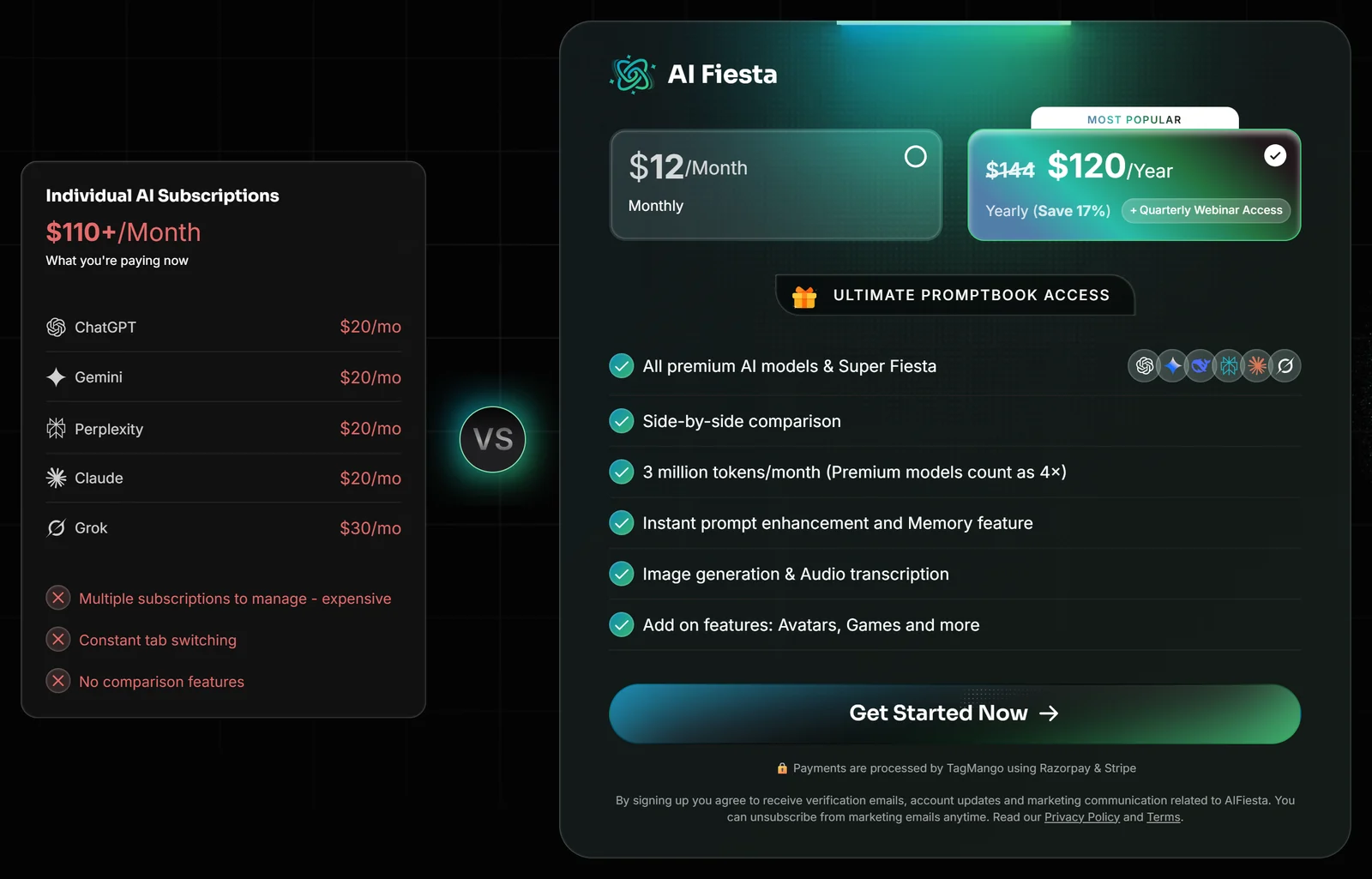
The comparison block. The five listed subscriptions total exactly $110 — and against their real September 2026 prices, that figure is accurate to within a cent.
| Basic (advertised) | Pro (not advertised) | |
|---|---|---|
| Monthly | $12 / ₹999 | $29 / ₹2,999 |
| Annual | $120 (from $144, “Save 17%”) / ₹9,999 | $279 / ₹27,999 |
| Tokens per month | 3,000,000 | 10,000,000 |
A few things worth knowing before you buy:
- The annual discount maths is honest. The struck-through anchors are genuine 12× monthly figures, and the real discounts are 16.67% and 16.59% — both round fairly to the advertised 17%.
- The “$110+/month” comparison is accurate. Priced against what those five products actually cost in September 2026, the basket totals $109.99. Two caveats: the site names them at stale versions, and the static HTML ships “$116+” before JavaScript corrects it to “$110+” — so text extractors and crawlers see the wrong, higher number.
- The “Save 90%” badge holds for the annual plan ($10/month effective is a 90.9% saving) but not quite for monthly ($12 is 89.1%).
- A Pro tier exists that the marketing site never mentions. It appears only in the Terms, at $29/month for 10 million tokens. The app’s own error messages indicate video and presentation generation live on that tier.
- Currency is set by detected country, with India getting rupee pricing and Cashfree/Razorpay checkout, everyone else dollars and Stripe. Apple’s in-app prices run well above the web prices — the App Store SKUs sit 30% or more higher, so subscribe on the web.
Where the 3 million tokens actually go
Tokens are consumed in both directions — your prompt and the model’s answer — and from one shared pool across every model. This is the single most common complaint about the product, and it is structural rather than a bug: every extra column you enable multiplies the burn on the same allowance.
At 4× for premium models, a 3-million allowance is effectively 750,000 premium tokens. At 8× for the four frontier models, it is 375,000. And some features are extremely heavy:
- Deep Research: about 100,000 tokens per run, roughly 15× a normal chat — about 30 runs a month on Basic, and the clarifying question it asks first bills separately.
- Image generation: metered per image, from 6,000 tokens (Grok Imagine) to 35,000 (Nano Banana Pro) — about 85 images a month at the top rate.
Running out is not a hard stop: the app drops into a “fair usage policy” mode and blocks premium models until you top up. The size of that fallback bucket is never quantified anywhere — not on the site, not in the Terms, not in the shipped code.
One unresolved contradiction: the Terms say unused tokens do not roll over, while the shipped pricing UI sells “Tokens roll-over every month” as an annual-plan benefit with a green check. The two cannot be reconciled from public information.
5. Refunds, Legal Terms and Compliance
The refund policy is absolute. The standalone Refund Policy states: “We do not offer refunds under any circumstances” — covering subscription fees, renewals, one-time token packs and add-ons, regardless of usage, reason or timing, and applying to Basic, Pro and enterprise agreements alike. Cancellation is self-serve but stops future billing only, with no proration.
Note that the homepage FAQ contradicts this, offering discretionary exceptions for billing errors and duplicate charges. The Refund Policy page is the stricter and more likely operative document. Assume you cannot get your money back.
What the legal documents do and do not say
| Topic | Status |
|---|---|
| Liability | Disclaims all damages, with no monetary cap and no fees-paid formula |
| Indemnity | No indemnification clause in either direction |
| Arbitration | One sentence: Delaware law, binding arbitration. No provider, seat, rules or opt-out window specified. No class-action or jury waiver |
| Your content | You keep ownership of outputs, but grant a licence to “store, process, and use your prompts and Outputs solely for the purpose of providing and improving our services” — “improving” is never bounded |
| Model training | The word “train” appears in none of the five legal documents. No training opt-out, no zero-retention commitment |
| Retention | ”only as long as necessary” — no period, maximum or deletion schedule |
| Sub-processors | Named only in the DPA: OpenAI, Anthropic, Google, xAI, plus TagMango, Stripe, Cashfree, Razorpay, Apple, Cloudflare and others |
| SOC 2 | The enterprise page shows a “Certified / SOC 2 Compliant” badge. No auditor, report type or scope is named, /security and /trust both 404, and SOC 2 appears in zero legal documents. Treat as unverified marketing |
| India’s DPDP Act | Entirely unaddressed — no Grievance Officer, no Data Fiduciary designation — despite rupee pricing and two Indian payment processors |
The encryption contradiction
This one is worth stating plainly because both sides come from the company itself. AI Fiesta’s enterprise page promises “Your enterprise data is encrypted in transit and at rest and never used to train external models.” Its own Google Play Data Safety declaration — a developer submission — states “Data isn’t encrypted — Your data isn’t transferred over a secure connection.”
Both cannot be right. That contradiction, plus the unsupported SOC 2 badge and the absence of any training language in the Terms, is why we would not put confidential material into this product.
6. What Real Users Say
This is the section that most moves the score, because it is the only genuinely independent evidence available.
| Source | Rating | Volume |
|---|---|---|
| Google Play | 2.5 stars | 14,700 reviews, 500K+ downloads |
| Google Play phone histogram | 2.4 stars | 14,296 ratings — 56% are one star, 32% are five star |
| Apple App Store (India) | 3.44 | 190 ratings |
| Apple App Store (Canada / US / Australia / UK) | 2.40 / 2.56 / 1.93 / 2.36 | 30 / 18 / 15 / 11 ratings |
| Trustpilot | Score suspended | 261 reviews |
Two of those rows deserve emphasis.
The Play histogram is bimodal. A majority of phone ratings are one star and a third are five star, with almost nothing in between. That shape usually means the product works well for one group of users and fails badly for another — consistent with the shared-token-pool complaint, where light users are satisfied and heavy users exhaust their allowance quickly.
Trustpilot has removed the score. The profile displays “This company’s rating is unavailable due to a breach of our guidelines” alongside “We’ve removed a number of fake reviews for this company.” That is Trustpilot’s own statement on its own platform. It means the visible star distribution there cannot be read at face value in either direction.
The documented, recurring criticisms are consistent: that the monthly token allowance is a single shared pool across all models, that the allowance compares poorly against the free tiers of the underlying services, and that the product repackages third-party APIs rather than building original technology.
One structural note in the company’s favour: the iOS app only shipped in December 2025, about three and a half months after the August 2025 web launch, so early subscribers had no iPhone app at all.
7. AI Fiesta vs Subscribing Directly and vs Other Aggregators
| Option | Price | What you get | What you give up |
|---|---|---|---|
| AI Fiesta | $12/mo | Side-by-side comparison, 88-model catalog, image, transcription, Deep Research | Shared token pool, 5-model cap, 20K character limit, no refunds |
| Five direct subscriptions | ~$110/mo | Full official apps, memory, native limits, each vendor’s own data terms | Five bills, five tabs, no comparison view |
| ChatGPT Plus alone | $20/mo | Deepest single ecosystem, memory, GPTs, Sora | One model family’s perspective |
| Poe | Subscription | Many models, bot ecosystem, long track record | Also a shared-credit model |
| OpenRouter (BYO API) | Pay per token | Every model, exact provider pricing, no markup | No chat UI of its own, requires technical setup |
| TypingMind / LibreChat (BYO key) | One-off or free | Own the client, own the keys, no subscription | You pay the API bills and do the setup |
The honest framing: AI Fiesta is not a substitute for a power user’s primary subscription. If you use one model heavily every day, $20 direct buys you more usable capacity than $12 shared across a pool that frontier models drain eight times faster. The bundle wins for breadth over depth — occasional use across many models, and genuine comparison — and for anyone in a market where $110 a month is simply not spendable.
If you are technical, OpenRouter or a bring-your-own-key client gets you the same catalog at provider cost with no shared pool, no five-model cap and no character limit. You trade convenience for control.
8. Pros and Cons
Where AI Fiesta delivers
- The comparison workflow is real and genuinely useful — no single subscription offers it
- The live catalog is deep and current: 88 models, 20 brands, including present-day frontier releases
- The price gap is enormous and the site’s own arithmetic on it is accurate
- Rupee pricing at ₹999 makes this meaningfully accessible in a market where Western AI subscriptions are not
- Context windows pass straight through from the providers, up to roughly a million tokens
- Extras are bundled, not upsold — image generation, transcription, Deep Research, Promptbook
Where it falls short
- User ratings are poor and high-volume: 2.5 stars over 14.7K Play reviews, with a majority of phone ratings at one star
- Trustpilot suspended the score and states it removed fake reviews
- No refunds under any circumstances, by the company’s own policy page
- The 8× frontier-model tier is undisclosed on the site and in the Terms
- “9+ perspectives” but a five-model cap, with nano and lite-class defaults
- 20,000-character prompt limit against million-token context windows
- The SOC 2 badge is unverified, and the company’s own Play disclosure contradicts its encryption promise
9. Frequently Asked Questions
Is AI Fiesta actually cheaper than paying for ChatGPT, Claude and Gemini separately?
On sticker price, decisively yes — $12 against about $110 for the five services it compares itself to, and that $110 figure checks out against real September 2026 prices. The catch is capacity, not cost. AI Fiesta meters everything from one 3-million-token monthly pool shared across all models, with premium models drawing 4x and the four frontier models 8x. A heavy daily user of one model will get more usable output from a single $20 direct subscription.
Is AI Fiesta a Y Combinator company?
No. The 'Built by Y Combinator Alumni' line is true in a narrow sense: co-founders Mohammad Hasan and Divyanshu Damani went through YC in Winter 2020 with a different company, TagMango. There is no YC listing for AI Fiesta or Fiesta Labs and no YC investment in it. Calling it 'YC-backed' — as several aggregator sites do — is wrong.
Which AI models does AI Fiesta actually include?
Far more than its website says. The homepage names nine models at mid-2025 versions, but AI Fiesta's own live catalog carries 88 models across 20 brands including current frontier releases. The catch is tiering: models are split into standard (1x tokens), premium (4x) and a four-model 'Pro' class at 8x — and that 8x tier, which holds the genuine frontier models, is disclosed only in an in-app tooltip.
Can I get a refund if I don't like it?
No. AI Fiesta's Refund Policy states plainly that it does not offer refunds under any circumstances, covering subscription fees, renewals, token packs and add-ons regardless of usage or reason. Its homepage FAQ suggests discretionary exceptions for billing errors, but the Refund Policy page is the stricter and more likely operative document. Cancelling stops future billing only, with no proration.
How many models can answer one prompt at the same time?
Five. The headline advertises '9+ perspectives' and more than nine are selectable, but the app pre-selects three and hard-caps any single prompt at five models. A new chat also opens in Super Fiesta single-model routing by default rather than comparison mode, and the eleven default models are all nano, lite, mini or haiku-class rather than flagships.
Is AI Fiesta safe for confidential work?
We would not use it for that. The word 'train' appears in none of its five legal documents, so there is no training opt-out or zero-retention commitment; retention is defined only as 'as long as necessary'. The enterprise page carries a SOC 2 'Certified' badge that names no auditor and appears in no legal document, and the company's own Google Play Data Safety declaration states 'Data isn't encrypted' — contradicting the encryption promise on that same enterprise page.
Why is the app's rating so low?
Google Play shows 2.5 stars across about 14,700 reviews, with 56% of phone ratings at one star and 32% at five — a bimodal split that usually means the product works for one group and fails another. The recurring documented complaints are that the token allowance is a single pool shared across all models, that it compares poorly to the free tiers of the underlying services, and that the product repackages third-party APIs. Trustpilot has separately suspended the company's score, stating it removed a number of fake reviews.
Should I subscribe on the app or on the web?
The web. Apple's in-app purchase prices for AI Fiesta run roughly 30% or more above the web prices for the equivalent plans. Note also that both app stores list the seller as TagMango, Inc, while every legal document names Fiesta Labs Inc. as operator — so the entity you contract with differs depending on where you buy.
10. Final Verdict: Who Should Actually Buy This?
AI Fiesta earns 3.2 / 5 — our lowest score for a product we still think has a real audience.
The idea is sound and the execution of the core feature is fine. Watching four models disagree on the same question genuinely changes how much you trust any one of them, and nothing you can buy from OpenAI, Anthropic or Google will show you that. The catalog behind it is deeper and more current than the marketing suggests. At $12, and especially at ₹999, the value on paper is extraordinary.
What pulls the score down is a consistent pattern rather than any single flaw: the advertised product and the shipped product keep disagreeing. Nine perspectives that cap at five. Frontier models at an 8× rate disclosed only in a tooltip. A Pro plan that exists in the Terms but not on the pricing page. Tokens that roll over in the UI and do not in the Terms. An encryption promise on the enterprise page contradicted by the company’s own app-store filing. Individually these are sloppiness; together they mean you cannot buy on the strength of the marketing — and there are no refunds if the shipped version disappoints you.
And the user evidence is hard to set aside. A 2.5-star average over 14,700 reviews is not a vocal minority, and a suspended Trustpilot score is a signal in its own right.
Subscribe if: You want cross-model comparison as an occasional research tool, your usage is light, you are buying in rupees where the alternative is nothing at all, and you treat the $12 as a one-month experiment you cannot reverse.
Skip it if: You lean hard on one model daily, you need confidential-data handling, you want refund protection, or you are technical enough to run OpenRouter or a bring-your-own-key client — which gives you the same models at provider cost with none of the caps.
Buy one month, not a year. The annual plan saves 17% but commits $120 to a product whose no-refund policy is absolute and whose shipped behaviour differs from its sales page in at least six documented ways. You can review the current plan on the official AI Fiesta website before deciding.
Disclosure: This review contains affiliate links. If you subscribe to AI Fiesta through our link, we may earn a commission at no additional cost to you. All factual claims here were verified against AI Fiesta’s own website, Terms, Privacy Policy, DPA, Refund Policy, public model catalog, app-store listings and credible press as of 15 September 2026. Claims resting only on the company’s own marketing are attributed as such, and allegations we could not independently verify have been deliberately excluded.