
Hacktron Review 2026: An AI Security Reviewer From People Who Find Real Bugs
Most AI code review tools are generalists. They comment on naming, structure and readability, and security remarks arrive buried in that stream. Hacktron is deliberately narrow. It reviews pull requests for one thing — whether an attacker could reach and abuse the change — and it pairs that reviewer with white-box penetration tests built on your source code.
What makes Hacktron worth a close look is not its marketing but its team’s track record. Vulnerabilities its researchers found are credited in advisories published by BeyondTrust, WSO2, Palo Alto Networks, Metabase and the maintainers of GNU Savannah, and Rocket.Chat’s own advisory for a critical account-takeover bug says it was caught by Hacktron’s PR scan. Few products in this category can point to evidence like that.
This review also covers what the homepage does not: there is no pricing page, the PR reviewer is static rather than dynamic, the headline benchmarks are Hacktron’s own, and the contract terms deserve a read before you sign.

Hacktron’s homepage, captured 30 September 2026.
1. What Hacktron Is, and Who Is Behind It
Hacktron describes itself as “an AI-native security platform for code reviews and penetration tests”. Its homepage headline is “Security for the age of AI-powered threats.” It lays out three pillars: Review for code security, Whitebox Pentest for product security, and Organization security, which is marked “Coming soon”.
The company
Hacktron is operated by Hacktron AI Inc., a Delaware corporation with a San Francisco mailing address. It was co-founded by Zayne Zhang (CEO), Mohan Pedhapati (CTO) and Harsh Jaiswal (Chief Research Officer). According to Hacktron’s team page, Zhang is a Cambridge computer science dropout who previously worked at TikTok, Pedhapati previously worked at Cure53, and Jaiswal came from ProjectDiscovery. The team page also lists Fabian Faessler, known as LiveOverflow, as Head of Agent Engineering.
Hacktron was one of six startups in the first cohort of Project Europe, announced in July 2025. In May 2026 it announced a $2.9M pre-seed round led by Crane Venture Partners, with Project Europe, Vercel Ventures, Plug and Play Ventures, Cambridge Enterprise Ventures and Overlook Ventures participating. LinkedIn lists a team of 2–10 people. The company says it made about $240,000 in revenue in its first nine months — its own figure.
2. Who Hacktron Is For — and Who It Is Not For
It fits you if:
- You want a security reviewer on every PR that is separate from your general AI reviewer
- You need a white-box pentest report for a SOC 2 or ISO 27001 audit without a long engagement
- Your team is tired of scanner noise and wants each finding to arrive with evidence
- You maintain an open-source project and can apply for free PR security reviews
- You need an on-premises deployment
Look elsewhere if:
- You need the cheapest per-seat option — Snyk, Semgrep and GitHub Code Security all start lower
- You need dynamic testing on every PR — Review is static; dynamic testing is part of the separate pentest product
- You need broad AppSec coverage in one bill (SCA, containers, cloud posture) rather than a focused reviewer
- You need a transparent, published price list before you talk to anyone
3. Hacktron Review: Security Findings Inside the Pull Request

The Review product page. The trial is 14 days and needs no credit card.
Hacktron Review connects to more Git hosts than most of its competitors: GitHub (Free, Team and Enterprise Cloud), GitHub Enterprise Server, GitLab.com and self-hosted GitLab, Azure DevOps Services and Server, and Bitbucket Cloud. Bitbucket Data Center is not supported. Most of this coverage is recent — Enterprise Server arrived on 7 June 2026, Bitbucket PR scanning on 15 July and Azure DevOps on 3 August.
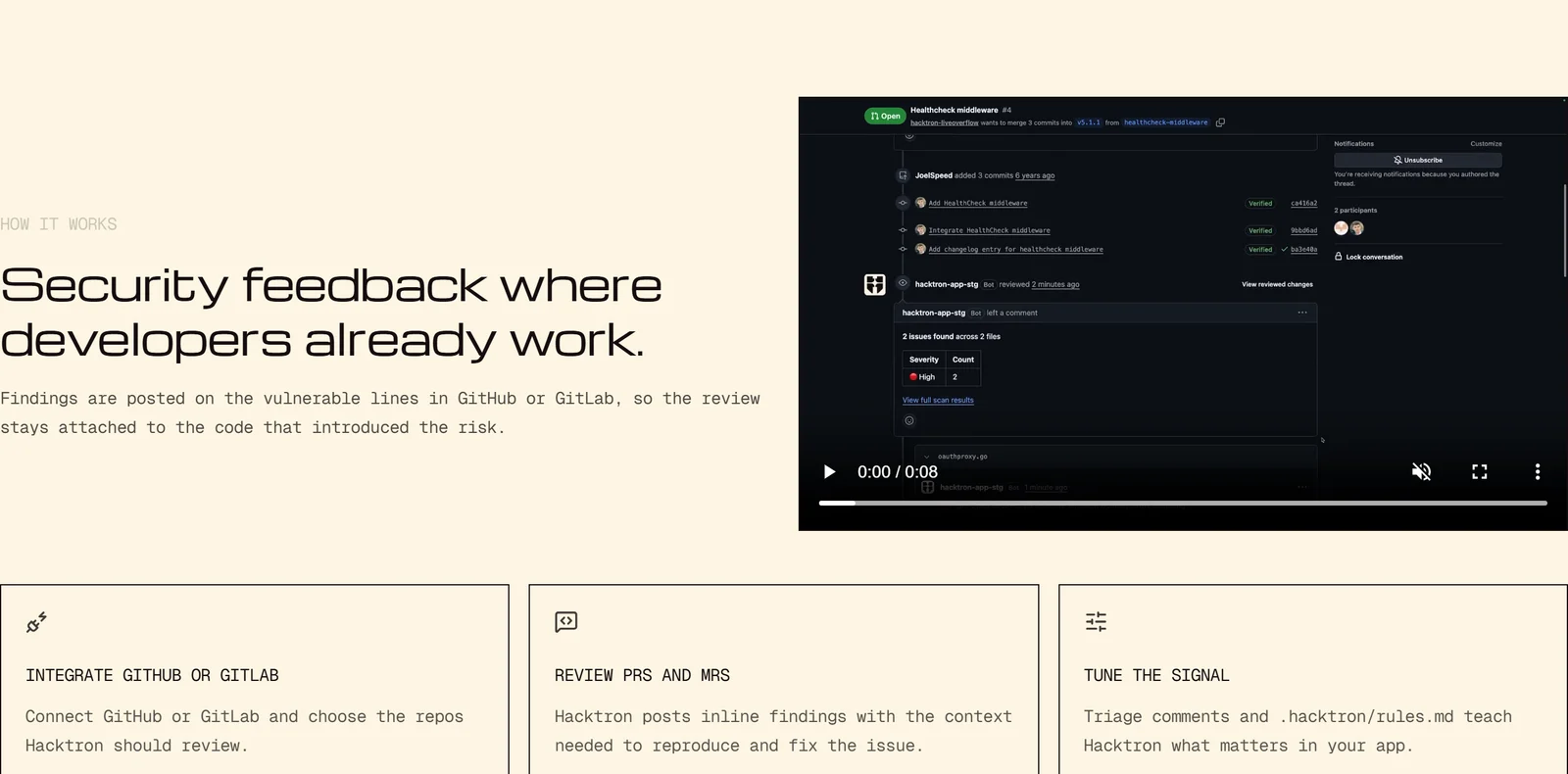
Findings land on the vulnerable lines of the pull request, not in a separate dashboard.
What a review looks like
Findings are posted inline on the vulnerable lines. Issues in code outside the diff go into the affected file or a collapsible “Findings outside diff” section, and on public repositories those details are hidden from the public thread. Each comment carries a severity badge, a collapsible proof-of-concept, trace diagrams and a “Fix with AI” prompt, and the Slack integration can open the fix in Cursor or Claude.
Hacktron states that every finding comes with a proof-of-concept exploit, and that it drops candidates it cannot prove exploitable. That is the core of its pitch, and it is Hacktron’s own description of its method.
The static-analysis caveat
Hacktron’s own blog is candid about a limit the product pages do not dwell on: Review can be called a SAST tool because, unlike the pentest product, it “does not perform dynamic testing against a live environment yet.” A review typically takes 1–2 minutes. So the proof-of-concept on a PR finding is reasoning about exploitability — it is not an exploit that was run against your application.
Tuning and control
- Triage commands. Reply
!fp,!accepted_risk,!validor!fixedon a finding, or triage in the web app or Slack. - Rules file. A
.hacktron/rules.mdin the repository teaches it what matters in your app. - Threat models. Hacktron builds repository and application threat models automatically, starting from the first reviewed PR.
- Merge gate. An optional
fail_on.severitysetting fails the check at a severity threshold; marking a finding as a false positive or accepted risk flips it back to passing. - On demand. Comment
@hacktronai reviewto trigger a review. When a later commit fixes a finding, Hacktron can close it automatically.
Hacktron says Review covers “web, mobile, backend, API, CLI, and native codebases” and targets business-logic flaws, injection (SQLi, XSS, SSRF, XXE), prompt injection, memory safety, access control, infrastructure-as-code exposures, supply-chain risk and secrets. It publishes no list of supported languages.
4. Security Review Is Not the Same Job as Code Review
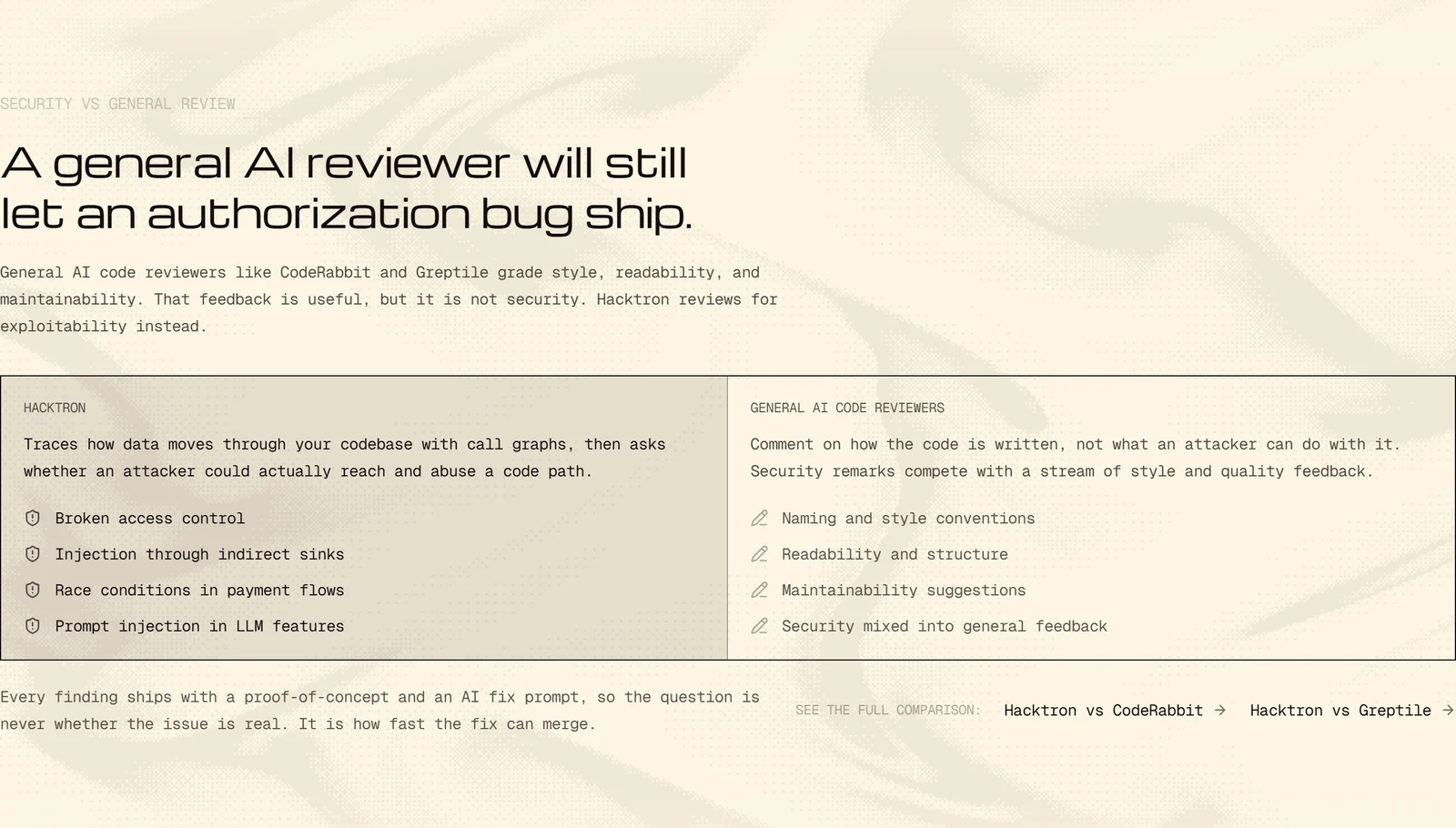
Hacktron’s own framing: general AI reviewers grade style, it grades exploitability.
Hacktron positions itself against general AI reviewers such as CodeRabbit and Greptile, arguing that they “grade style, readability, and maintainability” while it traces how data moves through the codebase and asks whether an attacker can reach a code path.
That framing is Hacktron’s marketing, but the underlying distinction is real and useful. A general reviewer and a security reviewer are complementary, not substitutes — many teams will run both. If you already use a general AI reviewer, the question Hacktron answers is whether a dedicated security layer on top of it is worth $40 a developer.
The strongest independent evidence that Hacktron’s PR reviewer catches real issues comes from a customer’s own disclosure: Rocket.Chat’s GitHub security advisory for CVE-2026-55666, a critical Apple OAuth account-takeover flaw, states that the issue was found by Hacktron’s PR scan.
5. Pentests, Automations and Free Tools
White-box pentests
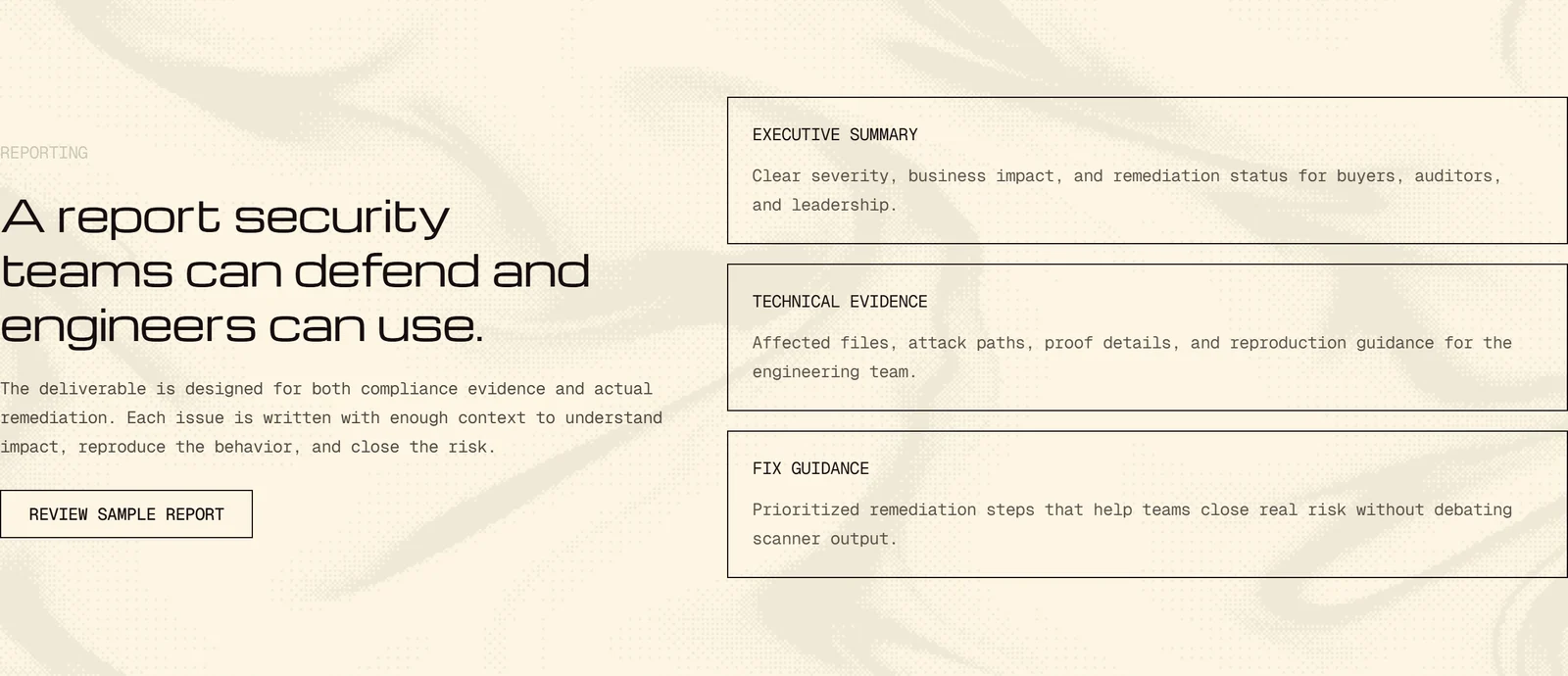
The report Hacktron’s pentests deliver, positioned as audit evidence and as engineering guidance.
A Hacktron Whitebox pentest uses a connected repository or an uploaded archive, a branch or commit, target URLs (staging or production), and test credentials — Hacktron’s docs ask you not to hand over production secrets. It tests the source code together with the live targets.
The product page promises “White-box penetration tests in hours, not weeks”; its FAQ says “most teams get a report within 5 days”, depending on scope. Hacktron says security researchers review the AI findings, confirm exploitability and prepare the report, which is designed as evidence for customers’ SOC 2 and ISO 27001 audits. A public 19-page sample report names three senior testers in the loop, and findings can also be exported as CSV, JSON or SARIF.
Automations
Automations trigger on findings filtered by severity and scope. Remediation is currently the only action: it first checks the finding is real, writes a minimal fix, runs your existing tests plus new regression tests, and opens a PR or MR for your team to review. Each finding is remediated at most once, and notifications go to Slack or email.
Free tools
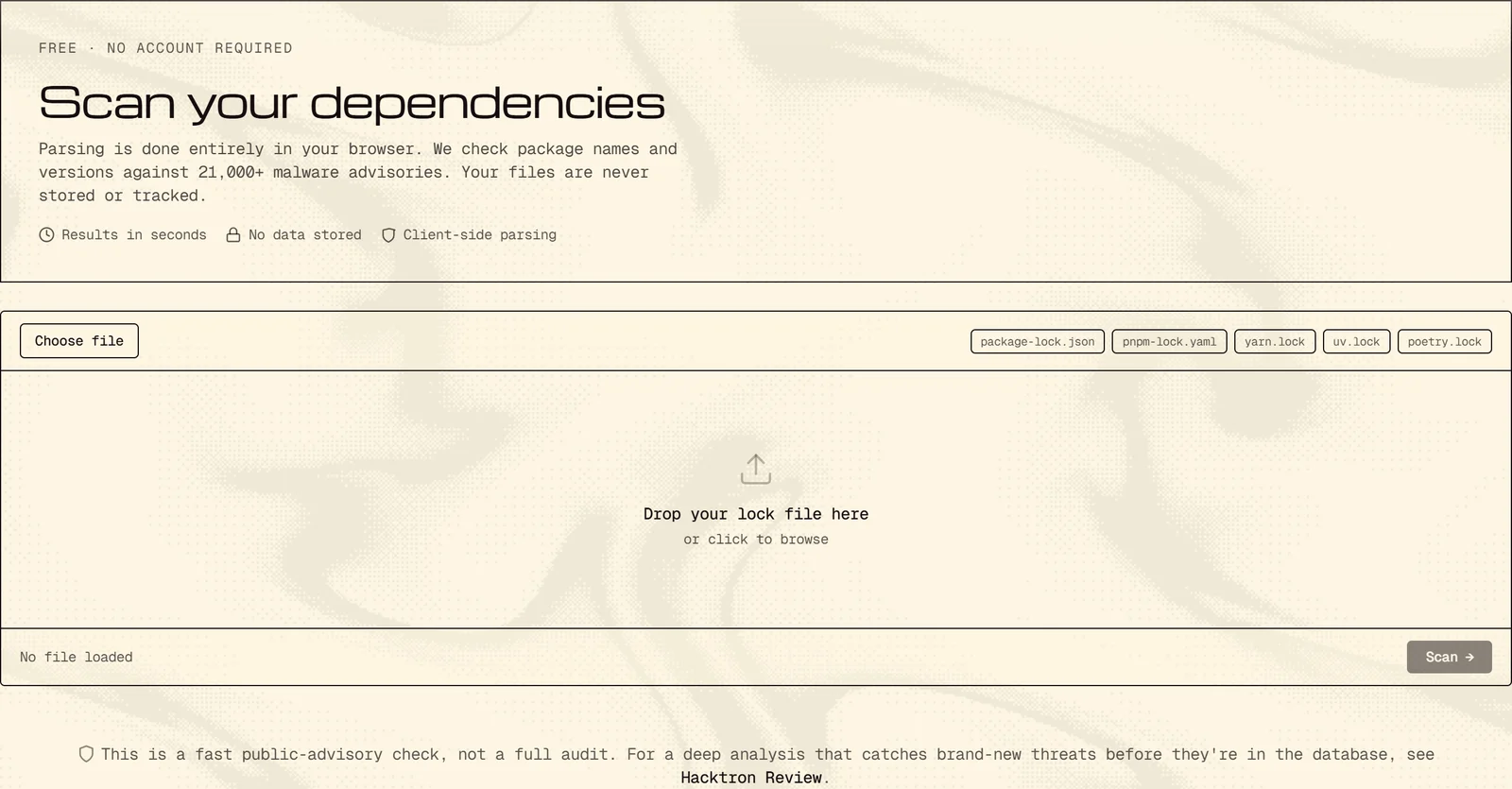
The free dependency scanner parses lock files in your browser and needs no account.
The dependency scanner checks package-lock.json, pnpm-lock.yaml, yarn.lock, uv.lock and poetry.lock against osv.dev’s 21,000+ public malware reports, entirely in the browser and without an account. Hacktron itself calls it “a fast public-advisory check, not a full audit.” There is also a free GitHub Action for npm and PyPI changes in PRs. Open-source maintainers can apply for free PR security reviews through a GitHub App.
6. The Research Track Record: What the Vendors Confirm
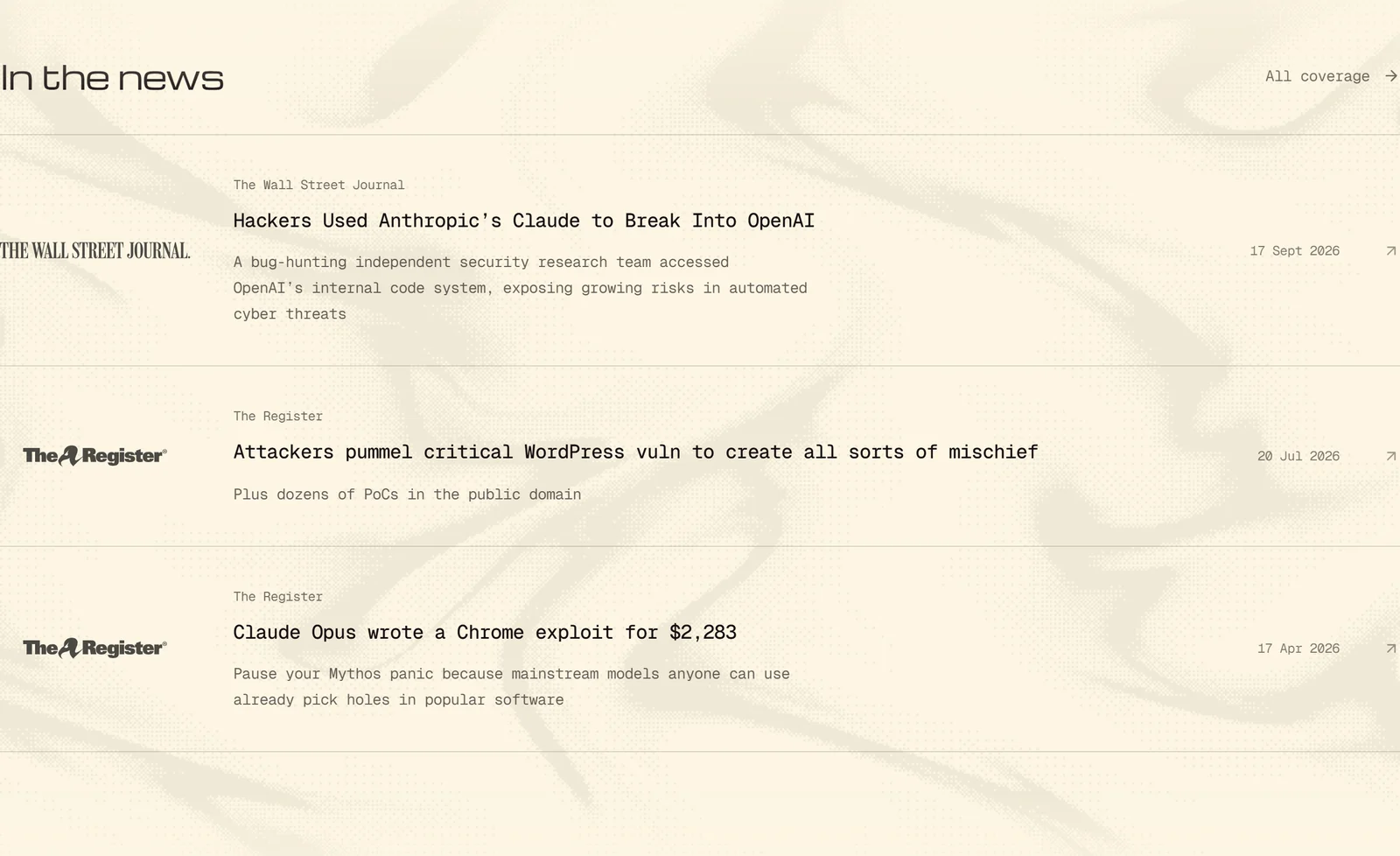
Hacktron’s “In the news” section. The claims below were checked against the affected vendors’ own advisories, not this list.
A security vendor’s research is its best credential, and it is also the easiest thing to overstate. We checked Hacktron’s headline finds against the affected vendors’ own advisories and CVE records rather than Hacktron’s blog.
| Affected product | Record | Severity | Credit to Hacktron in the vendor’s own record |
|---|---|---|---|
| BeyondTrust Remote Support / PRA | CVE-2026-1731 (BT26-02) | CVSS v4 9.9, pre-auth RCE | Thanks Harsh Jaiswal and the Hacktron AI team |
| WSO2 API Manager | CVE-2026-5430 (WSO2-2026-5328) | CVSS 10.0 multi-tenant, 9.8 single | Credits the Hacktron Team |
| Palo Alto Networks PAN-OS | CVE-2026-0265 | High | Credits Harsh Jaiswal from Hacktron AI, with Palo Alto’s internal teams |
| Metabase | CVE-2026-33725 | High 7.2, admin-authenticated RCE | Thanks Hacktron AI and Rahul Maini |
| Rocket.Chat | CVE-2026-55666 | Critical, OAuth account takeover | Found by Hacktron’s PR scan |
| Discourse | CVE-2026-32882 | High 8.8, RCE via malformed HEIF | Credits hacktronai-research |
| GNU Savannah | FSF incident report | — | The FSF thanked Hacktron researchers |
Two of these — the BeyondTrust and WSO2 flaws — were later added to CISA’s Known Exploited Vulnerabilities catalogue after exploitation by third parties. That speaks to how serious the bugs were, not to anything Hacktron did.
Where Hacktron’s role was smaller than the headlines. The WordPress “wp2shell” vulnerabilities were discovered by other researchers; the original finder said Hacktron independently reproduced the full chain, and Hacktron later published a benchmark showing its reviewer flagging both bugs in recreated pull requests.
The OpenAI research
In September 2026 Hacktron published research that drew coverage from The Wall Street Journal, NBC News, CBS News, TechCrunch, The Register and The Hacker News. By Hacktron’s account, its team chained an image-parsing flaw reachable through the Discourse software behind OpenAI’s community forum with a sign-in token issue, reached OpenAI’s internal code system, and then stopped. Hacktron says it did not access internal code, and The Hacker News reported that Hacktron “did not read any source code, merge or ship anything, or touch customer data.”
Hacktron reported the issues through OpenAI’s bug bounty programme, which paid $6,500. In a comment Hacktron published, OpenAI said the Discourse-hosted forum was “explicitly excluded” from its bug bounty programme and that the award covered only the OpenAI-side finding. OpenAI’s spokesperson told NBC News, CBS News and VentureBeat: “We thank the researchers for contacting us and sharing their findings,” and said it narrowed permissions on community sign-in tokens and revoked affected tokens and sessions. NBC reported no evidence that anyone else exploited the bugs.
Benchmarks are Hacktron’s own
Hacktron publishes model and product benchmarks — a Claude Opus Chrome exploit costing about $2,283, a GPT-5.6 Sol Ultra exploit chain for about $1,597, and a $350 scan compared with $4,000 runs from Aikido and XBOW. All of these are Hacktron’s own runs, graded by Hacktron. The $350 comparison covered a single open-source app, Fider; the author triaged the results himself, and the post admits that only 22% of Hacktron’s severity ratings matched his review, against 76% for Aikido and 71% for XBOW. It also notes that the Doyensec study supplying the Aikido and XBOW figures was sponsored by Aikido. Read these as interesting data points, not independent proof.
7. Pricing: No Pricing Page, but Published Numbers
Hacktron has no pricing page — /pricing returns a 404. The numbers below come from Hacktron’s AI SAST FAQ, its comparison pages and its docs, as of 30 September 2026.
| Product | Price | How it works |
|---|---|---|
| Review (Pro) | $40 per developer per month | 50 PRs per seat, pooled across the org; unlimited scans per PR and unlimited repos |
| Extra PRs | $1 per PR/MR | ”Spillover” — off by default, owners only, paid plans only |
| Whitebox pentest | Credit-based, “from $2,000 for most apps” | Cost estimated per scan before it starts; separate credit balance |
| Automations | Separate credit balance | No per-credit price published |
| Open source | Free | For qualifying projects, by application |
| Enterprise | Custom | Includes the on-premises option |
The trial is genuinely low-risk. Code Review has a 14-day free trial with no payment method required, cancellation is self-serve from the Billing page, and Code Review keeps working to the end of the current period. Seats are billed monthly on the seats active in the period; removing a seat mid-period does not reduce that period’s count, but it can be reassigned. Annual billing is available on request, with no published price.
Two things are unclear. First, the free automation allowance: the Automations page advertises “5000 free credits · One-time per organization”, while the docs tie the grant to an organisation’s first paid subscription and describe paid organisations as starting with $50 in automation credits. Hacktron publishes no per-credit rate, so you cannot convert one into the other. Second, refunds: we found no documented refund policy for self-serve plans or for unused credits.
The widely quoted “$350 pentest” is not a list price. It was Hacktron’s dynamic estimate for one small repository in its own benchmark, and its comparison pages quote pentests “from $2,000 for most applications.”
8. Data Handling, Security and Contract Terms
Handing a vendor your source code is a bigger decision than buying most SaaS. Here is what Hacktron commits to.
Your code and its AI providers. Hacktron’s docs name OpenAI, Anthropic and Google as its AI providers and say it has zero-data-retention agreements with all three and does not let them train on customer data. Its Master Services Agreement contractually bars AI providers from retaining data beyond generating output, training on it or disclosing it. The agreements themselves are not published.
Retention. Hacktron’s docs say it “does not retain any source code after each review is complete”, and its Trust Center says scans run in “isolated, ephemeral sandboxes provisioned for each scan and destroyed after use.” Findings — including relevant code snippets — are stored in your account, and threat models persist with revision history; no retention period is published for either. After termination you must request export or deletion in writing within 30 days, and backups may be kept up to 90 more days.
First-party use. You keep ownership of your data. The MSA also licenses Hacktron to use anonymised customer data to improve the service, and does not expressly address whether Hacktron trains its own models on customer data.
Certification. Hacktron announced SOC 2 Type 1 in January 2026. Its Vanta-hosted Trust Center now lists both SOC 2 Type 1 and Type 2 reports from Insight Assurance, available on request, and its docs say it has a Type 2 report; some marketing pages still say Type 1. It claims no ISO 27001 certification.
Sub-processors. The Trust Center lists seven — GitHub, Google Cloud Platform, Google Workspace, Stripe, Vanta, OpenAI and Anthropic — without locations. It omits Clerk, which the Privacy Policy names, and Google as an AI provider, which the docs name.
Contract terms worth reading. Paid services fall under an MSA with Hacktron AI Inc. under Delaware law, with no arbitration clause. Unless an Order says otherwise, fees are invoiced annually in advance, Orders auto-renew unless you give 30 days’ notice, and fees can rise at renewal with 60 days’ notice. We found no termination-for-convenience clause. By default the MSA lets Hacktron name you as a customer and use your logo, which you can revoke in writing. Hacktron commits to notify you of a confirmed breach affecting your data within 72 hours.
Deployment. Hacktron Enterprise can run on-premises as a single-VM appliance, supporting internal GitHub Enterprise Server and self-managed GitLab, with the operator choosing the model provider. We found no data-region option for the cloud service.
9. Hacktron vs the Alternatives
Prices are from each vendor’s own site as of September 2026.
| Tool | Entry price | Focus |
|---|---|---|
| Hacktron Review | $40/developer/month (per Hacktron’s FAQ) | Exploitability-focused PR security review |
| Snyk Team | From $25/month, teams up to 10 developers | Broad AppSec: SAST, SCA, containers, IaC |
| Semgrep Teams | $30/contributor/month (Code) | Rule-based SAST plus AI assistant; free up to 10 contributors |
| GitHub Code Security | $30/active committer/month | CodeQL and Copilot Autofix; free on public repos |
| Corgea Growth | $39/developer/month (min. 5) | AI SAST and auto-fix; free tier for 2 members |
| ZeroPath Team | $1,000/month + $60/developer | AI SAST |
| CodeRabbit | $24–$72/developer/month (annual) | General AI code review; security review on Advanced and up |
For pentests, Aikido’s typical pentest is a fixed $4,000 with white-box included, and its Rightsized pentest runs from $50 to $30,000+. XBOW now prices through sales. A traditional web-application pentest typically runs $5,000 to $30,000, according to pentest firm Bright Defense’s indicative range.
The honest summary: Hacktron is not the cheapest security reviewer, and it is not the broadest AppSec platform. What it offers instead is depth on exploitability, from a team with an unusually strong public record of finding real bugs. Whether that justifies $40 a developer over Semgrep or GitHub Code Security depends on how much your team currently loses to triaging scanner noise.
10. Pros and Cons
Where Hacktron is genuinely strong
- Vendor-credited research — BeyondTrust, WSO2, Palo Alto Networks, Metabase, Discourse and GNU Savannah
- Independent evidence for the PR product — Rocket.Chat’s own advisory credits its PR scan
- Security-only focus, with a PoC and fix prompt on every finding (Hacktron’s claim)
- Five Git hosts, including GHES, self-hosted GitLab and Azure DevOps Server
- SOC 2 Type 2, zero-data-retention AI agreements and an on-premises option
- Low-risk trial: 14 days, no card, self-serve cancellation
- Free for open source, plus a free browser-based dependency scanner
Where Hacktron falls short
- No pricing page; prices live in an FAQ and comparison pages
- More expensive per seat than Snyk Team, Semgrep Teams or GitHub Code Security
- PR review is static — no dynamic testing on each PR “yet”
- Self-graded benchmarks on a single app, with a 22% severity-agreement rate
- Opaque automation credits and no documented refund policy for self-serve plans
- Vendor-friendly contract terms, including default logo use and no termination for convenience
- Thin independent feedback — no G2, Capterra or TrustRadius ratings
- No published list of supported languages
11. Frequently Asked Questions
How much does Hacktron cost?
Hacktron has no pricing page. Its AI SAST FAQ and comparison pages list the Pro plan at $40 per developer per month, including 50 pull requests per seat pooled across the organisation, with unlimited scans per PR and unlimited repositories. Extra PRs cost $1 each through 'spillover', which is off by default and only available on paid plans. Pentests are credit-based and quoted 'from $2,000 for most applications'. Open-source projects can apply for free reviews, and Enterprise pricing is custom.
Is there a free trial?
Yes. Code Review has a 14-day free trial with no payment method required. Spillover is not available during the trial, and you can end the trial early to start a paid plan. Cancellation is self-serve from the Billing page, and Code Review keeps working until the end of the current trial or billing period. Resubscribing starts a paid plan immediately; the trial does not restart.
Does Hacktron run exploits against my application on every PR?
No. Hacktron says every PR finding comes with a proof-of-concept, but its own blog says Review can be called a SAST tool because it 'does not perform dynamic testing against a live environment yet', and a review typically takes one to two minutes. Dynamic testing against running targets is part of the separate white-box pentest product, which tests your source code together with the staging or production URLs you provide.
Does Hacktron send my source code to OpenAI or Anthropic?
Hacktron's docs name OpenAI, Anthropic and Google as its AI providers and say it has zero-data-retention agreements with all three and does not let them train on customer data. Its Master Services Agreement contractually bars AI providers from retaining your data beyond generating output, from training on it and from disclosing it. The agreements themselves are not published. Hacktron also says it does not retain source code after each review, although findings with relevant code snippets are stored in your account. An on-premises appliance is available on Enterprise if code must not leave your network.
Is Hacktron SOC 2 certified?
Hacktron announced SOC 2 Type 1 in January 2026, audited by Insight Assurance. Its Vanta-hosted Trust Center now lists both SOC 2 Type 1 and Type 2 reports, available on request, and its documentation says it has a Type 2 report. Some marketing pages still say Type 1. Hacktron does not claim ISO 27001 certification; ISO 27001 appears on its site only as a use case for its customers' own audits.
Did Hacktron hack OpenAI?
Hacktron published research in September 2026 describing a chain through the Discourse software behind OpenAI's community forum and a sign-in token issue. It reported the findings through OpenAI's bug bounty programme, which paid $6,500, and says it did not access internal code. OpenAI's spokesperson said: 'We thank the researchers for contacting us and sharing their findings,' and that it narrowed permissions on community sign-in tokens and revoked affected tokens. In a comment Hacktron published, OpenAI said the forum was explicitly excluded from its bug bounty scope.
Which Git platforms does Hacktron support?
GitHub (Free, Team and Enterprise Cloud), GitHub Enterprise Server, GitLab.com and self-hosted GitLab, Azure DevOps Services and Azure DevOps Server, and Bitbucket Cloud. Bitbucket Data Center is not supported. Most of this coverage was added between June and August 2026. Hacktron also integrates with Slack, Jira and Linear, and offers a REST API and a remote MCP server for tools such as Claude Code and Cursor.
How is Hacktron different from CodeRabbit?
CodeRabbit is a general AI code reviewer that covers style, readability, maintainability and bugs, with security review on its higher tiers. Hacktron reviews only for security and exploitability, tracing data flow across the codebase and attaching a proof-of-concept to each finding. The two do different jobs, and many teams would run both rather than choose between them. Hacktron's own comparison pages make this case, so treat their specific claims as marketing.
12. Final Verdict: Is Hacktron Worth It in 2026?
Hacktron earns a recommendation for teams that take application security seriously enough to pay for a dedicated reviewer. Its strongest argument is not on its product pages but in other companies’ advisories: BeyondTrust, WSO2, Palo Alto Networks, Metabase and Discourse credit its researchers, and Rocket.Chat credits its PR scan for catching a critical account-takeover bug. That is a rare kind of evidence in a crowded category.
The product matches the pitch where it matters: findings land inline on the vulnerable lines across five Git hosts, triage teaches it your codebase, and the trial needs no card. The data commitments — zero-retention AI agreements, SOC 2 Type 2, an on-premises option — are credible for a company this young.
The rating comes down for the gaps. There is no pricing page, the $40 seat price is above the obvious alternatives, the PR reviewer is static, the benchmarks are Hacktron’s own, automation credits have no published price, and the MSA is written in the vendor’s favour. It is also a small team with very little independent user feedback yet.
Try it if you already run a general AI reviewer and want a security layer that argues with evidence — the 14-day, no-card trial on a real repository will tell you more than any benchmark.
Before you sign an Order: confirm the price in writing, ask for the SOC 2 Type 2 report and the DPA, and check the auto-renewal and logo-use clauses.
Look elsewhere if you need the lowest per-seat cost or one platform covering SCA, containers and cloud posture as well — Semgrep, Snyk or GitHub Code Security will fit better.
Disclosure: This review contains affiliate links. If you sign up for Hacktron through our link, we may earn a commission at no additional cost to you; Hacktron’s affiliate programme pays 25% of a referred customer’s payments for their first three months, and gives the customer no discount. All factual claims were verified against Hacktron’s own website, documentation, changelog, Trust Center, Master Services Agreement and SLA, the affected vendors’ security advisories and CVE records, and press coverage, as of 30 September 2026. Hacktron’s benchmarks, customer metrics and revenue figures are attributed to Hacktron throughout; we could not verify them independently.