Coddy Review 2026: The Learn-to-Code App Where the Whole Catalog Is Actually Free
Most people who set out to learn programming do not quit because programming is hard. They quit in week two, when the app they downloaded runs out of free lessons and asks for a card. The pattern is so reliable that it has become the defining complaint of the category — you finish the free chapters, hit a locked module, and never come back.
Coddy is the platform in this category that does not do that. Its FAQ is unambiguous: every course is free to complete, and “Every course on Coddy awards a free certificate of completion” with a unique ID and a public verification URL. There are 125 of them. Nothing is behind a content paywall.
That is genuinely unusual, and it is the reason Coddy is worth your attention. But the money has to come from somewhere, and it comes from a daily energy allowance — which is also, by a wide margin, the thing its users complain about most. This review covers both halves honestly, along with several things Coddy’s marketing does not mention: a refund policy that evaporates the moment you use the product, iOS prices $5 a month above the web, and homepage rating badges that are better than the ratings they cite.
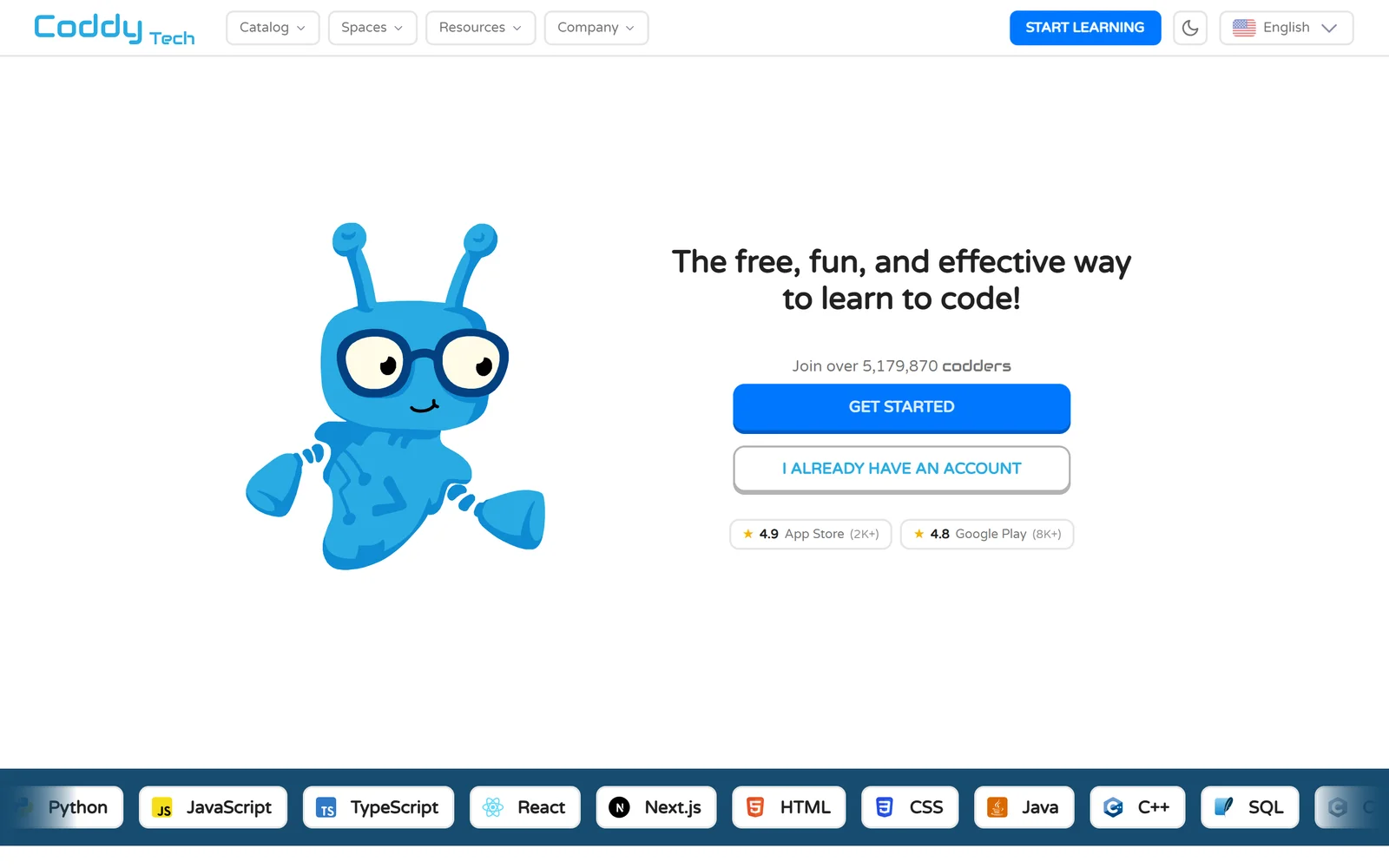
Coddy’s homepage, captured 16 September 2026. The live counter read “Join over 5,179,870 codders” — a self-reported figure that sits well above the 4M+ in its own press kit.
1. What Coddy Is, and Who Is Behind It
Coddy is a gamified, browser-and-mobile platform for learning to code through short interactive lessons. Its homepage headline is “The free, fun, and effective way to learn to code!”, and its app-store listing puts the comparison plainly: “Think of it as Duolingo for coding.”
The catalog page on 16 September 2026 read “All Coding Courses - 125 Free Interactive Courses”. The depth is uneven but real — Python leads with 68 courses, then C++ at 53, Java and JavaScript at 47 each, Go at 46, C at 45, and C#, R, Dart, Lua, PHP, Ruby, Rust and Swift in the forties. HTML has 26. SQL has 2. Topic filters cover Data Structures (16), Interview Preparation (10), Graph Algorithms (7) and Computer Networking (3). There are also non-coding “Spaces” for Chess and Math, both labelled Beta.
How many languages, exactly?
This is a small thing that tells you something larger. Coddy’s own pages cannot agree on the number:
- Title tag: “Python, JS & 15+”
- FAQ: “teaches 15+ languages” — then lists 19
- Homepage catalog blurb: “20+ programming languages”
- Apps page: “19+ other languages”
- App stores: “18+ languages”
- Press kit: “15+”
The homepage navigation lists 28 entries, but several are frameworks or tools rather than languages — React, Next.js, Terminal, Excel, Git and Docker are all in there. Call it roughly 19 actual languages plus a set of tooling tracks. It is a wide list either way, and it includes genuinely rare choices: Lua, Luau, Verilog and Assembly.
The company
Coddy was founded in 2022 by Nethanel Bar (CEO), Kevin Spektor (CTO) and Barak Glanz (CMO). Its press kit describes the company as “headquartered remotely”, while Tracxn and FinSMEs place it in Tel Aviv, its Terms run under New York law, and its Google Play listing carries a Delaware registered-agent address. Israel-founded and remote-first is the accurate summary; the sources genuinely conflict beyond that.
In May 2026 Coddy raised $10M in user-acquisition financing from PvX Partners. That detail is worth holding onto, because user-acquisition financing is money raised specifically to buy users — which is consistent with the ad load free users describe later in this review.
2. Who Coddy Is For — and Who It Is Not For
It fits you if:
- You are a complete beginner who has already abandoned one app at a paywall
- You learn in short sessions — Coddy’s own line is “as little as 15 minutes a day”, and its apps page says “Most lessons take five minutes or less”
- You are adding a second or third language and want something interactive for Rust, Go, Lua or R
- You commute and need lessons cached offline
- You are a teacher on a tight budget
Look elsewhere if:
- You want to sit down for a focused two-hour session on a free account — energy will stop you
- You need accredited qualifications rather than completion certificates
- You are past the fundamentals and want architecture, systems design or production practice
- You want a SQL-heavy curriculum — there are only two SQL courses
3. The Free Tier Is the Product
This is the heart of the review, so it is worth being precise.
Coddy’s FAQ states that every course is free with a daily energy limit, and that “Plus removes the limit and includes ad-free learning. Pro adds the AI assistant, advanced AI models, solution analysis, and premium challenges.” Read that carefully: the premium tiers sell rate, ads and AI — not content.
Compare that with the rest of the category, where the standard model is to give you an introductory sequence and lock everything after it. On Coddy, a patient free user can finish all 125 courses and collect 125 verifiable certificates without entering a card. A Google Play reviewer put it well in May 2026: “This is the best kept secret for learning programming languages for free!… if you’re just a little patient, you really don’t need to put any money into it.”
That word — patient — is doing a lot of work.
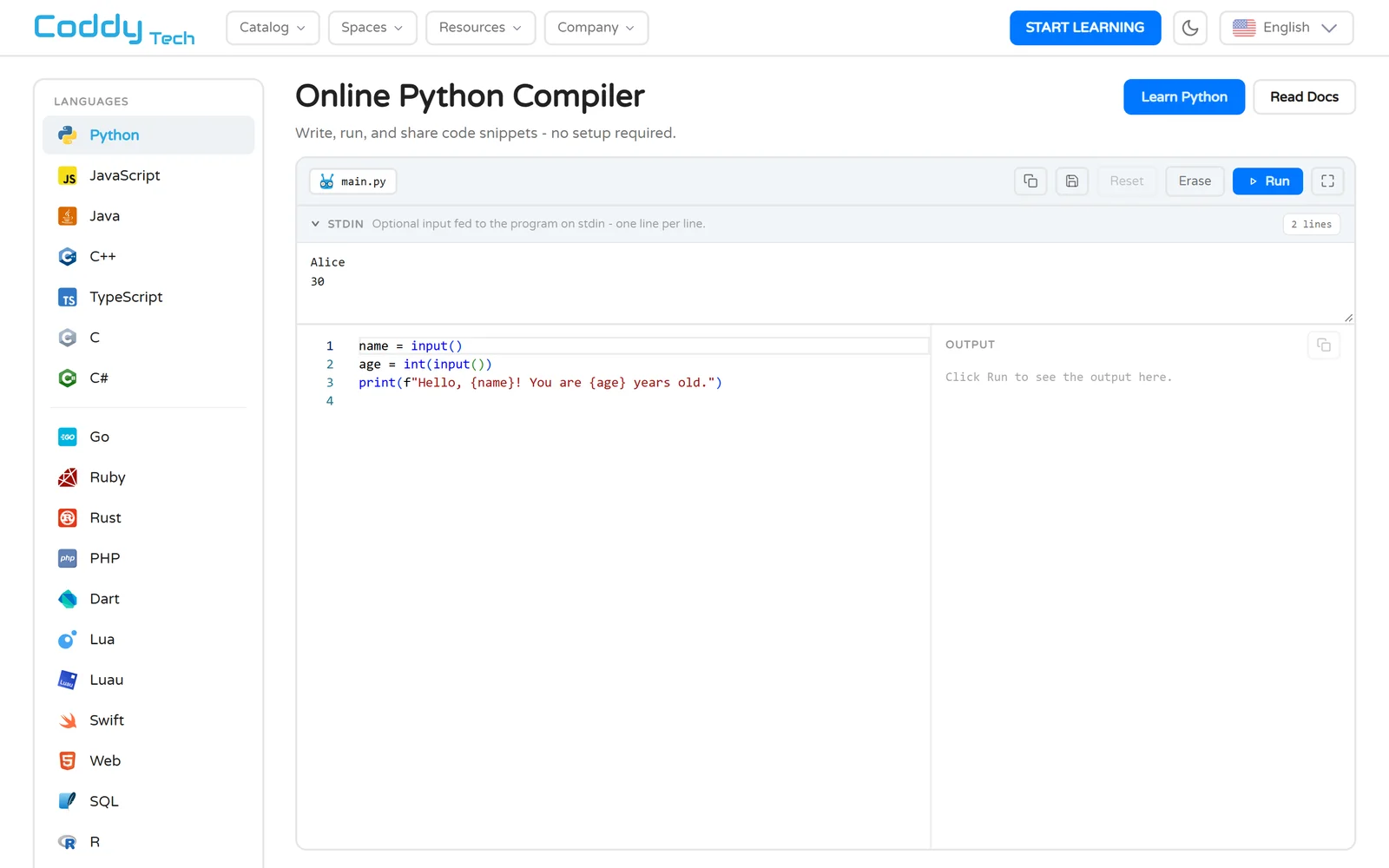
You type real code in an editor built on the same engine as VS Code, and it executes server-side against test cases.
You write real code, not tiles
The other common failure of gamified coding apps is that tapping pre-written fragments into order feels like progress without producing any. Coddy runs your submissions server-side against test cases. Its Python playground alone ships Python 3.11 with the standard library, NumPy, pandas, requests and pytest, in an editor built on the same engine as VS Code.
4. Energy: the Constraint Everyone Runs Into
Free accounts spend energy to run code. Coddy’s web bundle sets the default maximum at 5, and the paid feature is described as “Unlimited energy – Run your code with no limits!”
Here is the problem: Coddy does not publish the recharge rate. Not on the pricing page, not in the FAQ, not in the app listings. You find out how long you are locked out by being locked out.
The complaint shows up constantly in Trustpilot’s three- and four-star reviews:
“The whole ‘energy thing’ is really annoying, as we get only a limited amount per day. This limits my learning to about only 20 minutes.” — vivaan surkunte, 3 stars
“The course is good, but after a little while you cannot continue because you have no more energy.” — SELIM, 3 stars
“it’s taking time too much to regain only one token.” — Chamuditha Lakshan, 4 stars
To its credit, Coddy replies to these rather than ignoring them. Its response to the first: “The energy limit is a common concern, and many learners feel the same way. Expanding what is free so you can learn more each day is something we are working on.”
That is an unusually direct acknowledgement from a vendor, and it is the correct read of the situation. The energy system is what makes the free catalog economically possible — but an undisclosed recharge timer is a real design failure, because a learner cannot plan a study session around a number nobody will tell them.
5. Gamification, Streaks and Bugsy
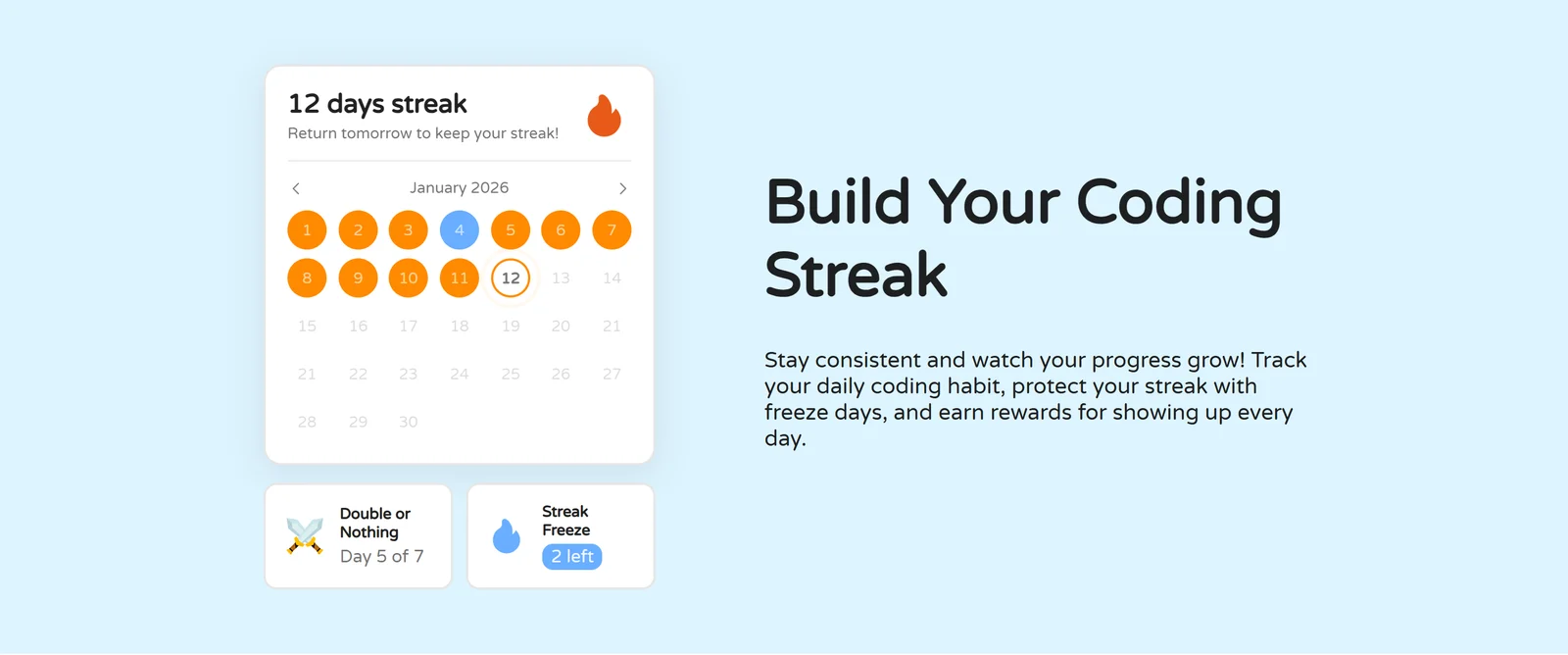
Streaks with freeze days, XP, badges and eight named leagues from Novice to Elite.
The habit machinery is comprehensive: daily streaks with freeze days to protect them, XP, badges, global leaderboards with eight leagues (Novice, Rookie, Apprentice, Starter, Challenger, Explorer, Master, Elite), personalized daily challenges, and tokens that buy cosmetic titles, themes and avatars.
One design decision deserves credit. Coddy uses energy rather than hearts — you are limited by how much you do, not by how many mistakes you make. Competitors that lock beginners out after three wrong answers are punishing exactly the behaviour they should be encouraging. Coddy does not do that.
Bugsy, the AI tutor that refuses to answer
Coddy’s assistant is built around a constraint most AI tutors abandon: “Reads your code and your error, explains, and hints. Never the answer.” The FAQ expands on it — Bugsy “reads the lesson, your code and your last failing test, then gives a hint or explanation… without giving the answer away.”
Free accounts get a daily AI-credit cap. PRO includes unlimited AI assistance, an advanced model, solution analysis and unlimited debugging.
6. Certificates, Mobile and Offline
Certificates are free on every tier. Each carries a unique ID and a public verification URL, with one-click “Add to LinkedIn profile”. These are completion certificates, not accreditation — no employer treats them as a qualification — but they cost nothing, which is not true of most of the category.
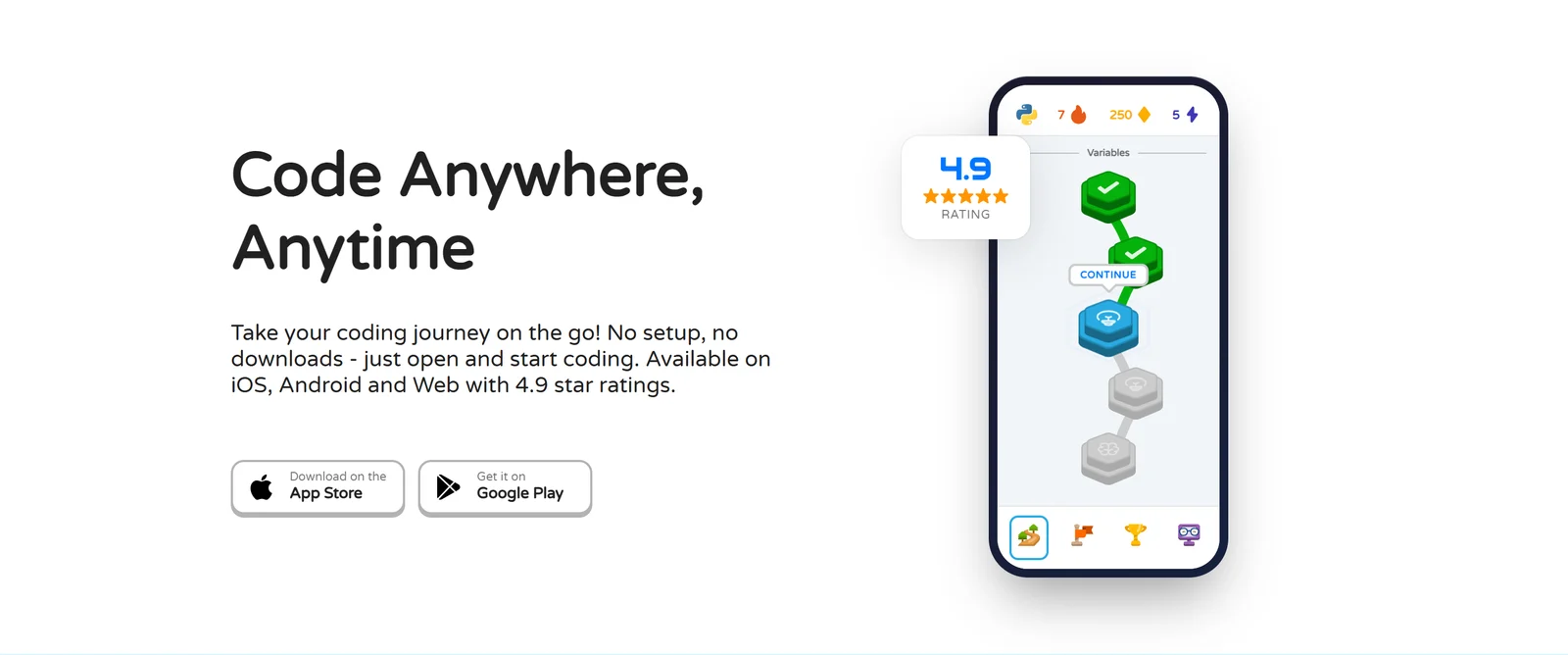
Native iOS and Android apps with offline lesson caching and cross-device progress sync.
The native apps carry full coding challenges, AI assistance, streaks and offline mode. Coddy’s apps page is specific about the offline behaviour: “The iOS and Android apps cache your current lessons, so you can keep learning on the subway or a flight.” Progress syncs across every device.
7. Pricing, and Two Things to Check Before You Pay
Web list prices as of September 2026:
| Plan | Monthly | Annual | Notes |
|---|---|---|---|
| Free | $0 | $0 | Full catalog, daily energy limit, ads |
| Plus | $9.99 | $79.88 (shown $6.65/mo) | Unlimited energy, no ads, Journeys, full quizzes, mobile premium |
| PRO | $14.99 | $119.88 (shown $9.99/mo) | Adds unlimited AI, advanced model, solution analysis, premium challenges |
| Lifetime | — | $399.99 one-time | All PRO features forever, exclusive badge, title and theme |
| Family | $29.99 | $239.88 | Five members |
| Teachers | — | from $2.42/seat/mo | $289.99/year for 10 seats; custom quotes above 300 seats |
Regional pricing exists in 11 currencies — GBP Plus £7.49/mo, EUR Plus €9,99/mo, INR Plus ₹399/mo, and so on. Discounting is frequent and specific: the bundle contains a 50% streak offer for yearly and lifetime plans, a 40% personal offer applied automatically at checkout, and the official promo page carries code COD25KLO for 25% off yearly or lifetime.
Check one: buy on the web, not in the app
iOS in-app monthly SKUs are $5 higher than the web — Plus Monthly $14.99 versus $9.99, Pro Monthly $19.99 versus $14.99. Over a year of monthly billing that is a $60 difference for the identical product. Subscribe in a browser.
Check two: the refund policy is stricter than it looks
Coddy’s Terms of Use state that “Subscription refunds are available within 14 days of purchase, provided you have not accessed or used the Service at all.”
Read that second clause again. It is not a 14-day money-back guarantee — it is a 14-day window that closes the first time you open the product. There are no refunds for unused portions, and tokens, boosters, titles, themes and avatars are explicitly non-refundable. There is also no free trial; the pricing FAQ answers that question by pointing you back at the free tier.
Cancellation itself is documented as painless — “You can cancel from your account in one click. No questions asked, no hassle.” One Reddit user’s experience differed, describing “three different pop ups one after the other telling me ‘are you sure? How about you just pause instead of cancel?’” Expect retention prompts.
8. What the Ratings Actually Say
Independent sentiment is genuinely good, and worth separating from Coddy’s own presentation of it.
| Source | Rating | Volume |
|---|---|---|
| Trustpilot | 4.7 | 4,033 reviews (79% five-star) |
| US App Store | 4.8 | 432 ratings |
| Google Play | 4.7 | 8.82K reviews, 100K+ installs |
| Capterra | — | 0 reviews |
On 16 September 2026 Coddy’s homepage displayed badges reading “4.9 App Store (2K+)” and “4.8 Google Play (8K+)”. The actual stores that day showed 4.8 from 432 US ratings and 4.7 from 8.82K reviews. The Google Play volume is roughly right; the App Store figures are not, in both score and count.
This is a small overstatement of already-strong numbers, which makes it a strange choice — Coddy’s real ratings are good enough that inflating them buys almost nothing and costs credibility.
The criticism worth taking seriously
Two themes recur beyond energy.
Ads. A three-star App Store reviewer in August 2026: “like 70 to 90% of the app are ads, really like Duolingo. subscriptions are pushed everywhere…” A one-star reviewer in January 2026 described “very disruptive full page time gated ads”. Google Play reviews complain the app is “rammed with long unskippable ads”. Plus removes them.
Bugs and content quality. A Reddit r/learnprogramming thread titled “Coddy.tech is utter garbage” reported that “The website is riddled with bugs, from non-loading lessons to timeouts and very… very slow validation”, that a Java section on Object Oriented Programming was marked “Coming Soon”, and that exercises demand exact output — a trailing space costs you the “first try” bonus. A commenter there suspected “80% of their course material was written by AI.” Boot.dev’s own competitor comparison, published 5 August 2026, notes that Coddy’s content is produced with generative AI and that “Some user reviews report buggy lessons and unfinished course sections.”
Balanced against that, an r/learnpython reply captured the majority view: “Coddy is actually well structured. The free plan gives you just enough to do each day that you don’t get overwhelmed…” — which is the energy limit reframed as a feature, and for some learners it genuinely is one.
9. Pros and Cons
Where Coddy is genuinely strong
- The free tier is the whole product. 125 courses, all completable, no locked chapters
- Certificates cost nothing and carry a unique ID plus a public verification URL
- You write real code that executes server-side against test cases
- Energy, not hearts — you are limited by volume, not punished for mistakes
- Rare languages — Lua, Luau, Rust, Verilog, Assembly, R and Go all have real tracks
- Offline-capable native apps with cross-device sync
- Teachers Plan at $2.42 per seat per month on annual billing
- Trustpilot 4.7 from 4,033 reviews, a substantial sample for a company founded in 2022
Where Coddy falls short
- The energy recharge rate is unpublished, so free users cannot plan a session
- Refunds require that you never used the product — a 14-day window that closes on first use
- No free trial of the premium tiers
- iOS monthly costs $5 more than the same plan on the web
- Heavy ad load on free, including full-page interstitials
- Its own pages disagree on how many languages it teaches
- Homepage rating badges overstate the real App Store score and count
- Bug reports and AI-generated content concerns appear consistently on Reddit
- Only two SQL courses, and some sections still marked “Coming Soon”
10. Frequently Asked Questions
Is Coddy really free, or is that marketing?
It is real, with one condition. Coddy's FAQ states that every course is free to complete and that every course awards a free certificate of completion with a unique ID and a public verification URL. There are 125 courses and none of them are locked behind a tier. What the paid plans sell is the removal of a daily energy limit, the removal of ads, and AI assistance — not access to content. A patient free user can finish the entire catalog without entering a card.
What is energy, and how long does it take to come back?
Energy is what free accounts spend to run their code. Coddy's own web bundle sets the default maximum at 5, and the premium feature is described as 'Unlimited energy – Run your code with no limits!'. Coddy does not publish the recharge rate anywhere — not on the pricing page, not in the FAQ, not in the app listings. Users report it limiting them to roughly 10-20 minutes of study a day, but those are anecdotes, not a published figure. This is the most common complaint about the platform.
Can I get a refund if I do not like it?
Almost certainly not, once you have started. Coddy's Terms of Use say subscription refunds are available within 14 days of purchase 'provided you have not accessed or used the Service at all'. Using the product once ends your eligibility. There are no refunds for unused portions, and tokens, boosters, titles, themes and avatars are explicitly non-refundable one-time purchases. There is also no free trial. Since the entire catalog is free anyway, the sensible approach is to use the free tier until you are certain.
Should I subscribe on my phone or in a browser?
In a browser, and the gap is not small. iOS in-app monthly SKUs are $5 higher than the web equivalents — Plus Monthly is $14.99 on iOS versus $9.99 on the web, and Pro Monthly is $19.99 versus $14.99. Over a year of monthly billing that is $60 for the same product. Coddy also runs frequent promotions on the web, including a 50% streak offer on yearly and lifetime plans and a public promo code for 25% off.
Are Coddy's certificates worth anything to employers?
They are completion certificates, not accreditation. Each has a unique ID and a public verification URL, so anyone can confirm it is genuine, and there is a one-click 'Add to LinkedIn profile' button. That makes them verifiable, which is more than many free alternatives offer. But verifiable is not the same as accredited, and there is no evidence either way about how employers regard them. Treat them as proof you finished something, not as a qualification.
How does Coddy compare with Codecademy and Mimo?
Codecademy has far more depth — 845 catalog items and 14 career paths — and is the better choice if your goal is employment rather than a habit. Mimo paywalls aggressively; subscribers report projects becoming unavailable in-app partway through. Coddy's distinguishing feature is that the free tier is the complete product, which is why our Top 5 Coding Learning Apps comparison placed it second overall behind Codecademy and ahead of Mimo, Sololearn and Codédex.
Is the content reliable?
Mostly, with caveats worth knowing. Trustpilot sits at 4.7 from 4,033 reviews and the app stores at 4.8 and 4.7, so the majority experience is positive. But Reddit threads report non-loading lessons, slow validation, sections marked 'Coming Soon', and exercises that fail on a trailing space. Boot.dev's comparison notes Coddy's content is produced with generative AI and that some reviews report buggy lessons and unfinished sections. Expect occasional rough edges, particularly outside the flagship Python and JavaScript tracks.
11. Final Verdict: Is Coddy Worth It in 2026?
Coddy earns a strong recommendation for one specific reason, and it is the right reason. In a category built on paywalling learners mid-course, Coddy paywalls nothing. All 125 courses are completable free, all certificates are free and verifiable, and you write real code the entire way. That is not a marketing position — it is a structural choice, and it is why our Top 5 Coding Learning Apps comparison ranked it second overall.
The energy system is the honest cost of that choice, and it is a real one. Twenty minutes a day is a constraint, and the refusal to publish a recharge timer turns a reasonable limit into an unpredictable one. If Coddy fixed one thing, it should be that number.
Buy Plus if you are using Coddy daily and the energy ceiling or the ads are interrupting you — $79.88 a year is the straightforward fix, and it is the tier most people need.
Buy PRO only if you actually want the AI assistance; the $40 a year premium over Plus buys Bugsy’s unlimited mode, solution analysis and premium challenges, and nothing about the course content.
Think hard about Lifetime. $399.99 to a company founded in 2022 is a bet on a four-year-old business still being here in a decade. The $10M raised in May 2026 is user-acquisition financing, not a durability guarantee.
Stay free if you are new. The catalog is complete, the certificates are real, and you can decide later. Given that refunds end the moment you use the product, using the free tier first is not just advice — it is the only safe way to evaluate this platform.