Runable Review 2026: One Agent for Websites, Apps, Slides and Video — If You Can Live With the Credits
Most AI assistants stop at text. You ask for a website and get a description of one; you ask for a pitch deck and get bullet points to paste somewhere else. Runable sells the opposite: describe the outcome and an agent plans the work, runs it in its own cloud sandbox, and hands back the finished thing — a hosted website, a slide deck, a video, a carousel, a report, even a mobile app.
It is an ambitious pitch from a young company. Runable launched in 2025, says it signed up more than 500,000 people in its first three months, and raised a $21 million Series A in August 2026. It is also a product with real rough edges: a credit system with no published price list, a strict no-refund rule, legal documents that leave important questions open, and app-store reviews split between “best agent I have used” and “waste of money”.
This review covers what Runable actually produces, what the Free, Pro and Max plans include, how credits really get spent, who owns what you make, and what our affiliate link does — and does not — give you.
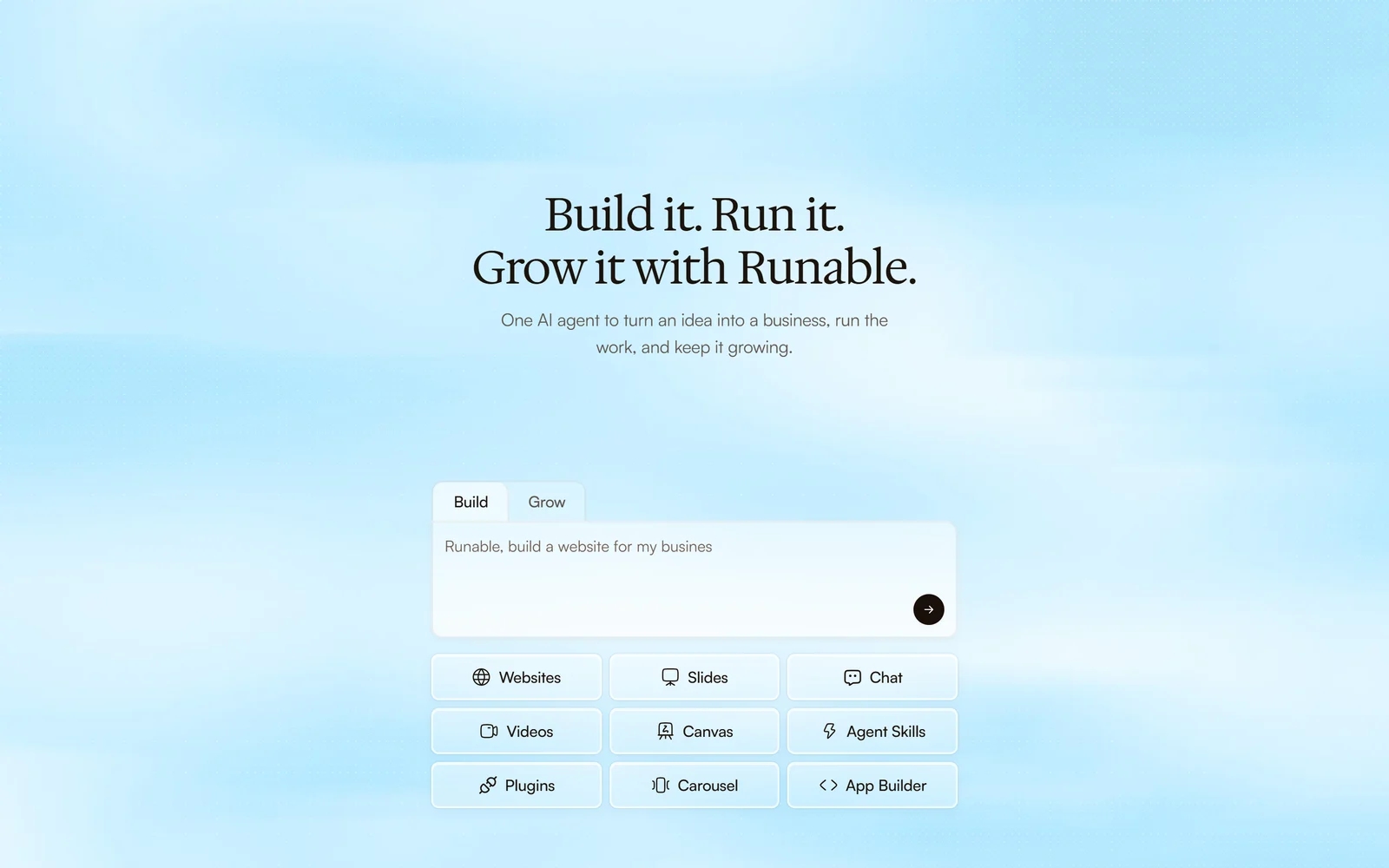
Runable’s homepage, captured 8 October 2026. One prompt box, nine kinds of output.
1. What Runable Is — and Who Is Behind It
Runable describes itself as “the AI general agent that thinks, plans, and executes end-to-end, so you can Build, Run & Grow.” Its homepage puts it more simply: “One AI agent to turn an idea into a business, run the work, and keep it growing.”
How it works under the hood. Runable’s own guide says everything “runs in a cloud sandbox with a built-in skill library and connectors to 3,000+ apps.” Tasks keep running after you close the tab. Its sub-processor list shows the pieces: sandboxed code execution from E2B, connected-app authentication from Pipedream, a model gateway from Vercel, and foundation models from Anthropic, OpenAI, Google, AWS and Microsoft Azure.
The company. Runable was founded in April 2025 and is run by a team of about 15 in Bengaluru, India, led by co-founder and CEO Umesh Kumar with co-founder Saksham Sarda. The App Store lists the seller as Runable Inc, and a Delaware corporation of that name is listed on OpenCorporates. According to TechCrunch, the company began building browser technology for large-scale scraping, and pivoted when users kept asking its browser agent for slide decks and websites.
Money and traction. On 26 August 2026 Runable announced a $21 million Series A co-led by Susquehanna Venture Capital and Nexus Venture Partners, with Together Fund and Array VC participating. TechCrunch reported a $65 million post-money valuation, about 1.7 million registered users, and a $2 million annualised revenue run rate reached within three weeks of switching on payments in March 2026 — while noting that gross margins are currently negative because Runable subsidises AI usage. The user figures are company-reported, and they vary by channel: the Google Play listing says 500,000+, the App Store listing 700,000+, and the funding announcement 1.5 million.
One claim to treat carefully. Runable’s app-store listings call it “the highest-ranked AI general agent in the world, independently verified across four industry standard benchmarks”, citing scores such as 92.1% on GAIA. No leaderboard, paper or auditor is linked anywhere, so these are Runable’s own numbers.
2. Who Runable Is For — and Who It Is Not For
It fits you if:
- You run a small business and want a website, booking page or FAQ built and hosted without hiring anyone
- You produce decks, landing pages, carousels and short videos regularly and want them from one tool
- You want an agent that does research and documents on a schedule and reports back in Slack or Telegram
- You have a mobile-app idea and want a working prototype whose code you can hand to a developer later
Look elsewhere if:
- You need predictable costs — Runable publishes no credit price per task, and heavy jobs can empty a balance quickly
- You need a refund option or a trial of the paid plans — fees are non-refundable and there is no paid trial
- Your work involves confidential or regulated data — the legal documents make no general no-training promise, name no legal entity, and there is no SOC 2 or ISO certification
- You are a developer who wants full control of the code — tools such as Bolt.new or Lovable are built around the codebase; Runable is built around the deliverable
3. What Runable Builds
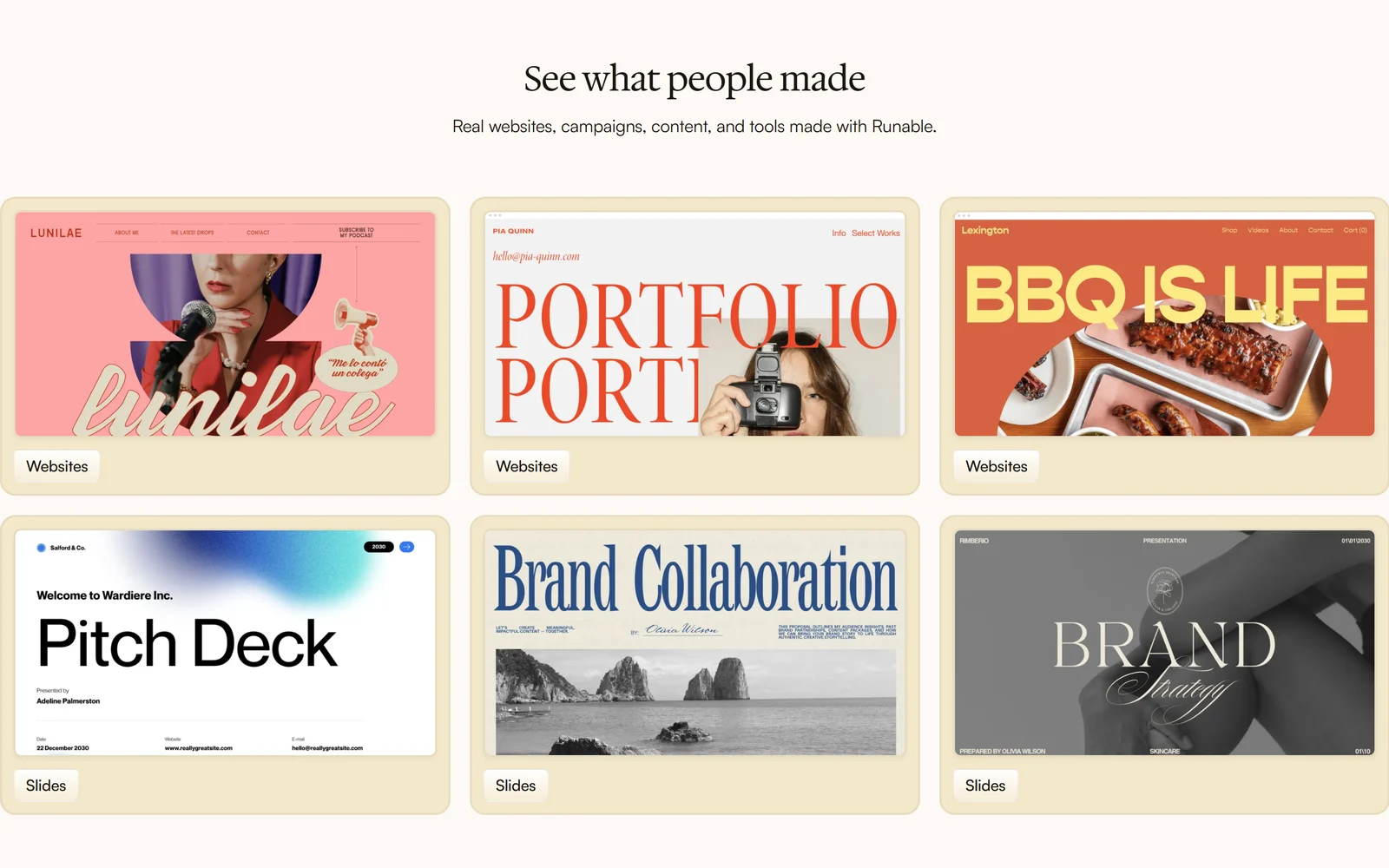
Example websites and decks from Runable’s showcase.
Runable’s guide lists ten output types: websites, slides, images, video, reports, spreadsheets, carousels, audio, canvas work and chat analysis. The ones that matter most:
Websites. You describe the site and get a live URL. Runable’s website page promises custom domains with free SSL and CDN hosting, a built-in database and Stripe payments, an SEO editor with analytics, and version history with one-click restore. Free-tier sites carry a “Made with Runable” badge. Runable’s pages disagree about code export — its 2.0 launch post says “no code export”, while its later comparison pages say web-app code can be opened, downloaded or exported to GitHub — so test this before you depend on it.
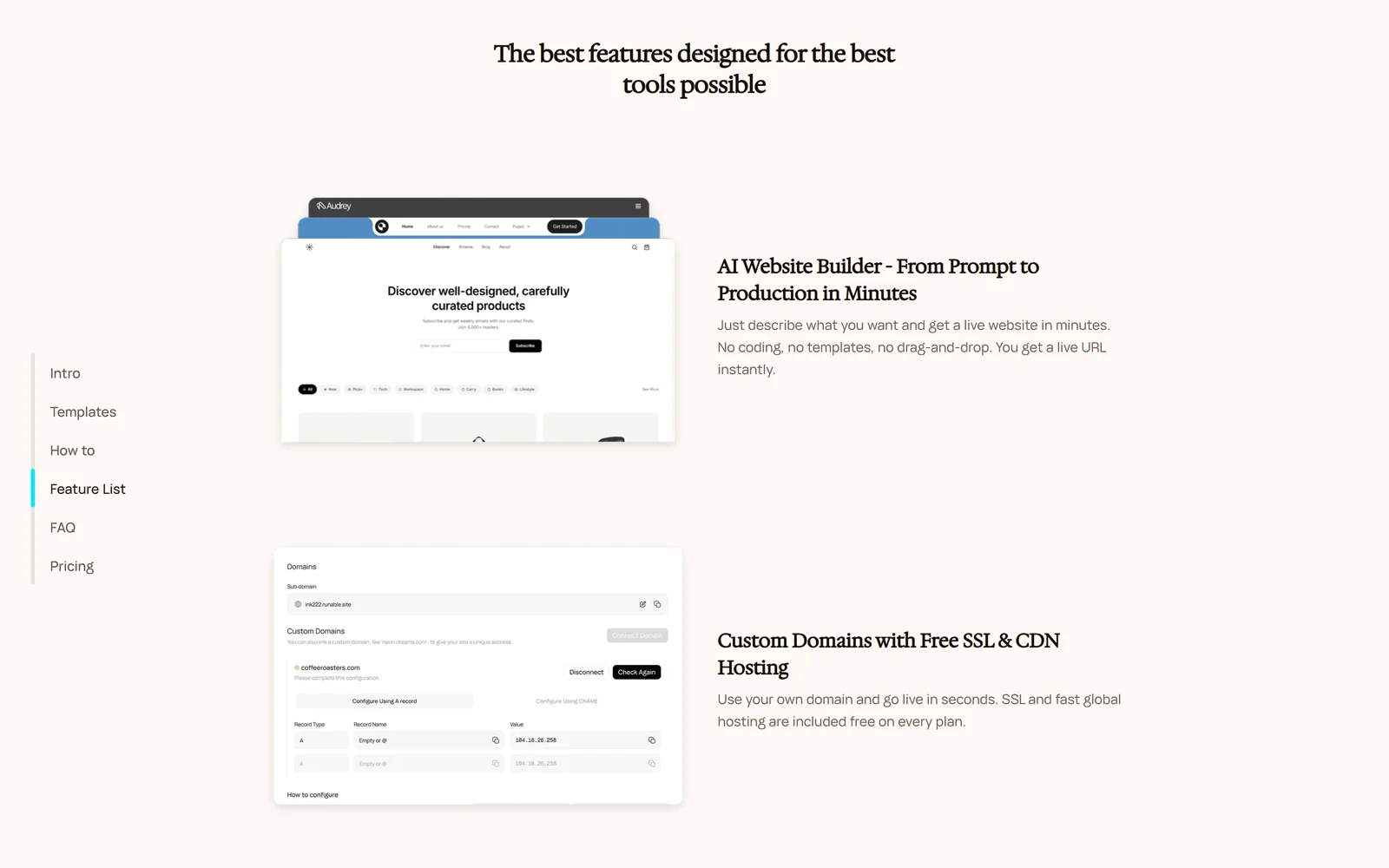
Live URL on publish, then your own domain with SSL.
Slides and carousels. Decks can be built from a prompt, a URL, a PDF or an outline, edited visually, and exported as PPTX, PDF or a live link, or sent to Google Drive. Carousels are sized for Instagram and LinkedIn. Runable’s template library showed almost 4,000 templates across presentations, websites and carousels.
Video and images. The video page advertises Kling, Seedance and Veo 3.1 models, clips of 5 to 120 seconds up to 4K, image-to-video and voiceovers. Image and video also live in a Canvas tool with upscaling, background removal and region edits, where credits are spent only on generation, not editing or export.
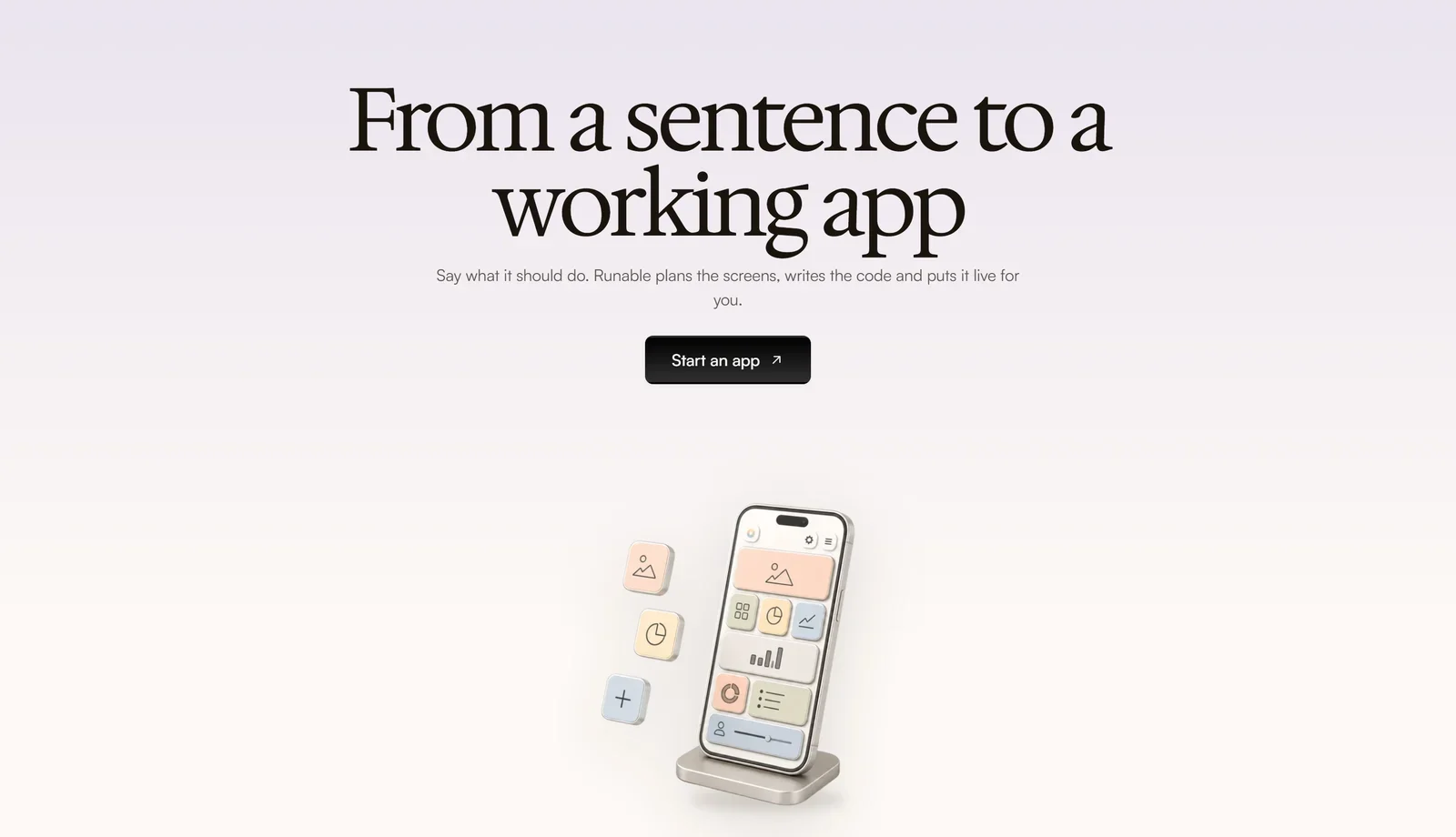
The App Builder produces native iOS and Android apps from one React Native codebase.
Mobile apps. The App Builder generates one React Native codebase compiled for iOS and Android, with sign-in, a database, file uploads, push notifications and Stripe subscriptions set up during the build. Store submission runs through your own Apple and Google developer accounts, and Runable says the source can be exported at any point and hosted elsewhere.
Documents and data. Reports export as PDF, spreadsheets are formula-based with XLSX and CSV import and export, and the chat can cite research from the web, news and papers.
Models. The pricing page lists the chat models available on every plan: GPT 6 Astra, Claude Opus 5, Claude Sonnet 5.0, Gemini 3.5 Flash, GLM 5.3, Grok 4.6, DeepSeek V4.1 Flash, Kimi K3 and a model listed as “Runner”. In Agent mode you pick a Lite, Pro, Max or Ultra tier rather than a model; Ultra routes to frontier models at a higher credit cost per task.
4. Running the Agent: Modes, Memory and Channels
Three modes. Chat answers questions and uses fewer credits. Agent does the work. Plan makes the agent research, ask clarifying questions and write a plan you approve before anything is built — the mode to use for anything expensive. Results support inline AI editing, one-click rollback to any earlier version, and chat forking to try several directions in parallel.
Memory. Runable checks its memory at the start of every chat, and you can set standing rules under Settings → Custom Instructions. You can attach up to 10 files of 25 MB each per message.
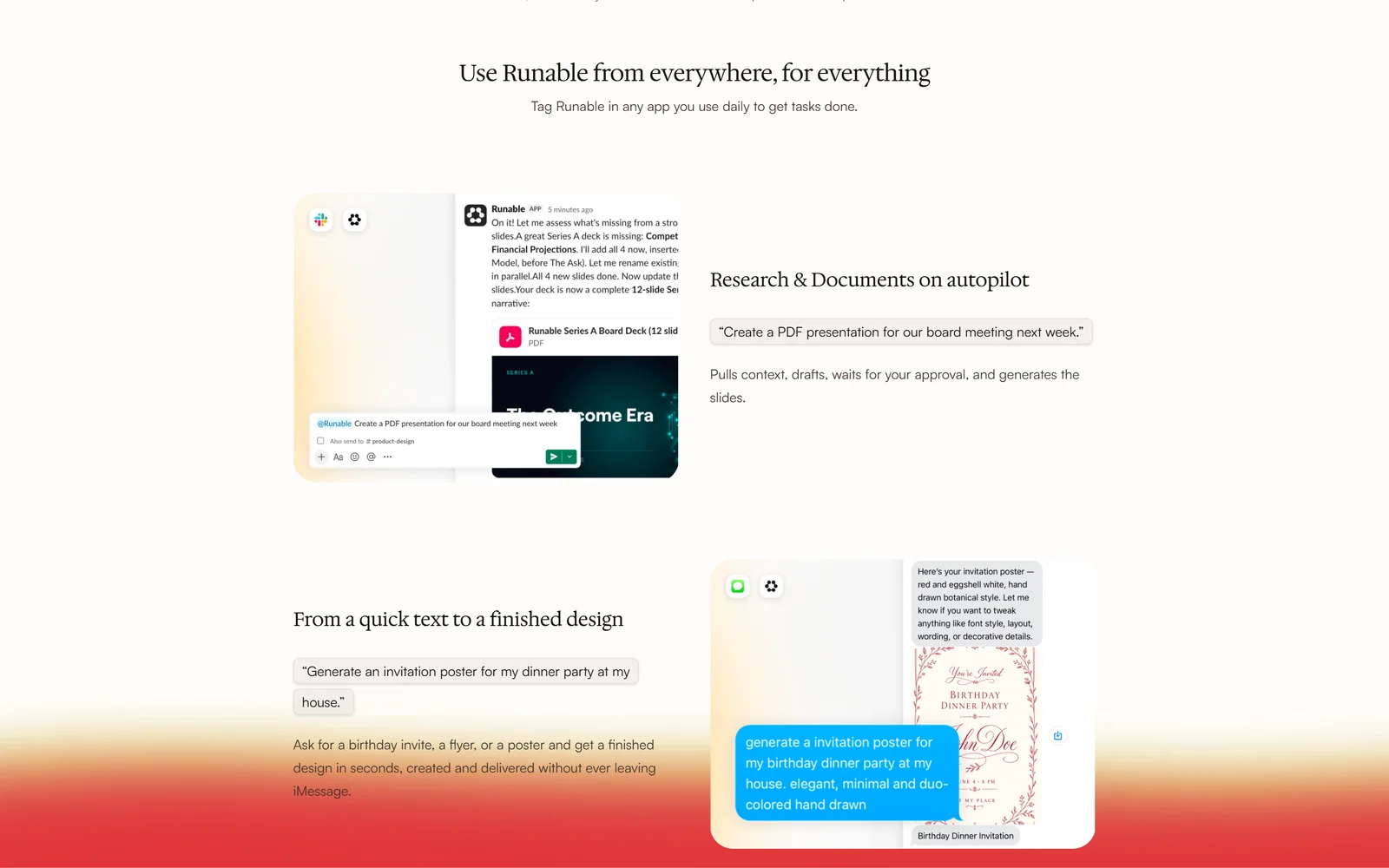
Claw puts the agent inside Slack, Telegram, Discord, Teams and iMessage.
Claw. Runable’s “Claw” runs the agent on an always-on cloud computer and lets you message it from Telegram, Slack, Discord, Microsoft Teams or iMessage. The Slack connector works on the free plan, and Runable states that Slack data is never used to train AI models.
Scheduled tasks and workflows. Tasks can run once, daily or on a schedule in the cloud, deliver results by email, mobile app, iMessage, Slack, Teams, Discord or Telegram, and continue in the same chat. Paid plans add “100+ curated workflows”, such as a company tear-sheet that pulls market data and outputs a presentation or spreadsheet.
Meet, Flow and plugins. Meet is a bot-based meeting notetaker for Google Meet, Zoom and Microsoft Teams that records up to 90 minutes per call and is billed in credits — Runable’s own test put a 10-minute call at about 50 credits. Flow is free Mac-only voice dictation into any app. Plugins connect Slack, Gmail, Google Drive, Notion, Shopify and, Runable says, 3,000+ apps in one click. An MCP server lets Claude, ChatGPT or Cursor start and monitor Runable tasks.
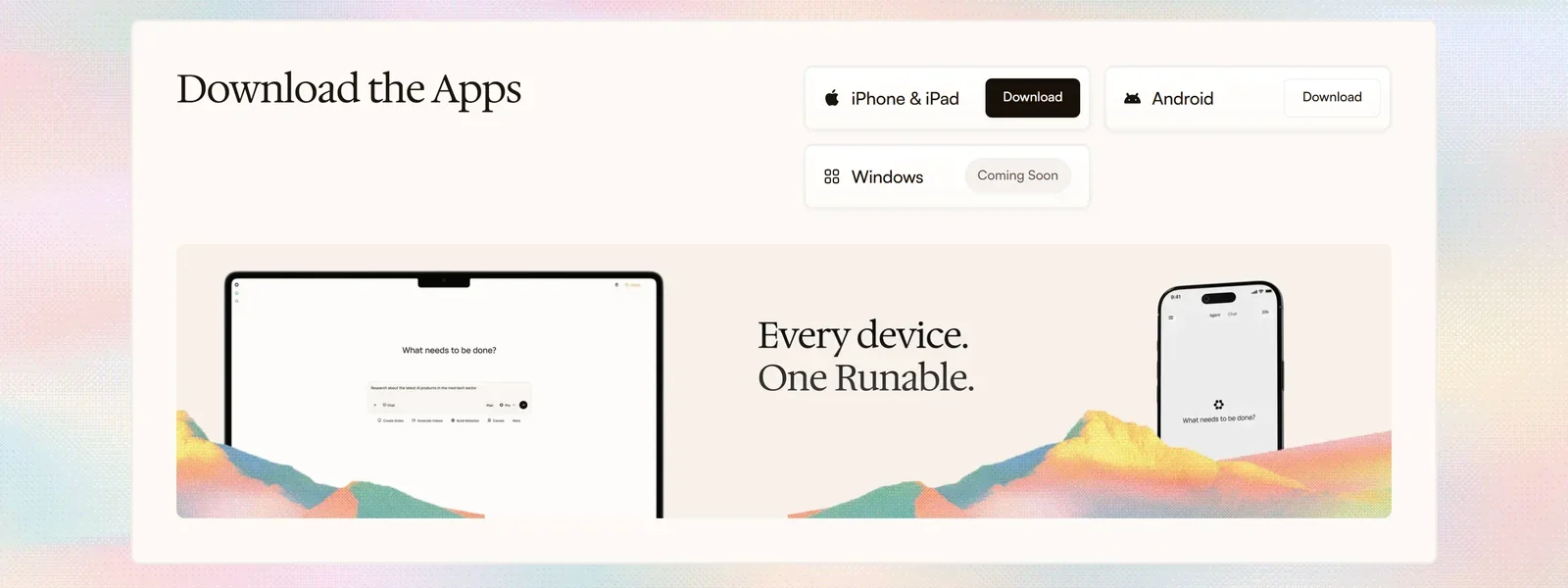
iPhone, iPad, Android and Mac today; Windows “coming soon”.
Apps. iOS (16.4+), Android (7.0+) and a macOS desktop app that the download page shows only to Mac browsers. Windows is listed as coming soon.
5. Pricing — and How Credits Really Work
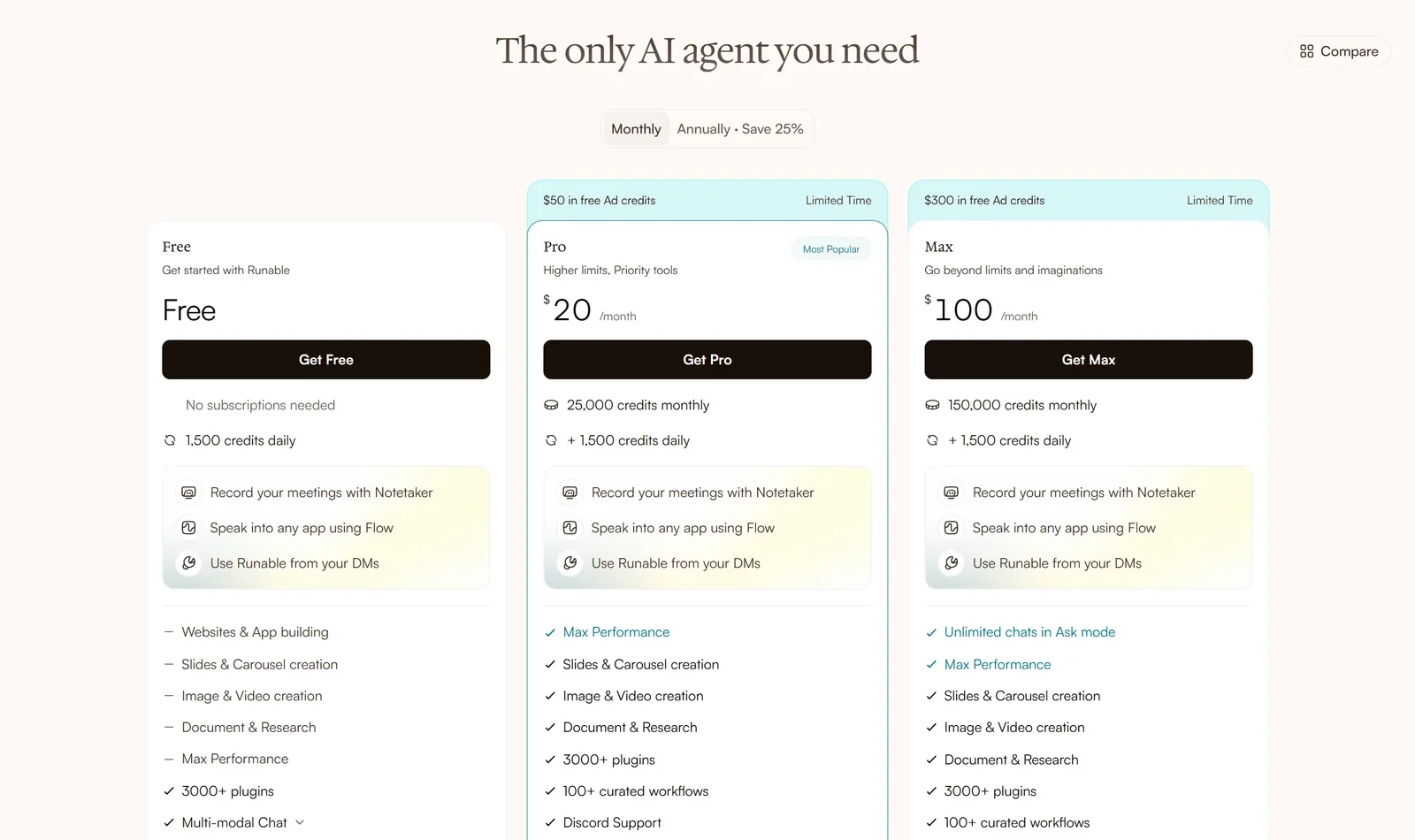
Runable’s plans with monthly billing, captured 8 October 2026. Prices are in US dollars everywhere.
| Plan | Monthly billing | Annual billing | Credits | Highlights |
|---|---|---|---|---|
| Free | $0 | — | 1,500 a day, up to 15,000 a month | Chat with all listed models, 3,000+ plugins, Notetaker, Flow dictation, DM access. Building tools shown as not included |
| Pro | $20 | $180/yr ($15/mo) | 25,000 a month + 1,500 a day | Websites and app building with free database, analytics, Stripe and sub-domain; slides, video, research; 100+ workflows; Discord support |
| Max | $100 | $840/yr ($70/mo) | 150,000 a month + 1,500 a day | Everything in Pro plus unlimited chats in Ask mode and the assistant in Slack, Teams, Telegram, iMessage and Discord |
Prices as shown on 8 October 2026. The toggle says “Save 25%”, which is right for Pro; Max’s annual price is actually 30% off. Both paid plans currently carry a “limited time” offer of free advertising credits for Runable’s Grow feature — $50 on Pro and $300 on Max — with no published expiry or conditions. There is no Team or Enterprise tier on the pricing page; SSO and data localisation go through “Contact Sales”. Runable changed its plan structure in mid-2026, so older reviews quoting $25, $50 or $200 plans are out of date.
What the Free plan can do is unclear. The pricing page marks “Websites & App building”, “Slides & Carousel creation”, “Image & Video creation” and “Document & Research” with a dash on Free, but Runable’s own blog posts say free-tier websites carry a badge and that free users get the Kling 3.0 video model. Expect to be able to try things on the free credits and to need Pro for real use.
How credits are spent
This is the part that decides whether Runable is cheap or expensive for you, and it is the part Runable explains least.
- No price list. Runable publishes no credit cost for a website, a deck, an image or a minute of video. Its guide says only that higher model tiers, higher resolution and longer duration cost more, that video is billed per second, and that videos with AI audio cost roughly twice as much. The only hard number is for Meet: about 50 credits for a 10-minute call. Runable told one reviewer that costs cannot always be stated upfront because they depend on the model, prompt complexity, steps, tool calls and iterations.
- Three balances. Credits are spent in this order: monthly plan credits, then purchased top-ups, then the daily free credits. Daily credits reset every day and do not carry over; monthly credits do not roll over; top-ups never expire. One App Store reviewer complained that a 10,000-credit job failed because the balances could not be combined.
- What users report. App Store and Google Play reviewers describe credits burning “fast on bigger tasks”, a single request using up the day’s 1,500 credits, an animated video costing around 10,000 credits for a few seconds, and the agent spending credits on “unrequested coding”. These are unverified anecdotes, but they are the most common complaint across every review site.
- Top-ups are available on paid plans only, with auto-refill optional. Web prices are shown only inside your account; the iOS app lists top-up purchases from $14.99 to $99.99 without stating how many credits each contains.
Billing rules to read first
- No refunds. Runable’s Terms state that “fees are non-refundable unless required by law.” Several reviewers say refund requests were answered with a credit top-up instead.
- No trial of paid plans. The free plan is the trial.
- Auto-renewal. Subscriptions renew until you cancel from the “manage subscription” dialog on the pricing page. Upgrades apply immediately; downgrades take effect at the next billing cycle.
- Not documented: what happens to published websites, apps and custom domains after you cancel.
About our link: opening Runable through our affiliate link shows the ordinary homepage and the same prices as going direct. There is no discount, bonus credit or extended trial attached to it.
Free plan · 1,500 credits a day · No subscription needed
Try one real task on the free credits first
Give it a genuine brief in Plan mode, watch how many credits it uses, then decide whether Pro’s 25,000 a month fits how you work.
Try Runable free
6. Ownership, Privacy and Legal Terms
This is where Runable’s youth shows most. The documents are short, and they leave questions open that established tools answer.
Who you are contracting with. Runable’s Terms of Service (last updated 8 January 2026) never name a legal entity or address; the contracting party is simply “Runable”, and the governing law is “the laws of the jurisdiction in which Runable is incorporated” — without saying which. There is no arbitration clause or class-action waiver. Liability is capped at what you paid in the previous 12 months, and the service is provided “as is”.
Who owns the output. You keep ownership of what you submit, and the Terms say “You may use exported outputs commercially.” But there is no clause assigning you ownership of AI-generated outputs, and Runable does not guarantee their originality, accuracy or legality. For a website or app you intend to build a business on, that is a gap worth asking support about in writing.
AI training. Runable’s app-store descriptions say “Runable does not train on your content.” That promise does not appear in the Terms or Privacy Policy. The legal documents commit only that Google user data obtained through Google’s APIs is not used to train general models, and that Runable’s AI providers are bound by terms prohibiting training on your data. The Terms let Runable use your content to “improve the Services”, undefined. The one product-level promise is on the Slack page: Slack data is never used for training.
Where your data goes. Nineteen sub-processors, all in the United States, including Anthropic, OpenAI, Google Cloud, AWS, Microsoft Azure, E2B, Recall.ai and Pipedream. Infrastructure is hosted on Google Cloud in Oregon. The Privacy Policy says it is designed to comply with the GDPR and Brazil’s LGPD but names no EU representative and offers no Data Processing Agreement.
Integrations reach deep. The Google Workspace connector asks for scopes covering Gmail, Drive, Sheets, Docs, Calendar, Slides and Forms, and on instruction can read, send, label, archive and trash emails. Messaging integrations may store preceding thread messages as transcripts, and disconnecting an integration does not delete what Runable already stored.
Security and deletion. There is no SOC 2, ISO 27001 or trust page; runable.com/security does not exist. Security is described in general terms (encryption in transit and at rest, access controls). Account and data deletion is by emailing support — and a Trustpilot reviewer and several Google Play reviewers say deletion did not work or went unanswered. In our own check, loading the site in a German-locale browser fired advertising trackers from Google, Meta, TikTok, X, LinkedIn and Reddit with no cookie banner.
Store labels disagree. The iOS App Privacy label declares contact info, user content, usage data and diagnostics as data used to track you; the Google Play data-safety section says no data is collected at all.
7. What Users Say
| Source | Rating | Reviews | Note |
|---|---|---|---|
| App Store, US (8 Oct 2026) | 3.9 | 60 | India storefront, which Runable links to, shows 5.0 from 17 |
| Google Play | 3.7 | 120 | 10K+ downloads; developer replies acknowledge credit complaints |
| Product Hunt | 4.8 | 45 | March 2026 launch, 65 upvotes |
| Trustpilot | 3.1 | 3 | Too few reviews to mean much |
What people praise: that Runable finishes whole tasks and produces real files, builds good-looking live websites quickly, runs several tasks in parallel, and — in one Google Play review — beats Manus and Genspark. Positive App Store reviewers include a business owner using it for market research, outreach lists, content and full websites.
What people criticise:
- Credits. The dominant complaint on every platform: credits disappear faster than expected, large jobs cannot finish without upgrading, and there is no way to see a task’s cost before running it.
- Billing and refunds. Reviewers report refund requests answered with small credit top-ups, a subscription the app refused to recognise despite bank statements showing payment, and an older $5 trial that converted to a $25 charge.
- Reliability. The most-helpful Google Play review says projects would not load at all after hours of work; US App Store reviewers describe sign-in failures and a frozen website lasting weeks; one says an API key connected to Runable had its credits drained.
- Account deletion and support. Users on Google Play and Trustpilot say the delete-account feature does not delete the account and that emails and chats go unanswered.
Read reviews with care. The YouTube reviews of Runable we found are largely sponsored or affiliate-linked, and Runable’s subreddit offers free credits for sharing use cases. A large wave of near-identical Reddit comments recommending Runable appeared in a two-week window in September 2026; whether that was coordinated is unknown. Earlier reviews also quote plans and prices that no longer exist.
8. Alternatives Worth Knowing
Prices are from each vendor’s own pricing page as of 8 October 2026.
| Tool | Free plan | Paid from | What it does | Training on your content (vendor’s wording) |
|---|---|---|---|---|
| Runable | 1,500 credits a day | $20/mo ($15 annual) | General agent: sites, apps, slides, video, research | No general promise in Terms; Slack data excluded |
| Manus | 300 credits a day | $20/mo ($17 annual) | General agent with browser operator and exports | Privacy policy allows use for service improvement |
| Genspark | About 100 credits a day (third-party) | $24.99/mo (App Store) | Agent workspace: slides, sheets, docs, sites, apps | No general statement beyond Google data |
| Lovable | 5 build credits a day | $25/mo ($21 annual) | Web-app builder with GitHub sync | Trains on customer content; opt-out in settings |
| Bolt.new | 1M tokens a month | $25/mo ($18 annual) | In-browser app builder with hosting | Opt-out default training from 7 Oct 2026 (non-EEA) |
| Gamma | 400 credits at sign-up | Plus tier | AI slides and simple sites, PPTX export | Opt-out for individuals; Business excluded |
| Durable | 300 credits | $25/mo ($22 annual) | Small-business website builder with CRM | Lists training ML models as a purpose |
| Hostinger AI Builder | 5 credits to test | $2.99/mo on a 48-month term | Website builder with hosting, domain and code export | No statement on training with prompts |
| Lindy | $50 of credits for 7 days | $29.99 per user/mo | Agent automations in Slack, inbox, meetings | Says data is never used to train models |
The closest rivals are Manus and Genspark, which TechCrunch also names as Runable’s competition. Manus publishes example credit costs for tasks and refunds credits for tasks that fail on its side — two things Runable does not offer. For websites and apps specifically, Bolt.new and Lovable give developers more control of the code, while Hostinger offers far cheaper hosting with code export if a conventional site is all you need. For agent automations across Slack and email, Lindy has clearer data-training terms.
9. Pros and Cons
Where Runable is genuinely strong
- One agent, many finished outputs — sites, apps, slides, video, carousels, reports, spreadsheets, audio
- Hosting, domains, database and Stripe built into websites
- A free plan with 1,500 daily credits and no subscription required
- Plan mode, rollback and forking to control an autonomous agent
- Leading models from several vendors behind one chat
- React Native source export for mobile apps
- Well funded for a one-year-old company
Where Runable falls short
- No published credit costs, and credits are the top complaint everywhere
- Non-refundable fees and no paid-plan trial
- Terms name no legal entity or jurisdiction, and do not assign output ownership
- No general no-training commitment in the legal documents
- No certifications or trust page; deletion by email only
- Mixed store ratings and reports of lost projects and sign-in failures
- Contradictory pages on the Free plan and on code export
10. Frequently Asked Questions
What does Runable actually do?
Runable is an AI general agent: you describe an outcome and it plans and executes the task in its own cloud sandbox, then hands back a finished deliverable such as a hosted website, a slide deck, a video, a carousel, a report, a spreadsheet or a native mobile app. It can also run scheduled tasks, record meetings, and answer you from Slack, Telegram, Discord, Microsoft Teams or iMessage.
Is Runable free?
There is a Free plan with 1,500 credits a day, capped at 15,000 a month, with no subscription required. It includes chat with the listed models, plugins, the meeting notetaker and Mac dictation. The pricing page marks websites, apps, slides, video and research as not included on Free, although Runable's blog suggests some free-tier building is possible with a badge. There is no free trial of the Pro or Max plans.
How much does Runable cost?
Pro is $20 a month or $180 a year ($15 a month) with 25,000 credits a month plus 1,500 daily credits. Max is $100 a month or $840 a year ($70 a month) with 150,000 credits a month, unlimited chats in Ask mode and the assistant across Slack, Teams, Telegram, iMessage and Discord. Prices are in US dollars only, and both paid plans currently advertise limited-time free ad credits for Runable's Grow feature.
How many credits does a website or video cost?
Runable does not publish credit costs per task. Its guide says costs rise with the model tier, resolution and duration, that video is billed per second, and that videos with AI audio cost roughly twice as much. The only official figure is about 50 credits for a 10-minute recorded meeting. Reviewers report single requests using the whole 1,500 daily allowance and short animated videos costing thousands of credits, so run your first real task in Plan mode and watch the balance.
Can I get a refund from Runable?
Runable's Terms say fees are non-refundable unless required by law, and reviewers report refund requests being answered with credit top-ups instead. Subscriptions renew automatically until you cancel from the manage-subscription dialog on the pricing page; a downgrade takes effect at the next billing cycle. Test on the Free plan before paying.
Who owns the websites and apps Runable builds?
You keep ownership of what you submit, and Runable's Terms allow commercial use of exported outputs. However, the Terms contain no clause assigning ownership of AI-generated outputs to you. Runable's App Builder says apps are standard React Native projects whose source can be exported and self-hosted, and its comparison pages say web-app code can be downloaded or exported to GitHub, although its 2.0 launch post said the opposite. Confirm export works before building anything important.
Does Runable train AI on my data?
Runable's app-store listings say it does not train on your content, but that promise is not in its Terms or Privacy Policy. The legal documents commit only that Google user data is not used to train general models and that its AI providers may not train on your data; they let Runable use your content to improve its services. The Slack connector page separately states that Slack data is never used for training. If this matters to you, ask Runable for the commitment in writing.
Does the link in this review give a discount?
No. Our affiliate link opens Runable's normal homepage with a referral code attached and shows the same prices as going direct. Runable's affiliate programme does not publish any discount, bonus credits or extended trial for referred users.
11. Final Verdict: Is Runable Worth It in 2026?
Runable is the most ambitious “do it for me” agent we have reviewed, and for the right person it is genuinely useful. A small-business owner or solo founder can describe a business and come back to a live website, a deck, a research summary and a scheduled task that reports to Slack — from one $20 plan, with leading models from several vendors behind it. Few tools cover that much ground.
The problems are about trust and predictability rather than capability. Runable publishes no credit costs, so you cannot know what a task will cost until it has cost it, and that is the complaint reviewers make most. Fees are non-refundable. The Terms name no company, no jurisdiction and no owner of the AI outputs, and the no-training promise lives in marketing copy rather than the contract. For a product that wants to host your business website and read your Gmail, those are not small gaps.
Use it the smart way. Start on the Free plan and give it one real task in Plan mode, watching the credit balance. Export anything you build — the deck as PPTX, the site or app code — so you are never locked in. Pay monthly, not annually, until you know your credit needs. And keep sensitive data out of it until the legal documents catch up with the marketing.
Choose something else if you need predictable pricing, refunds, a documented no-training policy, or full control of a codebase.
Disclosure: This review contains an affiliate link. If you subscribe through it, Runable’s affiliate programme pays us a 25% commission on your payments during your first year, at no extra cost to you; the link gives you no discount. Runable’s affiliate page states the referral tracking window as both 30 days and 90 days. All factual claims were verified against Runable’s website, pricing page, FAQ, blog, Terms of Service, Privacy Policy and sub-processor list, the App Store, Google Play, Product Hunt and Trustpilot, TechCrunch, Inc42 and DealStreetAsia, and each competitor’s own pricing page, as of 8 October 2026. User counts, revenue, benchmark scores and the “highest-ranked agent” claim are attributed to Runable; we could not verify them independently.