Poppy AI Review 2026: A Genuinely Useful Board, Sold on Terms You Should Read First
Most AI writing tools share the same weakness: they start from a blank prompt, so they sound like everyone else. Poppy AI starts somewhere else. Its pitch is to “Create From What’s Already Working” — drop the videos, ads and posts that already performed in your niche onto a visual board, let the model work out why they worked, and write your version on top of that pattern.
That idea is sound, and the product built around it is more capable than most of what competes with it. The board handles a wide range of inputs, Poppy lists models from Anthropic, OpenAI, Google and xAI, and independent ratings are strong.
But this review spends real time on the commercial terms, because they are where a buyer can get hurt. Poppy sells annual plans only. The $1 trial many visitors see converts into the full annual charge. The 30-day money-back guarantee the homepage calls “no hoops” is, in Poppy’s own Refund Policy, conditional on attending an onboarding call. And Poppy’s Subscription Terms state that “There is no trial period” at all.
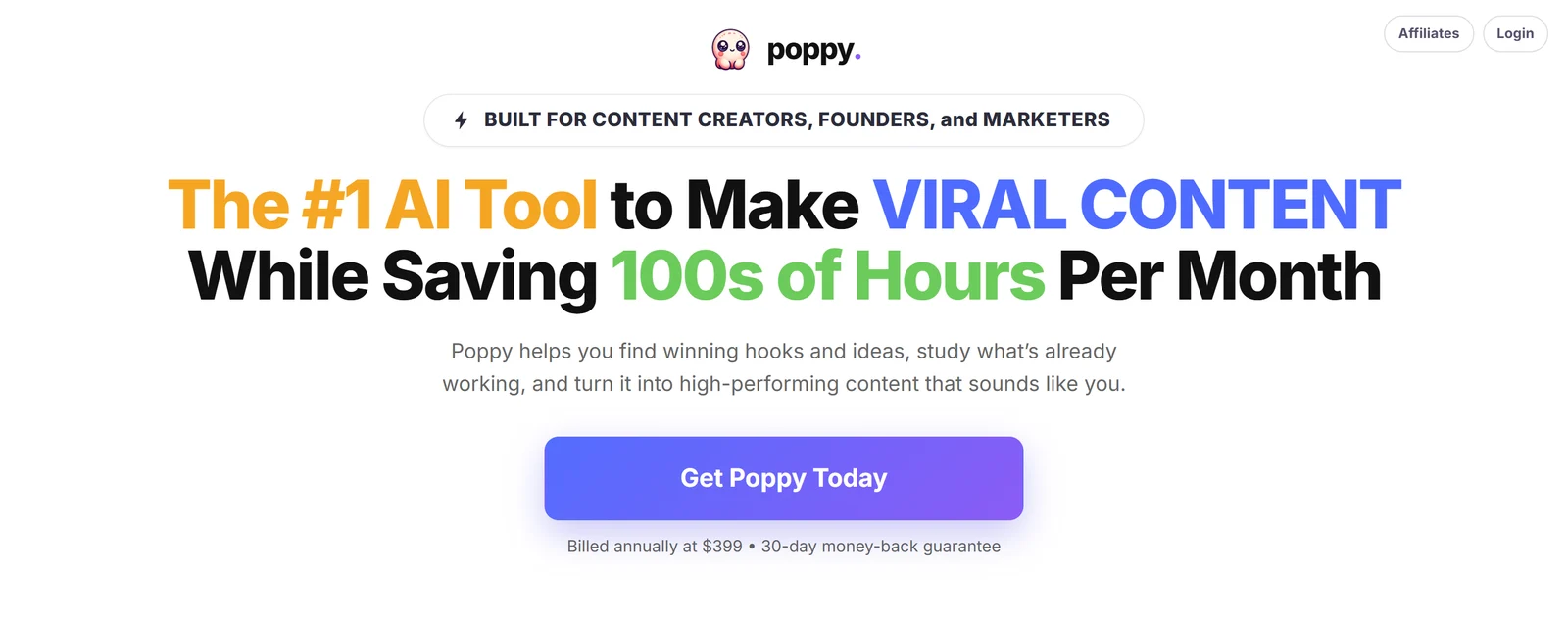
Poppy’s homepage as served on 28 September 2026 — this visitor was shown “Billed annually at $399” with no $1 trial. Poppy tests different offers on different visitors.
1. What Poppy Is, and Who Is Behind It
Poppy describes itself as an “AI content intelligence and production system”. Its homepage headline is “The #1 AI Tool to Make VIRAL CONTENT While Saving 100s of Hours Per Month” — a marketing superlative, not a measured ranking.
Strip the headline away and the product is an infinite canvas. You place source material on it, connect AI chat nodes to the specific sources you want them to read, and generate content from there. The FAQ puts the difference plainly: “Generic AI writers start from a blank prompt. Poppy starts from proof.”
The company
Poppy is operated by GetPoppy AI Corp, which its legal documents place at 28 Geary Street in San Francisco. It was co-founded by Rafeh Qazi and Nazariy (Naz) Dumanskyy, who previously built Clever Programmer, a coding-education business whose YouTube channel passed a million subscribers. The founders say they moved to San Francisco in 2024 to build Poppy; the getpoppy.ai domain was registered in April 2024.
Poppy is bootstrapped — the founders describe it that way, AppSumo lists it that way, and we found no announced outside funding round. LinkedIn lists a team of 2–10. The founders have publicly described fast revenue growth, but those figures are their own and unaudited.
One point of confusion worth clearing up: a separately funded startup also called “Poppy” (getpoppy.app) raised a pre-seed round in May 2026. It is a different company. Funding news attached to that name does not apply to Poppy AI.
2. Who Poppy Is For — and Who It Is Not For
It fits you if:
- You already script by studying what performed — outlier YouTube videos, winning TikToks, ads that keep running — and do it manually across many tabs today
- You buy ads and want new variations built from creatives still live in the Meta Ad Library
- You run an agency and need each client’s voice, research and past winners kept in a separate workspace
- You want Claude, GPT, Gemini and Grok available in one place with the same research attached
Look elsewhere if:
- You cannot commit $399 up front — there is no monthly plan on the pricing page
- You need scheduling or posting — we found no native publishing in Poppy’s documentation
- You need visual analysis of YouTube videos, which Poppy does not run on YouTube links
- Your organisation requires SOC 2, a DPA, or a clear statement on AI training before uploading client material
3. How It Works: the Board
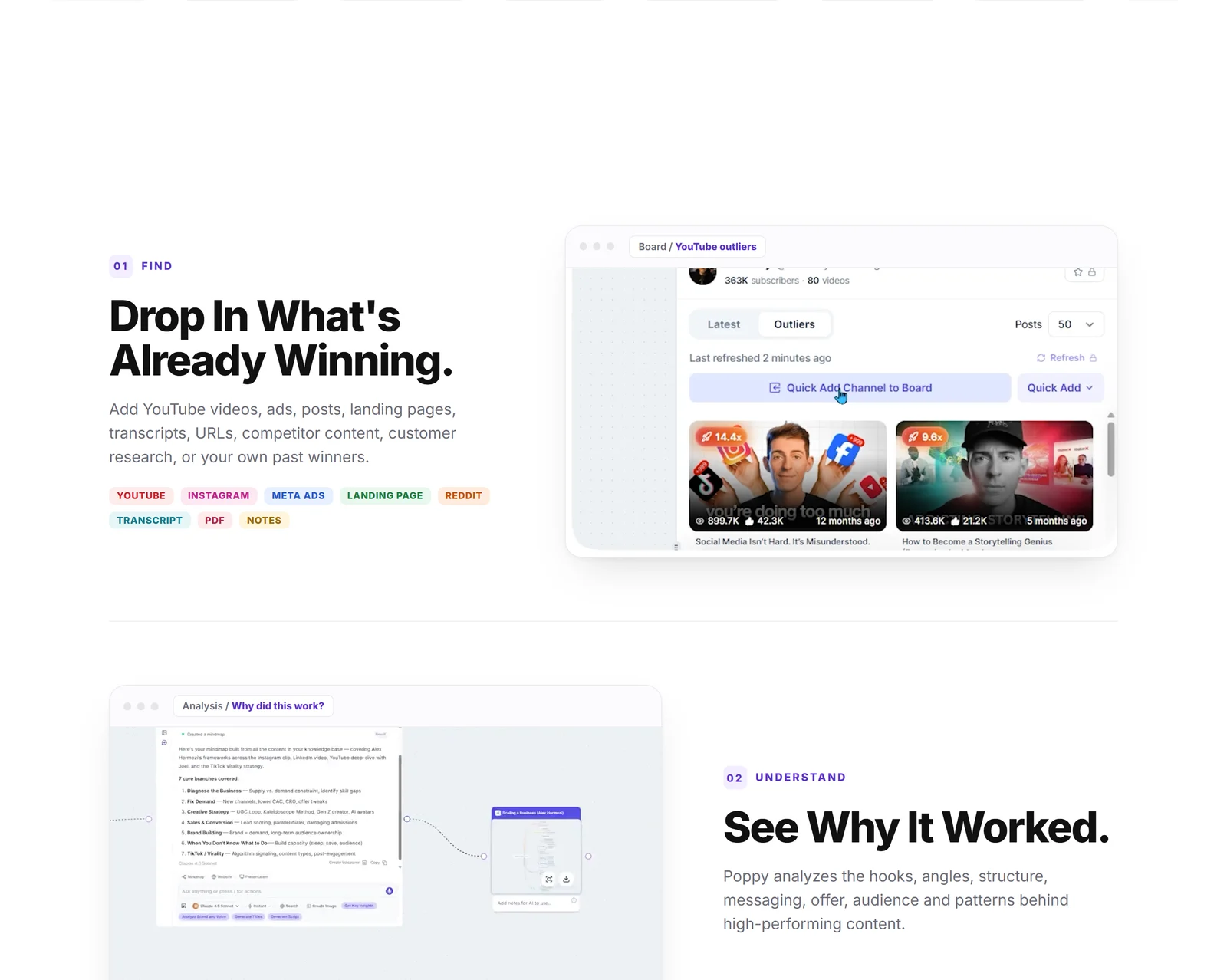
Find, then Understand: a YouTube channel’s outlier videos pulled onto a board, and an analysis chat connected to them.
The workflow runs in three steps, which Poppy labels Find, Understand and Create.
Find. Paste links or drag files onto the board. Poppy’s help centre lists supported links as TikTok videos and carousels, YouTube, LinkedIn posts, Instagram reels, carousels and posts, Facebook and Meta Ad Library ads, Loom, X/Twitter videos and Zoom. Uploadable files are PDF, CSV, Docs, MP3, MP4, MOV and TXT, plus Google Drive and Dropbox — each capped at 100MB.
Paste a creator’s profile instead of a single post — TikTok, Instagram (Reels only), LinkedIn or YouTube — and Poppy pulls in follower counts, per-post metrics and the posts that outperformed. For YouTube channels it shows the metrics but does not transcribe the videos automatically.
Understand. Each source becomes a transcript or breakdown, and an AI chat connected to those sources treats them as its knowledge base. You ask it why the content worked.
Create. The same chat, with your brand voice card and offer attached, writes your version.
Limits worth knowing before you build a workflow on it
- A website URL is read as that one page only. Poppy cannot follow links to other pages on the same site.
- Visual analysis does not run on YouTube, Zoom or Loom links. On-screen text, visuals and captions are read only for videos you upload from your computer.
- Deleted sources go dark. If a post is removed from its platform, Poppy can no longer read it.
- Voice chat understands English only, although voice memos are transcribed in any language.
- Reddit appears as a chip on the homepage, but we found no help article documenting Reddit links as a supported input.
4. What Comes Out, and Which Models Make It
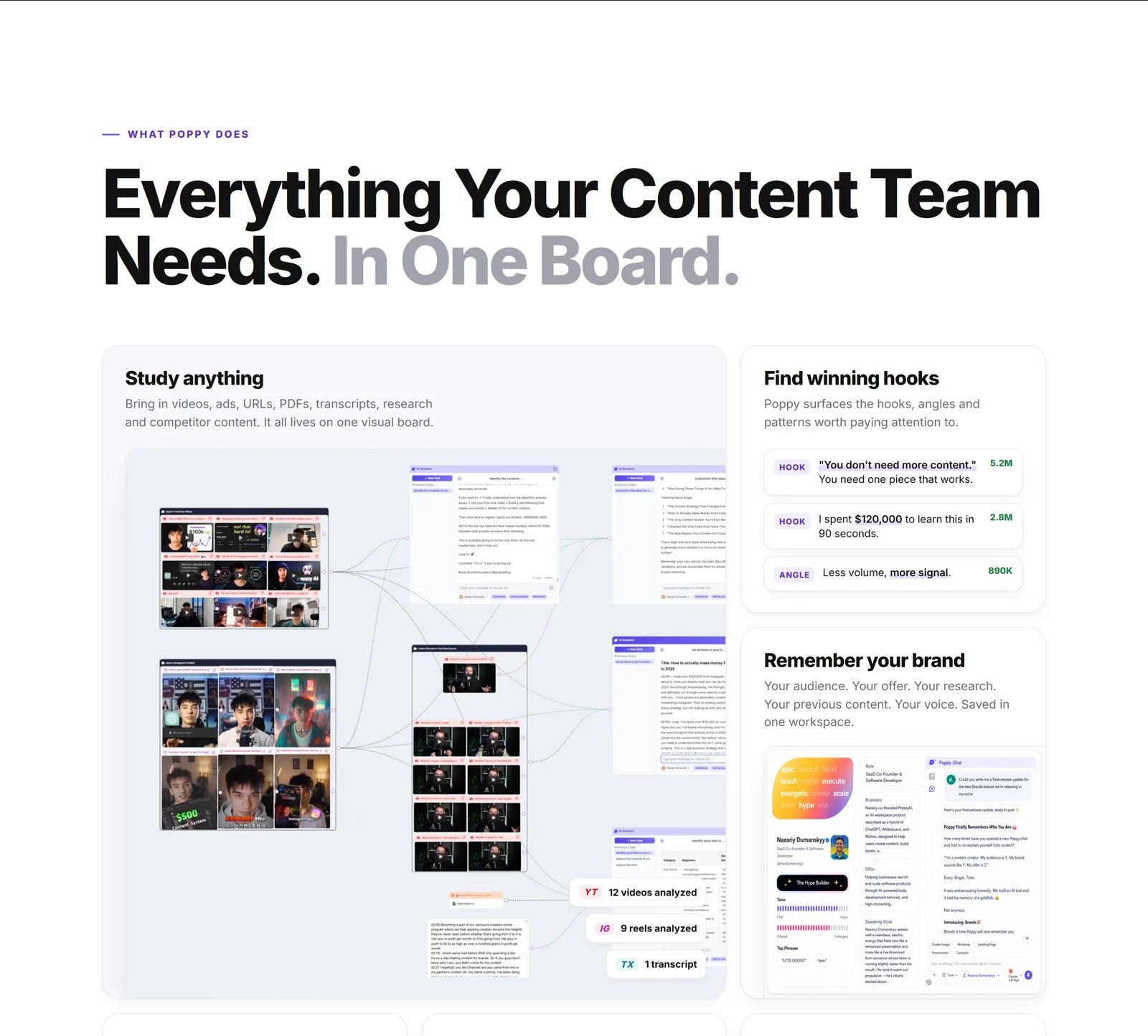
The board, hook surfacing and brand-voice memory as Poppy presents them on its homepage.
Outputs are text-first: scripts, ads, emails, VSLs, posts, newsletters, landing pages, images, carousels of 2 to 10 slides, HTML presentations and mind maps.
Models. Poppy’s AI Models Guide, last updated 26 July 2026, lists these text models: Claude 5 Sonnet, Claude Opus 4.8, Claude Opus 5, GPT-5.5, GPT-5.6 Terra, GPT-4o, Gemini 2.5 Pro, Grok 3 and GPT-5.4 Mini. Image models are GPT Image 2, NanoBanana 2, NanoBanana Pro and Seedream 4.5. You choose per chat, and five thinking modes (Instant through Extra High, the last for Claude Opus only) trade speed for credits.
Two documentation inconsistencies are worth noting. The public API docs list an older model set than the in-app guide. And web search — now an optional “deep research” toggle where Perplexity searches and Claude writes — contradicts an older help article that still says Poppy “isn’t connected to the internet”.
Landing pages. The builder produces a single HTML page, published on a Poppy link with a “Created with Poppy” badge, downloaded as HTML, or served on your own domain from the Creator plan up. It has no backend forms and no payment processing, and you cannot edit the code inside Poppy.
Getting content out. We found no native posting or scheduling in Poppy’s documentation. Content leaves by copy and paste, HTML download, the Notion integration, or the REST API with automation tools such as n8n, Zapier or Make. The API can query a board’s knowledge base and continue conversations, but it cannot upload files to boards — and it takes the API key as a URL query parameter, a practice that can expose keys in server logs.
5. Pricing: Annual Only, and What the $1 Trial Turns Into
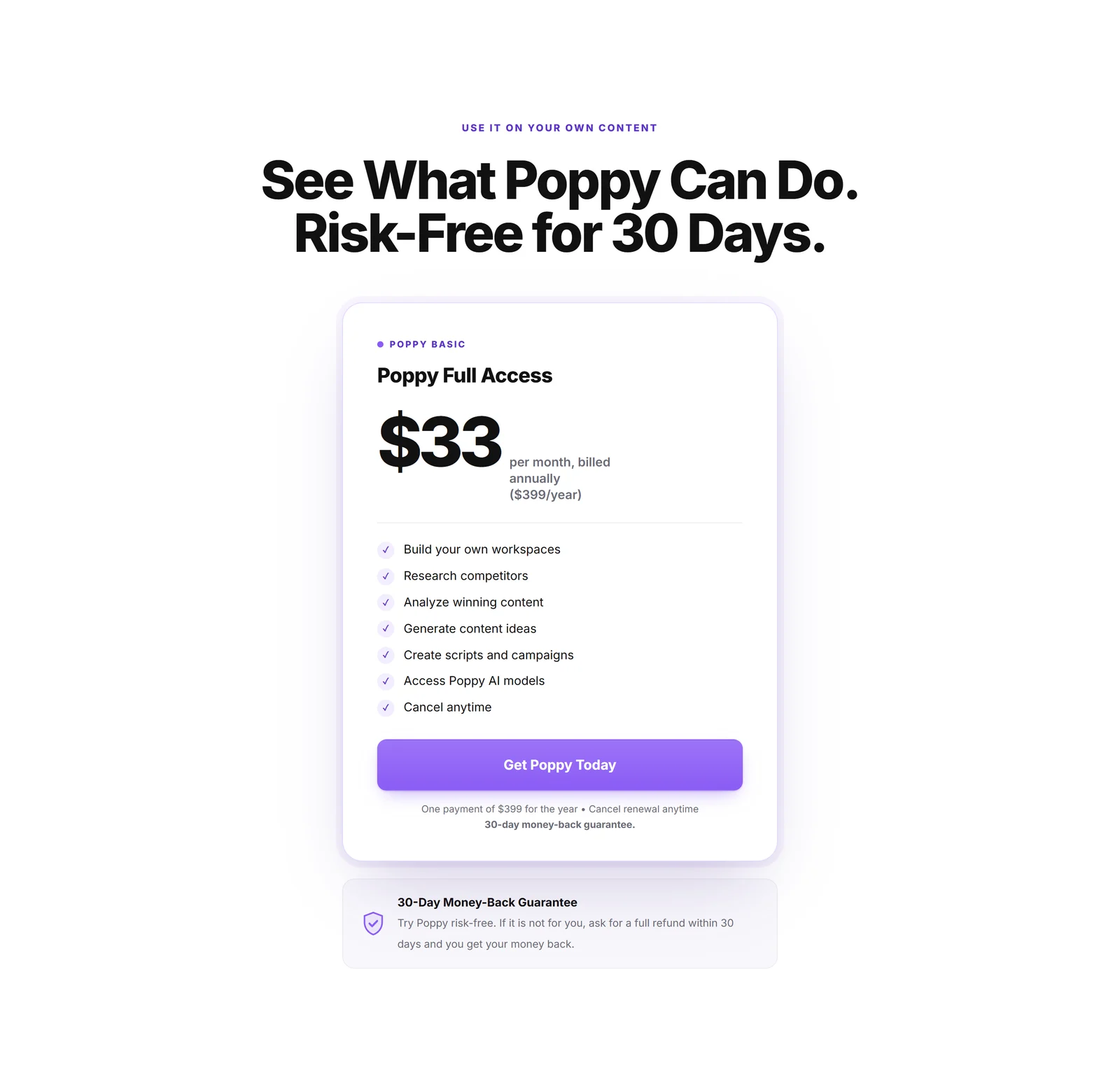
One of the pricing variants Poppy serves: a single $399 annual payment. Other visitors see a $1 / 7-day trial and a multi-plan picker instead.
As of 28 September 2026 Poppy’s help centre states “Annual billing only.”, and the pricing page shows no monthly option.
| Plan | Price | Credits / month | Seats | Notable inclusions |
|---|---|---|---|---|
| Base | $399/year (shown $33/mo) | 2,000 | 1 | Boards, scripts, ads, images, every model, page builder |
| Creator | $2,268/year (shown $189/mo) | 8,000 | 3 | VSL and landing-page builder, custom domain |
| Power User | Custom (book a demo) | 16,000 | 5 | Chatbots and agents, API access |
Which offer you see depends on who you are. Poppy split-tests its pricing page. Many visitors see “Try Poppy for $1 — 7 days of full access” with the three-plan picker above. In our own test the page instead showed a single plan at $399 paid upfront with no trial — and the same page still carried a mid-page button reading “7 days of full access” beneath a hero that said “Billed annually at $399”. Check what your own checkout says before you enter a card.
The $1 trial is an annual subscription with a delayed start
This is the single most important thing to understand about buying Poppy. The trial requires a card, and on day 7 the card is charged the full annual price unless you cancel: Poppy’s own wording is “$1 today for 7 days, then $399/year”, or “then $2,268/year” for Creator. The checkout states it directly: “$1 today. $399/yr in 7 days unless you cancel.”
Poppy discloses this — but the homepage FAQ answer about what happens after the trial says only that your plan “continues at the listed price”, without naming a dollar figure. If you start the trial, put a reminder in your calendar for day 6.
A further inconsistency: Poppy’s Subscription Terms, updated 5 August 2026, say “There is no trial period. Your subscription begins immediately upon purchase.” They also still refer to monthly plans that the pricing page no longer offers.
Credits
Credits are spent only when you chat with the AI — including generating images and landing pages. Uploading files and arranging boards are free. Credits reset on the 1st of each month and do not roll over, and when you run out you can still use your board but cannot prompt chats.
What Poppy does not publish is how many credits any action costs. Cost varies with how much connected content the chat reads, which model you pick, and how long the conversation runs, and Poppy offers only relative ratings. Extra credits are sold as separate credit-upgrade subscriptions or one-time boosts through support, with prices shown only in-app, and credit purchases are non-refundable.
That opacity matters because of a pattern in AppSumo reviews: critical reviewers describe burning 500–600 credits correcting template-like output, and attached PDFs being re-processed — and re-charged — with every message.
6. The Refund Guarantee Has a Condition the Homepage Leaves Out
Poppy’s homepage advertises a 30-Day Money-Back Guarantee, and its FAQ promises “a full refund, no hoops”.
Poppy’s Refund Policy (effective 5 August 2026) is narrower in three ways:
- You must attend an onboarding call. Verbatim: “To be eligible for a refund, you must attend an onboarding call with our team. If you do not book and attend an onboarding call, you forfeit your right to request a refund.”
- It covers the first subscription payment only. Renewal payments are non-refundable except where the law requires it, and after 30 days all sales are final.
- Credit purchases are never refunded.
Refunds cannot be requested in the billing portal — only through support@getpoppy.ai or the support chat. The policy also does not say whether the 30 days run from the $1 trial charge or from the annual charge, so do not assume you have a full 30 days after the $399 lands.
The practical advice is simple: if you buy, book the onboarding call immediately, whether or not you think you will want a refund. It is the only thing that keeps the guarantee available.
Cancelling is straightforward by comparison: profile picture → Billing opens the Stripe portal, or use support chat or email. Access runs to the end of the paid period, and renewals stay locked at your original price — Poppy says it emails a reminder before each annual renewal. Export anything you want to keep before cancelling; the Refund Policy reserves the right to delete data on cancellation.
7. Data, Legal Terms and Security
Poppy’s legal documents are short, and several things a business buyer would expect are absent.
- A broad licence over your data. Terms section 4: “You grant Poppy AI a license to use your data for purposes including but not limited to providing, improving, and expanding our services.” No scope limit is stated.
- Nothing on AI training or output ownership. None of the documents says whether your content or outputs train AI models, names the AI providers that process your content, or states that you own what you generate.
- Staff access. The Privacy Policy says staff and contractors “may access user data for purposes including troubleshooting, technical support, product improvement, and business analytics.”
- No certifications or DPA. We found no SOC 2, ISO 27001, security page, DPA or cookie policy. Data is retained for 90 days to 2 years after an account closes.
- Copyright risk sits with you. The homepage encourages adding competitor content and saving competitors’ winning ads, but the Terms contain no takedown procedure and no IP indemnity. If a generated script is too close to its source, that is your problem, not Poppy’s.
- Arbitration. Disputes go to binding individual arbitration under California law, with a class-action and jury waiver. You can opt out within 30 days of first accepting the Terms by emailing support@getpoppy.ai with the subject “Arbitration Opt Out”.
- Unilateral change. Poppy may change the Terms at any time, and may suspend or terminate accounts immediately and without notice.
None of this is unusual for a small bootstrapped SaaS, but it rules Poppy out for agencies whose clients require a DPA before their material is uploaded anywhere.
8. What the Ratings Actually Say
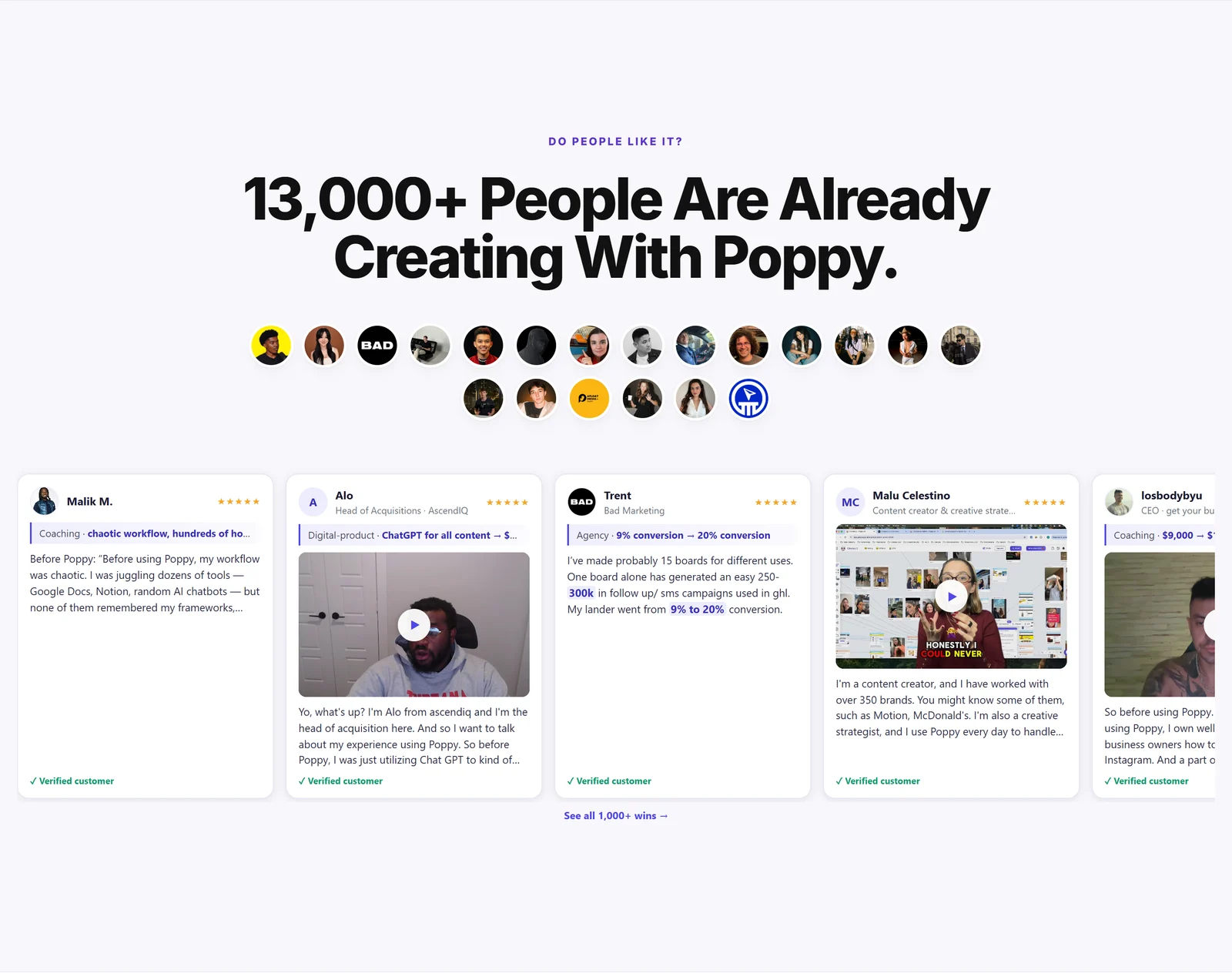
Poppy’s testimonial wall. Every card carries a “Verified customer” label and a five-star rating.
Independent ratings are strong, and they deserve to be stated plainly before the caveats.
| Source | Rating | Volume | Note |
|---|---|---|---|
| Trustpilot (28 Sep 2026) | 4.9 | 405 reviews | 97% five-star; claimed profile on a paid subscription |
| AppSumo | 4.83 | 161 reviews | Lifetime deal ran Jul–Aug 2026, now sold out |
| Homepage | 4.9/5 | — | No source named |
How to read those numbers
The homepage contradicts itself on users. The hero says “Trusted by over 13,000 Creators”; the strip directly below says “Trusted by 12,000+ creators & marketers”. The 4.9/5 beside them names no source.
Trustpilot volume has fallen. Reviews peaked between June and September 2025 at 21–44 a month and have run at 0–19 a month since. Trustpilot itself shows 67 reviews in the last 12 months and flags that “This company hasn’t invited customers recently, so reviews may not be representative.” Of the 200 most recent reviews, 105 mention the same onboarding representative by name — consistent with the onboarding call being a central part of the experience.
Poppy’s testimonial feed includes its own staff. Poppy’s own feed held 1,247 entries on 28 September 2026, none rated below four stars. At least seven five-star entries, dated late May 2026, come from people listing Poppy job titles — partnerships, customer support, sales and engineering roles.
Testimonials carry no disclosure. The homepage testimonials include large claims — follower growth into six figures, a 36X return on ad spend — which Poppy presents as its customers’ reports and which we could not verify either way. None carries a compensation disclosure or a “results not typical” note, and at least one homepage testimonial comes from a creator whom Poppy’s own affiliate page lists as having earned commissions.
What the critics say. Independent reviewer Ryan Doser, whose affiliate links point to a different product, praised the visual board, model choice and transcription but criticised the lack of publishing or scheduling, the annual lock-in, the hidden credit math, and “countdown timers on the checkout page that reset every five minutes.” AppSumo’s critical reviews cite template-like output with typos, bugginess and slowness, and pressure to book strategy calls. On Trustpilot, one September 2026 one-star reviewer alleges that a refund inside the window was not processed after the onboarding representative missed the required call, and that extra credits were offered instead — an individual account we could not verify.
9. Poppy vs the Alternatives
Poppy sits between three categories: board-based AI workspaces, viral-content research tools, and general AI chat. Prices are from each vendor’s own site as of September 2026.
| Tool | Entry price | Monthly billing? | What it is |
|---|---|---|---|
| Poppy AI | $399/year | No | Visual board + multi-model chat for content creation |
| AI Flow Chat | $29/month after 7 free days | Yes | Credit-based visual AI board, cancel anytime |
| Kosmik | $11.99/mo yearly, $14.99 monthly | Yes | Visual research canvas |
| Sandcastles | $49/month ($39 yearly) | Yes | Viral video research; no refunds on subscriptions |
| 1of10 | Free tier; $19/month basic | Yes | YouTube outlier research; 7-day money-back |
| Foreplay | $59/month ($49 yearly) | Yes | Ad swipe file; 14-day money-back after first charge |
| Claude Pro | $20/month ($17 yearly) | Yes | General AI chat with Projects on every plan |
| ChatGPT Plus | $20/month | Yes | General AI chat |
The honest comparison is with a $20-a-month Claude or ChatGPT subscription plus free transcript tools. That combination can do much of what Poppy does if you are willing to paste transcripts in by hand. What Poppy adds is the board itself: pulling a profile’s outliers automatically, keeping dozens of sources and several chats visible at once, per-client brand voice, and switching models without re-uploading anything. Whether that is worth $399 a year up front — against $240 a year for Claude Pro billed monthly, with no commitment — depends on how many sources you actually work with at once.
10. Pros and Cons
Where Poppy is genuinely strong
- Grounded generation. Chats read the specific sources you connect, not a blank prompt
- Wide input coverage across short-form, long-form, ads, calls and documents
- Profile outliers surface the posts that outperformed the rest of an account
- Models from four providers plus four image models, chosen per chat
- Per-client workspaces and brand voice cards built for agency use
- Strong independent ratings on Trustpilot and AppSumo
- Locked renewal pricing and a renewal reminder email
Where Poppy falls short
- Annual billing only, with a $399 minimum commitment
- The $1 trial converts to the full annual charge on day 7
- Refunds require attending an onboarding call — not mentioned in the homepage’s “no hoops” wording
- Subscription Terms say there is no trial period, contradicting the homepage
- No published credit cost per action, and credits do not roll over
- No visual analysis of YouTube links
- No SOC 2, DPA, AI-training statement or output-ownership clause
- Contradictory user counts and undisclosed testimonials on the homepage
11. Frequently Asked Questions
Is the $1 Poppy trial free, and what happens after 7 days?
It is not free — it costs $1 and requires a card. On day 7 the card is charged the full annual price unless you cancel first: '$1 today for 7 days, then $399/year' on Base, or $2,268 a year on Creator. The trial does not roll into a monthly plan, because Poppy currently sells annual billing only. Poppy also split-tests its pricing, so some visitors are shown $399 paid upfront with no trial at all. Set a reminder for day 6 if you start the trial.
Does Poppy have a monthly plan?
Not on its pricing page as of 28 September 2026. Poppy's help centre states 'Annual billing only.', and the smallest paid commitment is $399 for a year. Poppy's Subscription Terms still refer to monthly plans in general terms, but none is offered on the pricing page. If you need month-to-month billing, alternatives such as AI Flow Chat, Kosmik or a Claude or ChatGPT subscription offer it.
Can I get a refund from Poppy?
Only under specific conditions. The Refund Policy (effective 5 August 2026) gives a 30-day money-back guarantee on your first subscription payment only, and only if you book and attend an onboarding call — 'If you do not book and attend an onboarding call, you forfeit your right to request a refund.' Renewals and credit purchases are non-refundable, and refunds must be requested through support@getpoppy.ai or the support chat rather than the billing portal. The homepage's 'no hoops' wording does not mention the onboarding-call condition, so book the call as soon as you buy.
Which AI models does Poppy use?
Poppy's AI Models Guide, updated 26 July 2026, lists Claude 5 Sonnet, Claude Opus 4.8, Claude Opus 5, GPT-5.5, GPT-5.6 Terra, GPT-4o, Gemini 2.5 Pro, Grok 3 and GPT-5.4 Mini for text, and GPT Image 2, NanoBanana 2, NanoBanana Pro and Seedream 4.5 for images. You pick a model per chat. Note that Poppy's public API documentation lists an older model set than the in-app guide.
How far do 2,000 credits a month go?
Poppy does not say. Credits are spent only on AI chats, including image and landing-page generation, and the cost of each message depends on how much connected content the chat reads, which model you choose and how long the conversation runs. Poppy publishes only relative ratings, not a per-action table. Credits reset on the 1st of each month and do not roll over, and extra credit purchases are non-refundable. Critical AppSumo reviewers describe spending 500–600 credits fixing flawed output, so large boards on premium models can use credits quickly.
Does Poppy use my content to train AI models?
Poppy's legal documents do not say either way. None of them states whether uploaded content or generated outputs are used for training, names the AI providers that process your content, or states that you own your outputs. The Terms grant Poppy a licence to use your data for purposes 'including but not limited to providing, improving, and expanding our services', and the Privacy Policy says staff and contractors may access user data. Poppy publishes no SOC 2 certification and no DPA.
Can Poppy post or schedule content to social media?
We found no native posting or scheduling in Poppy's documentation. Content leaves Poppy by copy and paste, HTML download for landing pages, the Notion integration, or the REST API connected to automation tools such as n8n, Zapier or Make. Independent reviewers have listed the lack of a publishing function as one of Poppy's main gaps.
Is Poppy AI the same company as the Poppy that raised a pre-seed round?
No. Poppy AI at getpoppy.ai is operated by GetPoppy AI Corp, co-founded by Rafeh Qazi and Nazariy (Naz) Dumanskyy, and describes itself as bootstrapped. A separate startup also called Poppy, at getpoppy.app, raised a pre-seed round in May 2026. The two are unrelated, and funding news about one does not apply to the other.
12. Final Verdict: Is Poppy AI Worth It in 2026?
The product earns a recommendation. The purchase terms earn a warning. Both are true at once, and a buyer needs to hold both.
As software, Poppy does something a chatbot does not. Grounding every chat in the specific videos, ads and documents on a board — with profile outliers pulled in automatically, per-client brand voice, and a choice of models from four providers — is a real improvement for anyone who already researches what performs before they write. Independent ratings of 4.9 on Trustpilot and 4.83 on AppSumo suggest most paying users agree.
The commercial side is where the rating comes down. Annual-only billing, a $1 trial that becomes a $399 charge, a refund guarantee whose written condition the homepage omits, Subscription Terms that deny the trial exists, and credits with no published price per action add up to a purchase that punishes anyone who does not read carefully.
Buy Poppy if you already work from reference content across many tabs, you are confident you will use it for a full year, and you are comfortable with its data terms.
Before you pay: confirm what your checkout says the day-7 charge will be, book the onboarding call immediately to keep the refund available, set a reminder before the trial converts, and read the Refund Policy — not just the homepage.
Skip it if you need monthly billing, a DPA, or native publishing. In that case, a $20-a-month Claude or ChatGPT subscription with free transcript tools covers much of the same ground without a year-long commitment.
Disclosure: This review contains affiliate links. If you sign up for Poppy through our link, we may earn a commission at no additional cost to you. Readers should also know that Poppy runs an affiliate programme paying commissions on referred sales, and that a share of the Poppy review content online is produced under it. All factual claims here were verified against Poppy’s own homepage, Help Centre, API documentation, Terms, Privacy Policy, Refund Policy and Subscription Terms, plus Trustpilot and AppSumo, as of 28 September 2026. Customer results and user counts are attributed to Poppy throughout; we could not independently verify them.