
Whacka Review 2026: Can One Sentence Really Ship a Working App? (Evidence-Based Deep Dive)
There is a specific kind of small business that software has never served well. The salon that wants online booking but not a $200-a-month platform. The landscaping crew that needs a stock sheet that is not a spreadsheet. The tutor who wants students to log in and see their schedule. Every one of these needs a real app with a database and logins — and every one of them is far too small to justify a developer.
Whacka aims squarely at that gap with a promise printed as its homepage headline: “Say it. Ship it. Use it.” You describe what you want in ordinary language, and it generates the interface, the data model, the logic and a live public link. In its own FAQ: “Describe what you need. whacka generates the interface, the data, the logic and a live link — usually in just a few minutes.”
The product itself is more capable than the pitch suggests, and the pricing is the most aggressive in its category — a working hosted app starts at $3 a week. But this review will also spend time on things Whacka’s marketing does not mention, because they matter more than the feature list: the company behind it is seven months old and operated anonymously, the “no lock-in” promise is narrower than it reads, and apps go offline when you stop paying.
Quick verdict
Rating: 4.0 / 5
A genuinely capable app builder at a price nothing else in the category matches — attached to a company with no published team, no certifications and no track record.
Small operators who need a booking, inventory or member app fast and cheap, and who can accept that the app lives on Whacka’s infrastructure.
Pricing: From $3/week
Free tier needs no card but apps expire after 14 days. Persistent hosting starts at $8/mo; code export and custom domains at $32/mo.
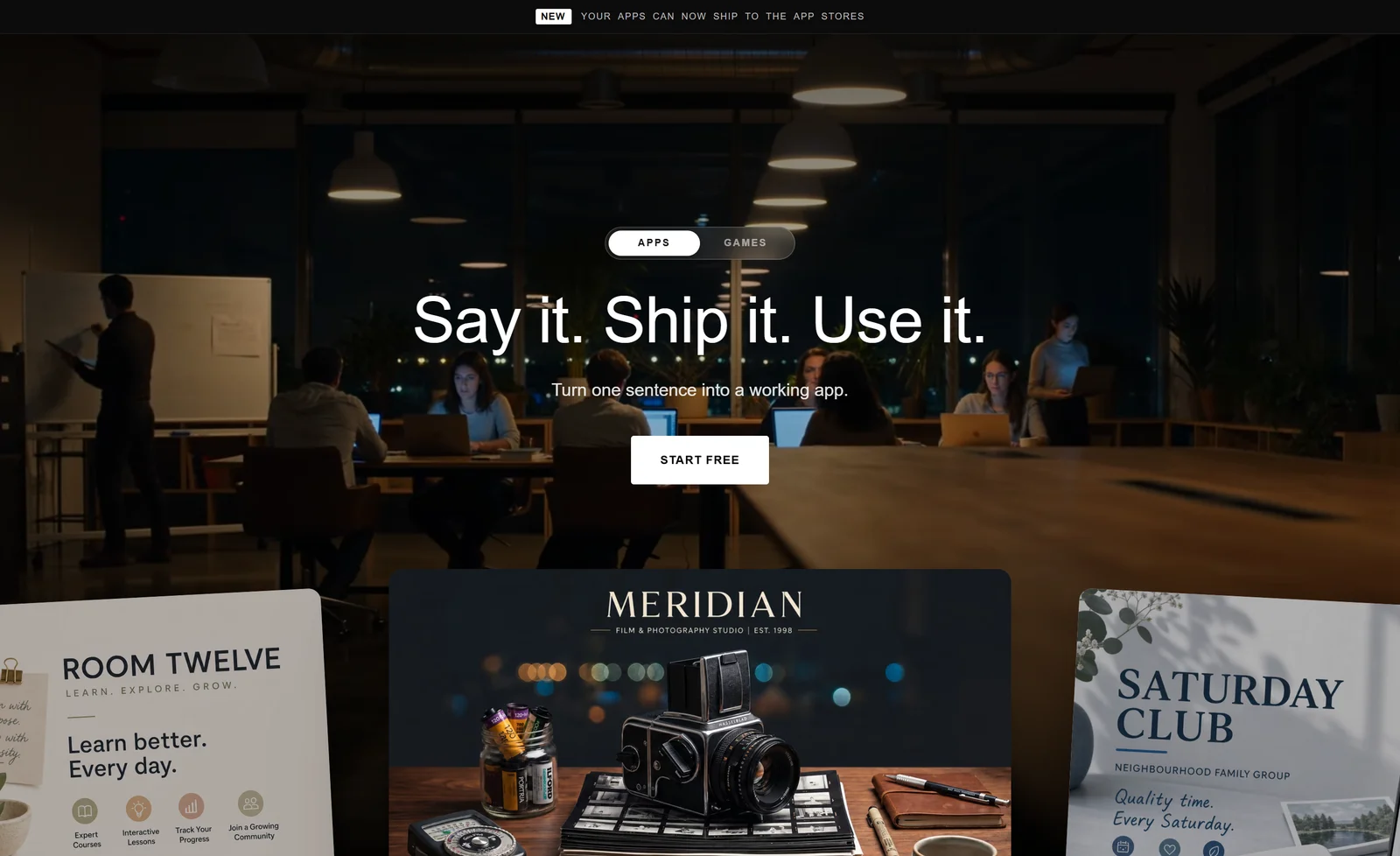
Whacka’s homepage, captured September 2026. The APPS / GAMES toggle and the app-store banner are both recent additions.
You can test the claim yourself without a card on the official Whacka website — the free tier is the trial.
1. What Is Whacka? Product and Company Background
Whacka defines itself in its own FAQ as “an AI platform that turns plain language into real, working apps — for yourself, your people, or your business. No code required.” Its Terms of Service are more precise about what gets generated: a platform that “uses AI to generate functional Progressive Web Apps (PWAs) that can be published, shared, and installed on devices.”
That PWA detail matters. What you get is a web app with its own address that installs to a phone’s home screen — not, by default, a native binary. Since 2026 Whacka also offers packaging for Google Play and the App Store as a paid extra, which we cover in section 6.
The company: what is and is not published
This is where a reviewer has to be blunt, because Whacka publishes almost nothing about itself.
- The only legal entity named anywhere on the site is “Promnes Lane Technology Inc, doing business as Whacka”, and it appears in exactly one document: the privacy policy. The Terms of Service name no company at all — they simply open “Welcome to Whacka.”
- Every page footer credits a different name: ”© 2026 whacka, Inc.” — an entity identified nowhere in any legal document.
- The published address, 8 The Grn Ste A, Dover, DE 19901, is a shared registered-agent suite, not an office. Delaware’s own registered-agent listings show a commercial agent at that address.
- No human being is named anywhere — no founder, no officers, no team page, no phone number.
/about,/team,/careersand/contactall return 404. Every legal document routes to a single email address. - The whacka.app domain was registered on 11 February 2026 and holds a single one-year registration. That makes the product roughly seven months old at the time of writing, and directly contradicts the “founded 2025” figure that AI directories repeat.
- There is no funding record, no investor, no press coverage. Hacker News has never mentioned whacka.app. No review exists on G2, Capterra or Trustpilot.
None of this proves anything is wrong. Plenty of good software ships from small anonymous teams. But if you are about to run your salon’s bookings and card payments on a platform, you are entitled to know that nobody is publicly accountable for it, and that is the situation here.
2. Who Should Use Whacka — and Who Should Not
Whacka fits the operator who needs a specific, modest app and has no path to building one: a booking page for a three-chair barbershop, a stock tracker for a market stall, a member directory for a community group, a course portal for a tutor. For these, the combination of price, speed and built-in bookings is genuinely hard to beat.
Whacka does not fit if any of the following is true:
- You need the app to survive you cancelling. Every Whacka app goes offline when the subscription stops.
- Procurement requires SOC 2, ISO 27001 or a completed security questionnaire. None exists.
- You are building anything regulated — health records, under-13 users, financial data. Whacka markets education use cases but publishes no COPPA mechanism, and there is no HIPAA posture at all.
- You need the source code as an exit path on a budget below $32 a month.
- You need SMS or email booking reminders. Reminders are browser push only — Whacka states plainly: “There’s no SMS or email reminder.”
Whacka is refreshingly direct about one of its own limits: under “What whacka can’t do yet” it lists “Payments need Stripe or PayPal in your country.”
3. How It Works: Chat In, Live App Out
Whacka’s own learning material gives a five-step flow: say what you want, watch the first version appear, refine in plain language, publish, and optionally install it like an app.
The key mechanic is that iteration and building are the same conversation. Per the Help Centre: “There’s no separate ‘edit mode’ — building and changing are the same conversation.” You keep talking, the preview refreshes.
Three things make this safer than it sounds:
- Publish is an explicit gate. Editing and previewing never change what visitors see. Nothing goes live until you press Publish.
- Every version is saved. You can roll back to any earlier version at any time and publish that instead. Whacka’s own troubleshooting advice leans on it: “If it persists, roll back to the last version that worked and try the change again.”
- The published link is genuinely public. No download, no account needed for visitors. Whacka’s own demo app resolves at a live
name-xxxx.whacka.appaddress and serves anonymously.
Note the subdomain shape: new apps get a random four-character suffix — “New apps come with a short random ending (like name-x7k2) — that’s by design, not a bug.” Picking a clean subdomain requires the Starter plan.
4. What Ships In Every App
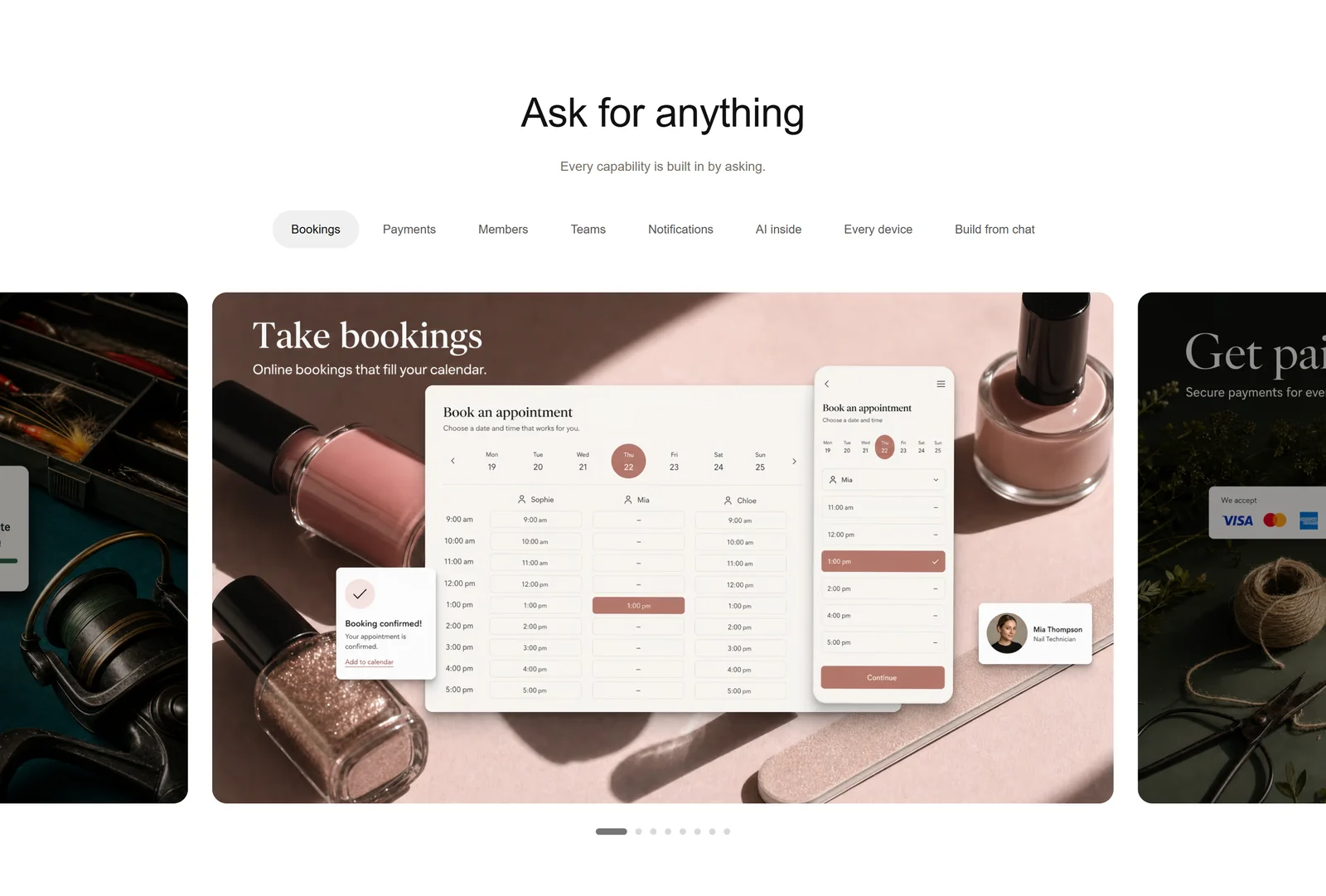
Whacka’s eight advertised capabilities. In its framing, “every capability is built in by asking” — you request the feature in chat rather than installing anything.
The homepage advertises eight capabilities — Bookings, Payments, Members, Teams, Notifications, AI inside, Every device, Build from chat — and a second marquee lists fourteen things included in every app, among them working logins, a real database, live syncing, push notifications, team accounts, file uploads and scheduled reminders.
The backend, and who actually runs it
To its credit, Whacka publishes a full sub-processor list rather than hiding behind “trusted cloud providers”:
| Layer | Vendor |
|---|---|
| Database, auth, file storage | Supabase on AWS us-west-2 (Oregon) |
| Application compute and generation | Alibaba Cloud, described as “ephemeral, not persisted”, US region |
| Edge, CDN, DDoS, static assets | Cloudflare (R2) |
| AI inference | Anthropic (Claude), OpenAI (GPT, DALL·E), Google (Gemini) |
| Transactional email | Resend |
| Platform billing | Stripe |
Two observations. First, Alibaba Cloud appears in the sub-processor list but not in the privacy policy’s data-sharing section — an inconsistency worth knowing if vendor origin matters to you. Second, you cannot choose the model: “Can I pick the exact model? No — the platform handles model routing so you never have to think about it.” No model IDs or versions are published anywhere.
The credit rule that actually matters
Infrastructure never consumes credits, on any plan. Whacka is explicit: “Database, storage, push, social login, and real-time messaging never consume credits. On every plan.” Only building and changing an app draws down your balance. This is the single most builder-friendly thing about the pricing model — an app with heavy daily usage costs you nothing extra to run, within the daily quotas.
5. Bookings, Payments and Messaging
Payments are the standout. Whacka is not a marketplace taking a cut — you connect your own Stripe or PayPal account, buyers pay on the provider’s official page, and the app unlocks automatically. In Whacka’s words: “whacka never holds your money and takes no cut of your sales.” One-time purchases and auto-renewing subscriptions are both supported (subscriptions via Stripe specifically), and refunds run from your own account with the unlock revoked automatically.
Messaging is more limited than it first appears. There are three separate channels and they are easy to confuse:
- Scheduled reminders — browser push only. One-time and recurring, fired in the user’s local time. No SMS. No email.
- Transactional email — via Resend, capped at 20 sends a day on Free and Weekly, up to 2,000 on Ultra.
- WhatsApp — outbound, shipped July 2026, and bring-your-own-account: it runs on your own free YCloud account and WhatsApp Business number, with Meta’s per-message template fees billed to you. Inbound WhatsApp requires manual setup in Meta’s Cloud API console.
Inbound webhooks shipped in July 2026, so apps can receive posted data from a website form, Zapier or Make. There is, however, no platform API, CLI or API-key console anywhere on the site.
A documentation warning. Whacka’s own pages contradict each other on payments. The Help Centre documents full Stripe and PayPal checkout including subscriptions, while
/use-cases/shopsstates “whacka doesn’t process payments. Orders go out through WhatsApp, DM, cash, or your own external payment link.” The bookings use-case page carries a similar stale claim. The site does not establish which is current — verify on the free plan before you rely on it.
6. Publishing: Subdomains, Domains and the App Stores
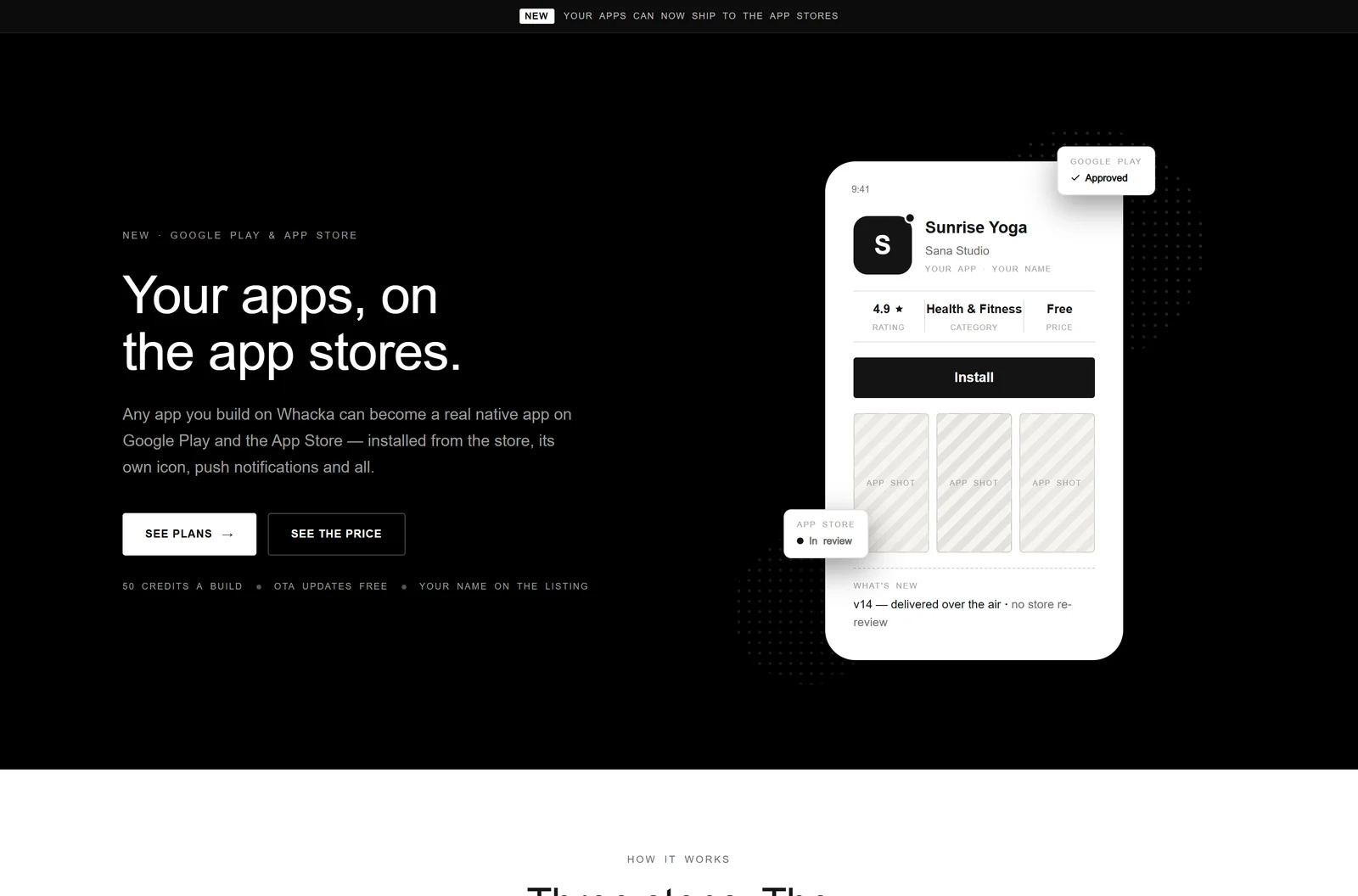
App-store shipping is the newest addition: 50 credits per build, over-the-air updates free, and the developer accounts stay in your name.
| What you want | Which plan | Notes |
|---|---|---|
Auto-assigned name-x7k2.whacka.app | Free | SSL and CDN included on every tier |
Choose your own name.whacka.app | Starter ($8/mo) | Subject to availability |
Your own yourbrand.com | Pro ($32/mo) | Buy the domain inside Whacka; DNS and HTTPS handled |
| Google Play and App Store listing | Pro ($32/mo) | 50 credits per build per store; OTA updates free after first review |
App-store developer accounts remain yours: “Google charges $25 once, Apple $99/year — paid to them, not to us.” Failed builds refund the credits automatically.
One caveat on the subdomain: the Terms reserve the right to “reclaim or reassign subdomains at our discretion.” If your customers know your app by its whacka.app address, that address is not contractually yours.
And another documentation conflict: the Help Centre still lists “Not listed on the App Store / Play Store” under current limitations, while the site-wide banner, the /stores page and the Pro plan card all sell store publishing. Treat the store route as new and lightly documented.
7. Pricing: Five Tiers and a 14-Day Cliff
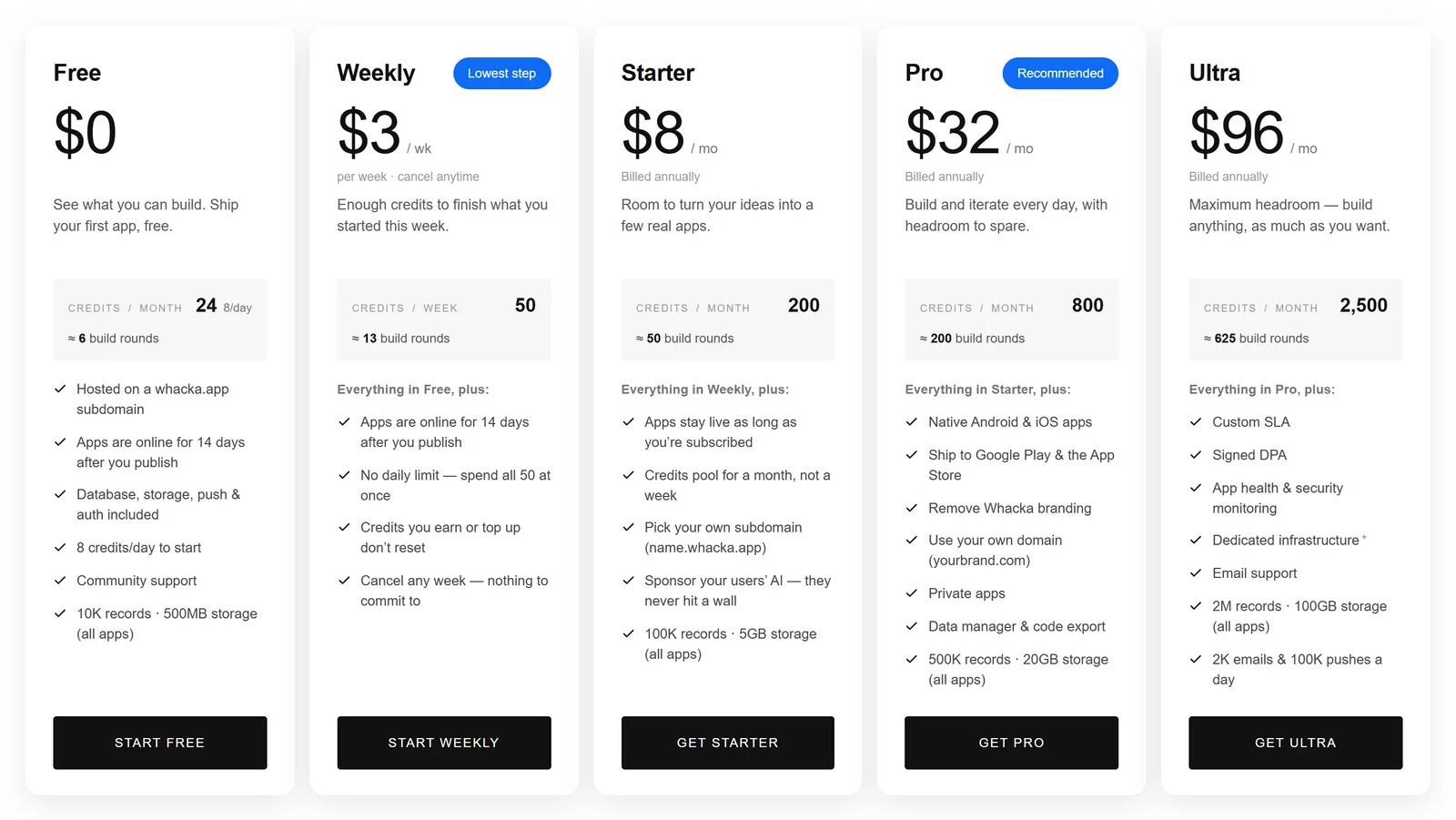
The five plans at the annual-billing rate the page defaults to. Billed monthly, Starter, Pro and Ultra are $10, $40 and $120.
| Plan | Annual rate | Monthly rate | Credits | Apps stay live |
|---|---|---|---|---|
| Free | $0 | $0 | 24/mo, capped 8/day (≈6 build rounds) | 14 days, then paused |
| Weekly | $3 / week | $3 / week | 50/week, no rollover (≈13 rounds) | 14 days, then paused |
| Starter | $8 / mo | $10 / mo | 200/mo (≈50 rounds) | While subscribed |
| Pro | $32 / mo | $40 / mo | 800/mo (≈200 rounds) | While subscribed |
| Ultra | $96 / mo | $120 / mo | 2,500/mo (≈625 rounds) | While subscribed |
- Annual billing saves exactly 20%, with no rounding or asterisk. Whacka never displays a yearly total; the arithmetic is $96, $384 and $1,152 a year.
- Top-ups are $12 per 100 credits or $55 per 500, valid 12 months — roughly 2.4× to 3× the effective in-plan rate, so plan sizing matters.
- Credits can be earned: 10 per invited friend who completes a build, capped at 500 a month, valid 365 days and immune to plan resets.
- No credit card to start, and no separate trial — per Whacka, “Free is the trial.”
- No stated app limit on any tier. Note the careful phrasing: Whacka never says “unlimited apps”, and record and storage caps are pooled across all your apps, not per app.
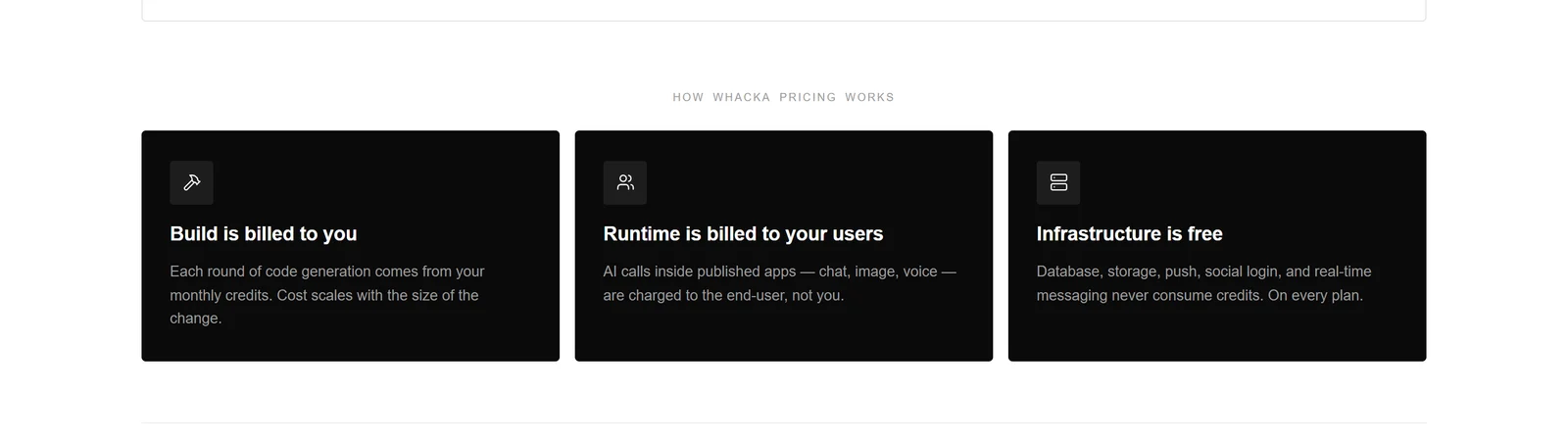
The three-way split: you pay to build, your end-users pay for AI features inside the published app, and infrastructure costs nothing.
The two pricing facts that decide everything
First, the 14-day cliff. On Free and on the $3/week Weekly plan, a published app is publicly live for 14 days from first publish, and re-publishing does not extend it. To Whacka’s credit the app is paused, not deleted — data, member accounts and version history are preserved, and subscribing brings it straight back. But a free app is a demo, not a deployment.
Second, AI inside your app is billed to your users, not you. “AI calls inside published apps — chat, image, voice — are charged to the end-user, not you.” Your customers draw on their own free daily allowance and can buy their own credits. You can absorb it via a Sponsor setting — but sponsoring requires Starter or above, which means on Free and Weekly your own customers can hit a paywall inside your app.
8. The Ownership Question: How Much Do You Actually Own?
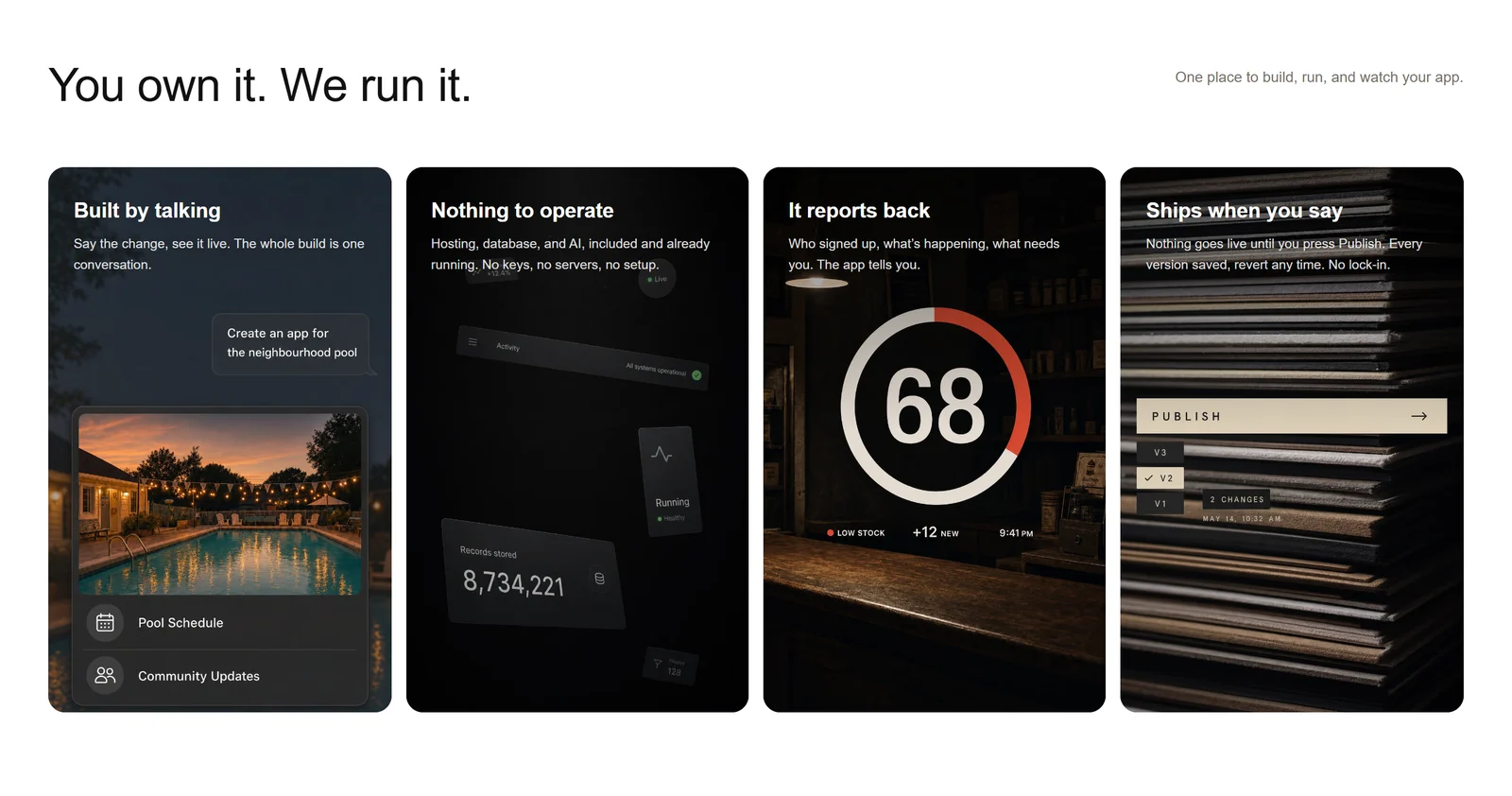
“You own it. We run it.” — the claim the rest of this section tests against Whacka’s own Terms.
This section exists because Whacka makes the ownership claim loudly, and the Terms say something more qualified.
What the homepage says: “You own it. We run it.”, “Every version saved, revert any time. No lock-in.”, and “Your data, your whacka.app subdomain, your users, with no lock-in.”
What the Terms say: “You retain ownership of the ideas and descriptions you provide. You are granted a license to use, modify, and distribute the AI-generated output for your apps.” You own your uploaded content under a separate clause. But for the generated app itself, you hold a licence, not an assignment of ownership.
Then there are the practical constraints:
- Code export is paywalled to Pro ($32/mo annual, $40/mo monthly). Free, Weekly and Starter users cannot export at all.
- The export format is undisclosed. Nothing on the site states what stack it produces, whether the database schema comes with it, or whether the exported app runs anywhere but Whacka’s Supabase backend. There is no self-hosting guide. The “no lock-in” claim cannot be verified from public information.
- Your subdomain is revocable at Whacka’s discretion, per the Terms.
- If you stop paying, the app goes offline. There is no read-only mode, no static archive.
- There is no wind-down protection — no advance-notice period, no data-return SLA on shutdown, no source-code escrow. The DPA’s only return obligation is request-triggered and covers Personal Data, not your generated code.
The honest summary: you own your data and you can take it with you. Whether you own a running app you can move elsewhere is unproven, and on plans below Pro it is simply not possible.
9. Security, Legal Terms and Risk
For a platform that wants to host bookings and payments for small businesses, this section is the one to read twice.
Certifications: there are none
Searching the full text of the Terms, Privacy Policy, DPA, Sub-processors, Security and Pricing pages returns no mention of SOC 2, ISO 27001, HIPAA, PCI-DSS, penetration testing or a bug bounty — not even “in progress”. There is no trust portal and no compliance-report request process. /.well-known/security.txt returns 404, so there is no machine-readable disclosure policy; the Security page offers only “email us with reproduction steps”, with no scope, response target or researcher safe harbour.
What Whacka does claim: HTTPS in transit, hashed passwords via Supabase Auth, Row Level Security for tenant isolation, US data residency, Stripe-handled card data, and no model training on your data. These are reasonable claims. They are also entirely unaudited.
Terms that shift risk onto you
| Clause | What it means |
|---|---|
| Liability cap | The greater of $100 or fees paid in the prior 12 months. On Starter annual, that is $100 |
| DPA liability | Subject to the same cap, with no carve-out for data breach or GDPR violation |
| Your indemnity | Uncapped, covering your use, your published apps, and data collected through them |
| Arbitration | Mandatory individual arbitration, jury and class-action waivers. You can opt out within 30 days by email — act in month one if you want court rights |
| Mass arbitration | Coordinated claims are batched in 50s with 5 bellwether cases, the rest stayed |
| Uptime | No guarantee on any plan. “We do not guarantee uptime, availability, or error-free operation.” A “Custom SLA” exists on Ultra with no published numbers |
| Backups | No backup, disaster-recovery or continuity commitment appears in any document |
| AI output | ”We do not guarantee the accuracy, functionality, or safety of AI-generated code. You are responsible for reviewing and testing any generated content before use.” |
That last clause deserves emphasis. You carry liability for code you did not write and — below Pro — cannot even read.
Privacy gaps worth knowing
- No California section at all. “CCPA” and “CPRA” appear zero times in the Privacy Policy. No Do Not Sell mechanism.
- GDPR is structurally present but incomplete: legal bases, data-subject rights, SCC Module 2 and a 72-hour breach commitment are there; no Article 27 EU representative, no DPO, no UK addendum, and the promised SCC annex does not exist on the site. The DPA contains no audit right, which GDPR Article 28(3)(h) contemplates.
- A signed DPA costs $96/mo — it is an Ultra-only feature.
- Three conflicting deletion timelines are published: 60 days on the Security page, 30 days for rights requests plus up to 90 days for app data in the Privacy Policy. The headline figure matches none of the others.
- The Security page contradicts the DPA on end-user data. The Security page says “End-user data — Never sent to AI.” The DPA describes “transmitting prompts and content to AI providers for runtime AI features.” If your app has any AI feature, your end-users’ content does reach third-party AI providers.
- No public status page.
/statusreturns 404, so neither you nor your customers can tell whether an outage is Whacka’s or yours.
10. Whacka vs Lovable, Bolt.new, v0, Replit and Adalo
| Platform | Entry paid price | Free tier | Code export | Best at |
|---|---|---|---|---|
| Whacka | $3/week, then $8/mo | 24 credits/mo, apps expire in 14 days | Pro only ($32/mo), format undocumented | Business apps with bookings, logins and payments for non-coders |
| Lovable | $25/mo (100 credits) | 5 credits/day, capped 30/mo | Pro and above, with Git sync to GitHub/GitLab | Polished web apps with a real Git workflow |
| Bolt.new | $25/mo | 300K tokens/day, 1M/mo, Bolt branding | Full project access in-browser | Developers who want to keep editing the code |
| v0 by Vercel | $30/user/mo | $5 credits/mo, 7 messages/day | GitHub sync, Vercel deploy | React/Next.js UI generation inside the Vercel stack |
| Replit | $20/mo ($18 annual) | Limited | Full IDE, real filesystem | Full-stack apps where you want an actual dev environment |
| Adalo | Paid plans | Limited | No source export | Native mobile apps via drag-and-drop, no AI generation |
The honest read: Whacka is by far the cheapest and the most opinionated. Lovable, Bolt and Replit all hand you a real codebase and a Git workflow — they are aimed at people who can read code. Whacka deliberately does not, and in exchange it ships the things a small business actually needs (a booking calendar, member logins, a payment checkout) without integration work.
Where Whacka is weakest against all of them is exit. Lovable syncs to your own GitHub from Pro; Bolt and Replit give you the project outright; Whacka gives you an undocumented export at $32/mo and nothing at all below that.
One qualifier: no independent benchmark exists comparing build quality across these tools. Every comparison, including this one, rests on published capabilities rather than measured output.
11. Pros and Cons
Where Whacka is genuinely strong
- Price has no peer in the category. $3 a week for a working hosted app with a database and logins is not something Lovable, Bolt, v0 or Replit offer
- Infrastructure is unmetered. Data, storage, push, logins and messaging never cost credits on any plan — a real structural advantage over token-metered rivals
- Payments go to your own account, with no commission and no money held
- Business features ship by asking — bookings, staff roles, member accounts, file uploads, reminders, with no integrations to wire
- Publish gating plus full version history makes iteration safe for non-technical owners
- Sub-processors are published openly, naming every vendor down to the compute provider
- The Terms are honest about AI output quality rather than overselling it
Where Whacka falls short
- The 14-day cliff on Free and Weekly, and the fact that every app goes dark when you stop paying
- “No lock-in” does not survive contact with the Terms — a licence rather than ownership, export paywalled at $32/mo, format undocumented, subdomain revocable
- Zero certifications and zero independent scrutiny. No SOC 2, no pen test, no bug bounty, no status page
- An anonymous operator with two conflicting company names, a registered-agent address and a seven-month-old domain
- A $100 liability floor against an uncapped indemnity, with no breach carve-out
- The documentation contradicts itself on payments, app-store publishing, end-user AI data and deletion timelines
- Reminders are push-only — no SMS, no email, which rules out a lot of real booking workflows
12. Frequently Asked Questions
Is Whacka really free, and what is the catch?
The free plan is genuinely free and needs no credit card — 24 credits a month, capped at 8 a day, which Whacka translates to about 6 build rounds. The catch is hosting: an app published on the Free or $3/week Weekly plan goes offline 14 days after you publish it, and re-publishing does not reset the clock. The app is paused rather than deleted, so data and version history survive and subscribing brings it back. Treat the free tier as a trial, not a deployment.
Do I own the app Whacka builds for me?
Partly. Whacka's Terms say you retain ownership of the ideas and descriptions you provide and of content you upload, but for the AI-generated output you are 'granted a license to use, modify, and distribute' it — a licence, not an assignment of ownership. Source-code export is available only on Pro ($32/mo annual) and Ultra, and Whacka does not publish what the export contains or whether it runs outside its own infrastructure.
What happens to my app if I stop paying?
It goes offline. Paid-plan apps stay live only while the subscription is active — this behaviour was introduced in August 2026. The app is paused rather than deleted and comes back automatically if you resubscribe, but there is no read-only mode and no static archive. There is also no published wind-down protection if Whacka itself were to shut down: no notice period, no data-return SLA, no code escrow.
Can Whacka apps take real payments?
Yes, through your own Stripe or PayPal account. Whacka builds the checkout, buyers pay on the provider's official page, the app unlocks automatically, and refunds revoke the unlock. Whacka never holds the money and takes no cut of your sales. One caution: Whacka's own shops and bookings use-case pages still claim it does not process payments, contradicting its Help Centre — verify on the free plan before you depend on it.
Does Whacka have SOC 2 or any security certification?
No. Searching the full text of Whacka's Terms, Privacy Policy, DPA, Sub-processors, Security and Pricing pages returns no mention of SOC 2, ISO 27001, HIPAA, PCI-DSS, penetration testing or a bug bounty — not even as work in progress. It does claim HTTPS, hashed passwords, Row Level Security tenant isolation, US data residency and no model training on your data, but none of it is independently audited. A signed DPA is available only on the $96/mo Ultra plan.
Who is behind Whacka?
Publicly, nobody is named. The privacy policy identifies 'Promnes Lane Technology Inc, doing business as Whacka' while every page footer credits 'whacka, Inc.' — a different name that appears in no legal document. The published address is a shared Delaware registered-agent suite. No founder, officer or employee is named on the site, on LinkedIn or anywhere else, there is no phone number, and /about returns 404. The domain was registered in February 2026.
Can my app send SMS or email booking reminders?
No. Scheduled reminders are browser push notifications only — Whacka states there is no SMS or email reminder channel. Apps can send transactional email separately (20 a day on Free and Weekly, up to 2,000 on Ultra) and outbound WhatsApp, but WhatsApp runs on your own YCloud account and WhatsApp Business number, with Meta's per-message fees billed to you.
Can Whacka apps go on the App Store and Google Play?
On the Pro plan and above, yes — 50 credits per build for each store, with failed builds refunded and over-the-air updates free after the first store review. Developer accounts stay in your name, so Google's one-off $25 and Apple's $99/year are paid by you directly to them. Note that Whacka's own Help Centre still lists 'Not listed on the App Store / Play Store' as a current limitation, so this route is new and thinly documented.
13. Final Verdict: Is Whacka Worth It in 2026?
Whacka earns 4.0 / 5, and the two halves of that score point in opposite directions.
The product deserves better than 4. For a small operator who needs a booking page, a stock tracker or a member portal, this is the shortest path from idea to a working app that exists right now, and the pricing is not close to anything else in the category. The decision to leave infrastructure unmetered is quietly the smartest thing in the product: your app can be busy every day and it costs you nothing more. Payments going straight to your own Stripe account with no commission is the second. Neither is standard in this market.
The company drags it down. A seven-month-old domain, two conflicting corporate names, a registered-agent address, no named human anywhere, no certifications, no status page, no independent review, a $100 liability floor, and marketing that promises “no lock-in” while the Terms grant a licence and paywall the export. Any one of these would be a footnote. Together, they mean you should not put anything you cannot afford to lose on this platform yet.
Use Whacka if: You want a real booking, inventory or member app running this week for the price of a coffee, you can keep the subscription live, and losing the app would be inconvenient rather than catastrophic.
Wait if: The app would be the backbone of your business, you need procurement-grade assurances, you need SMS reminders, or you need a guaranteed exit path with the source code in hand.
The sensible test costs nothing: build the app you actually need on the free tier, see how close the first version lands, and decide within the 14-day window whether it earns $8 a month. You can start on the official Whacka website without a credit card.
Disclosure: This review contains affiliate links. If you sign up for Whacka through our link, we may earn a commission at no additional cost to you. Readers should also know that Whacka runs an open affiliate program paying $20 per referred subscriber, and that a significant share of the Whacka “review” content online — including several sponsored YouTube videos — is produced under it. All factual claims here were verified against Whacka’s own published pages, Terms, Privacy Policy, DPA, Help Centre and public domain records as of 15 September 2026; claims we could not independently verify are attributed to the vendor throughout.