Publishing regularly is not the hard part any more. Five tools in this comparison will happily produce 3,000 words before your coffee cools. The hard part is everything either side of that: getting output that carries your brand voice past paragraph three, getting facts you can publish without a fact-check pass, and getting a bill at the end of the month that matches what you thought you bought.
The complaints in this category are strikingly consistent. A Jasper reviewer on Trustpilot says the brand voice “does NOT carry through, it reverts back to AI speak”. A Rytr reviewer says the output required “heavy editing”. A satisfied four-star Copy.ai reviewer still flags “a lot of rewrites and corrections”. None of that shows up on a pricing page. Neither does the Better Business Bureau file for Jasper AI, which carries an F rating with 16 complaints closed in three years, 14 of them unanswered by the company (read 17 September 2026).
There is a second problem that is newer and larger. Three of the five platforms here have stopped selling themselves as writing tools. Jasper’s homepage headline now reads “Put AI agents to work for marketing” (read 17 September 2026). Copy.ai’s homepage H1 is “The First AI-Native GTM Platform”, and its own blog states it is “built for end-to-end process automation”. Writesonic’s title tag reads “Writesonic | The AI Search Growth Engine. Win Customers.” If you are shopping for an AI writer, you can be shown in the vendors’ own words that the category you are buying into is not the one being built.
And the ground is moving underneath the output too. SEO analyst Lily Ray, writing on 13 May 2026, analysed 220+ sites running scaled AI content strategies and found that “54% lost 30% or more of their peak organic traffic. 39% lost 50% or more”, with 22% losing 75% or more. She notes the approach “can produce real short-term gains in both SEO and AI search”, and that sites are now “often removing, redirecting, or 410’ing many of the same pages featured as success stories in published case studies”. Volume alone is no longer a strategy. What follows ranks five platforms on what they actually deliver, at what price, under what terms.
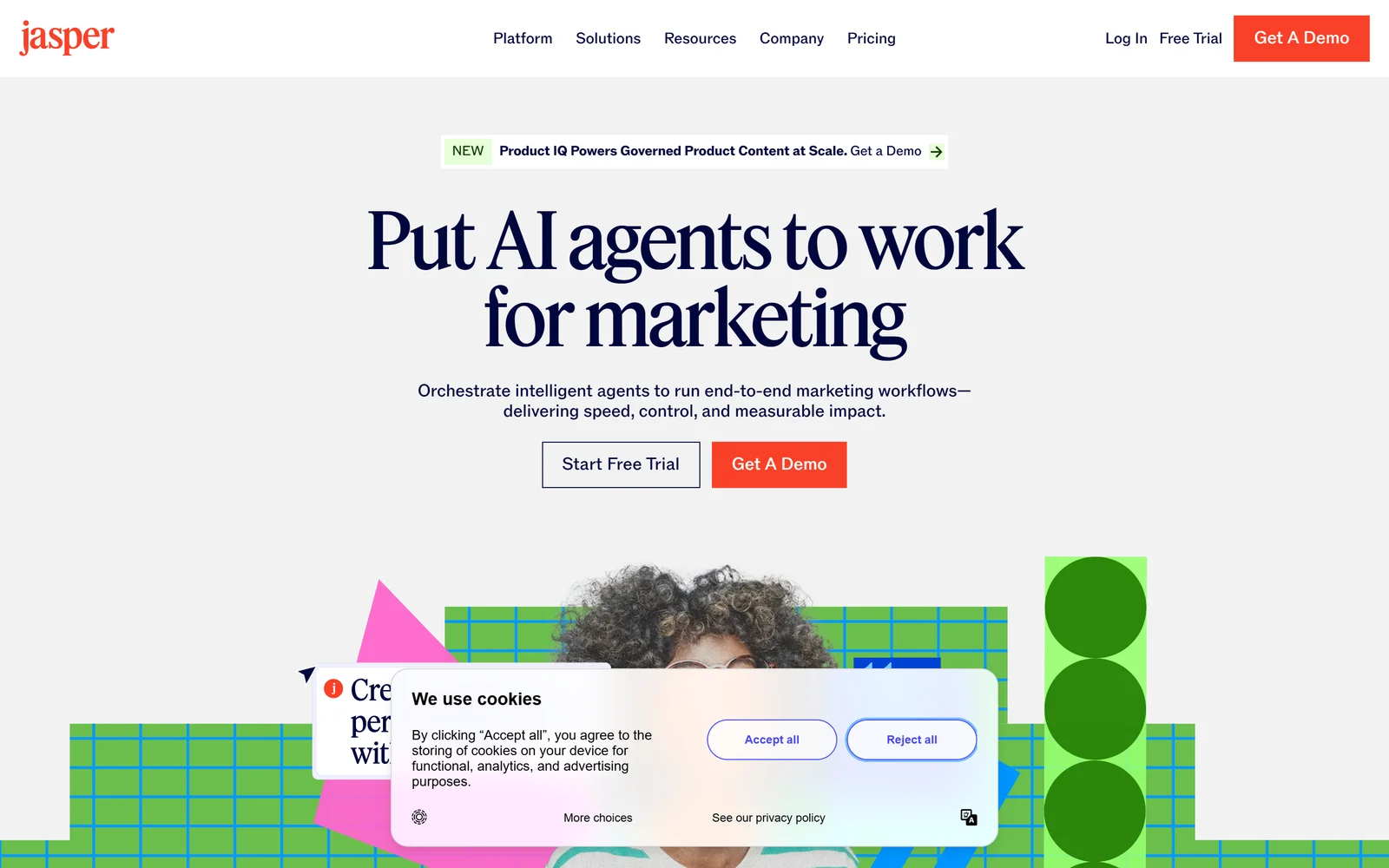
Jasper’s homepage, captured 17 September 2026. It has repositioned from an AI writer to a marketing platform, and the pricing reflects that.
1. Why AI Writing and Content Platform Buyers Get Burned (In Their Own Words)
Every quote below was re-verified on 17 September 2026. Each is one reviewer’s allegation or opinion, not an established finding about the company.
The output reads generic, and the editing cost eats the time saving. This is the single most repeated complaint across all five tools, and it comes from paying customers rather than tyre-kickers.
“The ONLY words it knows is delicious, indulge, Join us, or experience” — Samantha Downey, 1 star, Trustpilot (Jasper), 12 February 2024.
“delivering low-quality, generic content that required heavy editing” — silvia manduchi, 1 star, Trustpilot (Rytr), 28 February 2025.
Brand voice features do not survive long-form generation. Brand voice is the headline feature that justifies enterprise pricing, and it is the feature reviewers most often say collapses in practice.
“The Brand Voice does NOT carry through, it reverts back to AI speak.” — Katie Normet, 1 star, Trustpilot (Jasper), 31 March 2025.
“isn’t always straight forward and tends to go off mark so a lot of rewrites and corrections” — Joanne Blake, 4 stars, Trustpilot (Copy.ai), 14 June 2022. The four-star rating is the point: even a broadly happy user reports rewrite overhead.
Factual errors mean you cannot publish unchecked. No reviewer in this evidence set describes a fabricated citation, but several describe plain inaccuracy.
“The quality of the responses is mediocre at best, and there are frequent errors and inaccuracies.” — Che Mona, 1 star, Trustpilot (Rytr), 7 November 2024.
“The main problem is that its text demonstrates a relatively poor uniqueness rate, which is essential for SEO purposes.” — Yuriy Byron, 3 stars, Trustpilot (Jasper), 6 November 2023.
Billing continues after people believe they have cancelled. Jasper has the best-evidenced version of this, and unusually it sits on a neutral third-party register rather than a review site. Verbatim from BBB complaints against Jasper AI: “I cancelled my free trial and was still charged $69 USD without notice. Unacceptable and very frustrating” (21 April 2025), and “I am filing this complaint against Jasper AI for unauthorized billing totaling $936 over two years for services I believed I had cancelled” (7 July 2025). Corroborated on Trustpilot by “I only discovered it when I checked my credit card statement. By the time I realized it, I had already lost over $500.” — Yi, 1 star, 20 October 2025. These are unresolved consumer complaints, not adjudicated findings.
Credits and quotas disappear, and topping up is expensive or opaque.
“There has been a bug and all my credits are gone” — Emre Bayrak, 1 star, Trustpilot (Writesonic), 5 October 2025, in a review titled “Worst customer support ever”.
“purchasing further AI credits was cost prohibitive for me” and “There is also no option to pause my account and forego the monthly fee when I’m not using the platform.” — Edy Kubiak, 4 stars, Trustpilot (Surfer SEO), 21 November 2025.
Features you already paid for get removed or moved behind a higher tier.
“I’m paying more for chat sonic than ChatGPT but all the features are locked” — Andrew Gunn, 1 star, Trustpilot (Writesonic), 9 June 2025.
“Grow Flow was easy but they took it off” — Atlanta Designer Rugs, 3 stars, Trustpilot (Surfer SEO), 19 November 2025.
One correction to the mood this creates: only Copy.ai has a genuinely poor aggregate score. Read on 17 September 2026, Writesonic sits at 4.6/5 from 5,763 Trustpilot reviews, Rytr at 4.4/5 from 2,449, Surfer at 4.3/5 from 220, Jasper at 3.2/5 from 4,144 and Copy.ai at 1.8/5 from 196. The honest framing is that even well-rated tools attract a specific, repeating class of complaint.
2. How We Ranked Them
Seven criteria, weighted: capability depth (2x), value for money (1.5x), billing fairness (1.5x), trust and security (1x), ease of getting started (1x), free tier (0.75x) and support and docs (0.75x).
Capability depth asks what the platform can actually do beyond generating text — brand context that persists, measurement, publishing, API and agent surfaces. Value for money measures published entitlements against published price, not marketing claims. Billing fairness covers refund windows, cancellation routes, commitment length, and whether a buyer can calculate a bill from public information. Trust and security looks at certifications that are actually documented, data residency, model-training terms and liability caps. Ease of getting started covers trial friction and how fast a first seat becomes useful. Free tier rewards a permanent free plan over a card-gated trial. Support and docs weighs documentation currency, changelog activity and evidence of support responsiveness.
Every price, plan limit, contract clause and review score in this article was read directly from the vendor’s own live pages or the review platform on 17 September 2026. Ratings move weekly, so treat every figure as dated. Where a vendor makes a claim we could not independently verify — SOC 2 reports behind access gates, customer counts, uptime percentages — it is attributed to the vendor rather than stated as fact.
3. Jasper: The Most Capable Platform, Sold on the Most Hostile Terms
Jasper carries the deepest brand-context layer here — and caps its $69/month Pro plan at a single seat.
Jasper wins on the heaviest-weighted criterion by a clear margin. It is the only platform here that pairs a persistent brand-context layer (Brand Voices, Knowledge assets, Audiences, Style Guide) with a native AI-search visibility product and enterprise governance. Its pricing FAQ states single sign-on “is available on the Business plan and supports SAML 2.0, including Okta, Azure AD, and Google Workspace. Role-based access controls and an in-app AI audit log are also included”. The shipping cadence is visible and monthly: June 2026 release notes alone announce GEO Hub, a Translation Agent covering “27 languages, including Chinese, Japanese, Korean, Arabic, Hindi, and major European languages”, new Monday.com and Asana integrations, and “Build with Claude Sonnet 5 in Studio.”
The repositioning is real and you should price it in. Jasper’s homepage describes itself as “the agent workspace built for modern marketing teams”, and its 16 June 2026 press release boilerplate — “Jasper is the marketing agents platform, built to help enterprises orchestrate AI agents that execute marketing work at scale” — contains no reference to writing or copywriting at all. If you want a copywriting assistant, you are buying the leftovers of one inside a marketing execution platform.
The commercial terms are where Jasper earns its low billing-fairness score, and they are the reason a product this capable is not running away with the ranking. As of 17 September 2026 the pricing page lists exactly two plans. Pro is $69/month billed monthly or $59/month billed yearly, and includes exactly one seat. The FAQ is explicit: “Need more than 1 user on Pro? Contact Jasper’s sales team to customize the Business Plan with additional seats”. There is no published per-seat add-on. A second user forces a quote-only, 12-month Business contract whose price Jasper publishes nowhere. Jasper does publish a per-action credit rate card (Research Agent 1 run = 40 credits, Optimization Agent 1 run = 100 credits, Translation Agent via API = 40 credits), but no dollar-per-credit rate and no per-plan allowances — so a Business bill cannot be calculated from public information at all.
Meanwhile Pro throttles exactly the features that justify it: 2 Brand Voices, 5 Knowledge assets, 3 Audiences, all unlimited on Business. And the Terms of Service state there are “no refunds for cancellation”, adding: “In the event that Jasper suspends or terminates your Customer Account or this Agreement, you understand and agree that you shall receive no refund”. That is materially stricter than the pricing page’s “cancel anytime” framing, and it sits alongside an aggregate liability cap of the greater of twelve months’ fees or $50.00.
On trust, Jasper states on its pricing page that it “is SOC 2 Type II certified and complies with GDPR, CCPA, PCI, and DPA requirements, with annual third-party penetration testing” — its own claim, with the report not publicly downloadable, and its security page using the looser “SOC 2 Compliant”. No ISO 27001, HIPAA or FedRAMP is claimed. Hosting is Google Cloud “across multiple availability zones in the US-East1 & US-East4 regions”, with no EU, UK or APAC residency option advertised. There is also a documented conflict on model training: the trust page says “Your company data and outputs are never used to train third-party LLMs”, while the Terms grant Jasper a “royalty-free, sublicensable, transferable, perpetual, irrevocable, non-exclusive, worldwide” licence to customer content for purposes including “modifying, improving, and enhancing artificial intelligence models”. The marketing claim is narrowly about third-party models; the contract permits Jasper to improve its own. EU and UK users may object under Section 12; buyers elsewhere have no stated equivalent.
The Good (Pros)
The Bad (Cons)
#1 · Deepest brand context
Brand voices, knowledge assets and AI-search visibility
SSO, RBAC and an in-app AI audit log, plus a GEO Hub for AI-answer visibility. Pro is one seat only, and the terms allow no refunds under any circumstance.
Visit Jasper
4. Writesonic: Closes the Measurement Loop, Prices Out the Writer
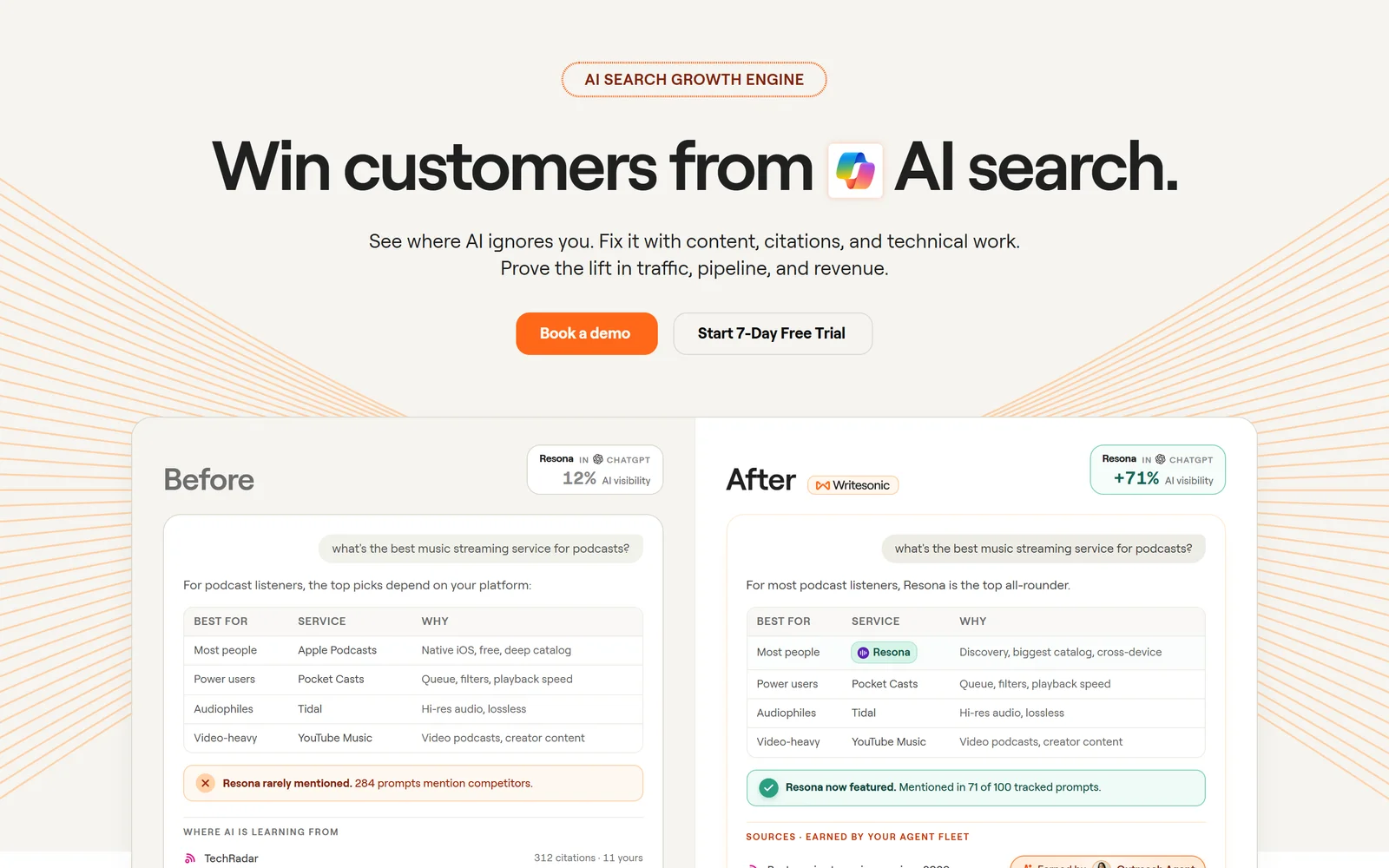
Writesonic measures how you appear inside AI answers, then ships the fix as cited long-form articles in the same subscription.
Writesonic is the only platform here that measures AI-search visibility and then ships the remediation inside the same subscription. Its docs describe scraping “the actual web interfaces of AI platforms—the same interfaces your customers use every day” while “simulating different geographical locations” — a genuine methodological difference from API-based monitoring, and a structural fragility, since it depends on continued access to third-party consumer UIs. The AI Article Writer produces “Long-form depth (3,000 to 8,000 words)” with “Full body, citations, FAQs, schema, internal links, hero image, alt text”, and one-click push “to WordPress, Sanity, Contentful, Webflow, or Ghost.”
The contractual data terms are the strongest in this comparison. The Terms state plainly that “Writesonic does not use Customer Data to train or fine-tune any general-purpose, foundation, or large-language model”, and that “As between the Parties, Customer owns all right, title, and interest in Outputs generated for Customer through the Service.” The DPA names Microsoft Azure as primary infrastructure with hosting regions configurable by enterprise contract, TLS 1.2+ in transit, AES-256 at rest, 72-hour breach notification and roughly 40 listed sub-processors including OpenAI, Anthropic and Google Cloud.
The problem is what you get for the money. Starter is $99/month billed monthly, $79/month annually, and buys 15 AI articles, 10 site audits, 1 user and 1 project. Basic is $249/$199 for 25 articles. Growth is $499/$399 for 50 articles. That is a steep floor for anyone who arrived wanting a writing tool. Worse, the two capabilities that justify platform pricing are withheld from self-serve buyers entirely. The FAQ states: “Basic and Growth track ChatGPT, Gemini, and Google AI Overviews. Enterprise tracks all 10 platforms including Perplexity, Claude, Microsoft Copilot, Grok, DeepSeek, Meta AI, and Google AI Mode.” The Action Center is “Available on Growth (trial) and Enterprise (full)” — Growth gets 5 off-page plus 5 on-page actions a month. Extra article packs at $100/20 articles are Growth-only. SSO/SAML is Enterprise-only, so no plan up to $499/month can enforce single sign-on.
Two further cautions. The advertised refund is narrower than it reads: the FAQ promises a “7-day, no-questions-asked refund”, while the Terms limit it to “a full refund of the initial subscription fee within seven (7) days of first purchase” and state that “Subscriptions purchased under an Order Form, including enterprise and agency plans, are non-refundable.” And Writesonic’s own help doc “Different Subscription Plans of Writesonic” (last updated 13 March 2026) claims Basic includes 100 articles and Growth 200 — roughly 4x what the live pricing page sells. Prices match across both sources; allowances do not. Treat the pricing page as authoritative and get entitlements in writing before you sign.
The 4.6/5 Trustpilot score from 5,763 reviews (read 17 September 2026) is real, but that pool overwhelmingly predates the GEO pivot and is evidence about the legacy writing product, not the current platform. Writesonic also concedes a measurement limit most competitors do not: its docs note AI platforms “intentionally vary responses”, so tracked visibility can move for reasons unrelated to any work you did.
The Good (Pros)
The Bad (Cons)
#2 · Measure then fix
Tracks your brand inside real AI answers
Scrapes the actual AI interfaces across locations, then publishes cited 3,000-8,000 word articles to WordPress, Webflow or Ghost. From $99/mo for 15 articles.
Visit Writesonic
5. Surfer: Sharp Measurement, Punitive Commercial Terms
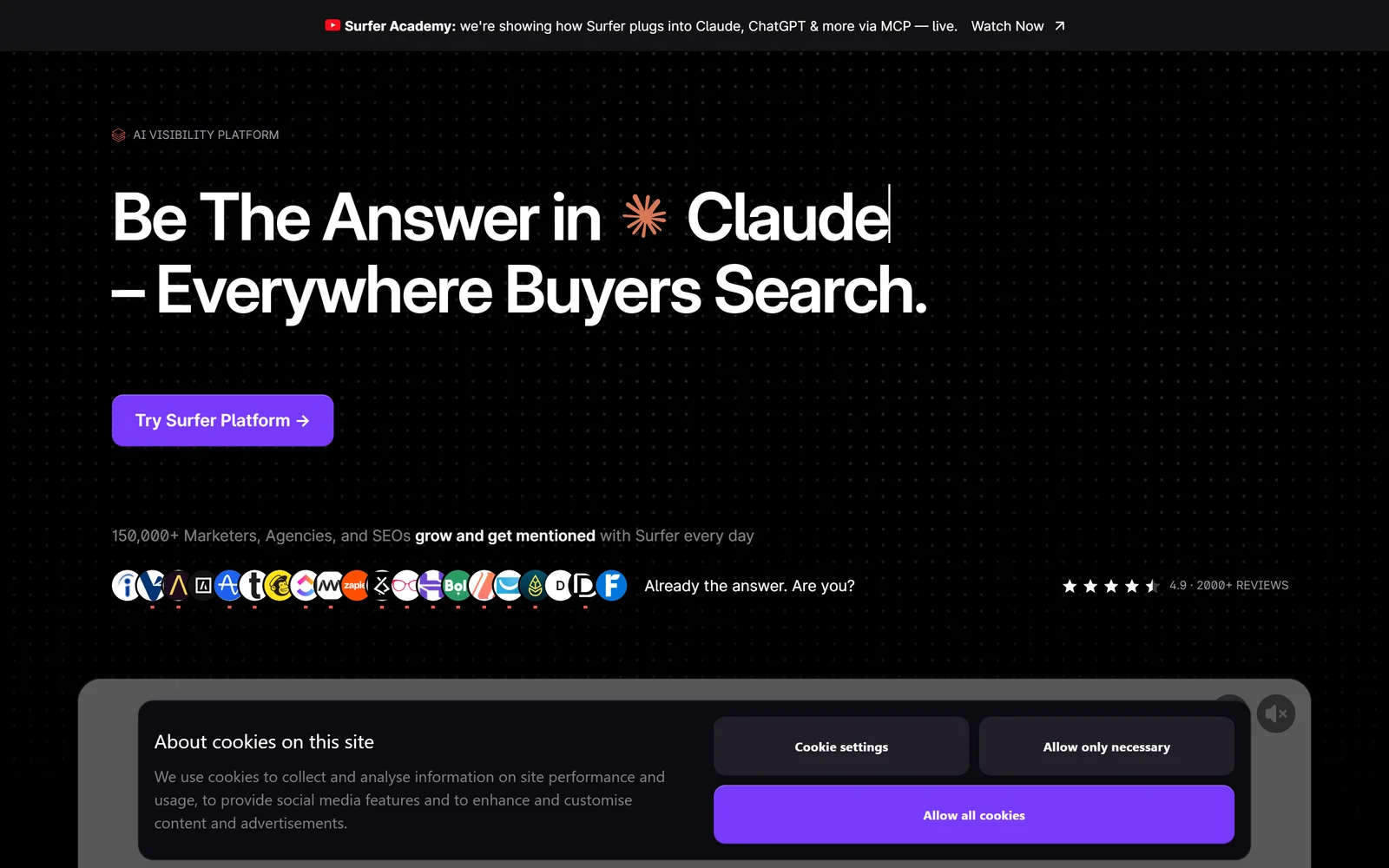
Surfer tracks five named AI engines by scraping real front-end answers, and publishes how far those answers diverge from classic search.
Surfer has quietly become an AI visibility platform — its own /ai-instructions/ page defines it as one that “shows how AI models talk about your brand, tells you what to change, and helps you become the source AI and Google cite, trust and recommend.” Its AI Tracker monitors exactly five named engines: ChatGPT, Gemini, Google AI Overviews, Google AI Mode and Perplexity. Notably, Claude is not tracked, though Claude works as an agent client for Surfer MCP. Surfer also publishes a methodology disclosure nobody else does: it reads real front-end responses rather than calling APIs, and states its own measurement found roughly 24% overlap in brands and 4% overlap in sources between scraped UI answers and API results. If you accept that finding, API-based competitors are measuring a different internet.
Pricing, read 17 September 2026, is six plans billed yearly: Discovery $49/month, AI Search Analytics $82, Standard $99, Pro $182, Peace of Mind $299 and Enterprise $999. Because Surfer publishes both the monthly-equivalent and the annual saving, the month-to-month prices are arithmetically fixed at $59, $95, $119, $219 and $359. Document allowances are the metering unit: Discovery 120, Standard 360, Pro 360, Peace of Mind “Unlimited*”. Standard and Pro therefore work out at 30 documents a month. Seats are bundled — 1, 3, 5 and 10 respectively — with no published per-seat add-on.
The commercial terms are where Surfer loses ground. The FAQ confirms annual plans are charged in full upfront: “Yes. Upon finalizing the purchase, you’ll be charged for the entire year.” Credits “reset yearly”, all limits are “granted upfront for the entire year”, and “Unused annual limit pools do not roll over to the next subscription year.” No money-back guarantee or refund policy appears anywhere on the pricing page or its FAQ — the words “refund” and “money-back” do not occur. The Regulations grant consumers a 14-day withdrawal right but disapply it once service has been provided with consent. And if a subscription lapses, Surfer’s help centre states “All your previously created Content Editors, Audits, tracked Sites, and all other work are completely erased.” That asterisk on “Unlimited*” is load-bearing too: a separate Fair Usage Policy caps Peace of Mind documents at 500/month or 6,000/year and puts 100-per-day ceilings on Auto-Optimize, Auto Internal Linking, Keyword Research and Topical Map.
On security, Surfer holds no published certification of its own. The Positive Group Trust Center’s ISO 27001 entry is scoped to sibling product Positive Signitic — “Positive Signitic is certified for rigorous information security” — and SOC 2 is not mentioned anywhere. The group banner claims “100% made and hosted in Europe”, but Surfer’s own customer privacy policy lists Google Cloud processing in “EU / United States”, Cloudflare as “Global”, and reserves the right to transfer data outside the EEA. No document anywhere states whether customer content trains AI models; that is a complete, genuine documentation gap. The Regulations carry no monetary liability cap and display no revision date.
Surfer’s API documentation is the best in this comparison — published rate limits of 10 requests/sec on most endpoints, 429 and 422 status codes, and x-ratelimit headers — though Surfer admits “There is currently no API endpoint to check remaining credits or quota usage programmatically.” Capterra rates it 4.9/5 from 422 reviews (read 17 September 2026); Trustpilot, under the name “Positive Surfer”, shows 4.3 from 220. Surfer’s own footer badge claims “Trustpilot 4.6/5 200+ Reviews” — which does not match the live source.
The Good (Pros)
The Bad (Cons)
#3 · Sharpest measurement
Five AI engines tracked from the real front end
Content editor, audits, topic maps and one-click Auto-Optimize. Billed a year upfront with no published refund policy, and your work is erased if the subscription lapses.
Visit Surfer
6. Rytr: The Cheapest Real Output, on a Product Nobody Is Building
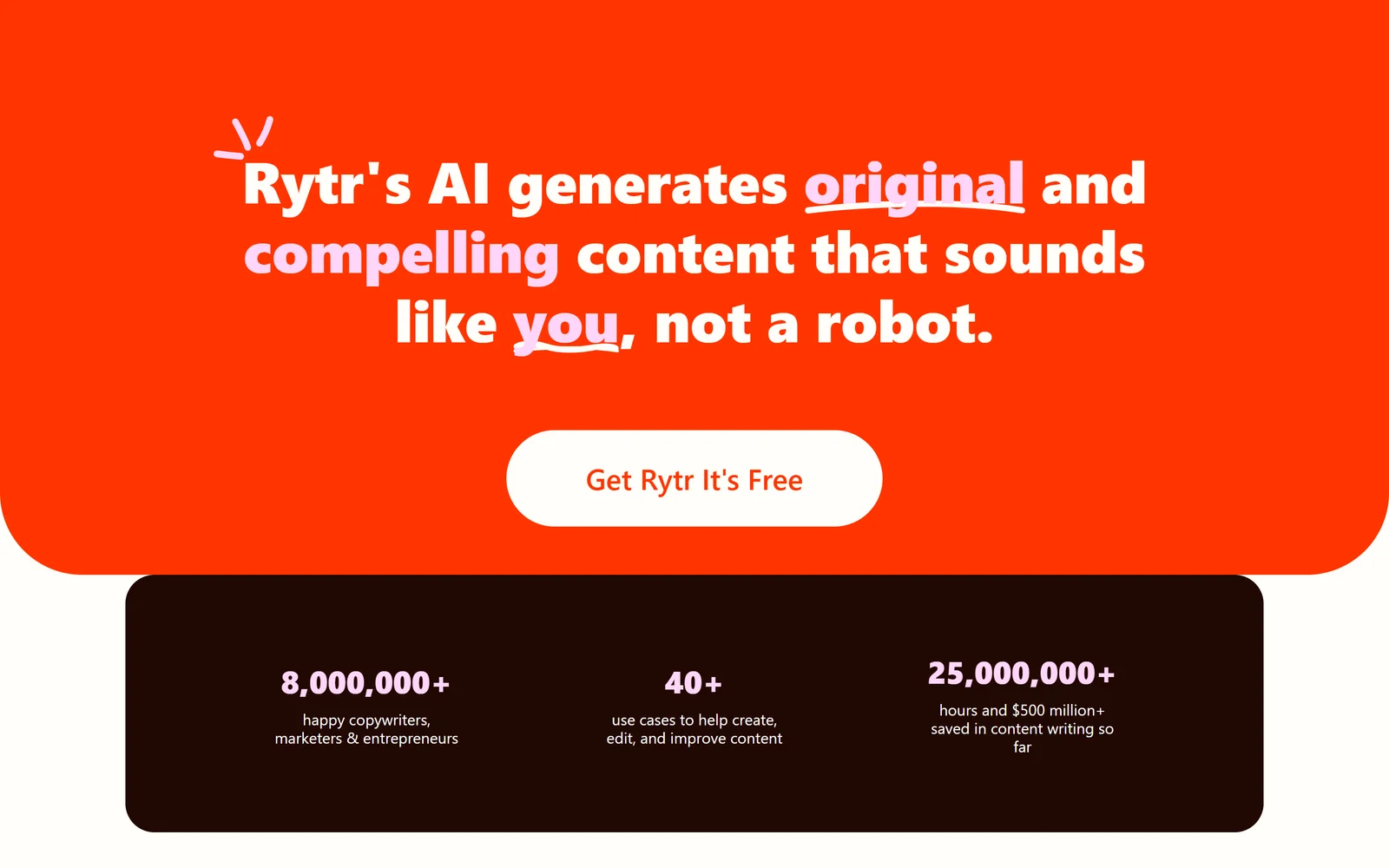
Rytr has the lowest cost floor for unmetered generation here, on a product whose blog has not been updated since 2023.
Rytr has the lowest verified cost floor for unmetered generation anywhere in this set. Unlimited is $7.50/month billed yearly or $9/month billed monthly, and it buys unlimited output characters, 50 Copyscape plagiarism checks and one custom tone match. Beneath it sits a permanently free tier — the card reads “Free forever, no CC required” — capped at 10,000 characters a month, which still includes the Chrome extension, 20+ tones and all 40+ use cases. For a solo marketer who wants a fast drafting surface and nothing else, that is unbeatable value on price alone.
There is one trap in the ladder that is easy to miss. The pricing comparison table shows Languages = 1 on Free, 1 on Unlimited, and 35+ only on Premium ($24.16/month yearly, $29 monthly). Paying $7.50 buys unlimited generation in a single language. Rytr’s own pages also give three different language counts for the top tier — 40+ on the homepage, 35+ in the comparison table, 30+ on the API page. The character quota counts both directions: Rytr’s help centre states “All generated and processed characters are counted as usage here”, and “The monthly quota resets every month and the credits can not be accumulated or added to the next month’s quota.” Paid plans advertise unlimited output but carry an undisclosed per-request input ceiling, shown only as “Limit Doubled” and “Limit Tripled” with no baseline published anywhere.
The maintenance signals are the real problem. The blog’s most recent post is dated 7 September 2023. The /use-cases index linked from Rytr’s own navigation renders only “This page is under construction. Check back soon for updates.” rytr.me/security, /trust, /dpa and /changelog all return HTTP 404. The help centre still describes the engine as “state-of-the-art GPT-3 based language models (provided by OpenAI)” in an article last updated 28 August 2025, and the team-plans article, stamped 11 September 2025, still quotes “$19/month ($190/annum) for now on Rytr Unlimited and $9/month ($90/annum) for Rytr Saver plan” — prices that no longer exist, making today’s per-seat cost undiscoverable from Rytr’s own docs. Every help.rytr.me article is footered ”© Copysmith AI 2026”, under an acquisition Rytr’s own site, Terms and press page have never disclosed. Tracxn records a Copysmith acquisition dated 7 October 2022; attribute that to Tracxn.
Commercially, Rytr is unforgiving. Its help centre states “All subscriptions are non-refundable and Rytr will not prorate any fees paid for a subscription that is terminated before the end of its term.” There is no self-serve cancellation in the Terms — you email support@rytr.me. The liability cap is the lowest here, “THE LESSER OF $100 OR THE FEES PAID”, which on the $90/year plan means $90. Rytr claims no security certification of any kind: SOC, ISO 27001 and HIPAA appear zero times in its Privacy Policy, which itself displays no date. The policy never addresses AI training at all — it contains no occurrence of “train”, “training”, “model” or “OpenAI”. Data is US-only with no regional option.
One historical note deserves both halves. On 18 December 2024 the FTC approved a final order, 3-2, against Rytr LLC over its review generator, barring it from “advertising, promoting, marketing, or selling any service dedicated to - or promoted as - generating consumer reviews or testimonials.” On 22 December 2025 the FTC reopened and set aside that order, 2-0, finding that “the complaint failed to satisfy the legal requirements of the FTC Act and that the order unduly burdens artificial intelligence (AI) innovation.” Rytr is no longer bound by it.
Lifetime-deal buyers had a bad run. Rytr’s own help article frames the change positively — limits “tripling from previous limits” — but an AppSumo reviewer, SumoLee (1 star, 13 July 2025), wrote: “They deprecated my account from 50k to 10k char/mo, which is the ‘free’ tier, so they’ve basically canceled the deal.” Trustpilot reviewer Rahul Kayan (1 star, 30 June 2026) wrote that the company “abandoned customers who purchased lifetime accounts with little more than a generic ‘sorry.’” Both sides are on record.
The Good (Pros)
The Bad (Cons)
#4 · Cheapest unmetered output
Unlimited characters from $7.50 a month
A permanent free tier with no card, 40+ use cases and a Chrome extension. The blog is dead since 2023 and several product pages 404.
Visit Rytr
7. Copy.ai: Unlimited Words, Attached to a Company That Left the Category
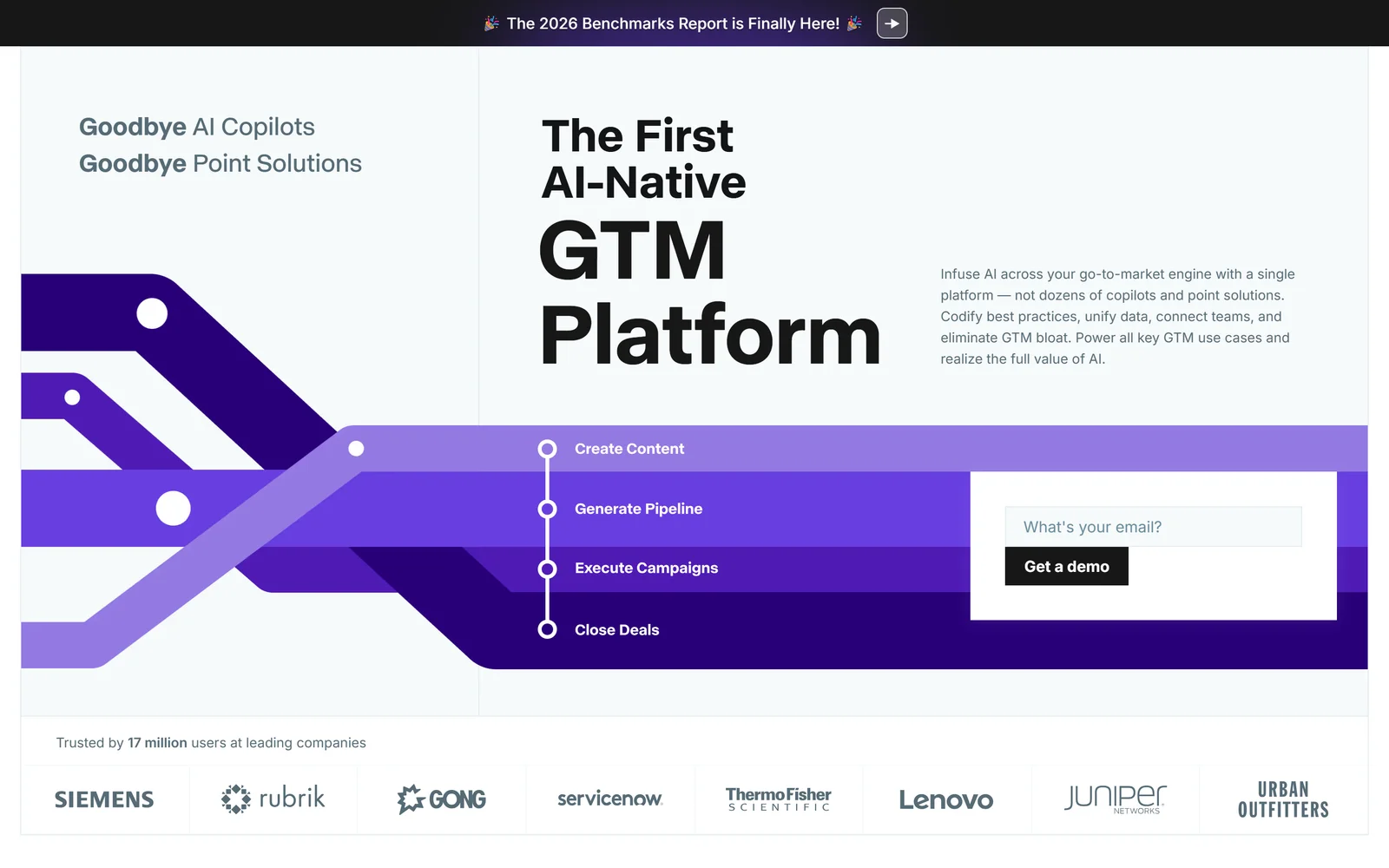
Copy.ai still sells unlimited words on a $29 entry plan, but the company was acquired by a RevOps vendor and has moved on from writers.
Copy.ai has the most attractive headline entitlement in this comparison. Its $29/month Chat plan (or $24/month billed annually at $288/year) lists “5 Seat”, “Unlimited Words in Chat”, “Unlimited Chat Projects” and “Access to OpenAI, Anthropic, and Gemini models” — roughly $5.80 per seat for genuinely unmetered generation. A five-star Capterra reviewer, Lawrence G. (3 June 2022), captured why that still matters: “Copy.ai is a great product for the price. I have been testing out copy generation tools and this one is the only one without a ridiculous word limit.” Underneath sits a real multi-step workflow engine with a documented REST API at api.copy.ai and webhook registration — so a repeatable content process can become a callable asset rather than a prompt someone re-pastes.
So why does it finish fifth? Capability is not the problem. Billing fairness, value for money and support are, and under a weighting that puts 1.5x on the first two and 0.75x on the third, that is enough to sink it.
Start with value. The live pricing page jumps from Chat at $288/year straight to Growth at $12,000/year — roughly 42x — with nothing in between, and the cheaper of the two includes zero workflow credits. Any team that needs workflow automation but not 75 seats has no tier to buy. API access appears only in the Enterprise column. Credit cost is also unknowable in advance: the FAQ states “How much a workflow run costs depends on the complexity of the workflow”, and that you see the cost only “by opening the side panel and looking at the ‘Credits used’ for the run.” Credits are pooled across the workspace, reset monthly and do not roll over, and a documented “Platinum actions” class “cost more credits” with no published multiplier. What happens when a workspace exhausts its allowance — hard stop, queue, degrade, overage — is documented nowhere.
Billing fairness is worse. The Terms state: “You may cancel your Subscription for a full refund within five (5) calendar days of your initial purchase. AFTER THAT, YOUR PURCHASE IS FINAL AND YOU WILL NOT BE ABLE TO CANCEL THE PURCHASE AND/OR RECEIVE A REFUND OF YOUR SUBSCRIPTION FEE AT ANY TIME.” That clause is not limited to monthly plans, so a $12,000 annual commitment carries a five-day window. Cancellation is documented only by email to cancel@copy.ai. Those Terms carry “Last Updated: October 12th 2023” and the Privacy Notice November 2023 — neither revised through the October 2025 acquisition.
That acquisition is the single most important company fact here. Per a PR Newswire release dated 15 October 2025, RevOps vendor Fullcast acquired Copy.ai; terms were not disclosed, and CEO Ryan Westwood is quoted as calling it “a defining moment for Fullcast and for the future of RevOps.” Copy.ai’s own post frames the rationale as ending tool fragmentation and makes no commitment about pricing and none that the standalone product continues — it is simply silent on both. The absorption is visible in infrastructure: docs.copy.ai now 301-redirects to support.fullcast.com, as do support.copy.ai articles. The changelog’s most recent entry is 16 June 2025, while the marketing blog carried posts dated 4, 8, 9, 10 and 15 September 2026. SEO content is still shipping; product communication stopped 15 months ago.
The storefront also contradicts itself. The pricing page lists no free plan, while copy.ai/reviews still closes with “Get Started for Free”, “No credit card required” and “2,000 free words per month”. The same reviews page claims “4.9 /5 on G2 Reviews” while G2’s own AI mirror showed 4.7 from 180 reviews (read 17 September 2026); the reviews page claims “10,000,000+ professionals & teams” while the homepage claims “Trusted by 17 million users” — two figures on the same site on the same day. And of nine packaged use cases, only two — Content Creation, and Translation & Localization — are content-writing use cases.
Support is the last brick. Trustpilot shows 1.8/5 from 196 reviews, read 17 September 2026 — but publish the caveat: the distribution is 63% five-star and 20% one-star with only “5 reviews in the last 12 months”, so the TrustScore is time-weighted, not an average. Recent negatives dominate. Trustpilot’s own flags on the profile read “Hasn’t replied to negative reviews” and “No recent history of asking for reviews”. A representative complaint, from reviewer AJH (1 star, 24 February 2026): “Reached out to support via email and via the website form. No response for months even after several messages.”
In fairness: Copy.ai’s SOC 2 Type II attestation is genuinely audited — the announcement names Prescient Assurance and cites AICPA SSAE 18 — though it dates to May 2023 with a July 2025 update and no post-acquisition compliance statement was found. The security page commits that “We value your trust, ensuring our models are trained without utilizing your individual data”, and on ownership, while the Terms say OpenAI LLC owns Generated Content, they simultaneously grant users a worldwide, sublicensable licence to “use, copy, modify, sell, create derivative works based upon, distribute, publicly display, and publicly perform Generated Content for your lawful business purposes.” You get a broad commercial licence, not assigned ownership.
The Good (Pros)
The Bad (Cons)
#5 · Unlimited words, absent vendor
Unlimited chat words and 5 seats for $29 a month
A real workflow engine with a documented REST API. Acquired by Fullcast in 2025, changelog silent since June 2025, 1.8/5 on Trustpilot.
Visit Copy.ai
Scored Comparison Chart
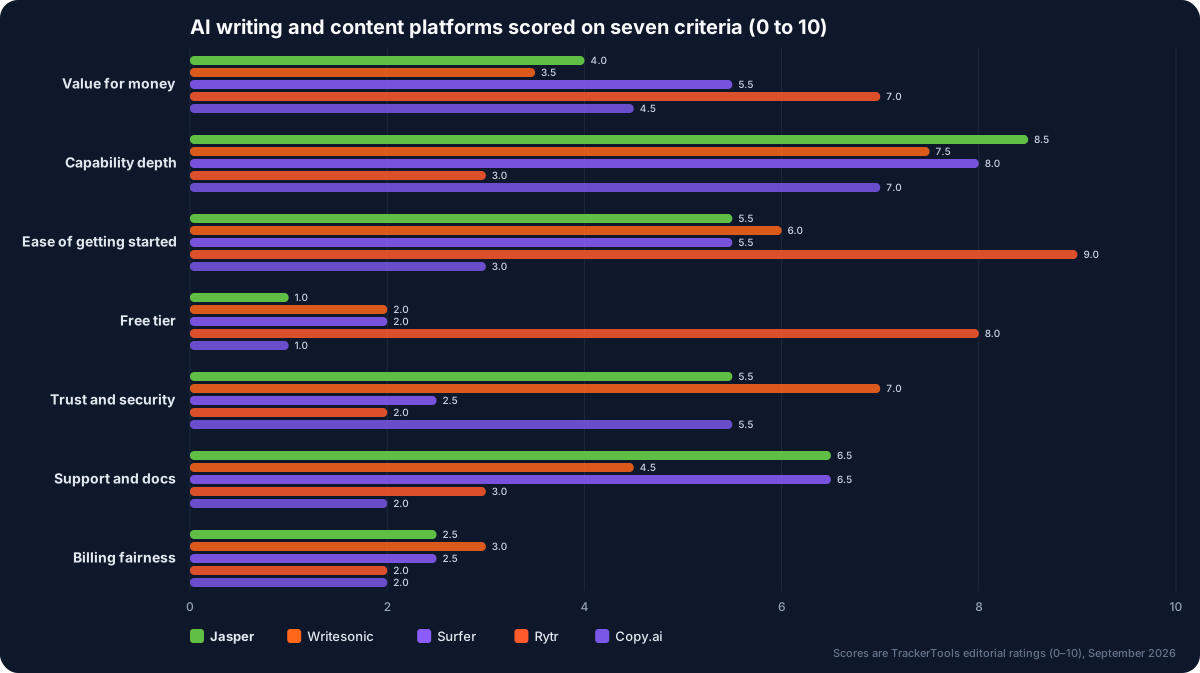
Seven criteria, five platforms. No product here scores above 3 on billing fairness, and the weighted spread between first and last is barely one point.
The top three are separated by 0.11 points, which is the real story of this category. Jasper takes first at 5.10 almost entirely on capability, which carries double weight. Nothing else here combines a persistent brand-context layer, native AI-search measurement, SAML SSO with an audit log, and a monthly shipping cadence. It loses more billing-fairness points than any other platform — the one-seat cap, the quote-only second tier, and a refund clause that survives even Jasper terminating your account — and still finishes on top. That should tell you how far ahead it is on the thing the weighting values most, and how little the rest of the field is doing on governance.
Writesonic at 5.01 and Surfer at 4.99 are effectively tied, and they lose points in different places. Writesonic scores well on trust — it is the only vendor here with an explicit contractual no-training commitment and customer ownership of outputs — but its value score suffers badly: $99/month for 15 articles, one seat and three tracked AI surfaces, with the headline capabilities reserved for quote-only tiers. Surfer scores better on value at the entry point ($49/month for 120 documents) and best of anyone on documentation, but its billing-fairness and trust scores are the weakest of the three: no published refund policy, annual charged upfront, stored work erased on lapse, no certification of its own, and complete silence on AI training.
Rytr at 4.56 and Copy.ai at 4.06 are low for opposite reasons. Rytr has the best free tier and the best price in the set, and gets dragged down by capability depth and support-and-docs — a blog dead since 2023, four 404ing policy pages, and help articles quoting prices that no longer exist. Copy.ai’s capability score is respectable; what sinks it is the combination of three weighted criteria in a row. A five-day refund window (1.5x), a 42x pricing cliff (1.5x), and a support record Trustpilot itself flags (0.75x) are enough to put a technically capable platform last.
Pros and Cons Matrix: Who Solves Which Pain Point
| Pain point | Jasper | Writesonic | Surfer | Rytr | Copy.ai |
|---|---|---|---|---|---|
| Persistent brand voice | ⚠ Capped at 2 on Pro | ⚠ Not plan-itemised | ⚠ 100 custom voices total | ⚠ 1 voice on Unlimited | ⚠ Not plan-itemised |
| Long-form, cited output | ✓ Agents plus Studio | ✓ 3,000-8,000 words, cited | ✓ Editor plus Auto-Optimize | ✗ Short-form templates | ⚠ Chat plus workflows |
| AI-search visibility | ✓ GEO Hub, credit-metered | ⚠ 3 surfaces self-serve | ✓ Five engines tracked | ✗ Not offered | ✗ Not offered |
| Predictable billing | ✗ No dollar-per-credit rate | ⚠ Clear tiers, gated features | ⚠ Full year upfront | ✓ Flat, published prices | ✗ Cost known post-run |
| Fair refunds | ✗ No refunds, ever | ⚠ 7 days, initial fee only | ✗ No policy published | ✗ Non-refundable | ✗ Five calendar days |
| Free entry point | ✗ 7-day trial only | ⚠ 7-day trial, no card | ✗ Card-gated trial | ✓ Free forever, 10k chars | ✗ None on pricing page |
| Enterprise governance | ✓ SSO, RBAC, audit log | ⚠ SSO Enterprise-only | ⚠ SSO Enterprise-only | ✗ Nothing published | ⚠ Enterprise bullets only |
| AI-training clarity | ⚠ Marketing vs Terms conflict | ✓ Contractual no-training | ✗ Undocumented entirely | ✗ Never addressed | ⚠ Security-page claim only |
| Support responsiveness | ⚠ BBB F, 14 unanswered | ⚠ Priority on Growth up | ⚠ 24h Mon-Fri, 15% replies | ⚠ Priority on paid plans | ✗ Months without reply |
| Active development | ✓ Monthly release notes | ⚠ 10 undated entries | ✓ Dated changelog | ✗ Nothing since 2023 | ✗ Silent since Jun 2025 |
Pricing at a Glance
| Platform | Free tier | Cheapest paid | Top published tier | Trial | Refunds | Trustpilot (17 Sep 2026) |
|---|---|---|---|---|---|---|
| Jasper | None listed | Pro $59/mo yearly, $69 monthly, 1 seat | Business, quote-only | 7-day Pro trial; card requirement not stated | None, per Terms, even if Jasper terminates | 3.2/5, 4,144 reviews |
| Writesonic | None permanent | Starter $79/mo yearly, $99 monthly | Enterprise, quote-only | 7-day free trial; FAQ says no card | 7 days, initial fee, self-serve only | 4.6/5, 5,763 reviews (pre-pivot pool) |
| Surfer | None | Discovery $49/mo yearly ($59 implied monthly) | Enterprise $999/mo | 7-day Pro trial; card required, no auto-cancel | No policy published anywhere | 4.3/5, 220 reviews |
| Rytr | Free forever, 10,000 chars/mo | Unlimited $7.50/mo yearly, $9 monthly | Premium $24.16/mo yearly, $29 monthly | No trial needed; free tier is permanent | Non-refundable, non-prorated | 4.4/5, 2,449 reviews |
| Copy.ai | None on pricing page | Chat $24/mo yearly ($288/yr), $29 monthly | Scale $3,000/mo; Enterprise custom | Terms retain a Free Trials clause; pricing page silent | Five calendar days from initial purchase | 1.8/5, 196 reviews (63% 5-star, 5 in last year) |
Which One Should You Actually Pick?
Jasper — for enterprise marketing teams who need governance more than they need a copywriter. If you require SAML SSO, role-based access control and an in-app AI audit log, and you have budget for a negotiated annual contract, nothing else here competes. The caveat is structural: Pro’s one-seat cap means any real team is going straight into a quote-only 12-month Business agreement whose dollar-per-credit rate Jasper publishes nowhere, under Terms that permit no refund under any circumstance.
Writesonic — for content leads whose actual KPI has become AI-search citations. If you need to see where AI answers ignore you and then publish long-form, cited, schema-marked articles straight into WordPress or Contentful, this closes the loop in one subscription with the best data terms in the set. The caveat: at $99/month you get 15 articles and three tracked surfaces, and the “10 AI platforms” headline is unavailable on any self-serve plan.
Surfer — for SEO-led teams and agencies optimising existing content at volume. Discovery at $49/month is the cheapest serious entry here, the API documentation is the best in the comparison, and the front-end scraping methodology is disclosed rather than implied. The caveat is severe: the full year is charged upfront, no refund policy is published anywhere, and if your subscription lapses, Surfer’s own docs say your Content Editors, Audits and tracked Sites are “completely erased”.
Rytr — for solo marketers and freelancers who want a cheap drafting surface and nothing more. $7.50/month billed yearly for unlimited output characters is unmatched, and the permanent 10,000-character free tier lets you test with no card. The caveat: one language unless you pay Premium, a $100 liability cap, non-refundable subscriptions, and a product whose blog, changelog and security pages suggest maintenance rather than development.
Copy.ai — for teams that genuinely want workflow automation and can live with the parent company’s direction. Five seats and unmetered chat generation for $29/month with OpenAI, Anthropic and Gemini access is real value, and the Workflows API is documented and usable. The caveat: Fullcast acquired the company in October 2025, the changelog has been silent since June 2025, and your refund window on a $12,000 annual plan is five calendar days.
Final Verdict
Jasper takes first place at 5.10 because the weighting rewards capability twice over, and because it is the only platform here that has built the governance layer an enterprise legal team will ask about. That win comes with the harshest commercial terms in the comparison and a documented tension between a trust page that says “Your company data and outputs are never used to train third-party LLMs” and Terms that grant a perpetual, irrevocable licence to customer content for “modifying, improving, and enhancing artificial intelligence models”. Both statements can be true. Read them together before you sign.
The more useful finding is what happened to the category. Three of these five vendors now describe themselves in terms that exclude writing. Jasper sells marketing agents. Copy.ai sells GTM orchestration and explicitly distances itself from “standard chatbots or writing assistants”. Writesonic sells AI-search visibility and, on its own comparison hub, benchmarks itself against Profound, AirOps and BrightEdge — Jasper, Copy.ai and Surfer appear zero times. If your requirement is genuinely “write me marketing copy at volume”, the two tools still built for that job are Rytr, at the bottom of the price range and the bottom of the maintenance range, and Copy.ai’s Chat tier, sitting inside a company that has moved on.
Whichever you pick, the billing terms deserve more attention than the feature grid. Across five vendors we found one refund window of five calendar days, one policy of no refunds under any circumstance, one that is non-refundable and non-prorated, one narrowed from “no-questions-asked” to the initial fee of a first self-serve purchase, and one that publishes no refund policy at all. That is the pattern this category has settled into, and it is the pattern the complaint volume tracks. Buy monthly first. Confirm entitlements in writing. Set a calendar reminder before renewal.
Pick Jasper if: you are an enterprise marketing team that needs SAML SSO, role-based access control and an AI audit log alongside brand context that persists, you have budget for a negotiated annual contract, and your procurement team is comfortable with Terms that permit no refund even if the vendor terminates your account.
Think twice if: you are a two-person team, you need to forecast a bill before you sign, or you want the freedom to leave mid-term. Pro is hard-capped at one seat with no published per-seat add-on, Business publishes no dollar figure and no credit allowance anywhere, and Jasper’s Better Business Bureau profile carries an F rating with 14 of 16 complaints unanswered (read 17 September 2026).
Disclosure: TrackerTools has no affiliate relationship with any product in this comparison, and the links above are plain nofollow links. Every price, plan limit, rating and quotation was verified against the vendors’ own pricing pages, terms of service, documentation, changelogs, G2, Capterra, Trustpilot and the original user posts on 17 September 2026. Where a vendor publishes price only on request, we say so rather than estimating.