You have a script, a deadline, and a budget line that says “video”. What you do not have is a way to know, before you pay, whether the tool you are about to buy will produce something you can actually put in front of a client — or whether it will quietly eat your month’s allowance on eleven generations that all put the wrong number of fingers on the presenter’s hand.
That is the real purchasing problem in AI video in 2026. Every vendor on this list sells credits. Every vendor deducts those credits when a generation runs, not when a generation is usable. And when the output is unusable, the money is gone. One Runway customer posting on Trustpilot as Todd summed up the whole category on 23 August 2026: “My credits are gone. My money is gone. And I have nothing usable to show for it.” He is not describing a bug. He is describing the business model.
The second problem is that the number on the pricing page is almost never the number that matters. Runway’s $15 Standard plan buys 625 credits, which at Runway’s own published rate of 12 credits per second of Gen-4.5 is 52 seconds of flagship video per month. Synthesia’s $29 Starter plan is sold monthly but meters annually: 120 minutes of video per year. HeyGen’s $29 Creator plan gives you 600 credits, which at HeyGen’s published Avatar V rate of 48 credits per minute is about 12.5 minutes. Luma’s $30 Plus plan gives 10,000 credits, and a single five-second 1080p HDR clip costs 1,600 of them. None of those facts are on the buy button.
We re-checked every price, credit rate, contract clause and review score below at source on 17 September 2026. We also re-verified 51 customer complaints at source on the same day. What follows ranks five paid AI video platforms on seven weighted criteria, and it names each one’s real weakness — including the winner’s, which is that its entry plans are a pilot budget dressed up as a product.
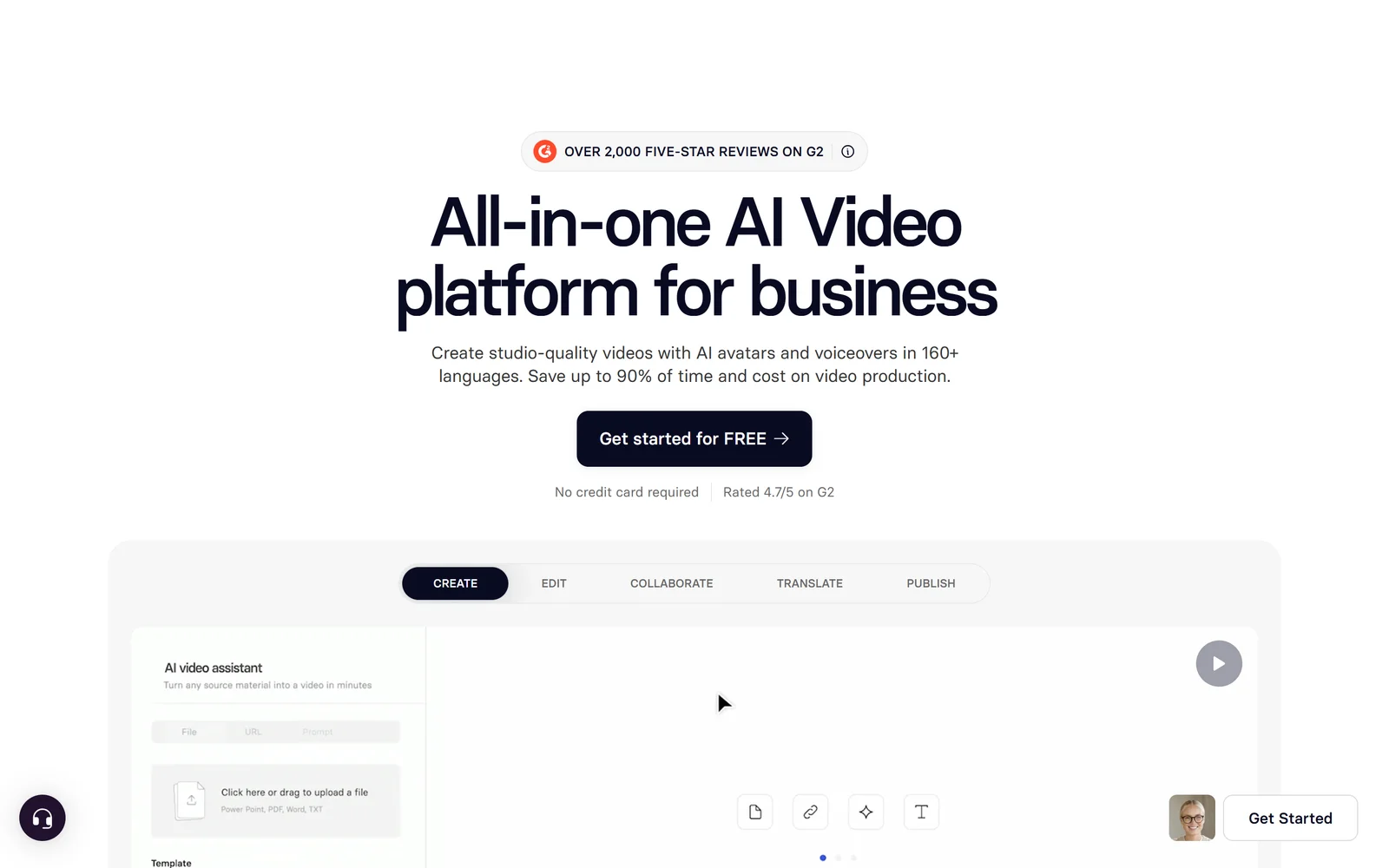
Synthesia’s homepage, captured 17 September 2026. It is the only vendor here whose compliance claims are externally audited rather than asserted.
1. Why AI Video Buyers Get Burned (In Their Own Words)
A note on evidence before the quotes. Trustpilot labels the Runway, Kling and Luma profiles as unclaimed, and displays on the Runway page: “No history of asking for reviews. This company hasn’t invited their customers, so reviews may not be representative.” HeyGen and Synthesia run claimed profiles that actively invite customers, and two of the HeyGen reviews below carry Trustpilot’s “Invited” tag. So the low scores are complaint-selected and the high scores are invitation-inflated. These quotes are reliable evidence of which failures recur and how buyers describe them. They are not prevalence data, and nobody should read them as such.
You pay per attempt, not per usable result — and refunds are refused when the model is the thing that failed. This is the most consistent complaint across every platform in the comparison.
“I wasted over forty bucks and when they just took 3000 credits and I reached out, I was basically told sorry and thanks.” — Chris Maxwell, Trustpilot (Kling AI), 11 September 2026
“My refund request was refused because I had used all of the credits.” — Gerda, Trustpilot (Runway), 12 August 2026
The demo reel is not what arrives. Continuity drift, warped faces and garbled on-screen text are the characteristic artefacts, and they are what burn the credits.
“Every single output was completely distorted, glitched, and entirely unusable.” — Kristina Sare, Trustpilot (Runway), 12 June 2026, who says she paid £32.03 for Pro and watched 2,000 credits go in ten minutes
“cars crash or drive backwards, smoke gets sucked back in at the end, extra people / dark shadows / ghost figures appear, and faces often warp or shake” — Anna Chen, 3 out of 5, Trustpilot (HeyGen), Invited review, experience dated 15 September 2026. Context matters here: the same review opens “I’m a heavy HeyGen user and I really want this company to win” and closes “I’ll keep using HeyGen.” This is a satisfied customer listing the artefacts she works around, not a condemnation.
Credits buy generation, not features. Resolution, watermark removal and export sit behind a second paywall.
“If you want to remove the watermark or generate in 1080p, you’re forced to buy a subscription on top of the credits you’ve already paid for.” — giacomo urgeghe, Trustpilot (Kling AI), 2 July 2026
“they recently introduced a blocking watermark that appears in the editor all the time even if you pay!” — Magda Targosz, Trustpilot (HeyGen), 17 September 2026
Moderation false positives destroy work that has already cost you time and credits.
“I literally just want to get them moving up the stairs and down the stairs, NOPE, VIOLATION.” — Stephanie Cooper, Trustpilot (Runway), 7 August 2026
“I spent 3 hours turning a pitch deck into a video only for it to be autoflagged.” — Ben Johnson, Trustpilot (Synthesia), 21 March 2026. A separate Synthesia reviewer, Francisco Barbieri (17 December 2025), wrote that “the moderation process feels subjective and incoherent” after a video approved with one avatar was refused the next day with the same script and a different avatar.
The price of a minute can change underneath a live subscription.
“Prices are rising too fast without any improvement in quality. Why did the rate for the Avatar V increase from 20 to 48 credits per minute?” — Hieu Ut, 1 out of 5, Trustpilot (HeyGen), Invited review, experience dated 16 September 2026. HeyGen’s current published rate is indeed 48 credits per minute for Avatar V, which corroborates the endpoint of his complaint.
“The company removed its previous $97/month Unlimited plan and replaced it with a credit-based system” — Mashal Mustaid, Trustpilot (Runway), 9 June 2026. A second, unrelated Runway reviewer (Marvin) describes the same change. Treat the $97 figure as the reviewer’s account, not as a published Runway price.
Cancelling is where the relationship goes wrong most often.
“First, they confirmed via email that my subscription had been cancelled, but then, a couple of days later, they charged my account.” — Aleksei Chprynin, Trustpilot (Kling AI), 10 August 2026. Two further Kling reviewers describe charges after cancellation. These are recurring user allegations, not established company conduct.
“I cannot cancel my subscription online. The “Manage at Luma AI” link from Stripe/Link sends me into a redirect loop, and the Dream Machine billing pages return 404 errors.” — Jonathan Smith, Trustpilot (Luma), 29 April 2026
“The moment I provided my card info, I was immediately charged for an entire year upfront.” — Ever Green, Trustpilot (Synthesia), 16 April 2026
2. How We Ranked Them
Seven criteria, weighted, because a brilliant model attached to a punitive billing contract is not a good purchase for a team with a budget to defend.
Capability depth (2x) — what the platform can actually produce: model quality, duration ceilings, resolution, audio, finishing formats and direction controls. Value for money (1.5x) — cost per finished, usable minute at the tier a real buyer starts on, calculated from each vendor’s own published credit rates. Billing fairness (1.5x) — refund policy, rollover, expiry, top-up mechanics, what happens on cancellation and whether the vendor’s own pages agree with each other. Trust and security (1x) — certifications that can be checked against a third party, data residency, and what the contract says about training on your content. Ease of getting started (1x) — how quickly a marketer or an L&D lead gets a finished asset out. Free tier (0.75x) — whether the free plan lets you evaluate the product you would buy, or only tease it. Support and docs (0.75x) — published channels, API documentation and candour about limitations.
Every price, credit rate, contract clause, app-store rating and review score in this article was read at source on 17 September 2026. Ratings move; re-check before you buy.
3. Synthesia: The Only Trust Stack You Can Actually Verify
Synthesia is certified to ISO 42001, ISO 27001 and SOC 2 Type II, with EU-only data storage and consent rules written into its acceptable use policy.
Synthesia wins this comparison on the criterion most of its rivals treat as a marketing bullet. Auditor A-LIGN, not Synthesia, states that “London-based Synthesia is the first AI video company to achieve ISO 42001 compliance”, certification issued 25 September 2024. Synthesia’s own security practices page adds that it “undergoes a periodic ISO 42001, ISO 27001, and SOC2 Type II audit”, that “Customer Data is currently stored within the European Union (EU), in data centers based in Ireland”, encrypted with AES-256 at rest and TLS 1.2+ in transit, with deletion completed within up to 90 days of request. Its Customer Terms contractually bar it from using your usage information to fine-tune components outside the services you use or to build independently provisioned AI models. And its own marketing pages carry the line “This content was generated using artificial intelligence and is labeled in accordance with EU AI Act Article 50 requirements”. No other platform here does that.
The product is built for the job most buyers actually have. Per Synthesia’s G2 description, you can “Type or paste a script, generate one from a prompt, or turn a PowerPoint deck, PDF, Word doc, link, or ready-made template into a polished, publish-ready video in minutes”, with 160+ languages and voices on every tier, AI dubbing, SCORM export, interactive branching and Roleplay Sessions. Its own integrations directory listed 55 named partners when counted on 17 September 2026 — 360Learning, Articulate 360, Docebo, Moodle, SAP Litmos, Workday, Slack, Microsoft Teams — against 47 verified on G2. That is an L&D stack, not a VFX stack.
Now the weakness, and it is real. Basic is $0 with 1,200 credits a month, which is ten minutes of video, and it cannot download an MP4 or remove the Synthesia logo. Starter is $29/month, or $18/month billed yearly, and buys 120 minutes of video per year. Creator is $89/month, or $64/month yearly, for 360 minutes per year. Every second costs 2 credits, credits do not roll over, and Synthesia’s help centre confirms that on a mid-cycle upgrade “unused credits from your previous plan do not carry over”. The pricing FAQ says that if you exceed your limit “your usage will be capped until renewal” and the fix is to upgrade; the credits help article says you can top up. Top-up pricing is published nowhere. The plan cards say $18 and $64 billed yearly while the FAQ on the same page says $264 and $804 a year — and neither pair reconciles with $216 or $768. Confirm the annual total at checkout.
Two more things to know before you sign. Fees are “non-cancelable and, except where the Contract expressly states otherwise, non-refundable”, and Synthesia says that holds “even if the subscription wasn’t used”. And the cancellation article is blunt: “Once the billing period ends, you lose access to Synthesia and all videos in your account.” Export everything first. Synthesia holds 4.6 from 2,806 G2 reviews and 3.9 from 1,823 Trustpilot reviews with a 13% one-star tail (both read 17 September 2026) — a polarised J-curve, with the one-star complaints concentrated on moderation and billing rather than output quality. One 3-star reviewer (srptrecruitment.com, 3 July 2026) titled their review “Excellent Product, Disappointing Credit Policy”, which is a fair summary of the whole platform. Separately: the “Synthesia” app on Google Play with 93.2K reviews is a piano-learning app from a different company. Ignore it.
The Good (Pros)
The Bad (Cons)
#1 · Only verifiable trust stack
ISO 42001, ISO 27001 and SOC 2 Type II, externally audited
EU-only storage in Ireland, a contractual bar on training from your data, and EU AI Act labelling. Starter buys only 120 minutes a year, and videos lock when the plan ends.
Visit Synthesia
4. HeyGen: The Highest Avatar Ceiling, at the Highest Price Per Minute
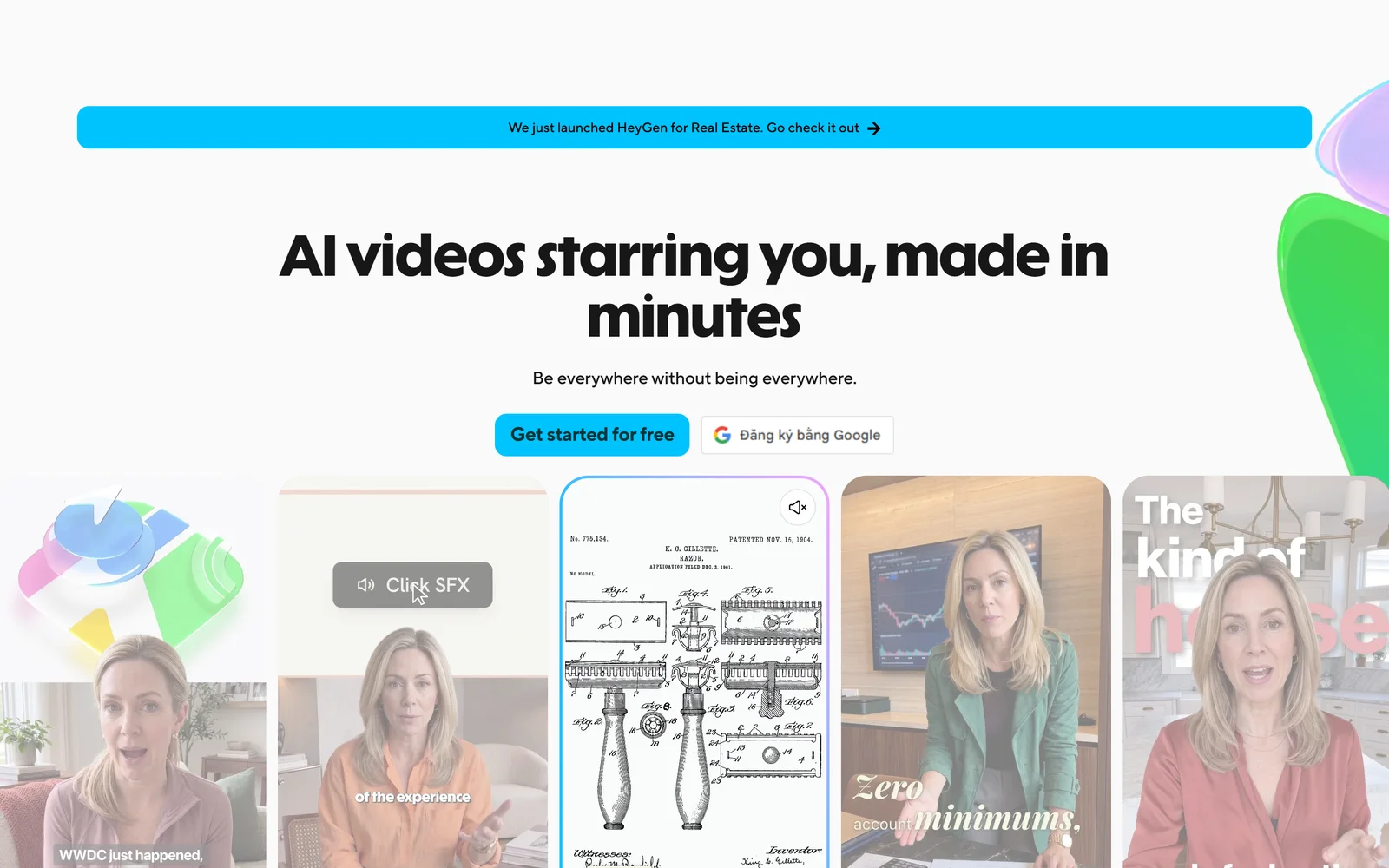
HeyGen’s pricing page, captured 17 September 2026. Creator’s 600 credits work out to roughly 37 minutes of Avatar IV, or 12.5 minutes of Avatar V.
HeyGen’s capability ceiling is the most impressive verified number in this comparison. Its July 2026 release blog states: “Our frontier avatar model can now generate a single 30-minute AI talking video in one pass. That’s 6x the industry ceiling and 10x our previous maximum.” That is HeyGen’s own claim, but the capability is documented across Avatar III, IV and V on both the web app and the API. Add Avatar V “Custom Motion”, announced May 2026, which takes plain-English performance direction over face, hands, posture, gaze and energy — HeyGen’s published example prompts include “Look at the camera, lean in, stay serious” and “Thumbs up at the end”. The same frontier model is exposed via API at “five cents per second”, or $3.00 per minute, so a marketing demo and an in-product video run on identical models.
The pricing is where it gets expensive. Free gives 3 videos a month, 1 minute each, watermarked, and HeyGen’s Terms licence free output “solely for personal, non-commercial, and internal evaluation purposes” — you cannot ship it. Creator is $29/month ($24 annually) for 600 credits, 30 minutes maximum per video, watermark removal, one seat. Pro starts at $49/month for 1,000 credits and scales to $4,300/month for 100,000 credits, adding 4K export. Business is $149/month plus $20 per seat for 1,500 credits and 60-minute videos. Now apply HeyGen’s own published burn rates — Avatar IV Photo Look 16 credits/minute, Avatar IV Video Look 31, Avatar V 48 for both — and Creator’s 600 credits buys roughly 37 minutes of Avatar IV Photo Look, about 12.5 minutes of Avatar V, or about 15 minutes of standard-mode Video Agent per month. Top-ups run $0.05 per credit with a $5 minimum.
The billing terms are better than Runway’s and worse than they look. Rollover exists: “Monthly subscribers’ unused credits roll over for one more month. Annual subscribers’ credits accumulate until their annual renewal date.” Cancellation keeps your features and remaining credits to the end of the cycle before dropping you to Free. But the Terms state “Payments are non-refundable, except where required by law”, and the help centre’s 15-day (HeyGen and Google Play) and 14-day (Apple) windows come with the caveat that refunds “may not be granted if a significant amount of credits has already been created”. Liability is capped at the greater of 12 months of fees or $100, under California law with venue in Los Angeles County.
On trust, HeyGen states it is “SOC 2 Type II certified” and claims GDPR, CCPA, EU-US Data Privacy Framework and EU AI Act compliance. It makes no ISO 27001 or HIPAA claim on that page. All customer data sits in the United States on AWS with no in-region option published. The clause that matters for agencies: “Enterprise customers’ data is excluded from AI model training by default. Non-enterprise customers may opt out at any time.” Default-on training for everyone below Enterprise. HeyGen holds 3.8 from 3,455 Trustpilot reviews and 4.8 from roughly 24,000 App Store ratings (both 17 September 2026) — and its own Fortune 100 claim reads 85% on the homepage and 80% on its App Store listing, which is a small tell about how carefully those marketing numbers are maintained.
The Good (Pros)
The Bad (Cons)
#2 · Highest avatar ceiling
30-minute talking avatars in a single pass
Plain-English direction over face, hands, posture and gaze, and the same models exposed via API at five cents a second. Unused credits are forfeited at cancellation.
Visit HeyGen
5. Runway: The Best Toolbox in the Category, Wrapped in the Worst Billing
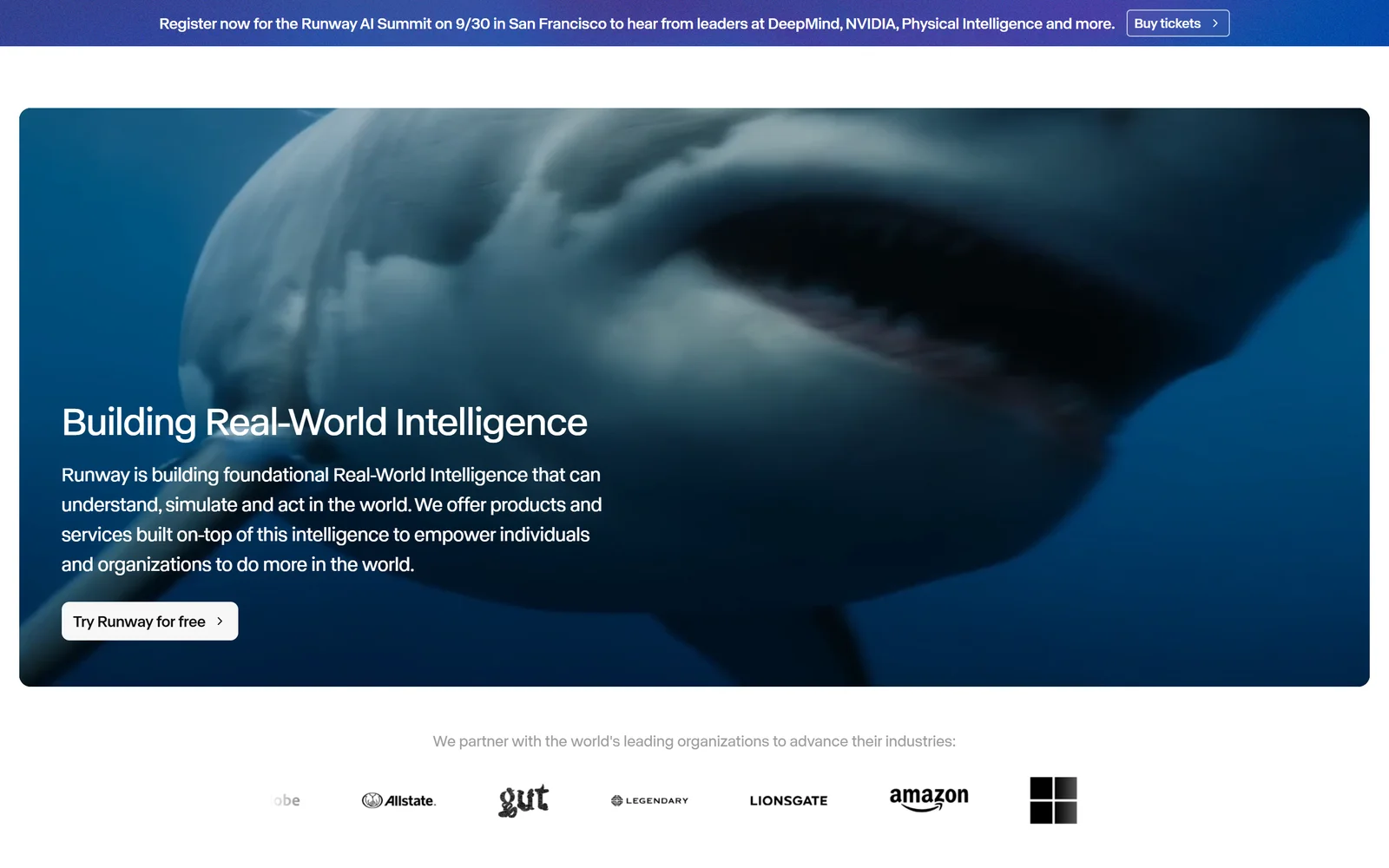
Runway puts its own frontier models and its rivals’ on one credit pool, wrapped in a real finishing pipeline.
Runway has the strongest capability case of any platform here, and it still lands third. The reason is not the models. Runway is the only vendor that puts its own frontier models and its direct competitors’ frontier models behind one subscription and one credit pool — Gen-4.5, Aleph 2.0, Kling 3.0, Seedance 2.5, Nano Banana Pro and Wan 3.0 all appear on the same runway.com/pricing table — then wraps them in a real finishing pipeline: ProRes, HDR, image sequences, 4K upscaling, Adobe Premiere Pro and After Effects panel plugins shipped 8 September 2026, Runway MCP and a documented REST API. Its public changelog records eleven dated releases between 15 August and 8 September 2026 alone. Runway’s own research page claims Gen-4.5 “holds the #1 position on the Artificial Analysis Text-to-Video benchmark with 1,247 Elo points” — that is Runway’s claim, against a leaderboard dated December 2025 that has moved since.
What pushed it down the ranking is value for money and billing fairness, and the evidence is arithmetic on Runway’s own published figures. Runway’s FAQ states “Gen-4.5 uses 12 credits per second of generated video”. Standard is $15/month for 625 credits, which is 52 seconds of Gen-4.5 — about $0.29 per finished second. Pro at $35 for 2,250 credits is $0.19 per second. Max at $95 for 9,500 credits is $0.12 per second, which is exactly Runway’s own developer API rate of $0.01 per credit. So Standard subscribers pay roughly 2.4 times the raw API rate for the privilege of a monthly plan. Aleph 2.0 at 28 credits per second means a Standard subscriber’s entire monthly allowance buys about 22 seconds of video-to-video editing.
Then the expiry mechanics compound it. Runway’s credits article states that Standard and Pro monthly credits “expire on your billing date”; only Max and Team roll over, and only for one month. The minimum top-up is 1,000 credits. Section 8.5 of the Terms of Use states that “all fees for the Services are non-refundable”, with discretionary 30-day carve-outs — and the sting is published in Runway’s own help centre: “In the event that a refund is granted, the feature access included with the previous plan, including any unused plan credits, is immediately lost and the account is downgraded to free.” App Store purchases cannot be refunded by Runway at all. There is no conventional free trial: Free is a one-time 125-credit deposit, roughly ten seconds of Gen-4.5, ever, and free output is watermarked.
The reviews split exactly where you would expect: 4.5 from 15,000 App Store ratings, 3.8 from 6.68K Google Play reviews, and 1.1 from 334 Trustpilot reviews on an unclaimed, uninvited profile (all 17 September 2026). The gap reflects who shows up in each channel, but the dominant complaint theme is identical in all three, and the fairest statement of it comes from an App Store reviewer who gave five stars. IzzDigiorno, 27 August 2026, in a review titled “Amazing, when it works…”: “I’ve made some genuinely awesome stuff on here but I’ve also wasted a ton of money on failed, flawed, or otherwise compromised generations that had nothing to do with my prompts. You pay per generation not just for the ones you actually use.” He adds: “I just wish you only paid for the stuff you kept.”
Two contract points for enterprise buyers. Runway’s Terms of Use section 4.4 state that “Inputs and Outputs may be used by the Company to train and improve its AI models”, with no documented opt-out for self-serve tiers; the only page promising otherwise is runway.com/enterprise, whose bullet reads “We don’t train on your data”. And SSO is Enterprise-only — Runway’s own Team announcement (4 September 2026, $69 per seat monthly or $55 annually, 2 to 9 seats, 6,900 credits per seat into a shared pool) says teams needing SSO must move up.
The Good (Pros)
The Bad (Cons)
#3 · Best toolbox
Its models and its rivals’ on one subscription
Gen-4.5, Aleph 2.0, Kling 3.0 and Wan 3.0 on one pricing table, plus ProRes, HDR, 4K upscaling and Premiere and After Effects plugins. Credits expire monthly.
Visit Runway
6. Kling AI: Cheapest Sound-On 1080p Second, Hardest Contract
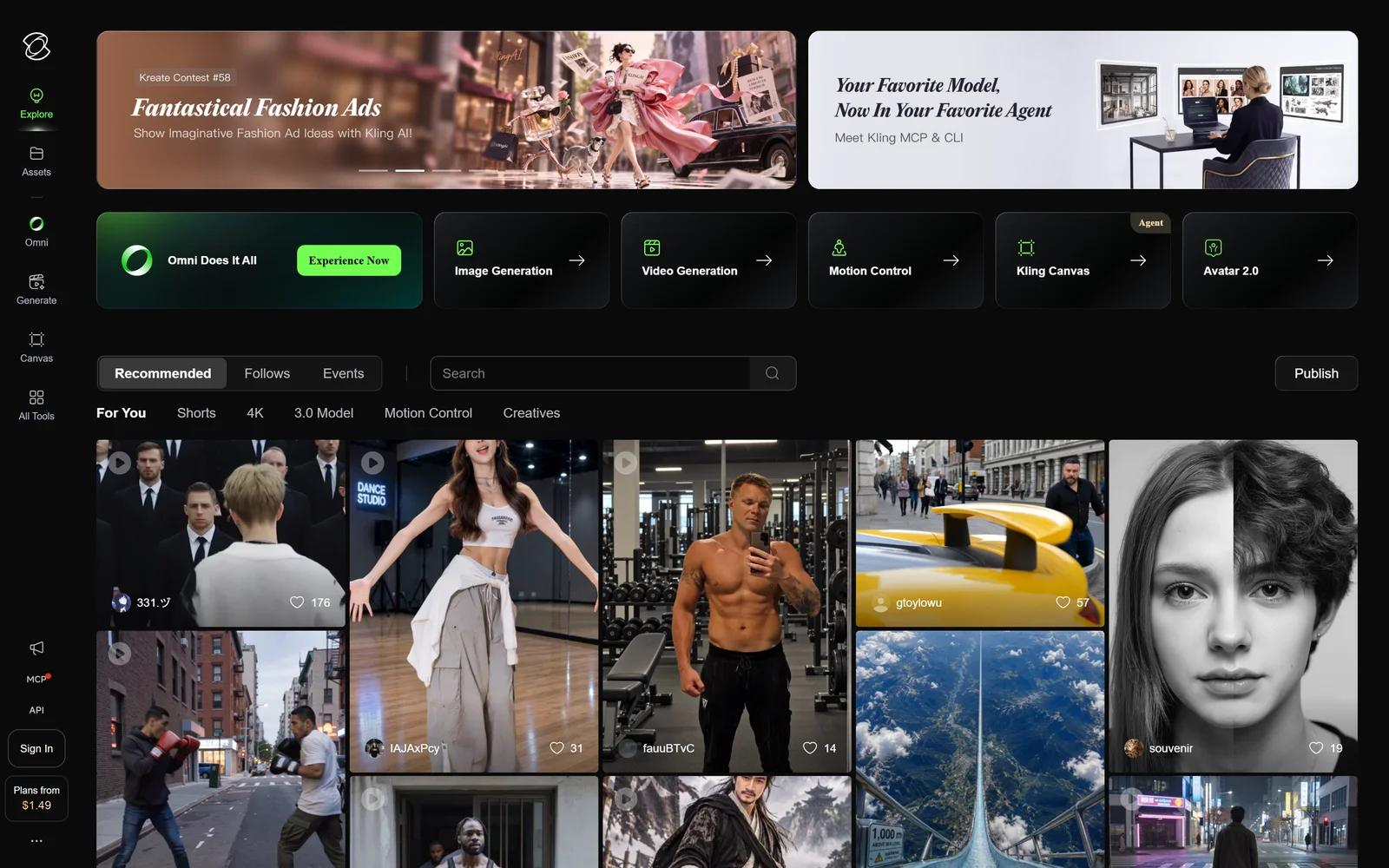
Kling publishes the cheapest per-second rate here for sound-on 1080p, on the harshest contract in the comparison.
On pure unit economics for generative footage, Kling is the cheapest verified route here to a finished, sound-on, broadcast-resolution clip. Its published API rates put Kling 3.0 Turbo at $0.112 per second at 1080p with native audio and Kling 3.0 at $0.42 per second at native 4K, on models that generate up to 15 continuous seconds with natively synchronised audio. Kling’s VIDEO 3.0 guide states: “The new model generates up to 15 seconds of continuous video, with a flexible duration ranging from 3 to 15 seconds.” Native 4K costs 3.75 times the 1080p per-second rate. The shipping cadence is real — native 4K on 23 April 2026, team features and a desktop app on 16 March 2026, Kling 3.0 and IMAGE 3.0 on 31 January 2026.
The consumer pricing needs decoding. The pricing page lists Basic $0, Standard $10, Pro $37, Premier $92 and Ultra $180, but the charged prices are a first-period rate and then an ongoing rate: Standard $6.99 then $8.80, Pro $25.99 then $32.56, Premier $64.99 then $80.96, Ultra $127.99 then $159.99. Credit allowances are 660, 3,000, 8,000 and 26,000 a month. Kling’s advertised “Price per 100 Credits” figures — $1.06, $0.87, $0.81 and $0.49 — reproduce to the cent when you divide the discounted first-month price by the credits, so the true ongoing unit cost is roughly 25% higher on every tier: about $1.33, $1.09, $1.01 and $0.62. By our calculation from Kling’s own credit table, a 5-second 1080p native-audio clip costs 60 credits, so Standard’s 660 credits buy 11 such clips at about $0.80 each, and Ultra’s 26,000 buy about 433 at roughly $0.37 each.
The contract is the weakest in this comparison. The Terms of Paid Service state: “Once the Paid Service (including any Membership Service and Credit service) is activated, the fee paid for the Paid Service is non-refundable.” Auto-renewal runs “without any limit on the times”, and Kling warns that cancelling within a day of the cycle end may not stop the payment processor. Subscription credits expire after a month, purchased credits last two years, and the shorter-lived credits are spent first. Worst of all for anyone buying credits without a subscription, the Credits Policy states: “Currently, “Credits” only support the use of specific functions. Other functions such as Fast-track generation, 1080p videos, Watermark removal, Master shot & video extension, Image upscaling are premium-only functions.” That is the mechanic behind the giacomo urgeghe quote in section 1, and behind App Store reviewer Mobius-220’s one-star complaint that credits already bought cannot be used without a membership.
Trust is thin. Kling asserts ISO 27001 in exactly one document, the API Service Privacy Policy, with no certificate number, certifying body, issue date or scope, and the claim does not appear in the consumer privacy policy. No SOC 2 reference exists anywhere in its published policies, and we found no trust centre, DPA or sub-processor list. Data is stored on servers in Singapore, with the contracting entity Kling AI Pte. Ltd. and Chinese parent Kuaishou Technology, which is partly state-owned. On training, the two products diverge sharply: the API policy promises your data will not be used “for any other purposes beyond those stated in this privacy policy (including, for example, model training)”, while the consumer Terms grant a broad licence over Input and Output covering research on new products and functions, with no documented opt-out. Marketers uploading client footage to the consumer web app should read clause 4.7 first. Kling’s own Terms also require you to label output with the Kling AI brand — relevant for white-label agency work. Ratings, 17 September 2026: 4.68 from 30,229 App Store ratings, 4.5 on Google Play (the page states 582K reviews in the header and 571K in the body), against 1.2 from 384 Trustpilot reviews on the unclaimed older profile, whose top-mention tags are Payment, Refund, Subscription and Cancellation.
The Good (Pros)
The Bad (Cons)
#4 · Cheapest sound-on second
Native-audio 1080p at 11 cents a second
Up to 15 continuous seconds with synchronised audio, and native 4K at 42 cents a second. Trustpilot sits at 1.2 out of 5 from 384 reviews, 89% of them one-star.
Visit Kling AI
7. Luma Dream Machine: Studio-Grade HDR You Probably Cannot Afford to Use

Luma is the only one here advertising native HDR with 16-bit EXR export for real colour and compositing work.
Luma has one genuinely categorical capability. Its Ray3 page advertises “studio-grade HDR through native high dynamic range color generation”, HDR video creatable “from text prompts, SDR images, as well as SDR video”, and output that can be “exported as 16-bit EXR for seamless integration into pro workflows” for “professional editing, color grading, and compositing pipelines”, with a Hi-Fi mode that masters to 4K HDR. Those are Luma’s words, and no other platform in this comparison advertises 16-bit EXR at all. For a team with a real grade or a compositing stage, that is not a preference, it is a requirement.
Then look at what it costs. Plus is $30/month ($25 yearly) for 10,000 credits; Pro $90 ($75) for 40,000; Ultra $300 ($250) for 150,000. From Luma’s official Ray3.14 FAQ, a five-second 1080p clip costs 400 credits, a five-second 1080p HDR clip costs 1,600, and a five-second 1080p HDR+EXR clip costs 2,800. So the $30 Plus plan buys about six HDR clips a month, or about three with EXR. Luma’s pricing page states plainly that “any unused credits expire at the end of the applicable billing cycle and will not be carried over to the subsequent month”. That is why Trustpilot reviewer YILDIZLIMO INC wrote on 7 April 2026 that “my entire balance of 10,000 credits was wiped out after generating only TWO 5-second videos” — he attributes the burn to high-consumption HDR settings applied without warning.
Luma also runs two incompatible price ladders simultaneously. The web pricing page sells Plus, Pro and Ultra. Luma’s own help documentation still documents legacy Free, Lite ($9.99 web / $12.99 iOS), Plus ($29.99 / $37.99) and Unlimited ($94.99 / $119.99) tiers, and the US App Store listing still sells Lite $9.99, Plus $29.99 and Unlimited $94.99 as live in-app purchases. Two different price lists, same company, same day. There is no free plan on the live pricing page at all, only an unquantified “Try for free” link, and lumalabs.ai/learning-hub/credits returns a 404 — so no free-tier credit allowance, resolution cap or watermark rule is published anywhere. That absence is itself the finding.
On trust, Luma publishes nothing. lumalabs.ai/security returns a 404, the enterprise page makes no SOC 2, ISO 27001 or residency claim beyond “Enterprise-grade SSO, access controls, and brand customization”, and the privacy policy lists among its uses: “Train, develop, and improve the artificial intelligence, machine learning, and models that we use to support our Services”. No-training is a paid upgrade — promised on the enterprise page and for API Provisioned Throughput, which starts at an 8-unit minimum of $2,100 per unit per month on a one-year commitment, or $16,800 a month before usage. Data is hosted in the United States. The terms warn in capitals at section 4.8(b) that “OUTPUT MAY NOT BE UNIQUE OR SPECIFIC TO CUSTOMER, AND OTHER USERS MAY RECEIVE SIMILAR OR IDENTICAL OUTPUT”, which brand-safety-sensitive marketers should read twice. And the public changelog’s most recent entry is dated 24 June 2025 — nothing about Ray3, Ray3.14 or Luma Agents appears there, so you cannot track releases from the vendor’s own feed. Ratings: 4.5 from 1.8K App Store ratings against 1.5 from 64 Trustpilot reviews (both 17 September 2026). Both sample sizes matter.
Credit where it is due on one design choice: Luma’s Agents FAQ says you can set an additional spending limit in account settings and “Luma pauses the moment you hit that limit”. Opt-in, user-capped overage is the single most buyer-protective billing mechanic in this whole comparison.
The Good (Pros)
The Bad (Cons)
#5 · Studio-grade HDR
Native HDR with 16-bit EXR export
A categorical advantage for grading and VFX pipelines. At 1,600 credits per five-second HDR clip, the $30 plan buys about six of them a month.
Visit Luma
Scored Comparison Chart
The weighted scores tell a story that the raw capability numbers hide. Synthesia takes first place at 6.06 not because it makes the most cinematic footage — it does not make cinematic footage at all — but because it is the only platform whose trust claims survive contact with a third party, and because its metering, whatever else is wrong with it, does not charge you for drafts. HeyGen at 5.81 is close behind on the strength of a capability ceiling nothing else matches, held back by a cost-per-usable-minute that is the highest here at Avatar V rates and by training exclusion being an Enterprise default.
Runway at 4.94 is the clearest case of capability being outvoted. On capability alone, weighted double, it wins the category outright: every frontier model on one bill, a real finishing pipeline, Adobe panel plugins and a documented API. It loses on the two criteria weighted 1.5x. On value for money, $15 buys 52 seconds of Gen-4.5 and $35 buys 187 — and Standard subscribers pay roughly 2.4 times Runway’s own API rate for the same output. On billing fairness, Standard and Pro credits expire on the billing date, the minimum top-up is 1,000 credits, fees are contractually non-refundable, and Runway’s help centre confirms that an approved refund forfeits unused credits and downgrades the account to Free. Three criteria, all documented on Runway’s own pages, cost it the top two spots.
Kling at 4.59 and Luma at 4.26 fall for related reasons. Kling has excellent unit economics and the longest continuous clip, then attaches them to a contract with no cooling-off period, open-ended auto-renewal, monthly credit expiry ahead of the two-year purchased balance, and premium features locked away from users who already hold paid credits. Luma has the one capability nobody else advertises and prices it out of the plan its buyers start on, while publishing no security posture at all and running two contradictory price lists on the same day.
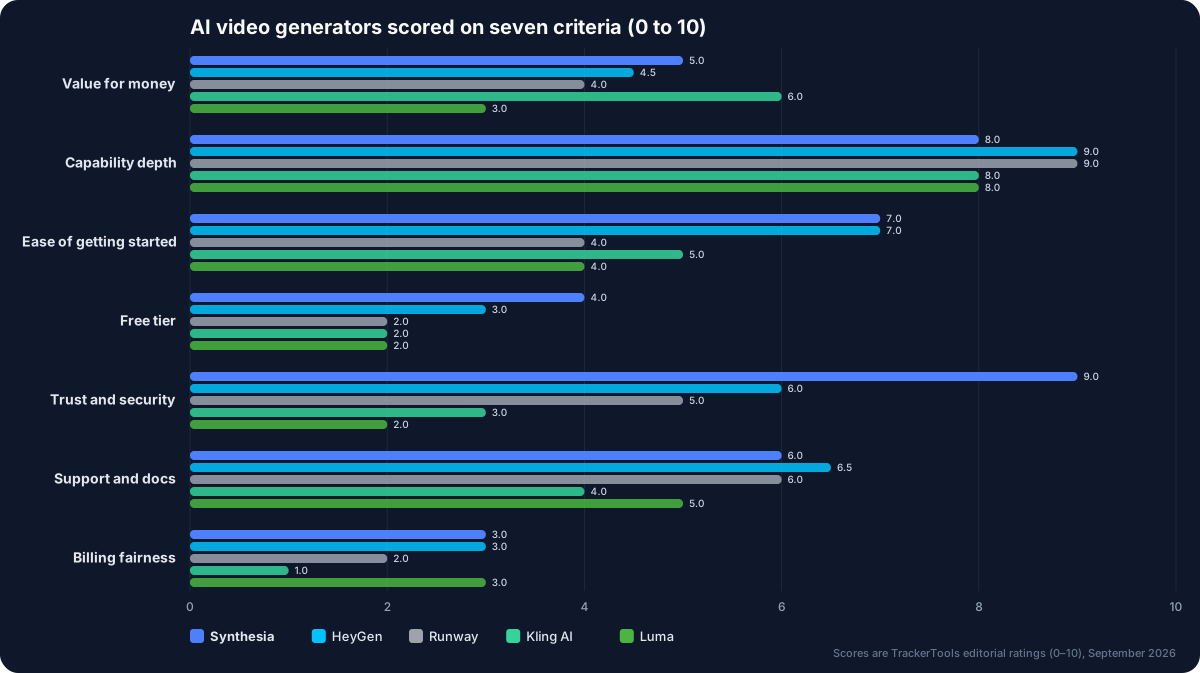
Seven criteria, five generators. Capability is high across the board; trust and billing fairness are where they separate, and Kling scores 1 on billing.
Pros and Cons Matrix: Who Solves Which Pain Point
| Pain point | Synthesia | HeyGen | Runway | Kling AI | Luma |
|---|---|---|---|---|---|
| Credits burnt on unusable output | ✓ Drafts free, edits metered | ⚠ Rolls over one month | ✗ Expire on billing date | ⚠ Refunded on failure | ✗ Expire monthly |
| Refunds when the model fails | ✗ Non-refundable, non-cancelable | ⚠ 14–15 day window | ✗ Refund forfeits credits | ✗ Non-refundable once active | ⚠ 30-day discretionary |
| Watermark and resolution gates | ✓ Removal from $29 Starter | ⚠ Removal from Creator | ⚠ No watermarks from Standard | ✗ Premium-only functions | ⚠ Reserved watermark right |
| Moderation false positives | ✗ Manual review, suspensions | ⚠ Appeals by email | ✗ Reported as very strict | ✗ Frequent guideline flags | ⚠ Not documented |
| Mid-subscription price changes | ⚠ New lower prices banner | ✗ Avatar V now 48 credits/min | ✗ Unlimited plan withdrawn | ⚠ Intro rate then +25% | ✗ Two live price ladders |
| Cancellation and billing friction | ✗ Lose all videos at period end | ✓ Keep credits to cycle end | ⚠ Access to renewal date | ✗ Auto-renew without limit | ✗ Redirect loop reported |
| Training on your content | ✓ Contractual bar | ⚠ Opt-out below Enterprise | ✗ Default on self-serve | ⚠ API no, consumer unclear | ✗ Default yes |
Pricing at a Glance
| Platform | Free tier | Cheapest paid | Top self-serve tier | Trial | Refunds | Rating (read 17 Sep 2026) |
|---|---|---|---|---|---|---|
| Synthesia | $0, 1,200 credits/mo = 10 min, no MP4 export, logo retained | Starter $29/mo or $18/mo yearly, 120 min/year | Creator $89/mo or $64/mo yearly, 360 min/year | Standing free plan, no card required | Non-cancelable and non-refundable, even if unused | 4.6 from 2,806 (G2); 3.9 from 1,823 (Trustpilot) |
| HeyGen | $0, 3 videos/mo, 1 min each, watermarked, non-commercial | Creator $29/mo or $24/mo yearly, 600 credits | Pro up to $4,300/mo for 100,000 credits | Free plan, no card required | Non-refundable except where required by law; 14–15 day windows | 3.8 from 3,455 (Trustpilot); 4.8 from ~24,000 (App Store) |
| Runway | $0, one-time 125 credits (~10s of Gen-4.5), watermarked | Standard $15/mo or $12/mo yearly, 625 credits | Max $95/mo or $76/mo yearly, 9,500 credits | No conventional trial | Fees non-refundable; approved refund forfeits credits, downgrades to Free | 1.1 from 334 (Trustpilot, unclaimed); 4.5 from 15,000 (App Store) |
| Kling AI | $0 Basic, no monthly credits, no commercial use | Standard $6.99 first period then $8.80/mo, 660 credits | Ultra $127.99 then $159.99/mo, 26,000 credits | No trial documented | Non-refundable once activated | 1.2 from 384 (Trustpilot, unclaimed); 4.68 from 30,229 (App Store) |
| Luma | No free plan listed; unquantified “Try for free” | Plus $30/mo or $25/mo yearly, 10,000 credits | Ultra $300/mo or $250/mo yearly, 150,000 credits | Unquantified free entry point | ”All Fees are final and non-refundable unless otherwise determined by Luma”; 30-day discretionary carve-out | 1.5 from 64 (Trustpilot, unclaimed); 4.5 from 1.8K (App Store) |
Which One Should You Actually Pick?
Buy Synthesia if you are an L&D, internal comms or enablement team that has to answer a security questionnaire. It is the only platform here whose certifications are confirmed by a named third party, the only one storing customer data in the EU, and the only one contractually barred from using your usage data to build independent models. The caveat: Starter’s 120 minutes a year and Creator’s 360 are annual pools that do not roll over, and you lose access to every video in the account when the paid period ends. Export before you cancel.
Buy HeyGen if the deliverable is a person talking, and it needs to be long. Thirty-minute single-pass generation, plain-English performance direction and the same Avatar V exposed at $0.05 per second via API make it the strongest avatar platform in the comparison. The caveat: at 48 credits per minute, Creator’s 600 credits is about 12.5 minutes a month, and training exclusion is the default only on Enterprise — everyone else opts out manually.
Buy Runway if you are a creative team doing real shot work and you can start at Max. One credit pool across Gen-4.5, Aleph 2.0, Kling 3.0 and Seedance 2.5, plus ProRes, HDR, image sequences and Adobe panel plugins, is a genuine production toolbox. The caveat: buy below Max and the economics turn against you. Standard’s $0.29 per finished Gen-4.5 second is roughly 2.4 times Runway’s own API rate, and those credits expire on your billing date.
Buy Kling AI if you need the cheapest sound-on 1080p second and you can live with the contract. $0.112 per second via the API, 15-second continuous clips and native 4K at $0.42 per second are the best published unit economics here. The caveat: fees are non-refundable once activated, auto-renewal is open-ended, and credits alone will not unlock 1080p, watermark removal or extension without an active subscription.
Buy Luma Dream Machine if you have a colour or compositing pipeline that needs 16-bit EXR. Nothing else in this comparison advertises native HDR generation with EXR export. The caveat: at 1,600 credits per five-second 1080p HDR clip, the $30 Plus plan buys about six a month, credits expire monthly, and Luma publishes no security posture at all.
Final Verdict
Synthesia takes first place on 6.06 because the criteria that decide real purchases in 2026 are not the ones the demo reels compete on. Its ISO 42001 certification is confirmed by auditor A-LIGN rather than by a badge on its own website, its data sits in Ireland, its terms contain an actual no-training clause, and it meters edits incrementally rather than charging you again for a re-render. HeyGen at 5.81 is genuinely close and wins outright on capability ceiling — if your entire output is a person speaking to camera for more than five minutes, buy it instead and accept the per-minute cost.
Runway’s third place at 4.94 deserves the plainest statement in this article: it did not lose on quality. It lost on two criteria weighted 1.5x each, using Runway’s own published numbers. Standard’s 625 credits buy 52 seconds of Gen-4.5 per month, Standard and Pro credits expire on the billing date, top-ups start at 1,000 credits, and the help centre states that a granted refund forfeits unused plan credits and downgrades the account to Free. An App Store reviewer who gave it five stars still wrote, on 27 August 2026, “I just wish you only paid for the stuff you kept.” When the happiest customers and the angriest ones describe the same mechanic, that mechanic is the product.
Kling at 4.59 and Luma at 4.26 both have a defensible reason to exist — Kling’s per-second price, Luma’s EXR export — and both undermine it with commercial terms. Kling’s fees are non-refundable once activated and its credits will not unlock the features most buyers assumed they were buying. Luma prices its flagship HDR feature at roughly six clips a month on the plan most people start on, publishes no security page, and sells two contradictory price lists on the same day. Across all five, the pattern from the 51 reviewer complaints we re-checked at source on 17 September 2026 is identical: credits consumed by unusable output, watermark and resolution gates stacked on top of credits, moderation false positives, mid-subscription pricing changes, and cancellation friction. Nobody has solved that yet. Some vendors merely document it more honestly than others.
Pick Synthesia if: you need scripted, multilingual, avatar-led video for training, onboarding or internal comms, your procurement team asks for certifications in writing, and you want the option of EU data residency and a contractual bar on model training.
Think twice if: you need cinematic b-roll, generative motion or a compositing hand-off — Synthesia does not do those. Think twice too if your finance team dislikes annual minute pools that do not roll over, or if losing access to every video in the account the moment the subscription lapses is a dealbreaker. Export first, and confirm the annual total at checkout, because Synthesia’s own pricing page gives two different answers.
Disclosure: TrackerTools has no affiliate relationship with any product in this comparison, and the links above are plain nofollow links. Every price, credit rate, rating and quotation was verified against the vendors’ own pricing pages, API documentation, terms of service, G2, Trustpilot and app-store listings on 17 September 2026. Per-minute costs are arithmetic from each vendor’s own published credit rates, and we say so wherever a figure is derived rather than printed.