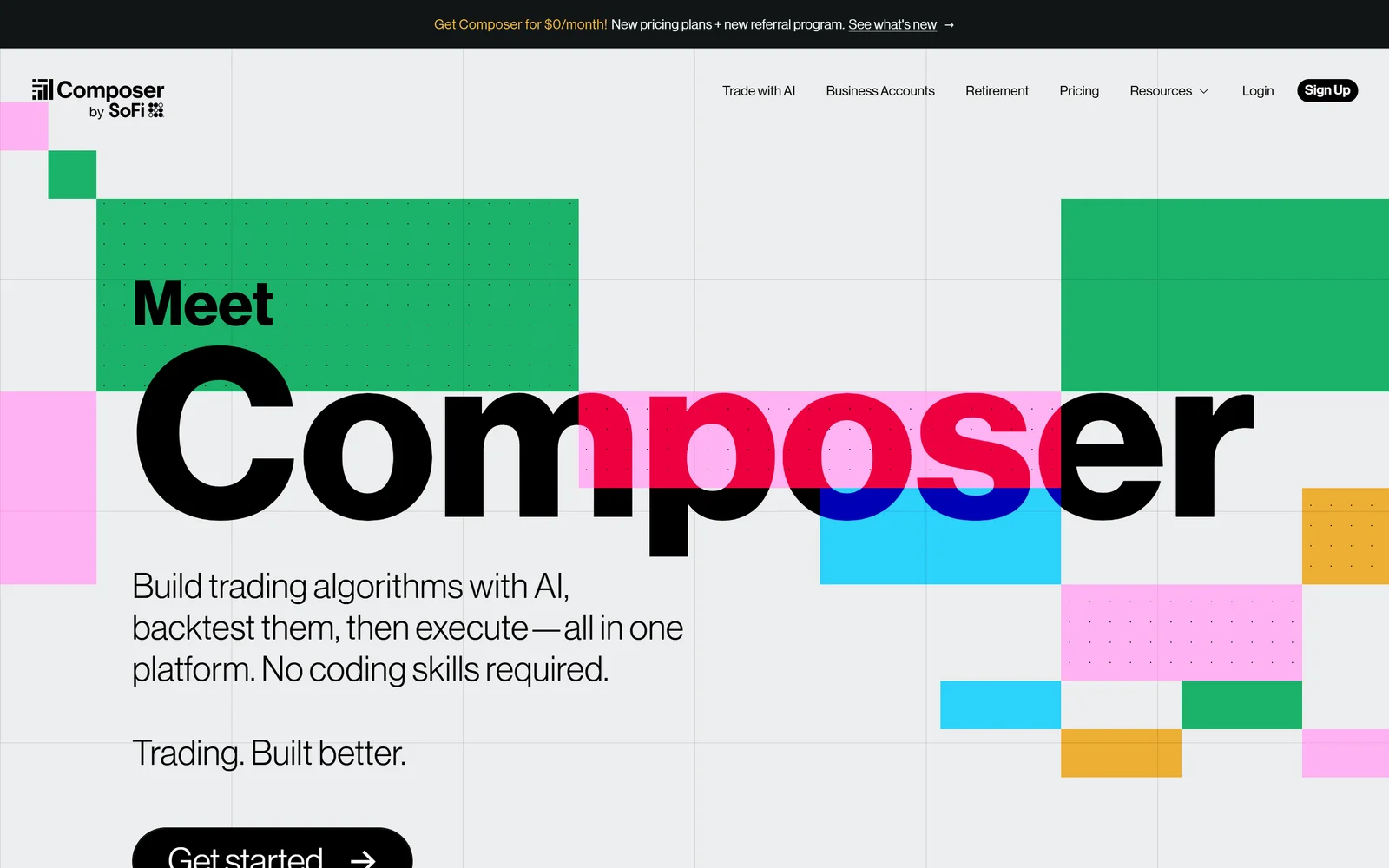
Composer’s homepage, captured 17 September 2026. It is the only tool here that is itself an SEC-registered broker-dealer rather than software pointing at one.
The Real Question Isn’t “Does the AI Work” — It’s “Can You Get Your Money Back When It Doesn’t”
A self-directed investor evaluating an AI research subscription faces a peculiar problem: the product’s core claim is the one thing you cannot test before paying. Trade Ideas gates its Holly AI signals behind a $2,136/year tier and offers no conventional free trial, only “Test Drive events on a bimonthly basis” (per its billing policy, read 17 September 2026) — while its own billing page states “ALL SALES ARE FINAL. Trade Ideas will allow for store credit or exchanges.” Danelfin’s headline performance is explicitly backtested: its Best Stocks Strategy page states the strategy “was backtested using Monte Carlo simulations covering the period from January 3, 2017, to June 9, 2025.” AlphaSense will not publish a price at all, and its Customer Contract states “all Fees are quoted in United States currency and are non-refundable.”
The second problem is that the number you evaluate today may not be the number an earlier subscriber saw. Danelfin’s July 2025 blog post announcing a new US model says AI Score 10 stocks “now show a +21% expected annualized alpha, up from +15% in the previous model” and that “Historical scores have also been updated to reflect the new model’s analysis.” That is a legitimate, disclosed model upgrade — but it means the track record is restated each time the model ships. Its own help centre article “Are AI Scores reliable?” still carried the older +14.69% figure when read on 17 September 2026. Buyers reading the sales page and the help centre get different numbers.
Separately, and involving none of the companies in this article: the SEC has brought enforcement actions on exactly this theme. On 18 March 2024 (release 2024-36) it charged two unrelated advisers, Delphia (USA) Inc. and Global Predictions Inc., with overstating their AI capability, with penalties of $225,000 and $175,000. Then-Chair Gary Gensler said: “Investment advisers should not mislead the public by saying they are using an AI model when they are not.” An earlier action (release 2023-173, 11 September 2023) charged nine advisers over hypothetical performance in advertising, with penalties totalling $850,000. Neither action involves Composer, Danelfin, AlphaSense, Trade Ideas or Tickeron. They are cited here only to explain why every performance figure below is labelled by source, period and whether it is backtested.
This article is information about software, not financial advice. Nothing here is a recommendation to buy, sell or hold any security, and no tool described here can predict markets. Consult a licensed financial adviser before acting on anything you read in a software review.
1. Why AI Investing Tool Buyers Get Burned (In Their Own Words)
1. The headline win rate is unaudited, and you cannot check it before you pay. Trade Ideas’ own Holly records page states: “Figures shown are profit potential. Each is measured from Holly AI’s signal price to that session’s high (buy signals) or low (short signals). They are moves our premium subscribers could have captured, not realized profits.” No aggregate win rate is published.
“Their Holly AI engine is very weak. I don’t see the 60% success they tout.” — Darryl Clemmons, Trustpilot 1 star, 6 April 2026 (read 17 Sep 2026). One named customer’s opinion, not a measured hit rate.
“Backtested results don’t always translate to real-world performance due to trading costs, slippage, and changing market conditions.” — Aditya Raghunath, WallStreetZen review of Danelfin, last updated 15 July 2026.
2. Refund policies are either “final sale” or simply absent from the documents. Trade Ideas publishes “ALL SALES ARE FINAL” on its billing-policies page. Composer’s Payment Agreement — the document that by its own first line “governs the fees, billing, renewal, cancellation, and other payment terms” — contains no refund, proration or money-back clause at all.
“I asked for refund which they refused.” — Trade Ideas Trustpilot, 2 stars, 2 January 2026. This is consistent with the vendor’s own published policy rather than contradicting it.
3. Auto-renewal is on by default and the vendor puts the cancellation burden on you. Trade Ideas states plainly: “Trade Ideas is not responsible for continued subscriptions should a client forget to cancel their account. It is the customer’s responsibility to confirm the cancellation.”
“the inability to turn the service off” — Tickeron Trustpilot, 1 star, 25 February 2025 (read 17 Sep 2026). A Tickeron reviewer named Ken separately alleges the company “turns on its autopay feature without its customers knowledge so that it can charge your account without you knowing” — an unverified single-customer allegation, not an established fact.
4. Scores move fast enough to make a rules-based approach hard to follow.
“ETF ratings fluctuate like crazy. Just yesterday SPY was rated 10, the next day it gapped down to 4.” — Danelfin Trustpilot, 3 stars, 16 April 2025. The same reviewer says ratings move “from a buy ‘10’ to a Hold or Buy in the space of a week.”
“67 stocks in US market. All entered at rating 10 with TP and SL. Market UP +7%, Danelfin Portfolio -4.6%” — Danelfin Trustpilot, 1 star, 18 September 2025. The review states no holding period.
5. The advertised price is a floor, not a ceiling. Composer’s pricing page states “Additionally, FINRA & SEC Regulatory fees are charged on the sale of securities.” Trade Ideas’ EULA states “All Subscriptions are exclusive of Exchange Fees and taxes.” Procurement firm Vendr reports AlphaSense expert-call and premium-content add-ons running at 20–40% of total contract value — Vendr negotiates contracts for a living, so treat that as an interested estimate.
“The high price point can be a sticker shock for smaller accounts.” — Riley A., Digital Marketer, Trade Ideas Capterra, 5 stars, May 2022.
“It’s expensive especially with free screeners out there but once I’ve set up my needs it runs so well.” — Lauren W., Trade Ideas Capterra, 5 stars, August 2022.
6. The AI feature you upgraded for is metered, and the meter is invisible. Composer’s help centre confirms “Every member gets a weekly token allowance depending on their plan,” but the absolute numbers are never published — only relative multipliers (Advanced 3x, Pro and Business 6x) buried in the pricing page’s embedded JSON.
“By the time I finally found the promising candidate, I hit the Discover / AI limit and could not continue evaluating the symphony until the reset.” — Composer Trustpilot, 2 stars, 6 May 2026.
“I’m getting increasingly frustrated with Composer’s Discover / AI usage limits.” — Ron Beech, Composer Trustpilot, 2 stars, 6 May 2026.
2. How We Ranked Them
Seven criteria, weighted: capability depth (2x), value for money (1.5x), billing fairness (1.5x), trust and security (1x), ease of getting started (1x), free tier (0.75x) and support and docs (0.75x).
Capability carries double weight because a research tool that cannot do the work is worthless at any price. Value for money and billing fairness carry 1.5x jointly because this category is unusually hostile on the commercial side: final-sale policies, 90-day cancellation windows, countdown-timer discounts and undisclosed metering are the norm, not the exception. Trust and security covers published certifications, regulatory registration verified against primary sources, and whether the vendor’s own pages agree with each other. Free tier is weighted lowest but not zero, because in a category where the core claim cannot be verified before purchase, a genuinely usable free tier is the only pre-purchase test that exists.
This weighting is what puts a high-capability product like AlphaSense in third place: its capability score is the strongest in the set, and its value-for-money, free-tier and billing-fairness scores are the weakest. The maths is explained in that section.
Every price, rating, review count and registration status below was re-verified at source on 17 September 2026. Registration facts were checked against FINRA BrokerCheck and the SEC’s Investment Adviser Public Disclosure system directly, not against vendor marketing.
3. Composer: The Only One That Is Actually the Broker
Composer Securities LLC is an SEC-registered, FINRA and SIPC member broker-dealer, so the strategy and the order live in the same place.
Composer’s structural advantage is that the idea, the backtest and the executed order all happen inside the same regulated entity. Its disclosures page states: “Securities products and brokerage services are offered by Composer Securities LLC, a broker-dealer registered with the SEC and member of FINRA / SIPC.” We confirmed that independently against FINRA BrokerCheck’s API on 17 September 2026: COMPOSER SECURITIES LLC, CRD 325118, SEC number 8-71057, status ACTIVE, no disclosure events. That is the correct answer to reviewer confusion about why the signup asks for a Social Security number — it is a brokerage account.
One important correction to Composer’s own site: its homepage FAQ structured data still asserts Composer is “a Registered Investment Advisor with the Securities and Exchange Commission,” and a Form ADV brochure remains posted at /legal/brochure. The SEC’s IAPD API, queried 17 September 2026, shows COMPOSER TECHNOLOGIES (SEC number 801-119952) as INACTIVE and Terminated effective 6 December 2024. Composer’s own Trade with AI Terms (v2, 20 March 2026) agree: “Composer is not an investment advisor.” Treat the relationship as self-directed brokerage, not advisory.
Pricing, verified against the pricing page’s embedded JSON, the Payment Agreement and the fee-schedule PDF dated 15 September 2026: Starter $0/month, Advanced $10/month (monthly only — no annual price exists), Pro $40/month or $384/year, Business custom. Note the display trap: the Pro card on the pricing page renders only with “Billed yearly” pre-selected, showing “$32/mo.” and “$384/yr”. The true $40 monthly price appears nowhere on that page. Tier limits are measured in nodes — 200 for Starter, 350 for Advanced, 10,000 for Pro — and that node ceiling, never explained in nodes on the public page, is the real gate on strategy complexity. Starter is permanent, includes one live automated strategy and unlimited backtesting, and is the only genuine idea-to-execution free tier in this comparison. There is no free trial of a paid plan; the pricing FAQ says so flatly (“There’s no trial”), even though the /ai page’s main button still reads “Start free trial.”
The weakness is execution fidelity, and Composer documents it itself. Automated trades run in one window: “On normal market days, Composer’s trading period is from 3:45 PM to 4:00 PM Eastern Time.” All instructions are “not held” orders, which Composer explains gives it “price and time discretion in handling the order,” adding that customers for whom that control matters “may need to consider alternative investment platforms for those strategies.” The mitigation — priority trade timing at 3:55 PM ET — is Pro-only and off until you email support. Backtests use daily adjusted closing prices with a default 1-basis-point slippage assumption, which Composer concedes “don’t represent real quotes from any point during the trading day.” Liability is capped at “ONE HUNDRED DOLLARS ($100)” or twelve months of fees. And composer.trade/security, /trust and /status all return HTTP 404: no SOC 2, ISO 27001, PCI DSS or penetration-test attestation is claimed anywhere, though the homepage FAQ does document 2FA and a 30-minute inactivity logout.
Evidence is split. The Apple App Store shows 4.4 from exactly 673 ratings (via Apple’s own lookup API, 17 Sep 2026). Trustpilot shows 2.7 from 27 reviews, 52% one-star and 0% three- or four-star — a barbell with no middle. Both samples are small; the Trustpilot profile also shows four five-star reviews all dated 27 February 2026, a pattern consistent with a solicitation campaign. SoFi announced the acquisition on 23 June 2026; terms were not disclosed.
The Good (Pros)
The Bad (Cons)
#1 · It is the broker
SEC-registered broker-dealer, free tier runs a live strategy
CRD 325118 with no disclosure events on BrokerCheck as of 17 September 2026. Automated trades are compressed into a 15-minute window each afternoon, and there is no published refund policy.
Visit Composer
4. Danelfin: One Daily Score, Explained Well, Proven Only in Backtests
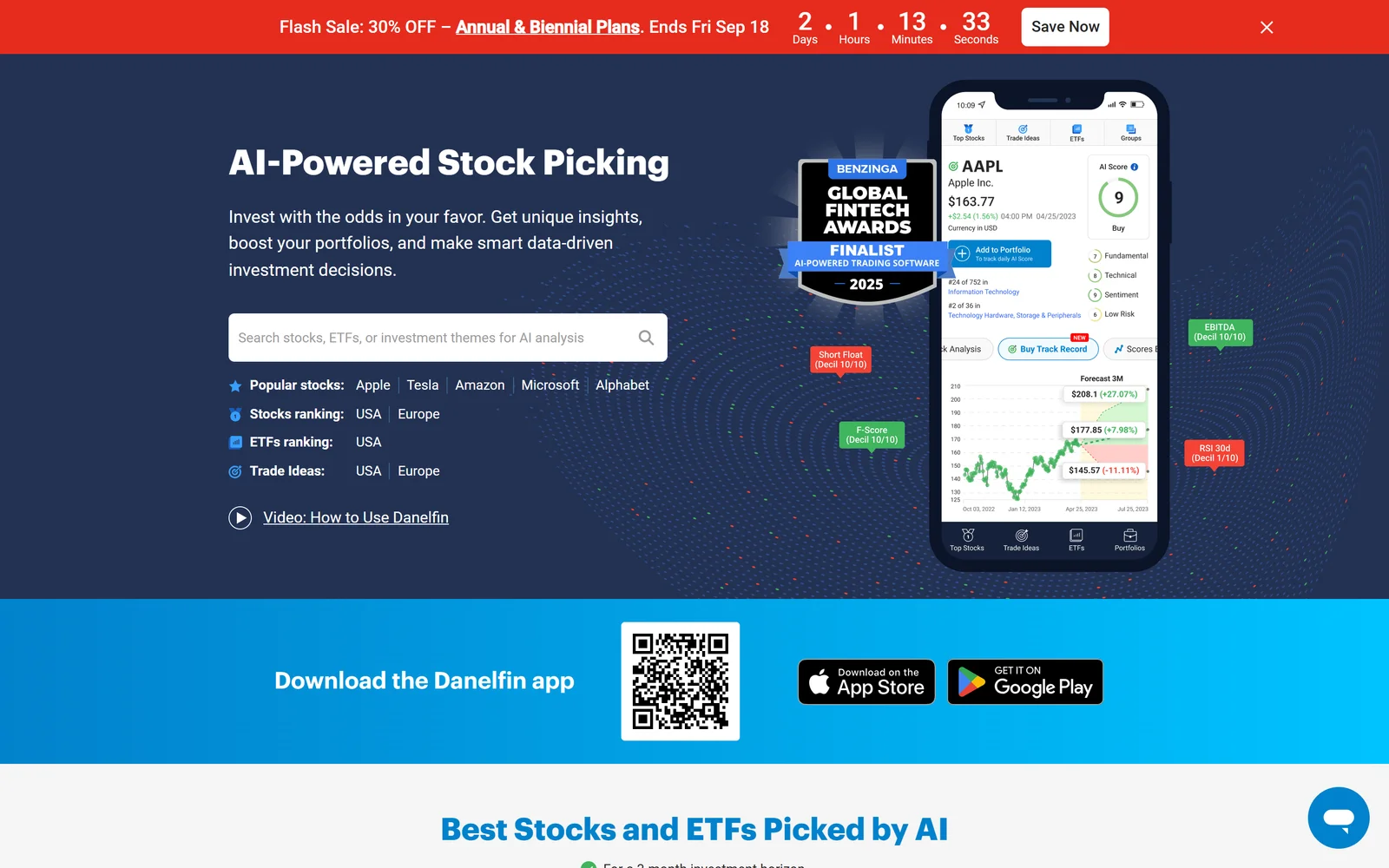
Danelfin explains which alpha signals drove each daily score, and states plainly that its performance figures have never been independently audited.
Danelfin is a subscription analytics platform operated by Danelfin Technologies, S.L. It is not a broker and executes no trades. Its How-it-Works page describes a platform that “rates stocks and ETFs with an easy-to-understand global AI Score, ranging from 1 to 10; the higher the score, the higher the probability of beating the market in the next 3 months.” The score is a probability rank, not a price target, benchmarked to the S&P 500 TR for US names and STOXX Europe 600 for European ones. Crucially, Danelfin explains that a 10/10 is relative odds, not a better-than-even bet: it notes “only 34.63% of all the US-listed stocks have outperformed the S&P 500 in a 3-month timeframe” over the last 12 months, and its own worked example gives USB “a 48.56% probability of beating the market in the next 3 months” while still scoring 10/10.
What Danelfin does better than anyone here is make itself cheap and easy to interrogate. The API Free tier is $0 forever at 500 calls/month and, unusually, includes “All US-listed stocks/ETFs and main European stocks” with “All daily AI scores since 2017” — the same coverage as the $599/month API Max tier, just metered harder. (One caveat Danelfin discloses in its docs: European historical data only goes back to 3 January 2022, so “since 2017” is US-only.) It also ships a first-party hosted MCP server, announced 6 May 2026, installable with the single command printed on its landing page, and it works on that free key. Per-stock explainability names the alpha signals and their decile context rather than handing you an opaque number.
Website pricing read on 17 September 2026: Free $0, Plus $29/month, Pro $79/month, Elite $179/month. The annual page showed struck-through list rates beside promotional ones — Plus $22 → $16/month billed $184.80/year, Pro $59 → $42/month billed $495.60/year, Elite $134 → $94/month billed $1,125.60/year — each labelled “30% OFF for the first year.” Two things to note. The monthly-equivalent figures are rounded up: $184.80/year is $15.40/month, shown as $16. And because the promotion is stated as exactly 30% off the displayed list rate, the implied undiscounted annual totals are $264, $708 and $1,608 — arithmetic derivations, not printed prices. Danelfin corroborates the middle one in a public Trustpilot reply dated 26 February 2026: “The subscription selected was Danelfin Pro billed annually, which is $59/month billed as $708 per year.” A live countdown sat above the text “Only for new annual or biennial plan subscriptions, first term only. Valid until Friday, Sep 18,” so renewal reverts to list.
The weakness is that everything you are paying up to roughly $1,608 a year for rests on backtests Danelfin itself has never had audited. Asked “Has it been independently audited?” about its AI Price Forecast, its help centre answers: “The forecast is validated internally through out-of-sample backtesting and ongoing review. It has not undergone a formal third-party audit.” The dashboard at audit.danelfin.com is Danelfin’s own self-published backtest dashboard, not a third-party audit. Its price-forecast validation “covers 2023–2024 outcomes, so it does not include the 2020 COVID crash or the 2022 bear market. That is an honest gap.” Published alpha figures — US 10/10 at “+21.05% on average after 3 months (annualized alpha)” against -33.28% for 1/10 — are recalculated retroactively with each model release. Danelfin publishes no SOC 2, ISO 27001 or any other security certification; danelfin.com/security returned “Page Not Found.” Its Disclaimer excludes liability entirely rather than capping it, and its API terms forbid redistributing or publicly displaying scores without written consent, which rules out building on it.
Trustpilot: 3.6 from exactly 35 reviews (63% five-star, 20% one-star), only 7 in the last 12 months. Trustpilot’s own panel notes “Replied to 100% of negative reviews.” The dominant complaint pattern is annual-billing shock followed by a fast refund: Joe Piskulic’s review, updated 6 March 2026, reads “I was still charged not $12 but $708. Asking for a refund,” then “After requesting a refund, I did in fact receive a full and complete refund in a manner of a day or two. Thank you Danelfin.”
The Good (Pros)
The Bad (Cons)
#2 · Explains its own score
A daily 1-10 score with the signals behind it named
A free-forever 500-call API tier and a first-party MCP server. Its published performance is backtested, has no third-party audit, and is recalculated whenever the model changes.
Visit Danelfin
5. AlphaSense: The Best Research Corpus Here, Priced for Institutions Only
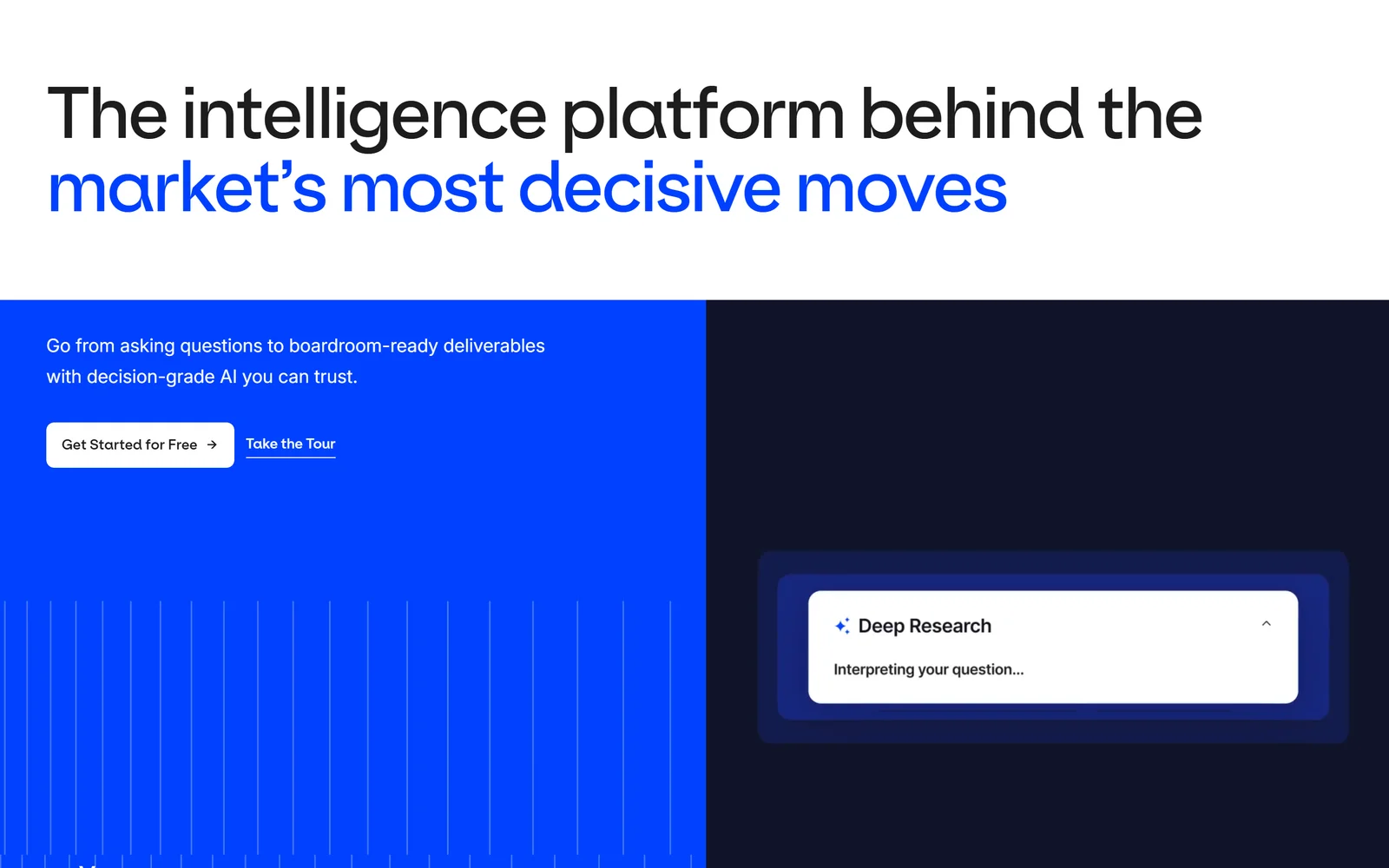
AlphaSense’s advantage is licensed content no consumer tool can legally reach: sell-side research from 1,000+ firms and 300,000+ expert transcripts.
AlphaSense scores highest in this set on capability and lowest on almost everything a retail buyer cares about, which is exactly why a 2x capability weight still leaves it third. Its advantage is a content-licensing moat rather than an AI moat: one agentic, citation-backed AI running across licensed sell-side research from “1,000+ sell-side and independent firms” (naming Morgan Stanley, J.P. Morgan, Bank of America, Barclays, HSBC, Macquarie and Deutsche Bank, with “exclusive partnerships with Citi and Goldman Sachs”), “300,000+” expert-call insights, and the customer’s own internal documents. No consumer research tool or general-purpose deep-research assistant can legally touch that corpus.
The security posture is also the only serious one here. AlphaSense holds SOC 2 Type 2 and ISO/IEC 27001, uses TLS 1.2+ in transit and AES-256 at rest, runs third-party penetration testing, and states “LLMs are never trained on customer uploaded data. We work exclusively with LLM vendors who adhere to a strict zero data retention policy.” Its privacy notice adds a carve-out worth reading: it does not train generative models on customer data “except where expressly agreed with the customer.” It is explicitly not ISO/IEC 42001 certified — its own security page says it “is seeking” that.
Now the reason it drops. There is no published price anywhere. The pricing page contains zero dollar figures and reads: “We provide annual subscriptions for all team sizes, ranging from enterprise packages to per-seat options. Please reach out, and a member of our team will be in touch to discuss pricing.” The only concrete numbers come from procurement marketplace Vendr, which reports a median annual contract value of $18,000 across 39 recorded purchases, ranging $9,500 to $51,600 — third-party estimates from a firm whose business is negotiating contracts down, not AlphaSense list prices. Billing fairness is the second hit: fees are “non-refundable,” you cannot cancel mid-term, declining renewal requires written notice at least 90 days before term end, and renewals escalate by “the greater of (i) 5% or (ii) CPI.” There is no free tier — only a sales-gated trial with no published duration or usage limits.
The third hit is fit. AlphaSense does not score, rate, rank or recommend securities, and automates no trading decision. Its Customer Contract states the content “SHOULD NOT BE USED AS A SUBSTITUTE FOR ORIGINAL RESEARCH OR EXPERT OPINIONS, NOR BE INTERPRETED AS LEGAL, INVESTMENT, FINANCIAL, MEDICAL, OR ANY OTHER PROFESSIONAL ADVICE,” and warns in capitals that its AI “MAY STILL OCCASIONALLY GENERATE INCORRECT, INCOMPLETE, MISLEADING, IRRELEVANT, OR NONSENSICAL INFORMATION.” For an analyst at a fund, that is the correct product. For a self-directed retail investor looking for equity decisions, it delivers none of the category’s implied automation at roughly 8x the cost of the most expensive retail alternative here.
Scale is not in doubt: $350 million raised on 3 June 2026 at a $7.5 billion valuation, ARR above $600 million as of Q1 2026, and “more than 7,000 global enterprises” as customers. The iOS app rates 4.5 from 80 ratings. Its Trustpilot profile is unclaimed with 0 reviews, so no Trustpilot score should be cited for it.
The Good (Pros)
The Bad (Cons)
#3 · Best research corpus
Licensed sell-side research and expert transcripts in one search
Citation-backed AI across a corpus general assistants cannot access. Quote-only pricing, fees non-refundable, 90 days’ notice to stop renewal, and renewals escalate by at least 5%.
Visit AlphaSense
6. Trade Ideas: A Real-Time Scanner Whose AI You Cannot Test First
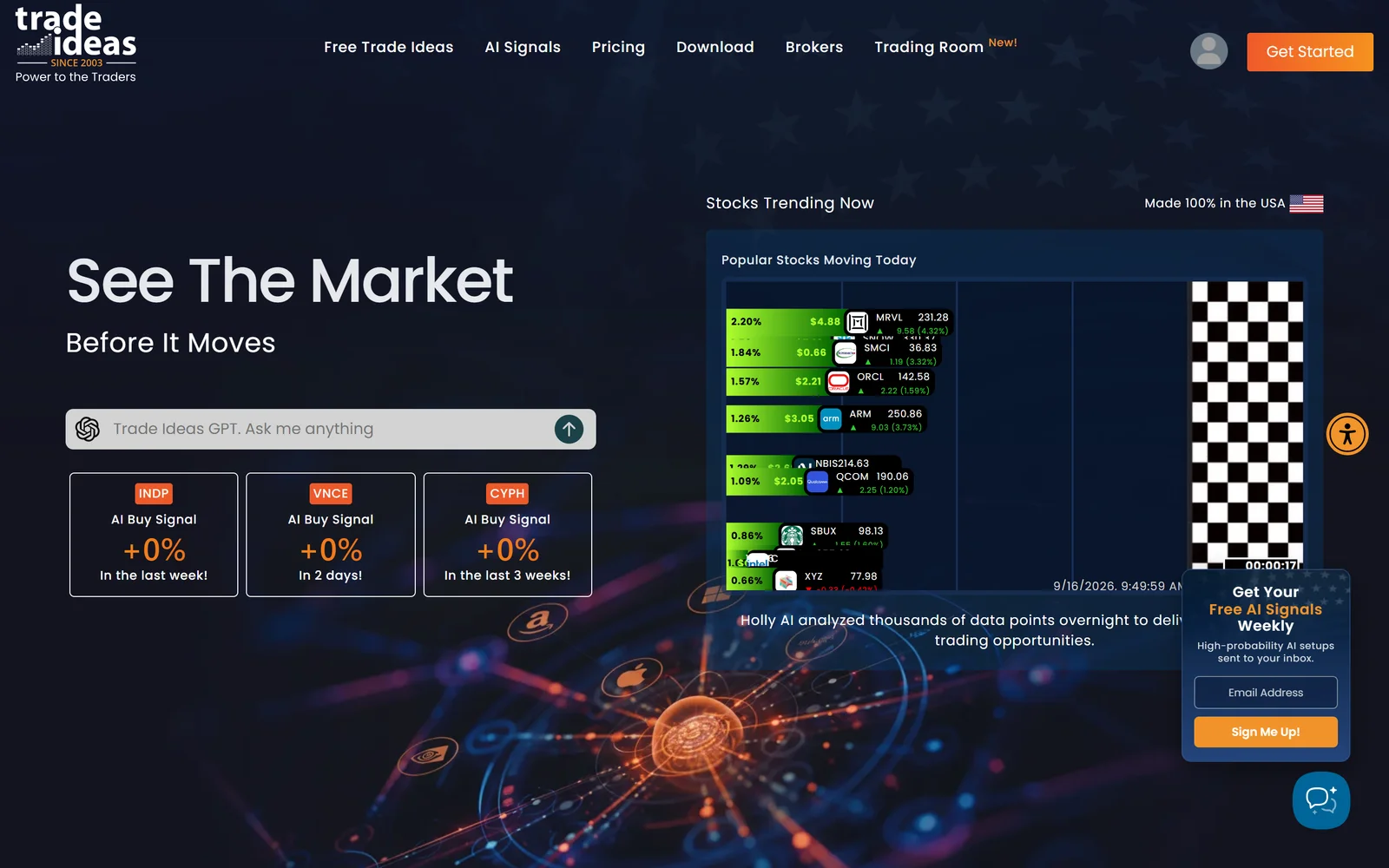
Trade Ideas routes from real-time scan to executed order across seven named brokers, and publishes no audited win rate for its AI engine.
Trade Ideas is the oldest company here, founded in 2003 and bootstrapped — the vendor says it grew “organically without outside investment.” Its strength is discovery-to-execution in one window: 500+ alert and filter data points, real-time scanning, and one-click or automated routing into seven named brokers (Moomoo, TradeStation, Centerpoint Securities, Cobra Trading, Interactive Brokers, E*TRADE and Alpaca). The TradeStation integration is the deepest documented, covering equities and options orders and position management through Brokerage Plus.
Pricing on trade-ideas.com/pricing, 17 September 2026: The Core (TI Standard) at $1,068 billed annually or $127/month; The Apex (TI Premium) at $2,136 annually or $254/month. The vendor’s saving maths checks out ($127 × 12 = $1,524 against $1,068). The problem is what sits on which side of the line. TI Standard gets real-time data, 10 charts on screen, customisable scans and screeners, paper trading and in-app trading — and no AI, no backtesting, no automated trading. Every AI feature is Premium-only: “1st Gen AI Signals,” backtesting, Smart Risk Levels, auto trading. A buyer who wants Holly pays $2,136/year, full stop.
That matters because the AI’s advertised results are unverifiable by design, and Trade Ideas says so. Its Holly records page states: “Figures shown are profit potential… They are moves our premium subscribers could have captured, not realized profits,” adding “These are selected examples. Not every signal is profitable and losses can occur.” No aggregate win rate or audited return is published. The vendor also declines to fix how many strategies Holly runs: “The exact number of strategies Holly uses might vary over time.” Its disclosure page is genuinely candid about why subscriber results diverge from model results, naming commissions, “lack of liquidity,” and that “server, delivery delays and other factors may cause the price you obtain to differ substantially from the price at the time of the alert.”
And you cannot try before buying or recover after. There is no conventional free trial — only paid “Test Drive events,” whose frequency the vendor’s own pages describe inconsistently (“bimonthly” on the billing page versus “Several times a year” on the Test Drive signup page). No official Test Drive price is published. The free account is time-boxed with data “delayed by 15 minutes,” and the duration is never disclosed. Sales are final with store credit only. Liability is capped at twelve months of fees, roughly $2,136 for a Premium annual subscriber. Security certifications are confirmed absent: /security/ returned 404, and the only safeguard the privacy policy describes is your own password — though it does carry a notable anti-front-running clause barring employees from trading on customer data, and names a Data Protection Officer.
Ratings diverge sharply by platform. Trustpilot: 3.7 from 48 reviews, 50% five-star and 40% one-star with nothing in between. Capterra: 4.6 from 38 reviews, with Value for Money its lowest sub-score at 4.4. Fewer than 100 reviews total for a 23-year-old company. One named Capterra reviewer, Joseph V. (Owner, 1 star, August 2026), writes “Customer support non-existent…I’ve tried emailing, calling over and over and get no response,” which sits against a 4.6 average on the same page. Note also that Trade Ideas’ self-reported volume figures contradict each other on the same day: “108M Shares Traded In August” on the pricing page versus “Our subscribers finished June trading 63M shares” on the homepage.
The Good (Pros)
The Bad (Cons)
#4 · Scanner to broker in one window
500+ alert types routed into seven brokers
A bootstrapped company operating since 2003 with no outside investment. Holly costs $2,136 a year with no free trial, and its own billing page states all sales are final.
Visit Trade Ideas
7. Tickeron: Broad Product Line, Storefront That Contradicts Itself
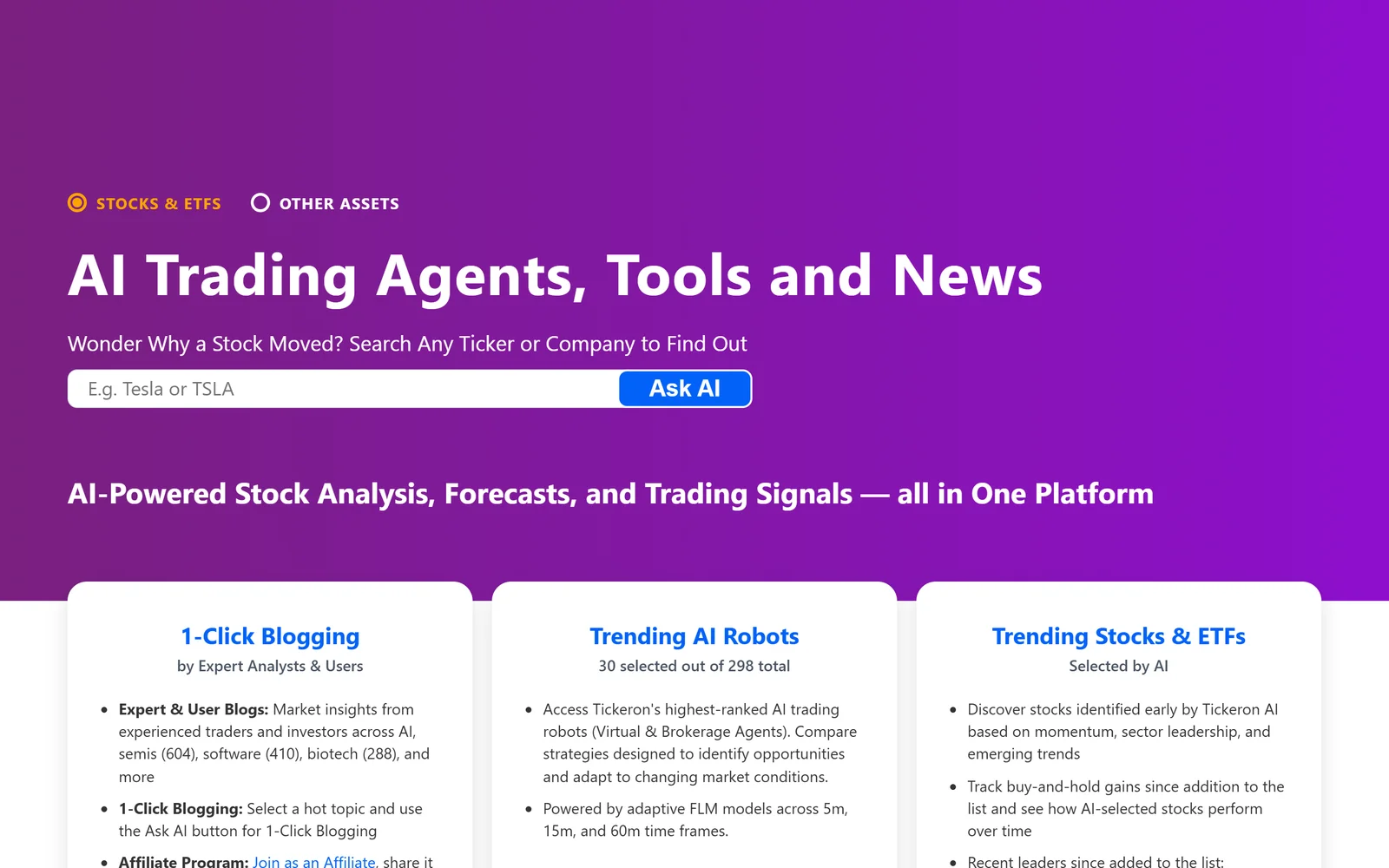
Tickeron sells seven distinct tools across stocks, ETFs and crypto, on a storefront whose plan cards contradict its own tab labels.
Tickeron sells more distinct products than anyone here for the money. Its footer lists seven: Real Time Patterns Stocks & ETFs, Real Time Patterns Crypto, Pattern Search Engine, AI Robots, Trend Prediction Engine, Screener and Time Machine. It publishes a free “Beginner” tier, ships both iOS and Android apps, and prices its individual products à la carte with the annual rate visible — Daily Buy/Sell Signals at “$240/yr $60/yr ( $5/mo )”, AI Robots (60-minute machine learning) at “$1,080/yr $540/yr ( $45/mo )”, and AI Robots Unlimited (60min, 15min and 5min timeframes) at “$3,000/yr $1,500/yr ( $125/mo )”, the most expensive publicly priced item on the site.
The problem is that the storefront does not agree with itself. On 17 September 2026 the pricing page rendered three plan cards — Beginner (Free), Intermediate One ($90/mo) and Intermediate Two ($145/mo) — above which sat tabs labelled Swing Trader, Day Trader and Expert that rendered no prices at all. Whatever the intended architecture, a buyer cannot map the cards to the tabs. No price for the top “Expert” tier rendered anywhere, so Expert pricing must be treated as unpublished. The page simultaneously pushed a “Labor Day Sale — Up to 75% Off” banner in two separate places, more than a week after US Labor Day 2026 fell on 7 September, with the discounted figures shown as the standing price.
The trial does not de-risk the purchase either. The pricing page offers “Try 14 days for Free” but qualifies it verbatim: “except for AI Robots, Expert Membership, Buy/Sell Signals and annual subscriptions.” Those four exclusions cover essentially everything a buyer would be evaluating. The marketing landing page confirms payment details are captured up front — “Your card will not be charged until the end of the trial period” — so the subscription converts automatically unless cancelled. The page does state “You can unsubscribe and/or downgrade to Beginner at any time.”
On registration: Tickeron’s landing page lists “Registered investment advisors” as a platform feature bullet. Independently checked against the SEC’s IAPD on 17 September 2026, TICKERON, INC. (SEC file 801-79039, firm ID 170121) shows investment-adviser scope as INACTIVE with a disclosure flag of “N” — no disclosure events. Deregistration by a firm repositioning as a software vendor is a routine, lawful filing, and the record shows no enforcement action of any kind. The fact to carry forward is simply that Tickeron is software, not a registered adviser, and the marketing bullet sits awkwardly against that.
Supporting evidence is thin and unfavourable. Trustpilot: 3.2 from exactly 27 reviews, 37% five-star and 56% one-star. The iOS app, “Tickeron Stock Signals & Bots,” rates 1.8 from exactly 17 ratings, with its most recent release version 1.2 dated 23 February 2023 — no update in over three and a half years. The BBB profile for Tickeron (Reno, NV), read 17 September 2026, shows a rating of F, not accredited, with 5 complaints closed in the last three years, attributed in part to “Failure to respond to 5 complaint(s) filed against business.” SEC EDGAR records $10,000,150 of disclosed equity fundraising across two Form D filings, with no SEC offering filing of any kind since August 2014. Even the founding year is inconsistent across the company’s own documents: the footer reads ”© 2013-2026,” the 2012 Form D states incorporation in 2011, and the 2014 Form D states 2013.
The Good (Pros)
The Bad (Cons)
#5 · Widest product line
Seven tools across stocks, ETFs and crypto
Machine-learning models at three timeframes, with a genuinely free entry tier. The 14-day trial excludes AI Robots, Expert Membership, Buy/Sell Signals and annual plans.
Visit Tickeron
Scored Comparison Chart
The chart shows an unusual shape for a software comparison: the highest-capability product finishes third, and the winner wins on structure rather than on features. Composer’s 7.03 comes from being simultaneously the cheapest way in ($0 permanent Starter with a live strategy), the only independently verified regulated broker in the set, and a product whose main capability gaps are disclosed by the vendor rather than discovered by the buyer. It does not win on sophistication.
AlphaSense’s 4.88 is the clearest illustration of what the weighting does. Under a capability-only ranking it would finish first by a distance — nothing else here has licensed sell-side research from 1,000+ firms, SOC 2 Type 2 and ISO 27001, or agentic search over your own internal documents. Three criteria drag it down. Value for money (1.5x): no published price at all, with Vendr’s third-party estimate putting the median at $18,000/year. Free tier (0.75x): none exists, only a sales-gated trial with no published duration. Billing fairness (1.5x): non-refundable fees, no mid-term cancellation, 90 days’ notice to decline renewal, and automatic escalation at the greater of 5% or CPI. Together those carry 3.75x of weight against 2x of capability, and that is the whole story of third place.
At the bottom, Trade Ideas (4.19) and Tickeron (3.62) lose on the same axis for different reasons. Trade Ideas is a capable scanner undone by billing fairness: “ALL SALES ARE FINAL,” no real trial, and AI locked behind $2,136/year. Tickeron loses on ease of getting started and trust — a pricing page whose cards and tabs disagree, a trial that excludes its flagship products, a BBB rating of F read on 17 September 2026, and an iOS app untouched since February 2023. Note that every Trustpilot sample here runs between 27 and 48 reviews, so none of these averages is a measurement; they are weak signals that happen to point the same way as the vendors’ own published terms.
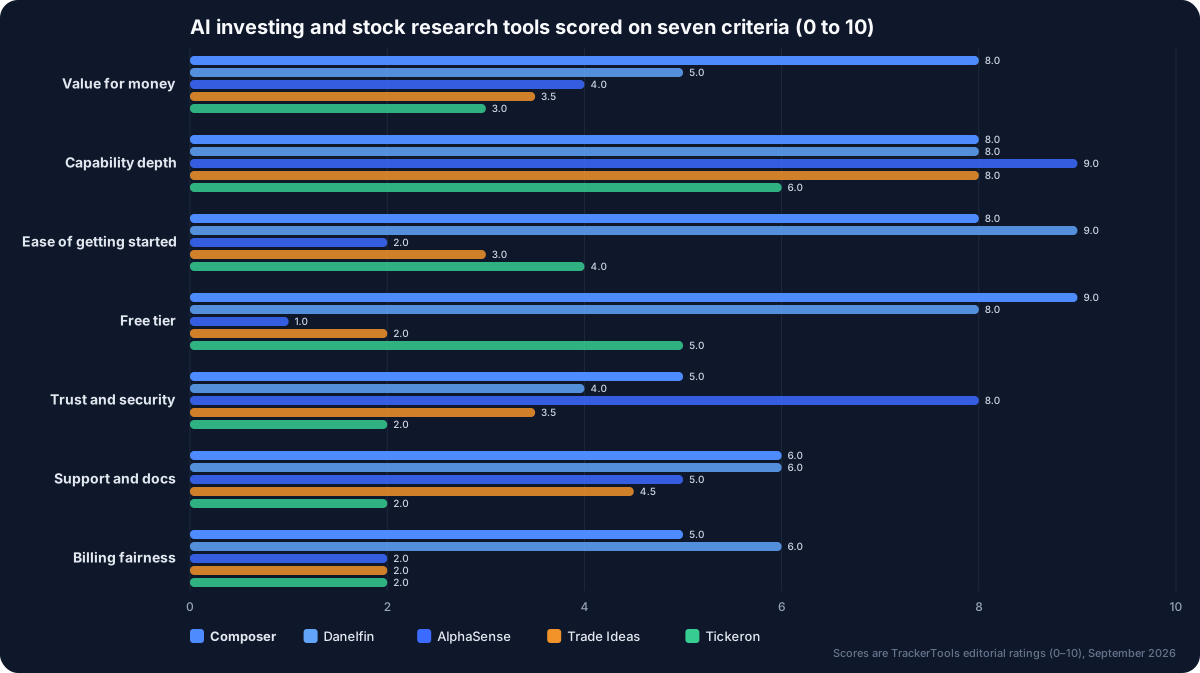
Seven criteria, five tools. What separates them is not model quality, which none of them let you verify, but registration, refund terms and whether you can test the product before paying.
Pros and Cons Matrix: Who Solves Which Pain Point
| Pain point | Composer | Danelfin | AlphaSense | Trade Ideas | Tickeron |
|---|---|---|---|---|---|
| Test before you pay | ✓ Free live strategy | ✓ Free API + 14-day trial | ✗ Sales-gated only | ✗ Paid Test Drive only | ⚠ Trial excludes flagships |
| Refund available | ⚠ None published | ✓ 30-day guarantee | ✗ Non-refundable | ✗ All sales final | ⚠ Terms unverifiable |
| Easy cancellation | ✓ Self-serve, stays open | ✓ Self-serve or email | ✗ 90-day notice | ⚠ Self-serve, your burden | ⚠ Downgrade anytime |
| Verifiable track record | ⚠ Backtests, hindsight flagged | ⚠ Backtested, unaudited | ✓ Sells no track record | ✗ Profit potential only | ✗ None publishable |
| Clear published pricing | ⚠ Monthly Pro hidden in JSON | ⚠ List rate only implied | ✗ No figure anywhere | ✓ Two tiers, exact | ✗ Cards contradict tabs |
| Security attestation | ✗ None; 2FA documented | ✗ None published | ✓ SOC 2 Type 2, ISO 27001 | ✗ None; /security 404 | ✗ None advertised |
| Regulatory clarity | ✓ Broker-dealer verified | ✓ Software only, says so | ✓ Disclaims advice | ✓ Publisher, not adviser | ⚠ Adviser status inactive |
Pricing at a Glance
| Platform | Free tier | Cheapest paid | Top published tier | Trial | Refunds | Rating (read 17 Sep 2026) |
|---|---|---|---|---|---|---|
| Composer | $0 Starter, permanent, 1 live strategy | $10/mo Advanced | $40/mo or $384/yr Pro (Business custom) | None (“There’s no trial”) | No clause published | Trustpilot 2.7/5 (27); App Store 4.4 (673) |
| Danelfin | $0 web tier + $0 API, 500 calls/mo | $29/mo Plus | $179/mo Elite ($1,608/yr implied list) | 14 days on Plus/Pro/Elite | 30-day money-back guarantee | Trustpilot 3.6/5 (35) |
| AlphaSense | None | Not published | Not published (Vendr median $18,000/yr, n=39) | Sales-gated, length unpublished | ”Non-refundable” | App Store 4.5/5 (80); no Trustpilot presence |
| Trade Ideas | Time-boxed, 15-min delayed data | $127/mo or $1,068/yr Core | $254/mo or $2,136/yr Apex | Paid Test Drive, price unpublished | All sales final; store credit | Trustpilot 3.7/5 (48); Capterra 4.6/5 (38) |
| Tickeron | Beginner, free | $90/mo Intermediate One | Expert: not published ($1,500/yr AI Robots Unlimited) | 14 days, excludes AI Robots, Expert, Signals, annual | Not verifiable at source | Trustpilot 3.2/5 (27); App Store 1.8/5 (17) |
Which One Should You Actually Pick?
Composer — if you want to automate a rules-based strategy and test the whole loop for nothing. It is the only platform here where you can write a strategy, backtest it over a 30-year window, and have a verified SEC-registered, FINRA/SIPC-member broker-dealer execute it, all on a $0 plan. Caveat: every automated trade lands in the 3:45–4:00 PM ET window as a “not held” order, and the 3:55 PM mitigation is Pro-only and requires emailing support to switch on.
Danelfin — if you want one daily quantitative score you can query programmatically and interrogate signal by signal. The free 500-call API and the hosted MCP server make it the cheapest serious evaluation in the category, and the 30-day money-back guarantee is the only published one here. Caveat: every performance figure is backtested, has never been independently audited, and is restated whenever a new model ships.
AlphaSense — if you are an analyst at a firm with a research budget and a procurement team. Nothing else gives you licensed sell-side research, expert-call transcripts and your own internal documents under one citation-backed AI. Caveat: it scores nothing and trades nothing, and the contract is non-refundable with no mid-term exit and a 5%-or-CPI renewal escalator.
Trade Ideas — if you are an active intraday scanner user who already knows what you want to screen for. 500+ data points, real-time alerts and direct routing into seven brokers is a genuine workflow, and Capterra’s 4.6 from 38 reviews reflects that. Caveat: AI and backtesting cost $2,136/year, there is no real trial, and all sales are final.
Tickeron — if you specifically want pattern recognition across crypto as well as equities and want to buy one product rather than a plan. The à-la-carte pricing is unusually transparent for individual tools. Caveat: the 14-day trial excludes AI Robots, Expert Membership and Buy/Sell Signals, and the BBB rated the company F on 17 September 2026 with five complaints unanswered.
Final Verdict
Composer takes first place at 7.03 not because its AI is the most sophisticated — it isn’t — but because it is the only product in this comparison where the commercial terms and the capability point in the same direction. The $0 Starter plan runs a real live strategy, the broker-dealer registration checks out against FINRA BrokerCheck’s own record, and the limitations that matter most are disclosed by Composer itself in plain language. The single 15-minute trading window and the “not held” order discretion are real, structural weaknesses; Composer’s own help centre tells you to consider another platform if execution control matters to your strategy. Add a $100 liability cap, no refund clause in any published document, invisible AI token limits that paying users complain about publicly, and zero security attestation, and the winner is far from clean.
Danelfin at 6.59 is the better buy if what you want is a score rather than an execution engine, and its free API tier is the most generous evaluation path in the category. But the thing you are paying up to a derived $1,608/year for has never been audited by anyone outside the company, its validation window excludes both 2020 and 2022, and its own help centre still carries figures from superseded models. AlphaSense at 4.88 has the strongest product and the worst fit: quote-only pricing, non-refundable fees, a 90-day exit window and no free tier make it economically irrational for a self-directed investor, whatever its corpus is worth to an institution. Trade Ideas (4.19) and Tickeron (3.62) both lose on billing fairness and on the inability to verify the core claim before paying.
One line to carry out of this: in a category where the product’s central promise is unfalsifiable before purchase, the refund policy and the free tier are not soft criteria. They are the only pre-purchase test available. That is why the ranking looks the way it does. This article is a comparison of software, not financial advice; nothing in it recommends a security, a strategy or an allocation, no tool here can predict markets, and every performance figure cited is a vendor claim, most of them backtested. Speak to a licensed financial adviser before putting money behind any of it.
Pick Composer if: you want to build and automate a rules-based equity or ETF strategy, you are a US resident, and you want to test the complete loop — prompt, backtest, live order — at $0 before committing $10 or $40 a month.
Think twice if: your strategy depends on fill timing or intraday execution control, you need a documented refund path, or you require a third-party security attestation. Composer compresses automated trades into one 15-minute window as “not held” orders, publishes no refund clause, caps liability at $100, and holds no SOC 2, ISO 27001 or penetration-test attestation of any kind.
Disclosure and important notice: this article compares software. It is not financial, investment or tax advice, it does not recommend any security or strategy, and nothing in it should be read as a prediction of market outcomes. Speak to a licensed financial adviser before acting on anything here. Past performance, and especially backtested performance, does not indicate future results, and every performance figure quoted in this article is a vendor claim reproduced with its source and period stated. TrackerTools has no affiliate relationship with any product in this comparison, and the links above are plain nofollow links. Prices, registrations, refund terms and quotations were verified against the vendors’ own pricing pages, terms of service, FINRA BrokerCheck, Trustpilot and credible press on 17 September 2026. Allegations we could not verify from a regulator filing or credible press report have been excluded.