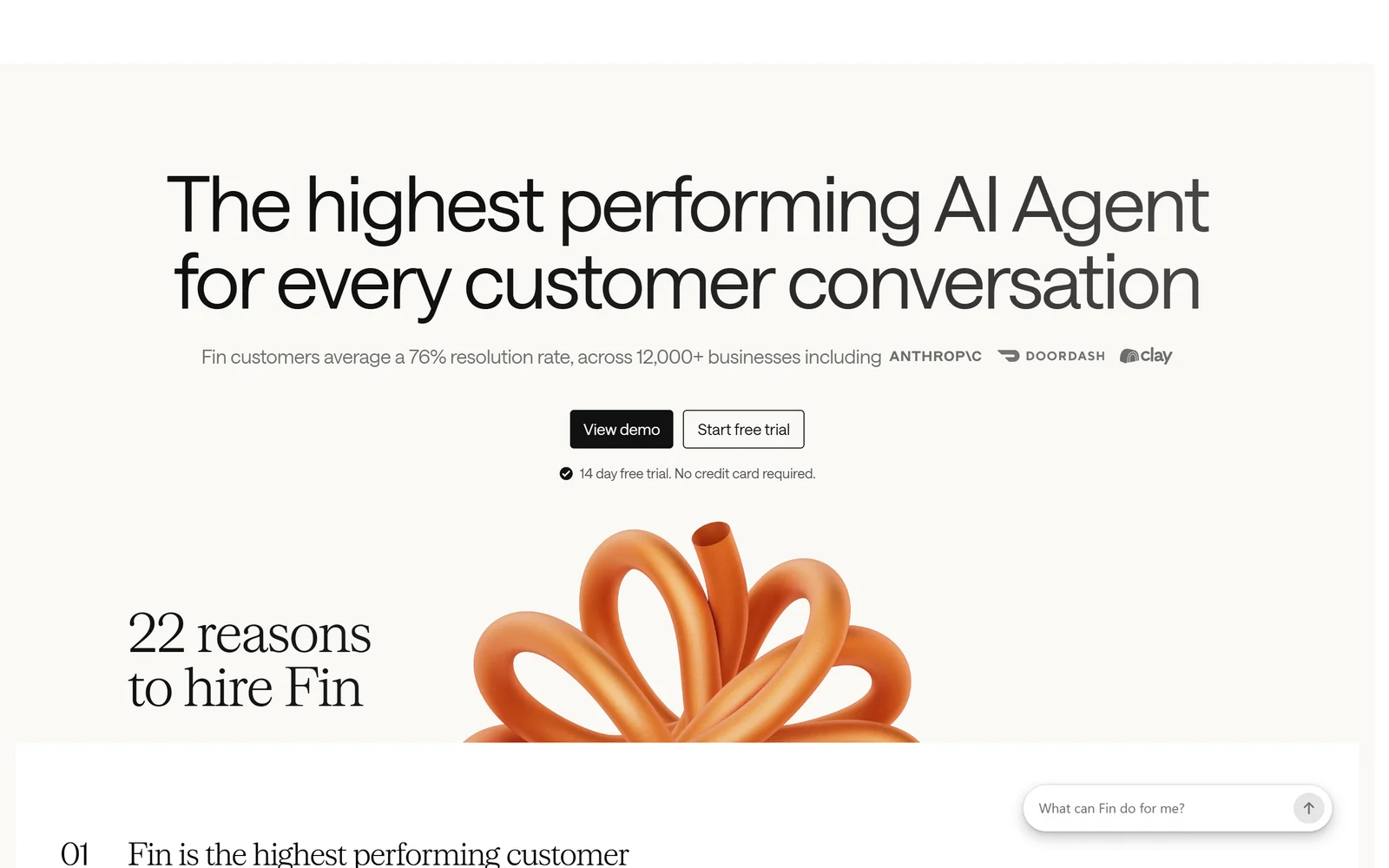
Intercom Fin’s homepage, captured 17 September 2026. Fin bills $0.99 per resolution, and its own docs count 24 hours of customer silence as one.
The support ticket that nobody answered, and the invoice that arrived anyway
You are being asked to put software in front of your customers. Not behind your agents, not in a draft box, but in the first reply a frustrated buyer sees at 11pm. That is a different purchasing decision from any other tool in your stack, and the vendors selling into it have built pricing models that most support leads only understand after their second invoice.
Here is the specific trap. Intercom’s own technical support engineer, Mateusz Leszkiewicz, posted the billing rule in the Intercom Community on 22 April 2025: a “soft resolution” occurs “When a customer exits the conversation without requesting further assistance within 24 hours of Fin’s last answer.” Fin’s help centre states the same mechanic verbatim: “If a customer disengages from the conversation for 24 hours after Fin’s last answer, it is considered an assumed resolution.” That bills at $0.99, identically to a customer who typed “that helped”. A customer who gives up and closes the tab is, on the invoice, indistinguishable from a customer you delighted.
Every vendor in this comparison has a version of this problem, because every vendor has to define the thing it charges for. Gorgias bills when “the AI resolves a customer conversation entirely on its own” but publishes no plan-by-plan interaction allowance and, verified on 17 September 2026, renders no plan names or prices as readable text on its own pricing page. Tidio’s marketing FAQ says a customer who leaves and returns “still counts as a single conversation” while its help centre says a thread closes after 15 minutes of inactivity and any new message “will start a brand new thread, and Lyro’s new response will be counted against your quota once more”. Chatbase meters per agent response with model multipliers up to 6x, and when the credits run out the widget tells your customer “This AI Agent is currently unavailable.” Crisp meters tokens in dollar credits and simply escalates to humans when they run dry.
This review ranks five AI support agents on seven weighted criteria, with every price, clause and rating re-read at source on 17 September 2026. It is deliberately unkind about the winner, because the winner has the most expensive failure mode in the category.
1. Why AI Support Agent Buyers Get Burned (In Their Own Words)
1. You are billed for the customer who gave up. The vendor documentation, not the complaints, is the strongest evidence here. Intercom’s Leszkiewicz set out both halves on 22 April 2025: “1. Hard resolution: When a customer confirms satisfaction by: Clicking the ‘That helped’ quick reply button, Entering an affirmative response like ‘Yes’ or ‘Sure’. 2. Soft resolution: When a customer exits the conversation without requesting further assistance within 24 hours of Fin’s last answer.” A merchant posting as bosbeest put the operational consequence bluntly on 24 April 2025: “This is an unfair practice, to both your customers (me) and my customers - because you are incentivising me to let the customer try the wrong answer, then click ‘Speak to Human’ and only then I can reply, to avoid paying $1.” Intercom’s own Paul Byrne, Support Engineering, conceded the point on 18 May 2025: “stepping in to provide the best experience for your customer should be seen as good judgment, not something to be penalized.” Another customer, Trevor, posted a contrary account on 28 January 2025 saying Intercom does not bill assumed resolutions where the user later reaches a teammate within 24 hours, while noting he had not confirmed it.
2. “Resolution rate” and “actual resolution” are not the same number, in either direction. Arthur Van Dyke wrote on 30 October 2024: “Our confirmed resolution rate is between 6-7% usually and our assumed resolution rate is near 60%.” His very next sentences argue the confirmed figure understates reality: “I would estimate that 1/3rd at least of the assumed resolutions represent a correct answer and our clients are just not clicking the ‘Yes that helped’ button… I rarely give bots feedback, because I know its not human.” The honest reading is that both metrics are bad proxies, and you need your own audit.
3. Answers can regress on content you did not touch. Sarah25 posted on 27 November 2025: “Our source will say you can do X with feature Y. In its answer, Fin says you can do Z (a different existing feature) with Y as well, even though this is not the case and Z is not at all mentioned in the sources Fin provides,” adding “I already tried to set up a Guidance but it does not reliably prevent Fin from inventing things.” Gustav Riederer, 26 January 2026, described replies that are “factually incorrect or off-topic, even though the underlying content and instructions haven’t changed.” For balance, independent Intercom consultant and community Top Expert Nathan Sudds wrote on 27 November 2025: “I’m not saying Fin can’t hallucinate but it should be very rare.”
4. Cancelling is a process, not a button. A Gorgias customer posting as Ann wrote on Trustpilot on 8 May 2025: “I have cancelled automate at least 3 times - Gorgias keep reactivating the subscription - how can this be possible? I do not want it - I never wanted it and now they are continuing to charge me?” A Chatbase reviewer identified as David T, 1 star, 3 September 2026, titled his review “Charged three times after I explicitly told them to close my account” and wrote, according to that review, “I do not want to re-activate. Please close my account.” Both are unadjudicated customer allegations, not established facts.
5. The AI can be good and the vendor still unreachable. Buck Ewing, 1 star, Trustpilot, 1 September 2026: “Tidio’s AI replies were very good, but for two months of trying, its Customer Support was the worst I have ever experienced.” Crisp drew a similar split from Dominik Rapacki on 19 December 2025: “Poor customer support and broken features,” and “You have to wait multiple days just to receive a screenshot.”
6. Getting your conversation history back out is not guaranteed. A Shopify merchant posting as TopJob wrote on 13 July 2026: “TIDIO doesn’t allow you to export any of your store’s customers’ questions and your answers.” Tidio replied publicly the next day confirming export is unavailable and offering alternatives, which makes this the one lock-in complaint in the set that is vendor-confirmed.
Read those against the current aggregates, all read 17 September 2026: Gorgias 2.2/5 from 151 Trustpilot reviews but 4.3/5 from 703 Shopify App Store reviews; Tidio 3.7/5 from 225 on Trustpilot and 4.8/5 from 1,340 on Shopify; Chatbase 3.9/5 from 65 on Trustpilot with a 29% one-star tail; Crisp 2.1/5 from 53 on Trustpilot against 4.6/5 from 148 on Capterra. The one-star reviews above are minority reports, and the aggregates are the honest context for them.
2. How We Ranked Them
Seven criteria, weighted: capability depth (2x), value for money (1.5x), billing fairness (1.5x), trust and security (1x), ease of getting started (1x), free tier (0.75x) and support and docs (0.75x). Capability carries the most weight because an AI agent that cannot take an action is a search box. Billing fairness and value carry the next most because in this category the meter is the product risk: you are buying a variable-cost line item that scales with the exact event you cannot control.
Two scoring rules matter. A certification counts only where the vendor publishes it; a vendor stating it holds SOC 2 is recorded as a claim, never as an audit this review verified. And a marketing percentage counts for nothing: Fin’s 76%, Tidio’s 67%, Crisp’s 50% and Gorgias’s 60% are all unfootnoted vendor figures with no published methodology, sample size or date range, and are quoted as claims only.
Every price, contract clause, rate limit and review score in this article was read at source on 17 September 2026. Where two vendor pages disagree, both are printed. G2 could not be read on that date (HTTP 403), so no G2 rating or review count appears anywhere below.
3. Intercom Fin: the best agent in the category, attached to the worst meter
Fin deploys on Zendesk, Salesforce, Freshdesk or HubSpot without migrating helpdesk, and charges per resolution rather than per seat.
Fin wins on capability and deployment flexibility, and it is not close. It is an AI customer agent that sits on top of the helpdesk you already run rather than replacing it: its help centre documents three Zendesk deployment modes with the instruction to “Keep Zendesk as your system of record”, and fin.ai/integrations states that “Fin resolves Salesforce cases across email, web forms, and live chat without migration.” Its own help centre states Fin “can automatically detect and resolve issues in more than 45 languages”. Intercom renamed itself Fin in May 2026, and Salesforce completed its acquisition on 10 September 2026, one week before this research date; Wikipedia reports the June 2026 agreement at approximately US$3.6 billion, and that price is attributed to Wikipedia, not to Salesforce.
The headline number is 76%: “Fin has industry leading resolution rates, averaging 76% across 12,000+ customers, with many seeing over 85%,” per fin.ai’s homepage, repeated verbatim in Salesforce’s 10 September 2026 release. Read Intercom’s own metrics documentation before you use that figure in a business case. It defines Resolution Rate as conversations Fin resolved divided by conversations Fin was involved in, not a share of all tickets, and defines Automation Rate separately as Involvement Rate x Resolution Rate. 76% is not a deflection rate. Note also that customer counts do not agree across sources: 12,000+ on fin.ai, 8,000 reported by VentureBeat in May 2026, and “more than 30,000 companies” in Salesforce’s release, which almost certainly counts the whole Intercom base.
Pricing is $0.99 per outcome with unlimited teammates and no seat cost on any non-Intercom helpdesk, or from $0.99 per outcome plus $29 per helpdesk seat per month if you also buy the Intercom helpdesk. Two published floors disagree: fin.ai/pricing states a 50-outcome monthly minimum at $0.99 (an effective $49.50), while Fin’s Zendesk help article states “$49/month including 50 AI resolutions” and adds the unquantified caveat “Minimum resolution commitments apply”. No “$49” figure appears on fin.ai/pricing at all. Four outcome types bill: resolutions, Procedure handoffs and disqualifications at $0.99, qualifications at $9.99. A conversation bills at most once. Fin does not bill for greetings, for abandoned clarifying questions, or for a resolution the customer later reopens, which is credited back.
The meter is still the problem, and the surrounding terms compound it. “Except as expressly set forth in this Agreement, all fees are non-refundable.” Annual terms auto-renew unless you give 30 days’ written notice. There is no published hard cap or overage penalty; spend simply accrues, with configurable alerts and limits as the only published control. The $1M guarantee is real and irrelevant to you unless you run over 250,000 monthly conversations in North America or Europe on Intercom. And the public record on billing clarity is not flattering: on 4 June 2025 Intercom employee Aisling O’Reilly corrected a statement her own company had made on stage, writing “A conversation is billed as a resolution when the end user gets an answer and doesn’t ask for further help,” immediately followed by “If the end user does ask to speak to a person—either by clicking ‘Get more help’ or replying with a follow-up request—then the conversation is not billed.” In a separate thread on 27 May 2025, bosbeest hand-audited one 40-ticket month and found that of 16 tickets marked resolved by Fin, “9 out of 16 are not solved by Fin at all.” That is one merchant, one month, self-audited, and should be treated as a prompt for your own audit rather than a property of the product.
Security is published, not proven here. fin.ai/trust-reliability states Fin “holds SOC 2 Type II, ISO 27001, ISO 27701, ISO 27018, ISO 42001, HIPAA, and GDPR/CCPA compliance”, with a claimed 99.8% SLA and residency in the US, EU or Australia. fin.ai/security returns 404 and the trust portal renders only as a JavaScript shell, so auditor names, report dates and scope could not be read. One item deserves a flag for regulated buyers: “Fin can use anonymized customer data for model fine-tuning, and you can opt out at any time with data deleted within 30 days.” That is opt-out by default.
The Good (Pros)
The Bad (Cons)
#1 · Best agent, worst meter
Runs on your existing helpdesk, no migration
Vendor-claimed 76% average resolution across 12,000+ customers, 14-day trial with no card. Read the section on assumed resolutions before you budget.
Visit Intercom Fin
4. Chatbase: the whole stack for $150, with a billing desk that keeps showing up in reviews
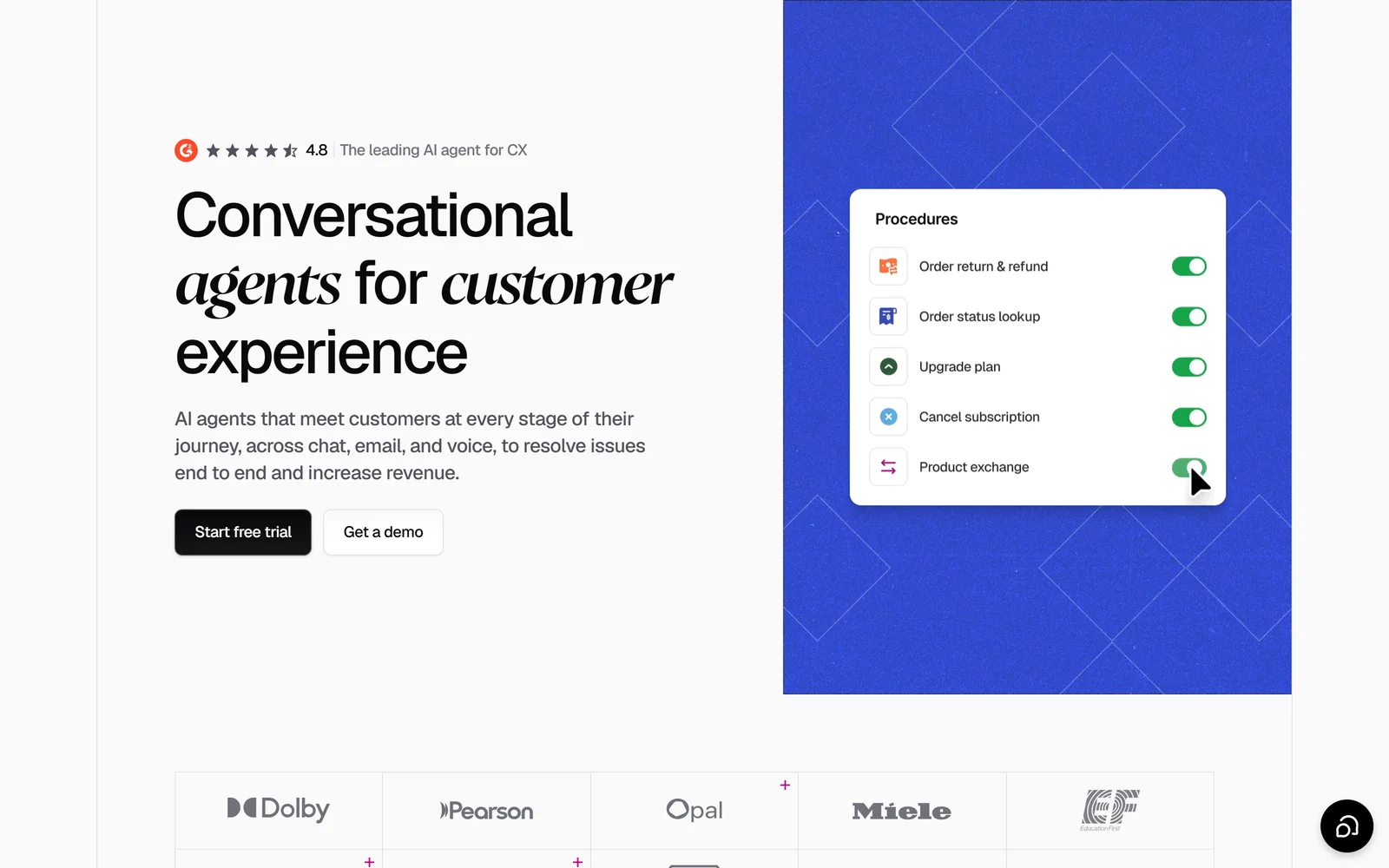
Chatbase ships the whole stack — agent builder, helpdesk, voice, API, CLI and mobile SDKs — self-serve at ## 4. Chatbase: the whole stack for $150, with a billing desk that keeps showing up in reviews50/month.
Chatbase ties Fin on the weighted score by winning the criteria Fin loses. It ships a complete, self-serve support stack at a price you can read on a page: an agent builder trained on files, websites, text, Q&A pairs, Notion and support tickets; a native helpdesk with ticket management, teams, routing, triggers and scheduling; voice, telephony and outbound campaigns; a documented REST API v2; an official CLI; and, as of 15 September 2026, first-party iOS and Android SDKs. Its docs list deployment across “Website, Email, Meta Apps, Shopify, Phone, Slack, Zendesk, and more” and pre-built actions for human escalation, Slack, Stripe, Calendly, lead collection and web search, plus custom actions to any API. Two releases landed on 15 September 2026, two days before this check.
Published pricing, read 17 September 2026: Free $0 with 50 message credits, 1 agent, 1 member and a 1 MB knowledge base; Hobby $40 with 700 credits; Standard $150 with 4,000 credits; Pro $500 with 15,000 credits; Enterprise quote-only. Extra agents are $25 per agent per month, overage credits are $40 per 1,000, and removing the “Powered By Chatbase” badge costs $99 per month, more than twice the entry plan. Yearly plans are advertised at 20% off. Standard at $150 is the real entry point for a support team: voice, telephony, outbound, API access, auto-resync and advanced integrations all start there, and the docs state plainly that “API v2 requires a Chatbase Standard Plan or above.”
The credit maths deserve a spreadsheet before you commit. Credits are consumed per agent response and multiply by model: 1 credit for baseline models, 3 for Claude 4.5/4.6 Sonnet, 5 for Claude 4.5/4.6 Opus and 6 for Claude 4.7/4.8 Opus. Pro’s 15,000 credits are roughly 2,500 responses at the top multiplier. Credits renew “monthly on the 1st of each month, regardless of when you subscribed”, so a 28th-of-the-month signup buys a full allowance for three days. And the failure mode is customer-facing: when credits run out the documented message is “This AI Agent is currently unavailable. If you are the owner, please check your account.” Knowledge-base caps are small for a mature help centre too: 1/10/20/40 MB by tier.
Chatbase’s data posture is the best of the self-serve group on one axis and the worst on another. Its privacy policy states verbatim: “We do not use your data to train AI models. We use Retrieval-Augmented Generation (RAG) to generate responses without compromising your data.” Against that, hosting is single-region US only, on “AWS infrastructure (us-east-1)”, with no published EU option, and zero data retention is an Enterprise-only feature. The security page displays GDPR, SOC 2 and HIPAA badges; HIPAA is scoped as “HIPAA-eligible” and Enterprise-only on the pricing page, ISO 27001 appears nowhere, and none of it was independently verified here.
The commercial experience is the documented weak spot. The Terms state “Payment obligations are non-cancellable and, except as explicitly stated in this Agreement, Fees are non-refundable,” with the only exception being an uncured Chatbase breach. Email cancellation takes effect only “provided that Chatbase confirms such cancellation in writing”. Trustpilot shows 3.9/5 from 65 reviews, the best aggregate in this comparison, but 29% of those reviews are one-star, and the recurring themes reported there are billing, charges continuing after cancellation requests, and support responsiveness. Shopify tells a different story: 4.8/5 from 32 reviews, 31 of them five-star. Capterra sits at 4.3/5 from 73, with conversation and token limits, inconsistent support and hallucination as recurring criticisms.
The Good (Pros)
The Bad (Cons)
#2 · Whole stack, self-serve
Agent, helpdesk, voice and API for $150 a month
No sales call, documented REST API, official CLI and native iOS and Android SDKs. Credits reset on the 1st and running out hard-stops the agent.
Visit Chatbase
5. Crisp: the cheapest honest AI meter in the category, with the weakest paperwork
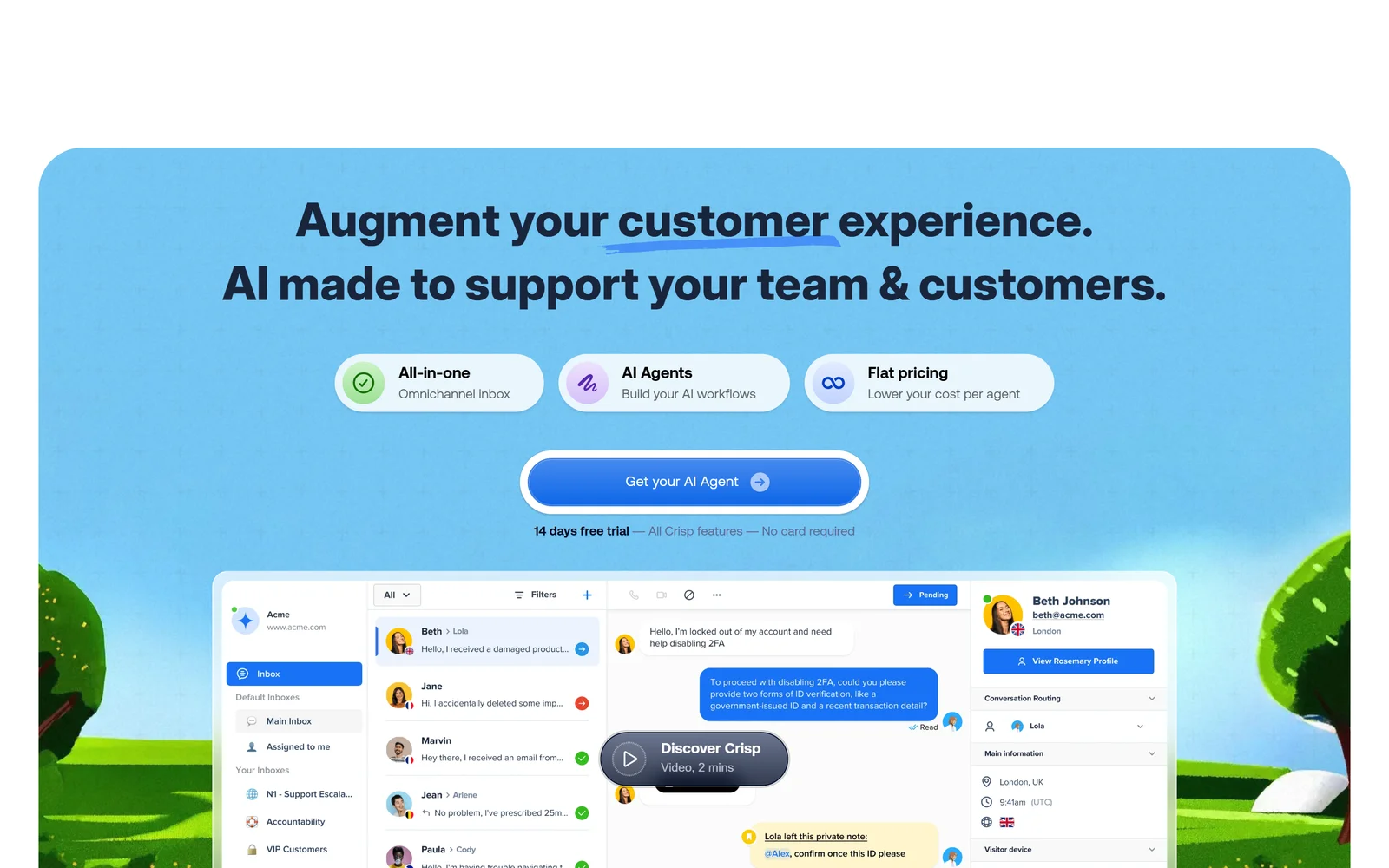
Crisp is the only vendor here charging per workspace rather than per seat, with AI metered at near pass-through token cost.
Crisp is the only serious contender that charges per workspace rather than per seat. Read on 17 September 2026: Free forever with 2 seats; Mini $45 per month per workspace with 4 seats; Essentials $95 with 10 seats; Plus $295 with 20+ seats, all with unlimited conversations, and extra agents at $10 each. For a 20-agent team, that is the cheapest published position in this comparison by a wide margin.
The AI meter is equally unusual. Hugo, Crisp’s AI support agent, is metered in dollar-denominated token credits, not per resolution: Mini includes $5 (“Around 90 automated conversations”), Essentials $25 (“Around 450”), Plus $75 (“Around 1350”), and Crisp’s billing article estimates “On average, a full Hugo-handled conversation costs around $0.05 to $0.10 USD”. Nobody else in this set charges within an order of magnitude of that per handled conversation. Credits reset on the 4th of the month; when they run out and Pay-As-You-Go is off, Crisp states “Hugo stops answering automatically and incoming conversations are escalated to human operators until credits become available again,” which is a far better failure mode than an error message shown to your customer. The Free plan ships no AI credits at all, so Hugo is not usable on it.
Crisp is also unusually candid about what Hugo cannot do, which is worth more than most marketing pages. Its troubleshooting article states “Hugo does not automatically learn from resolved conversations over time” and that it “is aware of the current ongoing conversation, but it is not trained on all other conversations in your inbox”. Crawling is capped at 2,000 pages per domain on Essentials and Plus, and Crisp explicitly warns ecommerce buyers that crawled content “is not ideal for data that changes often, such as product availability, prices, inventory, order status, subscriptions, account details, or booking slots.” Two configuration traps: MagicReply handoff is not automatic, and Crisp’s docs say “you will generally want to add a Fallback branch, to handle cases where the AI may not have found an answer”; and on email, “When Hugo cannot answer an email conversation, it may escalate without sending an escalation message by default.” Playground testing consumes real credits.
Data protection is genuinely strong and assurance is genuinely weak, and the gap is what pushes Crisp to third. Messaging data sits in the Netherlands and plugin data in Germany on DigitalOcean’s EU subsidiary, with US, UK and Singapore relays holding connection logs only, and the Terms carry an explicit clause: “Except as expressly agreed in writing, Crisp does not use Customer Data, AI Inputs, or AI Outputs to train or fine-tune the Crisp’s artificial intelligence models.” Buyers also pick the underlying model across OpenAI, Anthropic, Google, Mistral or Crisp-hosted families. Against that: Crisp’s own help centre states “Crisp hasn’t been over any SOC2 audit”, says only that it is “committed to aligning with ISO 27001 standards”, and crisp.chat/en/security/ returned a 404 on 17 September 2026. No trust portal, no published pen-test summary, no uptime SLA, and no numeric API rate limits published anywhere, including for the Plus plan’s “Enhanced rate limits”. The Terms refuse refunds “whether paid on an annual or monthly basis”, and are governed by French law.
Evidence splits hard. Trustpilot showed 2.1/5 from 53 reviews on 17 September 2026, 70% of them one-star, against 4.6/5 from 148 on Capterra, 4.6/5 from 148 on the Gartner-owned Software Advice (the same review pool, so one datapoint), 4.8/5 from 32 on Product Hunt and 4.4/5 from 520 ratings on the App Store. A reviewer posting as THIBAUT wrote on 6 February 2026 that after the Hugo rollout “my previous AI workflows got deactivated without notice. Users stopped getting answers, and I had to manually toggle on.” A five-star Capterra reviewer on 30 March 2026 called Crisp “quick to action bugs and their support is fantastic.”
The Good (Pros)
The Bad (Cons)
#3 · Cheapest honest meter
$295 a month flat for 20+ seats
AI billed at roughly $0.05-$0.10 per handled conversation, EU-only data storage, contractual no-training clause. No SOC 2 audit and no ISO certificate.
Visit Crisp
6. Tidio: the only vendor arguing from revenue, priced against the thing it sells
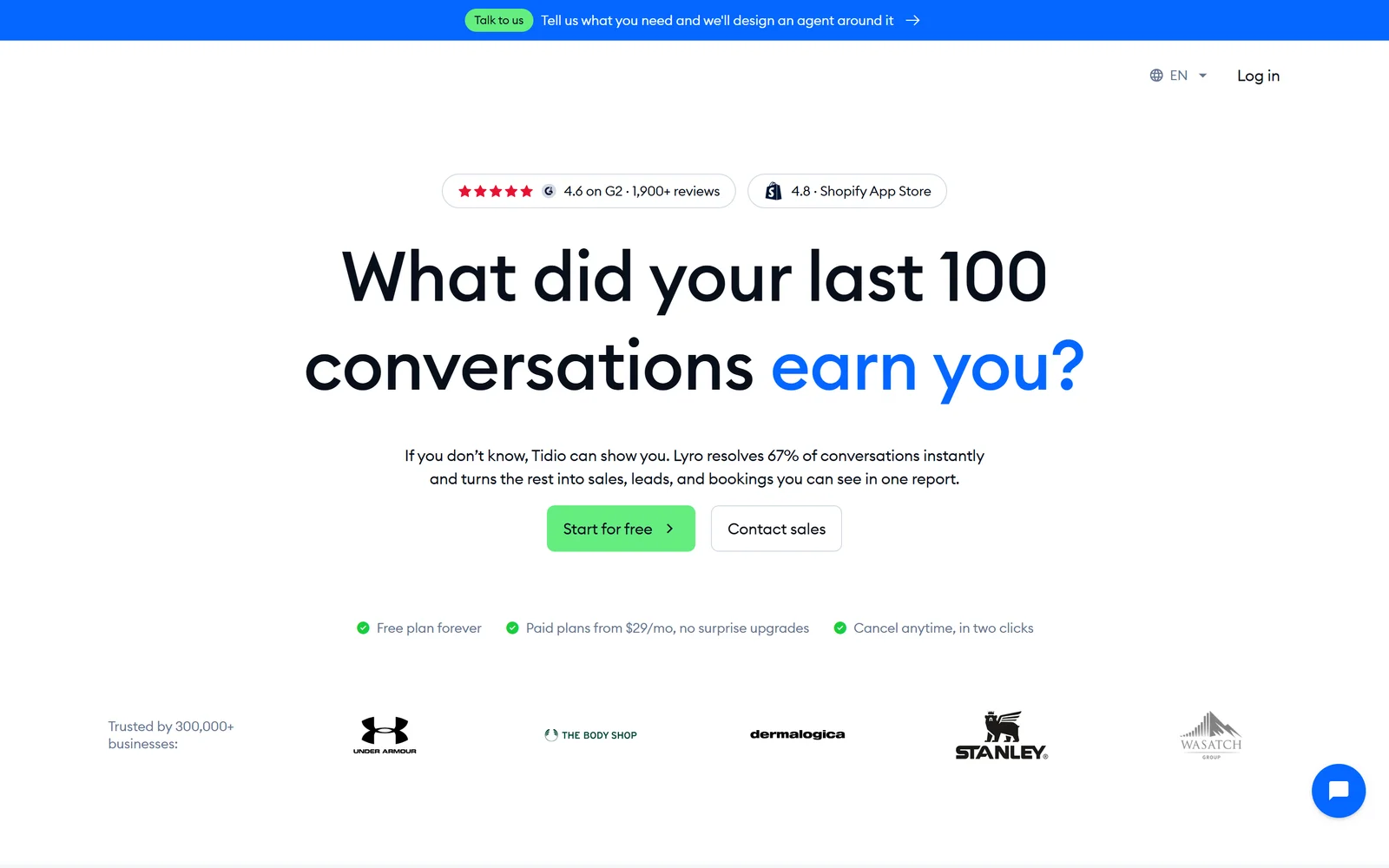
Tidio is the only vendor here arguing from revenue rather than deflection, with Shopify analytics showing the dollar value Lyro generates.
Tidio is the only tool here that frames AI support as a revenue line rather than a cost line, and it has shipped the plumbing to back it. Its 13 July 2026 changelog states that “Shopify Lyro Products Analytics shows the real dollar value Lyro generates from product answers and recommendations, right in your Tidio panel,” alongside sales-assisted value across Flows, agents and Lyro, product-recommendation cart value, AI-assisted orders and AOV in one view. If your board asks what support automation earned rather than what it deflected, no rival in this set answers that question natively.
The core platform is priced sensibly and the human meter is the fairest in the comparison. Free is $0 with 50 billable conversations and a 10-agent ceiling; Starter $29 for 100; Growth is volume-tiered from 250 conversations at $59 up to 2,000 at $349; Plus is $300 plus usage from 5,000 conversations and is sales-led. Annual billing is exactly ten months’ price, which is why the page advertises Starter at “$24.17/mo” by default. Crucially, per the pricing FAQ, a billable conversation requires “a message from a human agent (you)”, and “Unanswered messages initiated by visitors/customers are not counted” — spam does not bill, and Flows and Lyro replies do not count as agent replies.
Lyro, the AI agent, is where the model turns against the buyer. It is billed per conversation started, on a ladder running $39 for 50, $75 for 100, $140 for 200, $350 for 500 and $700 for 1,000: $0.78 per conversation at the bottom, flattening to $0.70 from 200 upward. The Lyro landing page advertises “Pay just $0.5 per conversation” under the heading “Get real cost efficiency”, but the same page’s FAQ ties $0.50 to Lyro Connect, “available only with Plus and Premium subscriptions”. No self-serve rung reaches $0.50. Worse, the meter and the marketing disagree on what a conversation is: the FAQ says a customer who returns later “still counts as a single conversation”, while the help centre states “a thread closes after 15 minutes of inactivity; any new message from the visitor will start a brand new thread, and Lyro’s new response will be counted against your quota once more.” Automatic tier upgrades are enabled by default and fire at 95% of quota on paid monthly non-Plus plans, and the Terms back this up: “you agree that Tidio may automatically upgrade your account in the event that your use of the Services exceeds your purchased subscription plan.” Refunds are denied by default and capped at three months at Tidio’s discretion.
The 67% resolution claim appears in four different strengths across the site with no methodology, sample or date range published: “resolves 67%”, “boosts your resolution rate to 67% on average — often even higher”, “users automate around 67%”, and “solves up to 67%”. The only binding commitment is 50%, it appears only in the Premium feature array as “Guaranteed 50% Lyro AI resolution rate”, and Premium is sales-led. Pay-per-resolution billing and SSO are in the same locked box. Seats cap at 10 on every self-serve plan, so an 11-agent team must talk to sales regardless of volume.
Security disclosure is a real strength. The Trust Center states “Tidio has successfully completed its 2026 SOC 2 Type II audit, conducted by an independent third-party firm” covering Security, Availability and Confidentiality, and Annex A of the Terms names each AI sub-processor with hosting region and training status: OpenAI (EU), Anthropic (US), Google Cloud Platform (EU), all marked “No” for training on customer data. That level of named disclosure in public terms is unusual. ISO 27001 appears nowhere and the Terms explicitly disclaim HIPAA. The liability cap is the lowest here: “THE GREATER OF ONE HUNDRED DOLLARS (US $100) OR THE AMOUNT YOU HAVE PAID US IN THE PAST TWELVE (12) MONTHS.” Two operational notes: the public changelog’s most recent entry is 13 July 2026, roughly two months stale at the time of reading, and Tidio’s own Shopify listing advertises quotas that no longer match tidio.com (200 Lyro conversations for $39 on Shopify versus 50 on the pricing page). Price from tidio.com. Aggregates are strong: Shopify 4.8/5 from 1,340 reviews, Capterra 4.7/5 from 590 with Value for Money the weakest sub-score at 4.5, Trustpilot 3.7/5 from 225, and Google Play 4.0 from 2.87K for the Android agent app.
The Good (Pros)
The Bad (Cons)
#4 · Argues from revenue
Shows the dollars Lyro generates, not just tickets deflected
Shopify product analytics, sales-assisted value and AI-assisted AOV in one panel. Lyro bills per conversation started, and auto-upgrade is on by default at 95% of quota.
Visit Tidio
7. Gorgias: the deepest Shopify agent, and the hardest bill to model
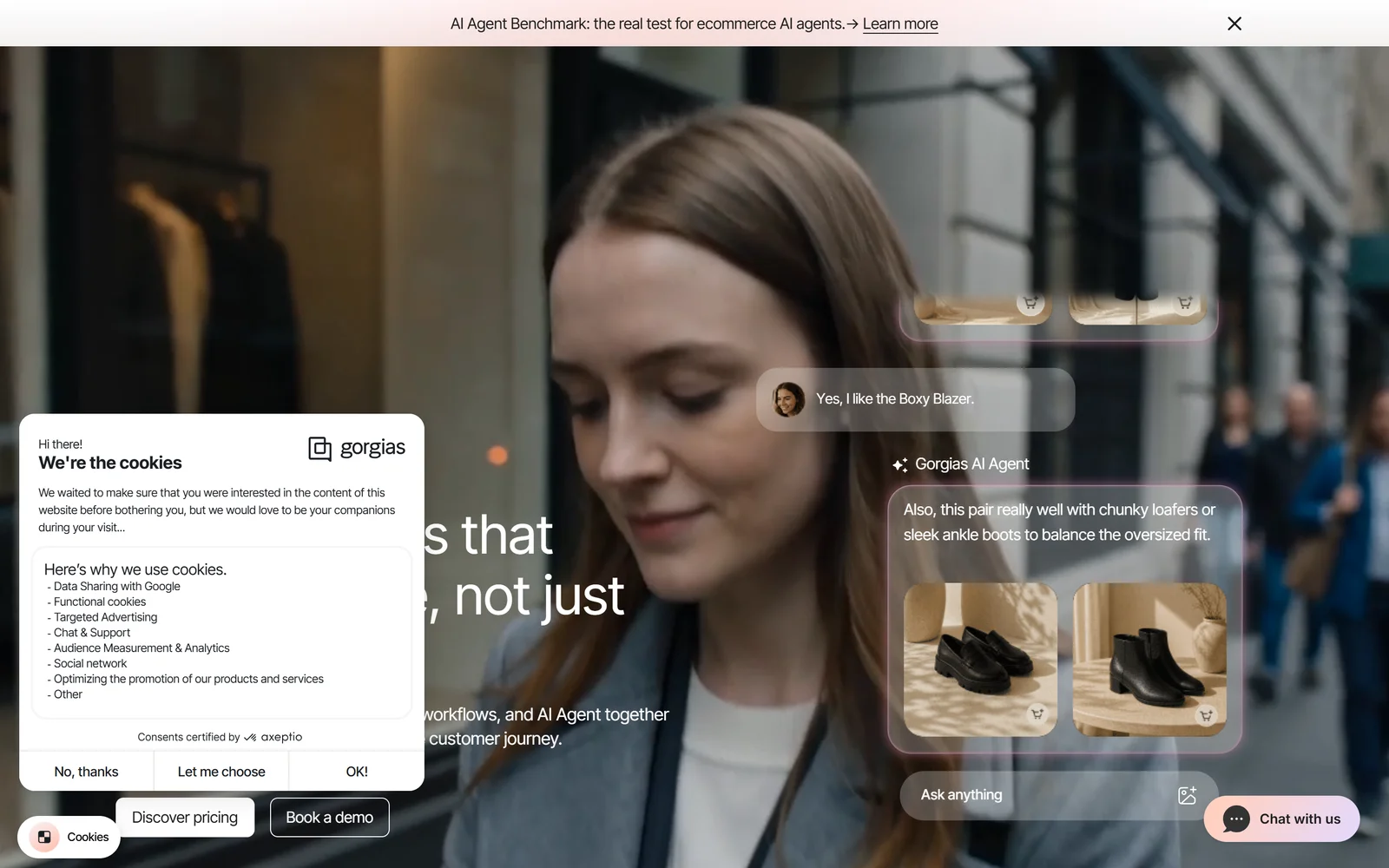
Gorgias reads live Shopify order and catalogue data and executes returns, cancellations and tracking inside the ticket.
Gorgias finishes fifth despite having the strongest ecommerce capability in this comparison, and it is worth naming exactly which criterion did it. Not capability, where it scores well: the AI Agent reads live order, catalog and customer data and executes track, return, cancel and report-order-issue actions, plus a Shopping Assistant that recommends products and applies discounts inside the ticket. A Capterra reviewer on 10 April 2026 wrote: “The Shopify integration is the best in class. You can see order history, issue refunds, and edit orders directly inside a ticket without switching tabs.” The helpdesk is metered on tickets, never seats, which Capterra reviewer Frank A. praised on 21 March 2026: “charging per ticket instead of per user allowed nearly everyone in our company to use it freely without worrying about seat limits.”
Value for money and billing fairness are what pushed it down, and the evidence is that you cannot model the cost before you buy. Gorgias’s own pricing page does not render plan names or prices as readable text even in a full browser, verified 17 September 2026. Every exact price below comes from Gorgias Inc.’s own Shopify App Store listing: Starter $10/month for 50 tickets and 3 agents; Basic $60/month or $600/year for 300 tickets; Pro $360/month or $3,600/year for 2,000 tickets; Advanced $900/month or $9,000/year for 5,000 tickets, with overage at $0.40 per ticket on the lower plans and $0.36 on Pro and Advanced. AI is separate: the pricing blog states “Most plans are $0.90 per resolved interaction. Starter plans begin at $1.” Plan AI allowances are published only as a range of 90 to 2,500+ interactions per month, with no per-plan figure anywhere, and overage runs $1.00-$2.00 per interaction on monthly Support-only plans, $0.83-$1.67 annually, and $1.50 per interaction on plans that add the Shopping Assistant. Three meters stack, and one of them has no published per-plan allowance.
To Gorgias’s credit, it publishes its own position on double-billing: “If the AI can’t fully resolve a conversation and hands it to a human agent, that ticket shifts over to your regular Helpdesk plan… You’re not charged for both.” It also states plainly that emails nobody replies to, spam and human-resolved conversations are not billable AI interactions. The contract is less generous. The Master Services Agreement, last revised 30 March 2026, states in capitals that “CUSTOMER WILL NOT BE ENTITLED TO RECEIVE ANY REFUND OR CREDIT FOR ANY… CANCELLATION, SUSPENSION, OR TERMINATION, NOR FOR ANY UNUSED TIME… ANY PRE-PAYMENTS”, and subscriptions auto-renew unless you give written notice “no less than 30 days prior to the end of the then-current Subscription Term”. There is no permanent free tier, only a 7-day trial.
Two capability caveats matter for anyone buying on the Shopify story. Order Management actions “Requires AI Agent subscription, supports Shopify stores only”, and the help centre admits the AI Agent does not automatically process refunds or order cancellations: a human must intervene. Article Recommendations supports BigCommerce and Magento only, with the Shopify version deprecated. On security, Gorgias states it is “SOC 2 Type II compliant since 2020” and lists HIPAA; ISO 27001 does not appear on its security page or its AI Agent security FAQ, and no in-progress status is published either. Its MSA permits use of information gathered in providing the service “solely to build and improve our internal machine learning… models”, and its AI FAQ confirms the agent learns across brands, while committing that “Gorgias will not use Customer Data to improve or train any third-party provider’s models.” That is a material difference from vendors that never train at all. There is also no customer-facing changelog: gorgias.com/changelog returns 404.
Evidence is the most polarised in the set. Shopify: 4.3/5 from exactly 703 reviews, but with 10% one-star. Trustpilot: 2.2/5 from 151, distributed 58% five-star and 36% one-star, a score far below the plain average of that distribution because TrustScore weights recent reviews. Capterra: 4.6/5 from 135. Tommy John wrote on 20 August 2026 that “The Shopify integration is unparalleled, and our CX team absolutely loves the platform.” Against the same 4.3/703 aggregate, a merchant posting as Mr Beer wrote on 27 April 2026: “No support, no onboarding, no chance. The when I told them we were looking for a better fit they handed me over to a third party consultant to get set up. Worst app experience on Shopify. Switched to Gladly and they we super helpful and responsive.” A Trustpilot reviewer, Miroslav Gallo, 2 stars, 31 July 2026, described the AI economics as he experienced them: “At 1.50 USD per AI conversation I cannot justify switching it on.” Gorgias publishes no per-resolution figure on its pricing page, so treat that as one customer’s account of what he was charged, not a vendor price.
The Good (Pros)
The Bad (Cons)
#5 · Deepest Shopify agent
Takes real Shopify actions inside the ticket
Track, return, cancel and report-issue actions plus a discount-applying shopping assistant, metered on tickets not seats. Its pricing page renders no readable prices.
Visit Gorgias
Scored Comparison Chart
The weighted scores cluster tightly — 5.97, 5.97, 5.82, 5.79, 5.68 — and that compression is the finding. No product in this category runs away with it, because each one trades a genuine strength against a documented commercial flaw. Fin and Chatbase tie from opposite directions: Fin wins capability depth and deployment flexibility by a distance, then gives most of it back on billing fairness and free tier, where an assumed resolution charged on 24 hours of silence and a blanket “all fees are non-refundable” clause both count against it. Chatbase scores lower on raw capability and trust (US-only hosting, no published EU region) but takes value for money, free tier and ease of getting started with a $0 plan, a readable price list and a complete stack at $150.
Crisp’s shape is the most lopsided on the chart. It posts the highest value-for-money score in the set on the strength of $295 per workspace for 20+ seats and $0.05-$0.10 per Hugo-handled conversation, then posts the lowest trust-and-security score because its own help centre says “Crisp hasn’t been over any SOC2 audit” and its security page returns a 404. Tidio sits just behind on the strength of a completed SOC 2 Type II audit, named sub-processor disclosure and a fair human meter, held back by the $0.50-versus-$0.70 gap, default-on auto-upgrades and a refund clause capped at three months.
Gorgias is the case worth reading closely, because its bar chart shows the highest capability score of the bottom three and the lowest overall total. Capability at 2x weighting was not enough to offset value for money and billing fairness at 1.5x each, and the evidence for those two scores is unusually concrete: a pricing page that renders no readable prices, an AI allowance published only as a range, three meters that stack, and an MSA that grants no refund or credit for unused time. If Gorgias published per-plan AI allowances and a readable price table, it would move up this ranking without changing a line of code.
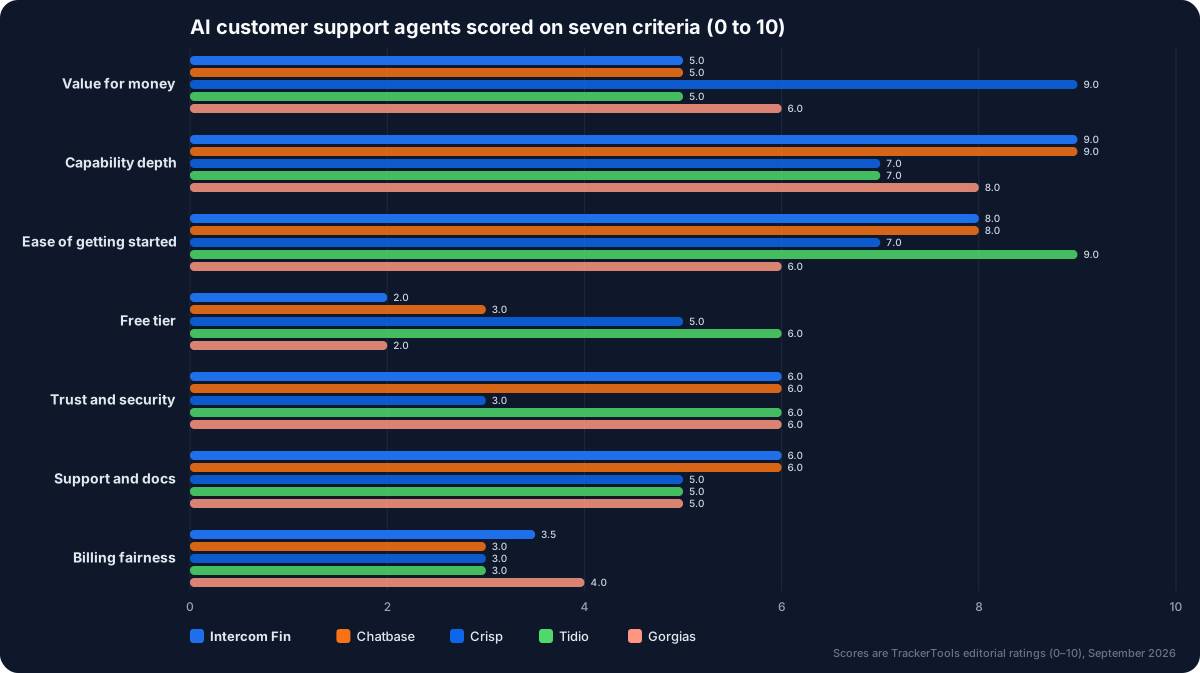
Seven criteria, five agents. The weighted spread from first to last is under 0.3 points, and every vendor scores 4 or below on billing fairness.
Pros and Cons Matrix: Who Solves Which Pain Point
| Pain point | Intercom Fin | Chatbase | Crisp | Tidio | Gorgias |
|---|---|---|---|---|---|
| Billed for customer silence | ✗ Assumed resolution bills | ✓ Per response, not outcome | ✓ Token credits only | ⚠ 15-min thread restart | ⚠ Resolution undefined per plan |
| Clear resolution measurement | ⚠ Resolution ≠ deflection | ✗ No rate published | ⚠ Credits, not resolutions | ⚠ 67% unfootnoted; 50% Premium only | ⚠ “60%” marketing claim |
| Hallucination control | ⚠ Guidance, high-risk refusals | ⚠ RAG only; reviewers cite drift | ✓ Confidence threshold setting | ⚠ Answers only from your content | ⚠ Reviewer complaints on quality |
| Cancellation and refund fairness | ✗ All fees non-refundable | ✗ Non-cancellable; written confirm | ✗ No refunds, monthly or annual | ⚠ Discretionary, capped at 3 months | ✗ No credit for unused time |
| Human support when it breaks | ⚠ 3.8/18 Shopify, tiny sample | ⚠ 29% one-star on Trustpilot | ✗ 2.1/53 Trustpilot | ⚠ 3.7/225 vs 4.8/1,340 Shopify | ⚠ 2.2/151 vs 4.3/703 Shopify |
| Behaviour at the quota edge | ✓ Never stops, spend accrues | ✗ Customer-facing error shown | ✓ Escalates to humans | ⚠ Auto-upgrades a tier | ⚠ Overage up to $2.00 |
Pricing at a Glance
| Platform | Free tier | Cheapest paid | Top self-serve tier | Trial | Refunds | Rating (read 17 Sep 2026) |
|---|---|---|---|---|---|---|
| Intercom Fin | None | $0.99/outcome, 50/month minimum (a $49 base is published in the Zendesk help article only) | Metered; +$29/seat/mo with Intercom helpdesk | 14 days, no card, unlimited outcomes | ”All fees are non-refundable” | 3.8/5 from 18 Shopify reviews (sample too small to generalise) |
| Chatbase | Yes, $0 with 50 credits | $40/mo Hobby, 700 credits | $500/mo Pro, 15,000 credits | 7 days on Hobby, Standard, Pro | Non-cancellable, non-refundable | 3.9/5 from 65 Trustpilot; 4.8/5 from 32 Shopify; 4.3/5 from 73 Capterra |
| Crisp | Yes, free forever, 0 AI credits | $45/mo per workspace | $295/mo per workspace, 20+ seats | 14 days, no card | Refused monthly and annual | 2.1/5 from 53 Trustpilot; 4.6/5 from 148 Capterra |
| Tidio | Yes, $0 with 50 conversations | $29/mo Starter, +$39 Lyro | $349/mo Growth, +$700 Lyro | 7 days, no card | Denied by default, capped at 3 months | 3.7/5 from 225 Trustpilot; 4.8/5 from 1,340 Shopify; 4.7/5 from 590 Capterra |
| Gorgias | None | $10/mo Starter, 50 tickets | $900/mo Advanced, 5,000 tickets | 7 days | No refund or credit for unused time | 4.3/5 from 703 Shopify; 2.2/5 from 151 Trustpilot; 4.6/5 from 135 Capterra |
Which One Should You Actually Pick?
Intercom Fin — for the team that already runs Zendesk, Salesforce or Freshdesk and wants the best agent without a migration. You keep your helpdesk as the system of record, pay no seat cost on the standalone plan, and get a 14-day trial with no card and no usage cap, which is enough time to audit outcomes yourself. The caveat: set spending limits on day one, and hand-audit a month of billed outcomes against your own definition of resolved before you sign anything annual, because assumed resolutions bill at the same $0.99 as confirmed ones and fees are non-refundable.
Chatbase — for the operator who wants the whole stack self-serve and will not sit through a sales call. At $150/month you get the agent, the helpdesk, voice, telephony, outbound and the API, and the company publishes an explicit no-training policy. The caveat: hosting is AWS us-east-1 only with no published EU region, and you must monitor credits, because running out shows your customers “This AI Agent is currently unavailable.”
Crisp — for the EU-based team of 10 to 20-plus agents that needs predictable cost more than it needs a certificate. Nothing else here offers $295 per workspace with unlimited conversations and AI at an estimated $0.05-$0.10 per handled conversation, with data stored in the Netherlands and Germany and a contractual no-training clause. The caveat: Crisp states it has never undergone a SOC 2 audit and holds no ISO 27001 certificate, so if your procurement team requires an audit report, this ends the conversation.
Tidio — for the ecommerce operator who has to justify support automation in revenue terms. The Shopify Lyro Products Analytics release puts the dollar value of AI-assisted conversations in the same panel as the conversations, and the human meter only bills when a human replies. The caveat: price from tidio.com rather than the Shopify listing, budget $0.70 per Lyro conversation rather than the advertised $0.50, and turn off auto-upgrade unless you want a tier change at 95% of quota.
Gorgias — for the Shopify merchant whose tickets are order tickets. Nothing else reads live order data and executes track, return, cancel and report-issue actions with a discount-applying Shopping Assistant in the same ticket, on a helpdesk that never charges per agent. The caveat: you cannot read the prices on the vendor’s own pricing page, per-plan AI allowances are published only as “90 to 2,500+”, and the AI Agent still cannot process refunds or cancellations without a human.
Final Verdict
Fin takes first place on capability, and it deserves it. It is the only agent here that deploys onto Zendesk, Salesforce Service Cloud, Freshdesk or HubSpot Service Hub without a migration, charges no seat cost standalone, resolves in more than 45 languages per its own help centre, refuses high-risk categories by design, and ships at a pace nobody else in this comparison matches. Its vendor-claimed 76% average across 12,000+ customers was repeated verbatim by Salesforce on 10 September 2026 when the acquisition closed. But read the vendor’s own metrics doc before you build a business case on it: Resolution Rate counts conversations Fin was involved in, not all tickets, and Automation Rate is Involvement multiplied by Resolution.
The tie at the top is real. Chatbase matches Fin’s weighted score by winning everything Fin cedes: a permanent free plan, a readable price list, a complete stack at $150 with no sales call, an explicit no-training policy, and the best aggregate rating in the set at 3.9/5 from 65 Trustpilot reviews. Its 29% one-star tail on that same page, concentrated on billing and post-cancellation charges, is the reason it does not win outright. Crisp and Tidio follow with mirror-image profiles: Crisp has the cheapest honest meter and the weakest paperwork, Tidio has the best disclosure and the most aggressive default settings.
Gorgias finishing last is not a verdict on its AI. It is a verdict on what a buyer can know before signing. When the vendor’s own pricing page renders no readable prices, when per-plan AI allowances exist only as a range from 90 to 2,500+, when three meters stack and the contract grants no credit for unused time, the product’s capability cannot be scored in isolation from the cost of finding out what it costs. Ask for a written per-plan AI allowance and a sample invoice before you commit, and the picture changes considerably.
Pick Intercom Fin if: you already run a major helpdesk, you want the deepest agent in the category without migrating, and you will set spend limits and hand-audit a month of billed outcomes during the 14-day, no-card trial.
Think twice if: your conversation pattern involves a lot of customers who read an answer and leave without replying, because 24 hours of silence is an assumed resolution billed at $0.99, all fees are non-refundable, and the two published price floors ($49.50 from a 50-outcome minimum, versus a $49 base in the Zendesk help article) do not match.
Disclosure: TrackerTools has no affiliate relationship with any product in this comparison, and the links above are plain nofollow links. Every price, billing rule, rating and quotation was verified against the vendors’ own pricing pages, help centres, terms of service, community forums, G2, Capterra and Trustpilot on 17 September 2026. Where a vendor’s pricing page does not render readable prices, we say so rather than estimating.