Choosing how to run your books and your company spend is one of the few software decisions where the downside is not “we wasted a subscription”. It is your general ledger, your payment rails and, in two cases here, the account your operating cash actually sits in. When one of these vendors changes its mind about you, the cost is measured in weeks of rebuilt books and missed vendor payments, not in a cancelled seat.
That is not hypothetical. On 27 December 2024 Bench emailed customers and posted a notice that its platform would be immediately inaccessible; one Hacker News commenter, jsnyoung, wrote the same day: “You guys are lucky. I didn’t even get an e-mail. I just found out I couldn’t login and happened across the website.” Bench filed for bankruptcy in Canada on 7 January 2025 with $2.8 million in cash against $65.4 million in liabilities. In June 2022, CNBC reported that Brex was “dropping tens of thousands of small business customers to focus on bigger venture-backed clients”, giving them until 15 August to move their money elsewhere. Brex’s own CEO Pedro Franceschi published a follow-up conceding: “We did a poor job explaining this decision, which eroded some of the valuable trust we built over the years.” That post did not reverse the decision.
The five products below are not the same kind of thing, and the first job of this comparison is to stop pretending they are. Brex and Ramp are corporate card and spend platforms whose revenue comes largely from interchange — Ramp’s own help centre states it plainly: “Every time you make a purchase, merchants incur a small fee known as an interchange fee. This fee is shared between Visa, Ramp’s card network partner, and the merchant’s bank. Ramp receives a portion of this fee.” Puzzle and Digits are AI-native general ledgers that issue no cards and move no company spend. Bench is a human bookkeeping service. Only Brex and Ramp will give you a company card; only Puzzle and Digits will replace QuickBooks; only Bench will do the work for you.
Neither Brex nor Ramp is a bank, and both say so. Brex’s checking account is provided by Column N.A. (current as of 17 September 2026), with Brex Treasury LLC a FINRA- and SEC-registered broker-dealer. Ramp Checking deposits are held at First Internet Bank of Indiana, Member FDIC, and Ramp describes itself as a fintech company. Every price, rating and legal term in this piece was read on 17 September 2026 and is stated with that date, because several of these numbers move monthly.
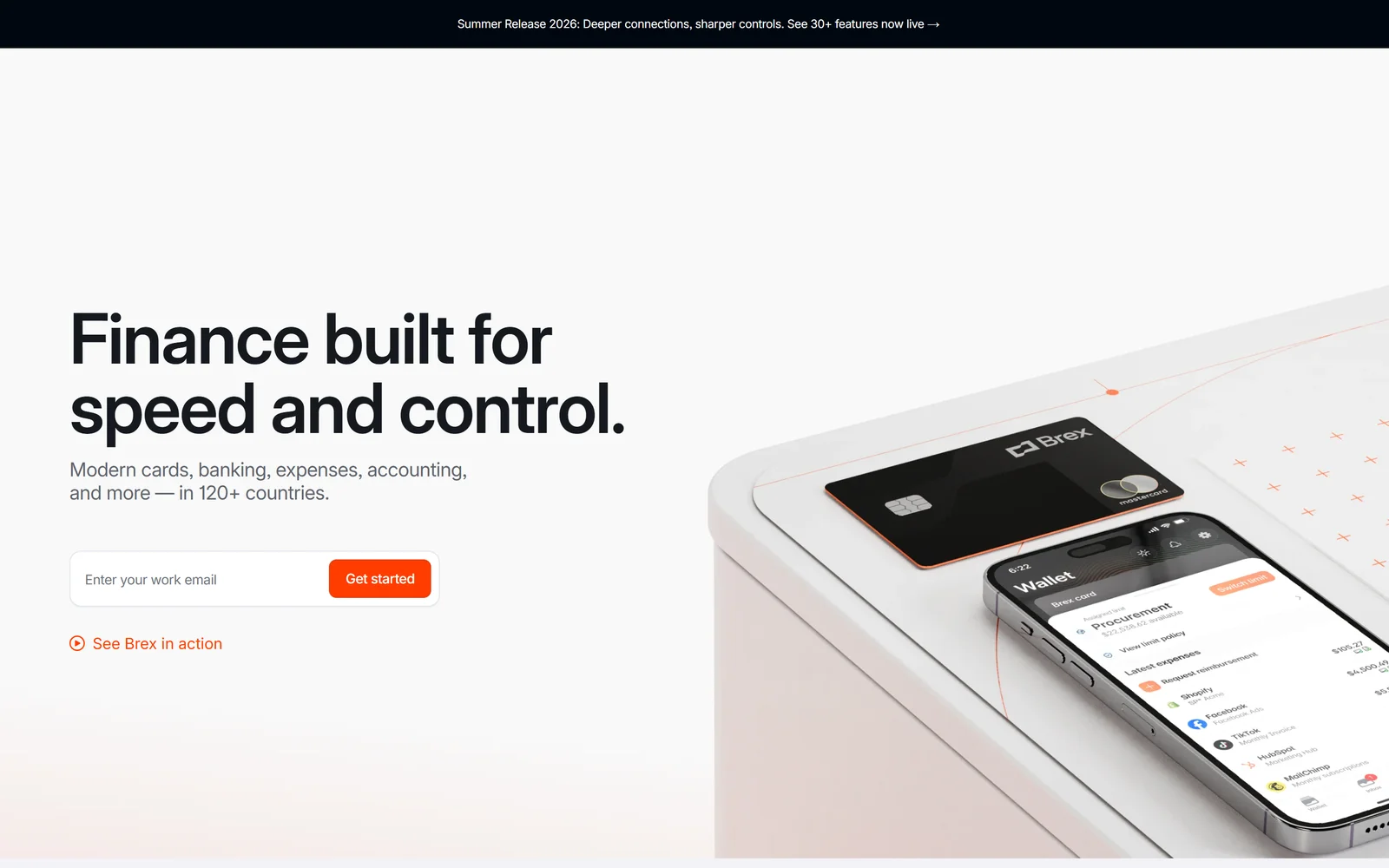
Brex’s homepage, captured 17 September 2026. Its free tier is unusually complete, and its Platform Agreement lets it end the relationship on 30 days’ notice.
1. Why AI Bookkeeping and Spend Management Buyers Get Burned (In Their Own Words)
1. The platform can decide you are no longer a customer it wants. This is the only pain point in the set that is documented by primary sources rather than anonymous reviews. Brex’s 2022 cut is on the record at CNBC, and co-founder Henrique Dubugras told them: “It’s terrible. It’s the worst outcome for us, too.” (CNBC, 17 June 2022). Brex’s published criteria to stay were broader than the funding-only framing that circulates — equity investment of any amount, or more than $1 million annual revenue, or more than 50 employees, or more than $500k in cash — but a profitable company below all four bars had to leave. Brex’s Platform Agreement still reserves the right to terminate “at any time and for any reason with thirty (30) days notice to you.”
2. Accounts and credit lines can change overnight, and reviewers say they get no reason. Trustpilot reviewer Robert Reichenbach, 1 star, 20 August 2026: “Despite their website and AI chat agent saying our business was a good fit, they denied our application without any explanation.” Josh Caruso, 1 star, 19 May 2026: “I went from having a line of credit to having 0 limit overnight with the way to reinstate it in time to prevent the cash flow issues it caused.” (phrasing is the reviewer’s own). These are customer allegations, not established fact, and Brex publicly replied to both — to Caruso on 1 June 2026.
3. Your money can sit still while your books are supposedly automated. Ramp reviewer Dave Atherton, 2 stars, 29 July 2026: “They hold your funds hostage and charge you 1% to get payments on the same day your vendor used to have the money in your account.” Reviewer Maddy, 1 star, 12 June 2026, described “holding onto funds for extended period of time and requiring a minimum of 1% fee”. Ramp’s published fee schedule lists same-day ACH as a flat $10 rather than a percentage, so read these as what reviewers report about their own experience.
4. The accounting sync is where the automation story quietly breaks. Ramp reviewer “Stripe customer”, 2 stars, 25 June 2026: “However, they DON’T SYNC WITH QBO as believed.” Capterra reviewer Robin B, Operations Director at a non-profit, November 2023: “We can’t upload to our Quickbooks Enterprise therefore, every transaction needs to be reentered again.” Both describe their own configurations, not an absence of a QuickBooks integration.
5. Automated categorisation degrades, and you end up doing it yourself. On the Bench shutdown thread, commenter rglover wrote on 28 December 2024: “I started having to manually categorize nearly all transactions despite there being existing identical transactions they could auto-categorize from.” Commenter ezekg, same day: “They had been slapping on a bunch of ‘AI’ tools this year, all of which required me to manually converse with the AI to categorize transactions. I was wondering what I was even paying Bench for with how much manual work I had to do each month i.r.t. to my books.”
6. Nobody checks the exit terms until they need them. Commenter entangledqubit, 28 December 2024, replying to a competing vendor pitching migrations in the Bench thread: “While you have documentation about migrating to your platform, you don’t seem to have any documented promises around export and leaving your service.” And when Bench customers did face migration, yolo2122 wrote on 27 December 2024: “My businesses will have real damages from this - both the money that has been paid to bench all year for now no output of annual books/a financial summary as well as the cost of now having to pay to redo my 2024 books.”
One caveat on all of the above: this is a self-selected sample of negative reviews and forum posts. Some reviewers report these problems. Nothing here establishes that they are typical.
2. How We Ranked Them
Seven criteria, weighted: capability depth at 2x, value for money at 1.5x, billing fairness at 1.5x, trust and security at 1x, ease of getting started at 1x, free tier at 0.75x, and support and docs at 0.75x.
Capability depth carries double weight because these tools replace headcount, and a ledger that cannot do accrual revenue recognition or a card platform that cannot enforce policy is not cheap at any price. Billing fairness sits level with value for money because two vendors here make it impossible to calculate what you will pay before you sign, and one makes all fees non-refundable. Free tier is deliberately the lightest weight alongside support and docs — a generous free plan is a real advantage, but it should not outvote whether the product does the job.
This weighting is what separates first from second. Ramp arguably has the better free tier of the two card platforms and scores well on capability, but billing fairness and the readability of its terms cost it enough at 1.5x to finish 0.18 behind Brex. It also explains Bench’s 3.32: it is the only option here that removes the work entirely, and that capability is real, but non-refundable fees, a 60-day annual cancellation notice, a D- BBB rating and a 2024 platform shutdown drag three weighted criteria to the floor.
Every price, fee, rating, review count and legal clause below was re-verified on 17 September 2026. Ratings and interest rates move; the read date is stated everywhere it matters.
3. Brex: The best free tier in the category, attached to the biggest access risk
Brex gives away full REST API access, travel, bill pay and an FDIC-insured account on a $0 tier, funded by interchange rather than seats.
Brex’s homepage reads “Finance built for speed and control.” with the subheadline “Modern cards, banking, expenses, accounting, and more — in 120+ countries.” It states it is “Trusted by 35,000+ top companies” — a vendor self-reported figure. Pricing is four options: Essentials at $0 per user per month, Premium at $12 per user per month, and both Enterprise and the separate Smart Card product at custom pricing.
The $0 tier is the story. Essentials is not a time-limited trial, and it includes global card acceptance with one local card program, AI-powered custom rules, accounting integrations, local currency wires, bill pay, reimbursements, real-time reporting, travel booking (free on Essentials) and — unusually — full Brex API access. Most rivals gate a REST API behind a paid plan. The only published hard limit is entity count: “Up to two entities (1 global entity).” No seat cap, no transaction cap, no credit or token metering appears on the pricing page. The attached business checking account is provided by Column N.A. and was advertising 4.01% on $0–$500K, rising through 4.11%, 4.21% and 4.26% to 4.36% above $20M, read 17 September 2026 and variable. Checking deposits are FDIC-insured to $250,000, with the Vault sweep extending coverage to “up to $6 million” across program banks; Treasury balances sit in the Dreyfus Government Cash Management Fund and are not FDIC-insured.
Premium is billed monthly in arrears on active users, not purchased seats: “Fees are calculated based on the number of active users during the prior billing period at a rate of $12 USD per active user per month.” At list that is $144 per active user per year. There are no credits, tokens or minutes, so overage charges are structurally impossible, and non-payment triggers suspension of Premium features rather than fees. You can cancel any time from the dashboard and revert to Essentials. Brex publishes no annual plan and no annual discount, though negotiated Enterprise terms cannot be ruled out. One clause deserves attention before you build workflows on Premium: “Upon downgrading to Essential, certain Premium features may become read-only, inactive, or subject to reduced functionality at Brex’s discretion.”
On capability, Brex markets three AI agents in its own words — assistants that write memos and fetch receipts, an audit agent that “monitors company expenses according to your internal processes and categorizes potential violations by risk level”, and a review agent that “auto-approves low-risk expenses and requests, escalates exceptions, and follows up with anyone out of compliance.” Managers can act on flagged spend from Slack or SMS without logging in. Brex advertises “99.7% GL CODED”, “99% AUTOMATED” and cites “98% compliance rates without manual enforcement” — all vendor self-reported marketing metrics published with no methodology, period or sample size. Similarly, Brex claims “automatic syncing across 1,000s of native integrations” while its own integrations page enumerates roughly 100 named ones, including NetSuite, QuickBooks Online and Desktop, Sage Intacct, Xero, Dynamics 365 BC and F&O, Workday Financials, plus AI-accounting tools Campfire, Digits, DualEntry, Rillet and Puzzle. Brex operates an MCP server supporting Claude Code, Codex, Cursor and Slack.
The weakness is access and recourse, not software. Trustpilot shows 1.9 out of 5 from 575 reviews (read 17 September 2026), concentrated on denials, freezes and closures rather than product quality — the same population of onboarded users rates the iOS app 4.8 from 8.8K ratings. Liability is capped at fees paid in the trailing twelve months, which for every Essentials customer is literally $0; a 20-seat Premium customer caps Brex at roughly $2,880. Governing law is Utah, with binding arbitration available to either party and a 30-day customer opt-out. Brex states it is “SOC 1 Type II, SOC 2 Type II, and PCI-DSS compliant” — its own word is “compliant”, it names no auditor or report date, the reports are gated behind a trust portal, and it does not claim ISO 27001 anywhere. It publishes no commitment either way on whether customer data trains AI models: its DPA contains no model-training provision and its privacy policy never mentions AI. Brex has also been owned by Capital One since the acquisition completed on 7 April 2026 (Wikipedia reports $5.15 billion in equal parts cash and stock, less than half the $12.3 billion 2021 peak). The durability of a $0 tier under bank ownership is unproven.
The Good (Pros)
The Bad (Cons)
#1 · Best free tier
Full API, travel and bill pay at $0 per user
No seat, transaction or token cap, plus an FDIC-insured account through Column N.A. Approval is the hard part: Trustpilot sits at 1.9/5 from 575 reviews, mostly about denials and freezes.
Visit Brex
4. Ramp: The most complete free plan here, and the least readable contract
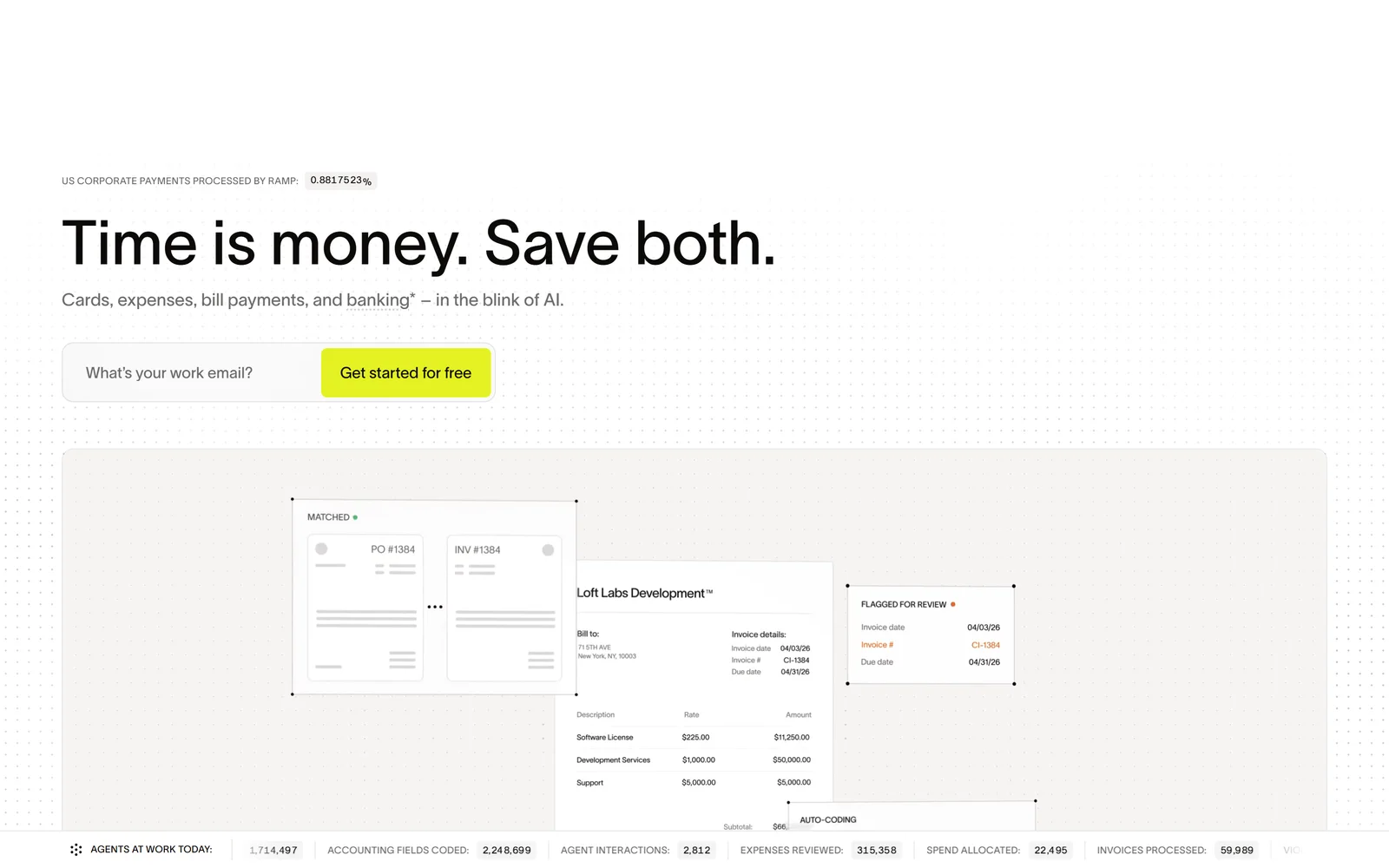
Ramp’s free plan covers cards, expenses, AP and accounting sync because the product is funded by interchange, not subscriptions.
Ramp’s press boilerplate defines it as “the finance operations platform uniquely designed to save businesses their most valuable resources—time and money.” Its homepage claims it is “Trusted by 70,000+ businesses including Notion, Shopify, Webflow, Eventbrite, Poshmark, and Quora”, that customers “close books 75% faster” and “have saved 27M+ hours collectively”, and that it takes “7x fewer clicks to process a bill compared to Bill.com”. Every one of those is an unaudited vendor claim with no published methodology.
The free plan is the most complete in this category, and the reason is structural: Ramp’s help centre states that it “earns revenue primarily through your use of the Ramp card and Ramp Plus subscriptions”, and that because the card is a charge card, “we do not profit from charging interest on carried balances.” Free includes unlimited physical and virtual cards (“you can issue unlimited virtual and physical cards to your team at no extra cost”), a corporate-liability charge card, expense management with policy questions answered over SMS or Slack, AP with AI-powered OCR and payment by check, ACH, card and wire, QuickBooks Online and Xero sync, a custom report builder and vendor price intelligence. The treasury side advertises 2% APY on an FDIC-insured business account (stated accurate as of 16 September 2026, variable) with no fees, minimum deposits or transfer caps, and up to 4.51% on a separate Investment Account net of an advisory fee of up to 0.15% (as of 3 September 2026) — that one is explicitly not FDIC-insured, is not a deposit product and may lose value.
Then the pricing stops being calculable. Plus is listed at $15 per user per month plus an additional “Platform fee based on team size”, and that fee’s amount appears nowhere on the pricing page. Ramp advertises “Save 20% with annual billing” but never prints the resulting figure. Enterprise is custom, annual only. So the honest statement is that the true cost of Ramp Plus cannot be determined from public information. Plus does offer a 30-day free trial and can be paid by ACH or with rewards earned from card spend, and the FAQ says you can upgrade or downgrade from the dashboard. Bill pay carries published fees — standard ACH $0.59 and standard check $1.99 (both effective 1 June 2026), same-day ACH $10, domestic wire $15, international SWIFT USD wire $20, overnight check $20, check attachments $1 per page, and 1099 filing at $0.65 per IRS filing with free state filing. Those transaction fees are waived only “When paying out of Ramp Checking Account”, which makes the discount conditional on moving your operating cash to Ramp.
Capability is genuine breadth rather than relabelling: eight product lines (Corporate Cards, Expense Management, Accounts Payable, Travel, Procurement, Ramp Intelligence, Accounting Automation, Ramp Banking). Ramp markets “Ramp agents” as “AI teammates powered by the best LLMs available, trained on your policies and data” without naming the vendors on that page, though its Trust Center discloses AI subprocessors including Modal, Cerebras, Anthropic and Together AI (the last marked no longer in use as of 30 March 2026). The developer API uses OAuth 2.0, documents 200 requests per 10-second rolling window enforced per source IP with 429 responses, terminates requests over 60 seconds with a 504, caps pagination at 100 items and runs an MCP server at mcp.ramp.com. Notably, Ramp documents no X-RateLimit headers, so backoff must be driven by catching 429s. Ramp’s integrations directory header says “120 Integrations” while the FAQ on the same page says “200+” and separately “40+ leading accounting systems”; take the directory figure and note the contradiction. On Free, QuickBooks Online and Xero are the only accounting integrations — NetSuite, Sage Intacct, Acumatica and Dynamics 365 BC require Plus, and Workday and Oracle Fusion require Enterprise.
Security is the strongest on this list on paper: SOC 1 Type 2 and SOC 2 Type 2 (period ending October 2025), ISO/IEC 27001:2022, PCI DSS v4.0 AoC, FedRAMP Moderate, GovRAMP, TX-RAMP, Cyber Essentials Plus and CCPA, none marked in progress. But there is no published no-training clause for AI; the strongest statement is marketing copy — “we use your data thoughtfully to make your Ramp experience better—and yours alone” — which is not a contractual commitment. And the billing-fairness problem compounds: every page under ramp.com/legal/_ renders only the string “Ramp Legal” to a reader, so no refund, cancellation or liability term can be reviewed before signing up. Trustpilot sits at 2.4 from 211 reviews (read 17 September 2026) with a barbell distribution — 61% five-star, 33% one-star — and Trustpilot’s own profile note flags that Ramp “Hasn’t replied to negative reviews”. Capterra, an admin-buyer audience, shows 4.9 from 221 reviews. Support complaints recur: reviewer Zach Bradt, 1 star, 2 December 2025, _“Ramp has the absolute worst customer service. There is no number, just a general email that takes days to get a response.”* One reviewer, Kirsten Maitland (1 star, 18 May 2026), alleges that nine bills totalling $92,453.70 were released despite documentation stating AP Clerks cannot release payments; that is an allegation from a review with no posted vendor reply, not a verified event.
The Good (Pros)
The Bad (Cons)
#2 · Most complete free plan
Unlimited cards, AP and accounting sync at $0
QuickBooks and Xero sync, custom reporting, vendor price intelligence and a 2% APY account with no minimums. Paid pricing is unquotable and the legal pages render no readable terms.
Visit Ramp
5. Digits: An open AI ledger that has nothing to do with company cards
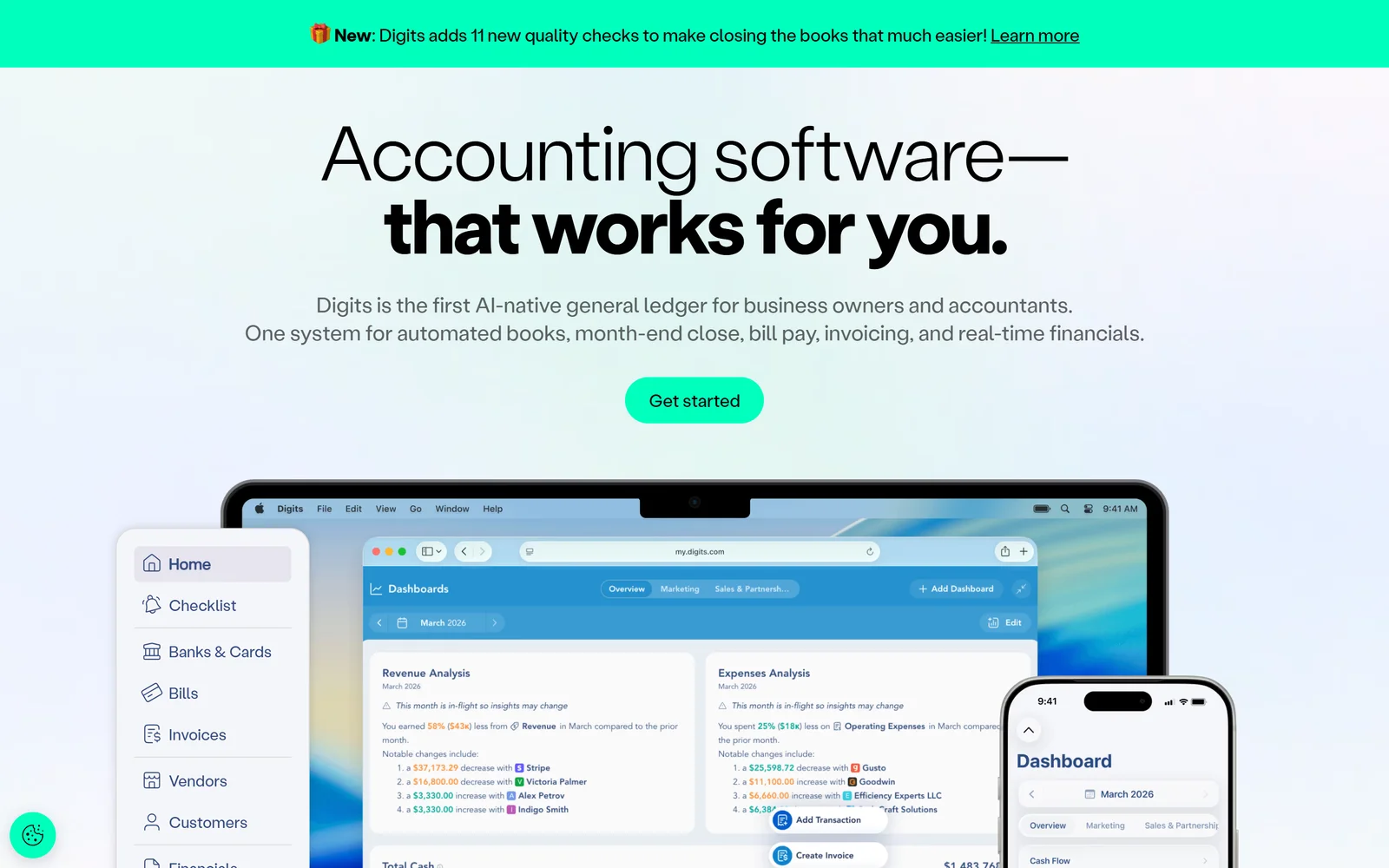
Digits is an AI general ledger, not a card platform. Its pricing ties the vendor’s revenue to its own automation claim.
Digits calls itself “the first AI-native general ledger for business owners and accountants” — a vendor superlative, not a verified first — with the hero line “Accounting software—that works for you.” Business pricing read on 17 September 2026 is Essentials $65/mo, Core $100/mo (badged Most Popular) and Pro $250/mo, whose CTA reads “Coming soon”, so the top tier cannot actually be bought. There is no annual billing and no annual discount: a raw fetch of the pricing page returned only three dollar figures in the entire source and zero instances of “annual”, “yearly” or “/yr”. There is no free tier, only a 30-day trial.
The pricing model is refreshingly seat-blind. Digits bills per business, not per seat, with no setup fees, and advertises unlimited team seats for accounting partners. The catch is multi-entity: “Digits supports multi-entity businesses. Each business or location would need its own Digits subscription.” That is how the bill scales, at every tier. Metering sits on payment rails rather than AI — invoice card processing at 3.2% + 30¢ on Starter, 3.0% on Essentials and 2.9% on Core, inbound ACH at 1.0% (uncapped on Starter, capped at $15 on Essentials and $10 on Core), $15 per chargeback, $7.50 per ACH return. Bill Pay costs 50¢ per ACH, $2.50 per mailed check and $2 for Digits Pay; expedited check, overnight check and domestic wire are all labelled “coming soon”, so Digits cannot currently send a wire.
Where Digits is genuinely differentiated is openness. Its developer overview states: “No partner fees. No paywalls. No marketplace restrictions.” Developer API and MCP are included on every business plan, including $65 Essentials — OAuth 2.0 authorisation code, an OpenAPI spec and sandbox, webhooks and a Zapier path. Rate limits are published and low: 180 requests per minute per Client ID and 60 per minute per Access Token, returning 429 with RATE_LIMIT_EXCEEDED. Digits also documents its own webhook race condition in public: “Two material updates to the same bill within one second can share a deduplication key and suppress the later webhook.” Publishing that is unusually candid. On the firm side, Digits moved to outcome-based pricing in early April 2026 where “A client qualifies when 95% or more of its transactions are zero-touch” (CPA Practice Advisor, 7 April 2026), with CEO Jeff Seibert framing it as “If Digits does the work, we should get paid. If it doesn’t, we shouldn’t.” (Accounting Today, 8 April 2026). No firm-side dollar figure is published.
The reason Digits sits third rather than higher is scope. For a comparison about company cards and spend management, it is not in the category: a text search of its homepage, pricing page and AGL product page on 17 September 2026 returned zero occurrences of corporate card, company card, virtual card, card issuing or spend management. Card spend arrives only via Plaid or the Ramp integration. The constraints stack up from there: US-only, USD-only (“Multi-currency accounting and FX conversion are not supported at this time”), no sales tax calculation or tracking, no Shopify or Amazon integration (CSV and manual journal entries are the documented workarounds), reports capped at 36 months for P&L and 12 for balance sheet and cash flow, and plan changes that are not self-serve — you must email support to upgrade or downgrade a $65–$250/mo subscription. Cancellation is self-serve, but the help centre warns that after the period ends “your access will end, and you will no longer be able to view your data.” No refund policy is publicly retrievable in either direction.
Trust signals are thin but honest. The Vanta-hosted trust centre lists SOC 2 Type I and Type 2 badges with access-gated 2024, 2025 and 2026 reports and penetration test SOAs; no ISO 27001, PCI, HIPAA or GDPR badge appears, and Digits’ own wording wobbles between “SOC 2 Type II compliant” on its security page and “SOC2 Type II certified” in its pricing FAQ. It publishes 19 subprocessors, 18 US-based, including both Anthropic and OpenAI for LLM APIs — so frontier models sit in the data path despite the “proprietary models” framing. On training, the only clear statement is scoped: “Learning is not shared globally across clients”, which sits in unresolved tension with the AGL page’s claim of “Proprietary AI models trained on over 170 Million transactions totaling $875 Billion”. Third-party validation is almost nil: 1 Capterra review (5.0), 12 Product Hunt reviews (5.0), 0 Trustpilot reviews, 7 App Store ratings. Funding is roughly $97.5M with the last priced round in March 2022 — a four-and-a-half-year gap.
The Good (Pros)
The Bad (Cons)
#3 · Open AI ledger
Firms pay only when 95% of transactions are zero-touch
Developer API and MCP server included from the $65 tier, with no partner fees or marketplace restrictions. It issues no cards, is US-only and does not support multi-currency.
Visit Digits
6. Puzzle: Real dual-ledger accrual accounting, sold by a company mid-carve-out

Puzzle keeps simultaneous cash and accrual ledgers from the same source data, with auto-drafted schedules linked back to the transaction.
Puzzle’s homepage reads “Accurate Books. At AI Speed.” with the subheadline “The accounting core where agents work for you. Get trusted books in less time, with full control.” Like Digits, it is a ledger, not a spend platform: it issues no cards and moves no money, and card and bank data arrives through integrations with Stripe, Ramp, Brex, Mercury, Gusto and roughly twenty other named partners plus a Plaid bank feed.
The technical case for Puzzle is the strongest capability claim in this comparison at the price. Puzzle states it “generates two different general ledgers from the same underlying data, resulting in two different reporting views”, letting a finance lead “Switch between cash visibility and accrual accuracy instantly with a single toggle.” Prepaids get automated full-lifecycle schedules, revenue recognition gets continuous full-contract schedules, and fixed assets get auto-detected schedules, each producing “Individual monthly entries (not summarized) posted and linked directly to” the source transaction, contract or asset. That is genuine controller-grade work at $120/mo, which is where revenue recognition starts — it is gated to the Complete tier, so ASC 606 is unavailable on Starter or Core.
Software list prices billed monthly are Starter $30 (1 seat), Core $72 (5 seats), Complete $120 (unlimited seats, badged Most popular) and Scale $360 (unlimited seats). The metering trap is AI credits: the pricing page gives both Starter and Core “25 lifetime AI credits” — the $72 plan buys more seats and reports but not one extra credit over the $30 plan. Only Complete (100/month) and Scale (300/month) get a recurring allowance. Extra credits can be bought (the help centre has an article on it) but neither the price of a pack, what one credit buys, nor whether credits roll over is published anywhere. Scale is also the only tier advertising “No transaction limits” and “No integration limits”, which means the other three carry caps whose numbers Puzzle does not publish. An annual toggle labelled “Yearly · Save 20%” exists but renders no annual dollar figure for any tier.
Trial terms are decent — 14 days with Complete-level features, and Starter customers get two months free — and when a free period lapses, users keep what was generated and only lose access to newly generated statements. Puzzle also advertises “50% faster month-end close — or your money back”, conditioned on completing onboarding and a setup call within 7 days, single-entity structures only, and a refund request within 30 days (up to 90 days from the original subscription date), limited to subscription fees. That marketing guarantee is not mirrored in the contract: the customer Agreement grants no general money-back right, only a for-cause termination clause requiring 10 days written notice of an uncured material breach. Human bookkeeping is available as a bundle at $171/mo for companies under $10K monthly expenses, but the humans are partner firms, not Puzzle staff, and Puzzle’s own page states: “Puzzle assumes no responsibility or liability for their services.” Add-ons: migration $149 one-time, R&D study at 1.5% of qualified expenses, catch-up bookkeeping from $300 per month of books behind, tax filing from $1,250/yr.
The reasons Puzzle lands fourth are trust and continuity. On 2 September 2026 Accrual announced an agreement to acquire Puzzle’s accounting-firm technology and business, with founder-CEO Sasha Orloff and members of the team joining Accrual; terms were undisclosed and the deal was expected to close “in the coming weeks”. Accrual’s announcement says “Puzzle will continue to operate independently for startups and small businesses” — but who leads that remaining business after the CEO’s departure is stated nowhere. On the same day Puzzle published “Introducing Puzzle 2.0”, repositioning around partner firms. Its only compliance claim is “We’re SOC2 compliant” on its own blog, with no type, no auditor, no report date and no period; a Vanta monitoring dashboard is not an audit. Two different liability caps apply: the website Terms of Service cap damages at $100, while the customer Agreement caps at amounts paid in the prior twelve months and inconsistently names a different entity, “VALENCIA DATA”. Section 5.3 of the Agreement survives termination and lets Puzzle use customer data “to run analytics, create benchmarking data and to otherwise improve Puzzle’s services”. There is no no-training commitment either way. Practical limits matter too: Puzzle is “built for US entities with USD only transactions”, syncs with partners once daily overnight rather than in real time, and syncs categories from Ramp and Brex only once, so a re-categorisation must be made in both systems. The API is read-only and the MCP integration is in alpha and cannot write. Independent validation is one Trustpilot review (3.2, read 17 September 2026) and 33 uniformly five-star Product Hunt reviews; G2 and Capterra returned HTTP 403 and could not be read.
The Good (Pros)
The Bad (Cons)
#4 · Real accrual accounting
Cash and accrual ledgers from one dataset
Auto-drafted prepaid, revenue-recognition and depreciation schedules at $120 a month. In September 2026 it agreed to sell its ledger technology and its founder-CEO to Accrual.
Visit Puzzle
7. Bench: A human bookkeeper at a published price, from a company that switched off once
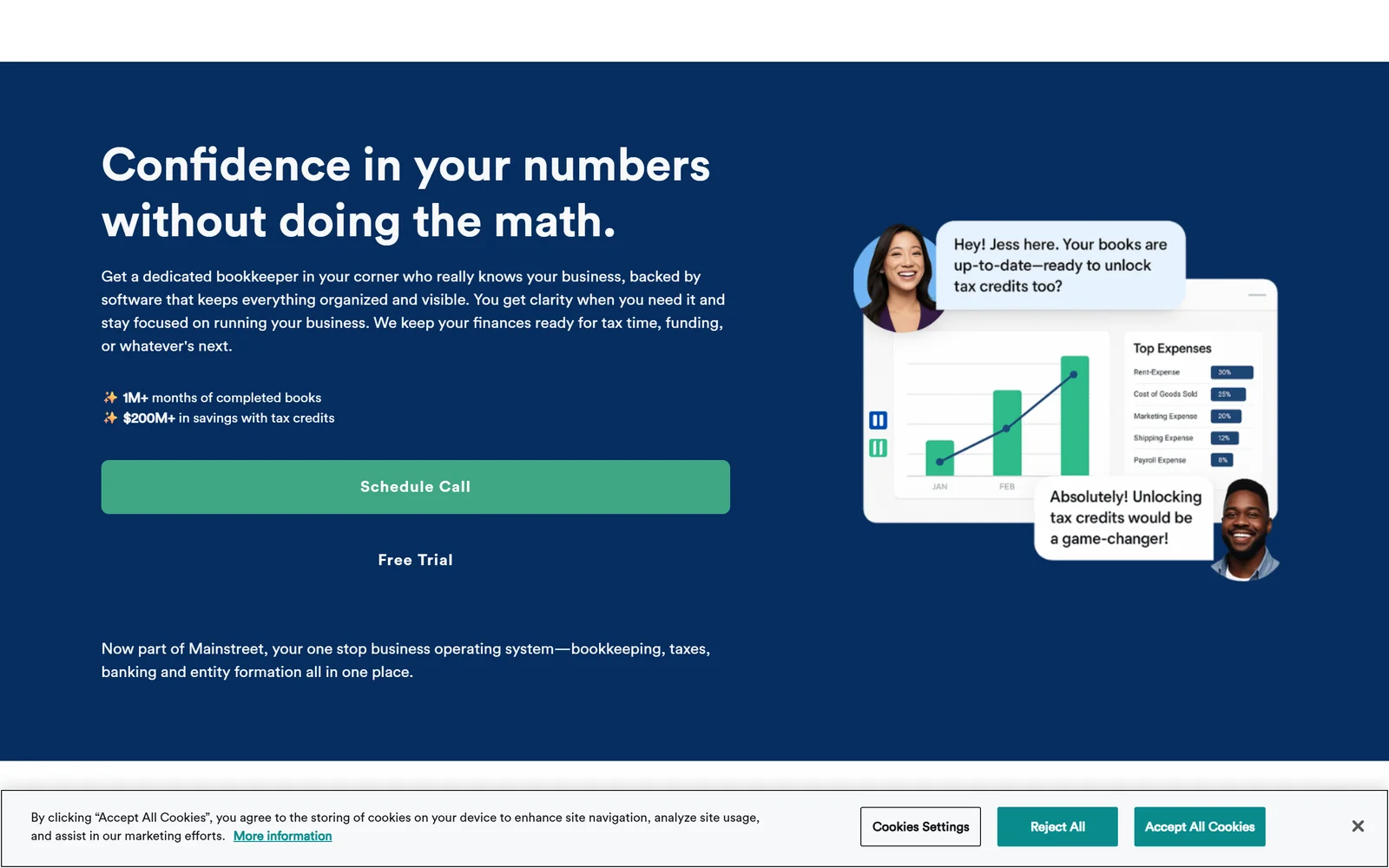
Bench is human bookkeeping at a published price, from a company that cut customers off from their own books in December 2024.
Bench is the odd one out and should be read that way. Its About page states: “Bench is an online bookkeeping and tax service for small business owners in the United States.” The work is done by people: “Behind every account is a human, dedicated bookkeeper backed by software that automates the busywork.” It automates neither the close nor company cards. There is no corporate card, no spend controls, no approval workflows and no receipt-matching platform; the only card offering is debit cards via a partner product, Banking by Mainstreet, with no credit limits, virtual cards, pricing or partner bank documented. Bench’s FAQ also confirms it does not run payroll, invoicing or accounts payable, and that it “works on a modified cash basis by default, with limited accrual adjustments as needed” — a blocker if you need GAAP accrual books for investors or an audit.
Pricing is at least published. Read on 17 September 2026: Bookkeeping Grow from $199/mo (for businesses doing less than $250,000 annually), Core from $399/mo, Core + Tax from $599/mo, and a QBO Certified Bookkeeper option from $55/hr with a $1,200 onboarding fee. Annual pricing is $1,910, $3,830 and $5,750 respectively, and the advertised 20% discount checks out arithmetically ($199 × 12 × 0.8 = $1,910.40). Personal tax filing is $59/mo billed annually or $69 monthly. Note the “Starting at” wording: these are floors. Tier gating is straightforward — Grow gives pre-scheduled communication only, Core adds unlimited communication with your bookkeeping team, and only Core + Tax includes licensed tax professionals who actually file. On the bookkeeping-only plans, per Bench’s own FAQ, you get “a tax-ready year-end financial package that you or your CPA use to file.” The two Bench pages also disagree about free access: the pricing page offers one prior month of bookkeeping and a set of financial statements for free, while the FAQ states “Bench does not currently offer a free trial.”
The billing terms are the harshest in this comparison. The Terms of Use state “All Fees are in U.S. dollars and are non-refundable, unless otherwise provided herein”, with no money-back guarantee anywhere. Subscriptions auto-renew for the same duration unless you give 15 days notice on monthly terms or 60 days on annual terms. Liability is capped at fees paid in the three months prior to the event, and the terms specifically exclude “ANY TAX PENALTIES, FINES, FEES, OR OTHER CHARGES IMPOSED BY ANY GOVERNMENT AGENCY” — the exact category of harm that dominates the public complaints. The contracting entity is Bench Accounting USA Inc., a Delaware company, with arbitration seated in Wilmington.
The counterparty history cannot be waved away. Bench was founded in 2012 as 10sheet Inc., rebranded in 2013, and on 27 December 2024 told customers the platform would be immediately inaccessible. Employer.com announced its acquisition on 30 December 2024; Bench filed for bankruptcy in Canada on 7 January 2025 with $2.8 million cash against $65.4 million in liabilities; operations resumed in January 2025. Per TechCrunch (30 December 2024), Bench’s archived site claimed more than 35,000 American small business owners, while Employer.com told TechCrunch that Bench had approximately 12,000 customers — different measures, not a subtraction. On the data-access question, an unnamed customer told TechCrunch the consent gate was “a very slimy, low thing to do”, while Employer.com CMO Matt Charney explained: “Simply put, the only way that they can get their data at all is to opt into giving Employer.com permission to access their data, because the only other entity that currently has that data to begin with no longer exists and is in active bankruptcy proceedings.” Bench’s own current About page dates the acquisition to “Mainstreet in December 2024”, while its own press blog dates Employer.com’s acquisition of MainStreet to 5 May 2025 — the company’s published history contradicts itself.
Current signals are mixed rather than uniformly bad. Trustpilot shows 4.2 from 1,353 reviews (read 17 September 2026), but the shape matters: 73% five-star against 13% one-star. Recent one-star titles include “Do not trust Bench with your bookkeeping and tax needs” (9 June 2026) and “They Are Scammers” (22 January 2026), with recurring themes of late or unfiled returns, continued billing during non-delivery and refused refunds. The BBB lists Bench Accounting at a D- rating, unaccredited, with 23 complaints closed in three years and a stated cause of “Failure to respond to 11 complaint(s) filed against business.” Software Advice shows 4.5 from 312 reviews, but still lists stale pricing of $349 and $699 flat rate per month, so that pool skews pre-shutdown. The iOS app is rated 2.3 from 23 ratings and was last updated on 29 June 2019. Bench’s own audits are SOC 2 Type 2 and SOC 3 annual examinations; ISO 27001, FedRAMP and PCI belong to its hosting provider, not to Bench. One genuinely good disclosure sits on the security page: “Prompts, responses, and data accessed through Bench’s AI Assistants remain within Bench’s isolated boundaries and aren’t used to train public or third-party AI tools or LLMs” — the clearest no-training statement any vendor here publishes.
The Good (Pros)
The Bad (Cons)
#5 · Human bookkeeper, published price
A dedicated bookkeeper from $199 a month
Categorisation, reconciliation and month-end close handed back as finished financials, with tax filing bundled on the annual plan. Read the counterparty-risk section before committing.
Visit Bench
Scored Comparison Chart
The chart shows two clusters and one outlier. Brex (7.21) and Ramp (7.03) sit together at the top because they are the only products that do both jobs the category name promises — issue cards and automate the close — and because both give away meaningful software at $0. The 0.18 that separates them is almost entirely billing fairness and the readability of terms at 1.5x weighting: Brex publishes its $12 per active user rate, its monthly-arrears mechanic, its cancellation clause and its liability cap where anyone can read them, while Ramp’s Plus price is incomplete by design and its entire legal library renders as the words “Ramp Legal” to a reader.
Digits (5.94) and Puzzle (5.62) score respectably on capability and value and then lose ground on scope and assurance. Digits is the more open platform — API and MCP on a $65 plan, published rate limits, honest documentation of its own bugs — but it is not a spend product at all and carries a “Coming soon” top tier. Puzzle has the deepest accounting capability per pound of anything here, with true dual cash-and-accrual ledgers at $120/mo, and then gives back points on a credit ladder where two tiers share the same 25 lifetime credits, an unverifiable SOC 2 claim, and a corporate carve-out announced on 2 September 2026 that removes its founder-CEO.
Bench’s 3.32 is not a judgment on human bookkeeping, which is a real product with real value for a founder who never wants to open a ledger. It is what happens when billing fairness (non-refundable fees, 60-day annual notice, three-month liability cap, tax penalties excluded), trust and security (a 2024 shutdown, a 2025 bankruptcy filing, a D- BBB rating) and free tier (there is none) all score near the bottom at a combined 3.25x weight, while the capability being paid for is human labour rather than automation.
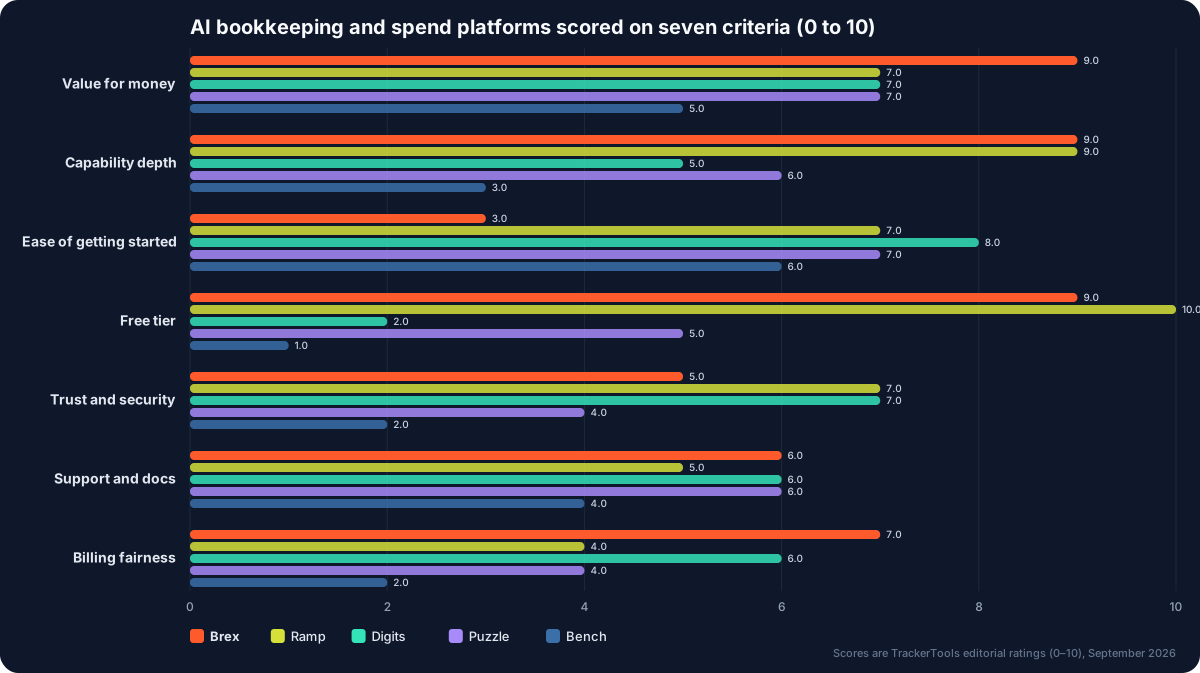
Seven criteria, five platforms. The interchange-funded card platforms win on free tier and value; the accounting ledgers win on nothing decisively; Bench trails on trust.
Pros and Cons Matrix: Who Solves Which Pain Point
| Pain point | Brex | Ramp | Digits | Puzzle | Bench |
|---|---|---|---|---|---|
| Can you be cut off? | ⚠ 30-day any-reason clause | ⚠ Terms unreadable | ✓ No eligibility bar | ⚠ Carve-out pending | ✗ Went offline 2024 |
| Company cards and spend controls | ✓ Full, free tier | ✓ Unlimited cards, free | ✗ None at all | ✗ None at all | ✗ Partner debit only |
| Cost knowable before signing | ✓ $0 or $12/active user | ✗ Hidden platform fee | ✓ $65/$100/$250 flat | ⚠ No annual figures | ✓ Published, floors only |
| Accrual close and schedules | ⚠ ERP sync, not a GL | ⚠ ERP sync, not a GL | ✓ Schedules on Core | ✓ Dual ledger, ASC 606 | ✗ Modified cash basis |
| Exit and refund rights | ⚠ Cancel anytime, no refund clause | ✗ Terms unpublishable | ⚠ No refund policy found | ⚠ Guarantee not in contract | ✗ Non-refundable, 60 days |
| Independent review evidence | ⚠ 1.9 Trustpilot, 4.8 App Store | ⚠ 2.4 Trustpilot, 4.9 Capterra | ✗ 13 reviews total | ✗ 34 reviews total | ⚠ 4.2 but 13% one-star |
| Published AI data commitment | ✗ No statement either way | ✗ Marketing copy only | ⚠ Per-client-file learning | ✗ Broad data-use clause | ✓ No third-party LLM training |
Pricing at a Glance
| Platform | Free tier | Cheapest paid | Top published tier | Trial | Refunds | Rating (read 17 Sep 2026) |
|---|---|---|---|---|---|---|
| Brex | Yes, $0/user/mo, no seat cap | $12/active user/mo (Premium) | Enterprise, custom | Not needed; Essentials is free | No refund clause; billed monthly in arrears | 1.9/5 Trustpilot (575); 4.8/5 App Store (8.8K) |
| Ramp | Yes, $0/user/mo | $15/user/mo + unpublished platform fee | Enterprise, custom, annual only | 30 days on Plus | Terms not readable pre-signup | 2.4/5 Trustpilot (211); 4.9/5 Capterra (221) |
| Digits | No | $65/mo (Essentials) | $250/mo Pro, marked Coming soon | 30 days | Not published in either direction | 5.0/5 Capterra (1); 5.0/5 Product Hunt (12) |
| Puzzle | No | $30/mo (Starter, 25 lifetime credits) | $360/mo (Scale) | 14 days; 2 months free on Starter | Marketing guarantee only; no contractual right | 3.2/5 Trustpilot (1); 5.0/5 Product Hunt (33) |
| Bench | No; one free prior month of books | From $199/mo (Grow) | From $599/mo (Core + Tax) | No free trial per FAQ | All fees non-refundable | 4.2/5 Trustpilot (1,353); 4.5/5 Software Advice (312) |
Which One Should You Actually Pick?
Brex — for the venture-backed startup that wants cards, banking and an API without paying for software. Essentials at $0 with full REST API access, bill pay, reimbursements and travel booking is the best value in this comparison, and the Column N.A. checking account was paying 4.01% or better on 17 September 2026. The caveat: your contractual recourse is $0, and Brex reserves the right to end the relationship with 30 days notice for any reason.
Ramp — for the finance lead who wants the widest free feature set and will negotiate Plus properly. Unlimited cards, AP with wires, a custom report builder and a 2% APY account at $0 per user is hard to argue with, and the compliance list is the deepest here. The caveat: do not sign Plus until Ramp gives you the platform fee in writing, and ask for the legal terms as a document, because you cannot read them on the website.
Digits — for the US-only, USD-only business that wants an AI ledger with a real API and no seat tax. $65/mo buys the same core feature set as $250/mo plus API and MCP access, and firms get a pricing model tied to actual automation. The caveat: it issues no cards, does not track sales tax, has no Shopify or Amazon integration, and you must email support to change plans.
Puzzle — for the startup that needs investor-grade accrual books without hiring a controller. Dual cash and accrual ledgers, ASC 606 revenue recognition and auto-drafted prepaid and depreciation schedules at $120/mo is a genuine capability bargain. The caveat: the founder-CEO and the firm-side technology were agreed for sale to Accrual on 2 September 2026, and nobody has said who runs the SMB product next.
Bench — for the founder who wants to hand bookkeeping to a person and never look at it. $199/mo, or $5,750 a year including licensed tax professionals who actually file, is a clear, published alternative to hiring. The caveat: all fees are non-refundable, annual plans need 60 days notice to cancel, tax penalties are explicitly excluded from liability, and this is the company that took its platform offline without warning on 27 December 2024.
Final Verdict
Brex wins because it is the only product here that does the whole job and lets you read the deal first. A $0 tier with no seat cap, a full REST API, an MCP server, bill pay and reimbursements, plus Premium metered at $12 on active users billed in arrears with a dashboard cancel button, is a set of terms a finance lead can actually evaluate. That matters more under the published weighting than a marginally richer free plan, and it is why Brex finishes at 7.21 to Ramp’s 7.03.
The winner’s weakness is real and should be priced in. Brex’s liability cap is fees paid in the trailing twelve months, which is exactly $0 for every Essentials customer, and the Platform Agreement permits termination for any reason on 30 days notice. The 1.9/5 Trustpilot score from 575 reviews (read 17 September 2026) is not about the software — the same user base rates the iOS app 4.8 from 8.8K ratings — it is about applications denied and accounts frozen, which is a materially different risk to evaluate. Brex has replied publicly to several of those reviews. And Capital One has owned Brex since 7 April 2026, so the durability of a free tier inside a bank is unproven.
If your problem is the ledger rather than the cards, the ranking inverts. Puzzle does accounting work at $120/mo that Brex and Ramp do not attempt, and Digits gives you an open API on a $65 plan. Both are US-only and USD-only, both have review bases in the low dozens, and both come with a governance question attached — Puzzle’s carve-out to Accrual, Digits’ four-and-a-half-year gap since its last priced round. Pair one of them with a card platform rather than expecting either to replace it. And whichever you choose, do what entangledqubit told a vendor in the middle of the Bench collapse and ask for the documented export and exit promise before you sign, not after.
Pick Brex if: you want corporate cards, banking and expense automation at $0 per user with a full API included, you can read and accept a 30-day termination clause and a liability cap equal to what you have paid, and you would rather have published pricing than a marginally larger free feature list.
Think twice if: you are a bootstrapped small business below the thresholds Brex published in 2022, you need a contractual liability floor above zero, or you need a general ledger with true accrual schedules — in which case pair a card platform with Puzzle or Digits, and treat Bench as the done-for-you human alternative rather than a peer.
Disclosure: TrackerTools has no affiliate relationship with any product in this comparison, and the links above are plain nofollow links. This article compares software and services; it is not financial, tax or legal advice, and none of these companies is a bank unless its own disclosure names the partner institution holding deposits. Every price, contract term, rating and quotation was verified against the vendors’ own pricing pages, platform agreements, terms of service, court and bankruptcy filings, credible press, G2, Capterra and Trustpilot on 17 September 2026. Allegations we could not verify from a credible source have been excluded.