
WebScraping.AI Review 2026: Credits, Prices and the Fine Print
What every request really costs, what the 7-day refund covers, who carries the legal risk, what “handles CAPTCHAs” means at 50 credits a request — and why there are no customer reviews to read.
A scraping API is a bet that someone else’s browsers and proxies will get a page back more cheaply than yours. The market that makes that bet has consolidated around a handful of names — ScrapingBee, ScraperAPI, Zyte, Bright Data, Firecrawl — and every one of them publishes success rates, collects reviews and appears in the benchmarks. WebScraping.AI does none of that. It has run since 2019, claims “100M+” pages extracted, sells a 250,000-credit plan for $29 that only Scrape.do and ScrapeOps match, and is, as far as we can tell, invisible: no Trustpilot or G2 review, no forum thread, no independent test. That combination is the reason for this review.
The product is a single HTTP API. Send a URL and an API key; get back rendered HTML, clean text, a CSS-selected fragment, an AI answer, typed JSON, parsed Google results or structured data for a known kind of page. The service runs headless Chrome, rotates datacenter, residential or stealth proxies in 13 countries, retries, and charges in credits — 1 for a plain fetch, 5 with JavaScript, up to 50 for the stealth tier — and only for requests that succeed. Around it sit seven SDKs, a hosted MCP server for Claude and Cursor, a CLI with an agent skill, an n8n node and a proxy mode for tools you already run.
This review explains what WebScraping.AI does on 19 November 2026, what every request costs on the Free, Personal, Plus and Startup plans and on pay-as-you-go, how the credits, refunds, upgrades and price-change rules work, what the Terms and privacy policy push onto you, what the AI endpoints promise and disclaim, what the complete absence of user reviews and benchmarks should mean to a buyer, who is behind the company, and how it compares with ScrapingBee, ScraperAPI, Scrapfly, ScrapingAnt, ScrapeOps, ZenRows, Scrapingdog, Scrape.do, Crawlbase, Zyte, Bright Data, Oxylabs, Decodo, Apify, Firecrawl and Diffbot.
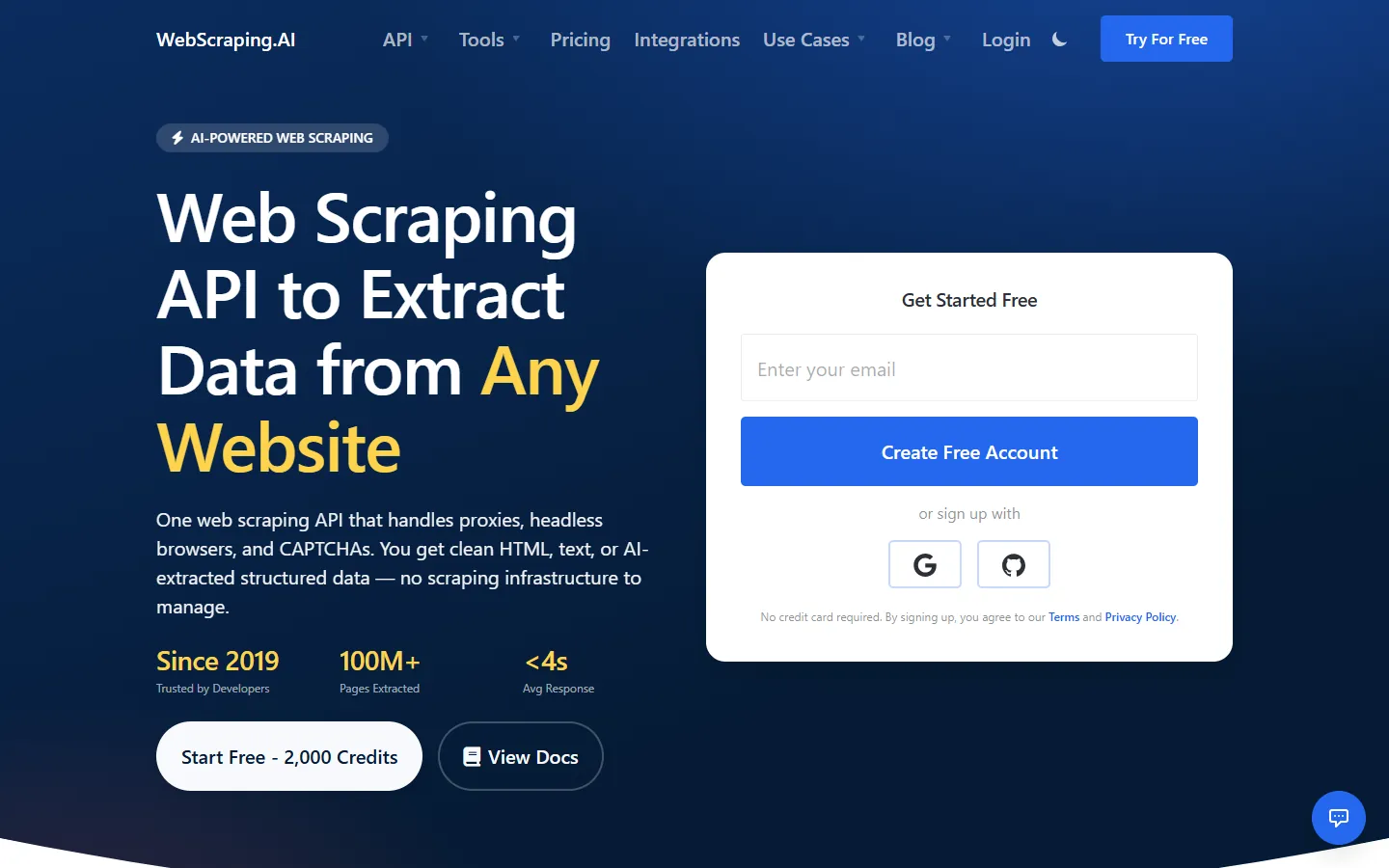
webscraping.ai on 19 November 2026. The three numbers on the hero are the company’s own; no customer logo, review badge or benchmark appears anywhere on the site.
1. What Is WebScraping.AI — and Who Is Behind It
The homepage calls it “One web scraping API that handles proxies, headless browsers, and CAPTCHAs” from which “You get clean HTML, text, or AI-extracted structured data — no scraping infrastructure to manage.” The site’s own Markdown index, written for language models, is more exact: “send a URL, get back rendered HTML, clean text, CSS-selected fragments, or AI answers and structured JSON extracted from the page. JavaScript rendering, rotating datacenter/residential/stealth proxies and retries are handled server-side.” There is no desktop app, no point-and-click robot and no crawler; everything is a request against api.webscraping.ai, and the free browser tools — a selector tester, a cURL converter, an HTML-to-Markdown converter — exist to help you write that request.
The company. The Terms of Service, last updated 24 May 2026, name the operator as “Urlooker LLC, a Wyoming limited liability company, with a mailing address of 10350 N Vancouver Way #8001, Portland, Oregon 97217, USA” — a Wyoming registration, a Portland address with a four-digit suite number of the kind mail-forwarding services issue, and, on the about page, a phone number with Houston’s 832 area code. G2’s seller profile and Crunchbase, which we could read only through search snippets, both place the company in Houston. The about page says “We’ve worked in web scraping since 2016 and launched the WebScraping.AI API in 2019” and names nobody; no founder, team member, headcount or investor appears anywhere on the site, in the Terms or in any registry we could reach. The one public trace is the GitHub organisation, created in September 2020, whose only public member is a user called Drakula2k — “Full stack developer, entrepreneur”, website webscraping.ai — who wrote on Hacker News in December 2020, “I’m working on simplifying web scraping for developers”, linking the site, and whose account has a karma of 3. A ScrapeOps article lists WebScraping.AI as a Y Combinator Winter 2020 company; Y Combinator’s own company page for it returns a 404 and the vendor never mentions YC, so we treat that as unconfirmed. The official Python client was first published on 27 March 2020; six of the organisation’s other repositories — the JavaScript, Go, Java and .NET SDKs, the n8n node and the CLI — were all created between 12 and 19 May 2026 and have no stars between them (the PHP client has four, the Ruby client none), and the recent commits we sampled in the Python client and MCP server repositories are all signed “WebScraping.AI” or “WebScraping.AI Bot”. The picture is of a small, possibly one-person company that has shipped steadily for seven years and told the world almost nothing about itself.
Scale. The homepage says “100M+ Pages Extracted”, “<4s Avg Response Time”, “24/7 API Availability” and “Since 2019”, the last captioned “Trusted by Developers”; the about page restates them as “100M+ Successful page extractions and counting” and “24/7 API availability monitoring”. There are no customer names, logos, case studies or testimonials, and no review-site badge, because, as section 8 explains, there is nothing to badge. The external signals are small: the MCP server package had 1,444 downloads on npm in the month to 18 November 2026, the Python package 409 on PyPI, the MCP server repository 45 stars and the Python client 17. A directory’s estimate of 20,700 monthly visits to the site in May 2026 is unverified. None of this says the API is bad; it says it is little used by people who talk.
The 2026 direction. This has been a busy year on the product side. The /serp endpoint arrived in September 2026 (“Priced per search” in the Python client’s 4.1.0 changelog, then per results page with pagination in 4.3.0 on 24 October), /data for structured records in late September or October (its 4.2.0 changelog entry carries a misprinted date; the extension to any public page shipped on 26 October), the hosted MCP server replaced the local one, four SDKs, an n8n node and a CLI were published in May, and the site was rebuilt around AI readers — llms.txt, Markdown for every page, an agent skill under /.well-known/agent-skills. Two smaller changes matter for buyers. The Personal plan was $42 a month in August 2024 according to an independent review; it is $29 today, and an older FAQ that promised “a full refund within 7 days if you’ve used less than 30% of your plan quota”, still mirrored on a directory, has been replaced by the price-minus-usage rule in the current Terms. And on 24 and 25 October 2026 the vendor removed credit prices from its SDK documentation, changelog and MCP tool descriptions — “CHANGELOG: stop quoting credit prices in past entries”, “Drop the credit amount from the question/fields tool descriptions” — because, the changelog says, prices are set server-side. The table in section 4 is what the site showed on 19 November 2026; check it before you budget.
2. Who WebScraping.AI Is For — and Who It Is Not For
It fits you if:
- You are a developer or data team that wants one HTTP call to return a rendered page, its text, a CSS-selected fragment or AI-extracted JSON, without running your own browsers and proxies
- You need Google results as JSON or structured data from YouTube, LinkedIn, Instagram or Indeed pages and would rather pay a flat 15 credits a page (50 on Reddit) than maintain parsers
- You want an AI assistant or agent (Claude, Cursor, Windsurf, Codex) to fetch live pages through a hosted MCP server, or an n8n, Zapier, Make or Pipedream workflow to scrape without code
- You scrape in bursts and want pay-as-you-go credits that last 12 months instead of a subscription that resets every month
- You value published, fixed per-request prices and a rule that failed requests are free, and you are happy to escalate from datacenter to residential to stealth proxies yourself (or let
proxy=autodo it)
Look elsewhere if:
- You need screenshots, PDF rendering or a browser you can drive step by step — there is no screenshot endpoint and no remote browser;
js_scriptruns one snippet, nothing more - Your targets are the hardest anti-bot sites at volume — stealth requests cost 50 credits each, so a Personal plan buys 5,000 of them a month, and no success rate is published
- You need more than 13 proxy countries, city-level geotargeting on ordinary pages, or sticky sessions — the country list stops at the US, the UK, Germany, France, Canada, Spain, Turkey, Russia, Japan, South Korea, India, Italy and Hong Kong
- You want a money-back promise on deliverability or a vendor that will tell you which LLM reads your pages — the Terms disclaim AI accuracy and the model providers are named only under NDA
- You need crawling, site-wide jobs, scheduling or storage — this is a per-URL API; crawlers, datasets and schedules are what Apify, Firecrawl or Zyte sell
3. What You Actually Get: Nine Endpoints, Four Proxy Tiers, Seven SDKs and an MCP Server
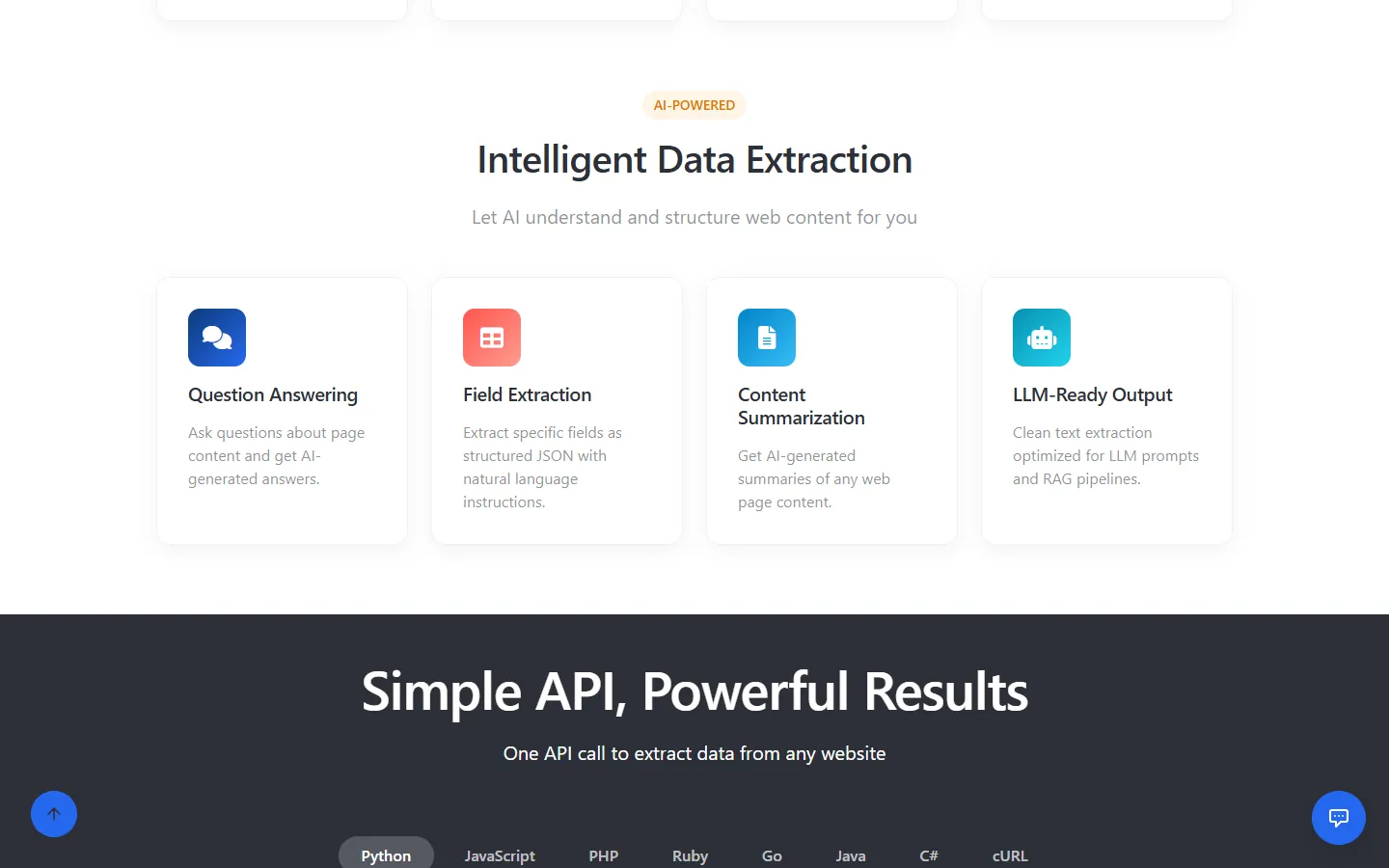
The AI layer on the homepage: questions, typed fields, summaries and clean text for prompts. The first three run through the two AI endpoints at 5 credits on top of the fetch; the fourth is the plain /text call, with no surcharge.
The endpoints. Everything is a GET against api.webscraping.ai with an api_key query parameter, except that /html, /text, /selected and /selected-multiple also accept POST when you need to send a body to the target page. /html returns the page after headless Chrome has rendered it (“Includes JavaScript rendering via headless Chrome and automatic proxy rotation”); /text returns clean text “optimized for LLM prompts and RAG pipelines”; /selected and /selected-multiple return the HTML of one or several CSS selectors. The two AI endpoints take a page and a prompt: /ai/question answers a question about the page, /ai/fields returns typed JSON for fields you describe in plain English (“Extract specific data fields from any webpage as structured JSON”). /serp is “query-shaped, not URL-shaped”: it takes a Google search and returns organic results with position, title, link, snippet and date, related searches and pagination, 10 results a page, up to 5 pages a call, 100 pages deep, and only Google (“Google is the only engine today”). /data returns structured JSON “for any public web page from its normal URL”: sites with a dedicated parser (YouTube, TikTok, X, LinkedIn, Instagram, Reddit and Indeed are the ones the site names; Amazon has no dedicated parser and its page points you to /ai/fields instead) come back with fixed fields, and for any other site “the first request for a new kind of page also has an AI model learn the page’s structure, so it can take up to about 45 seconds”. /account reports your remaining monthly and pay-as-you-go credits.
The knobs. js is on by default (5 credits) and off for 1; js_timeout waits 2 seconds for scripts by default, up to 20; timeout is 10 seconds by default and “Maximum: 25000 ms (25 seconds); larger values are capped”; wait_for holds the request until a selector appears; device emulates desktop, mobile (an iPhone 11 viewport) or tablet; headers carries cookies, bearer tokens and referers; js_script runs your own JavaScript on the page; custom_proxy routes through a proxy you own; error_on_404 and error_on_redirect turn soft failures into billable-free errors. country picks one of 13 proxy countries, with the United States as the default.
The proxy ladder. Four values: datacenter (“Fast datacenter proxies with rotating IPs”), residential (“Real residential IPs from ISPs”), stealth (“Premium proxies with advanced anti-bot bypass”) and auto, which “Tries datacenter, then residential, then stealth inside one request and returns the first result that isn’t blocked” and bills “The tier that worked (1–50 credits)”. When a target blocks you, the 500 response is structured: it names the error (target_blocked), shows the target’s status and a body preview, and includes a next_step with the exact parameters to retry and their cost — “Retry with proxy=residential (10 credits per request). Failed requests are not billed.” The docs say the ladder is “datacenter → residential → stealth” and that “Anti-bot challenge pages go straight to proxy=stealth, because they need the hardened browser, not just a better IP.” There is no screenshot endpoint, no session persistence and no remote-browser control; those are things ScrapingBee, Zyte and Bright Data sell and WebScraping.AI’s own comparison pages concede.
Proxy mode. For tools you already run, proxy.webscraping.ai:8888 accepts your API key as the username and your parameters as the password (js=true&proxy=residential), with examples for cURL, Python requests, Scrapy, Selenium and Playwright; the docs warn that the proxy “uses a self-signed cert”, so TLS verification has to be switched off in the client.
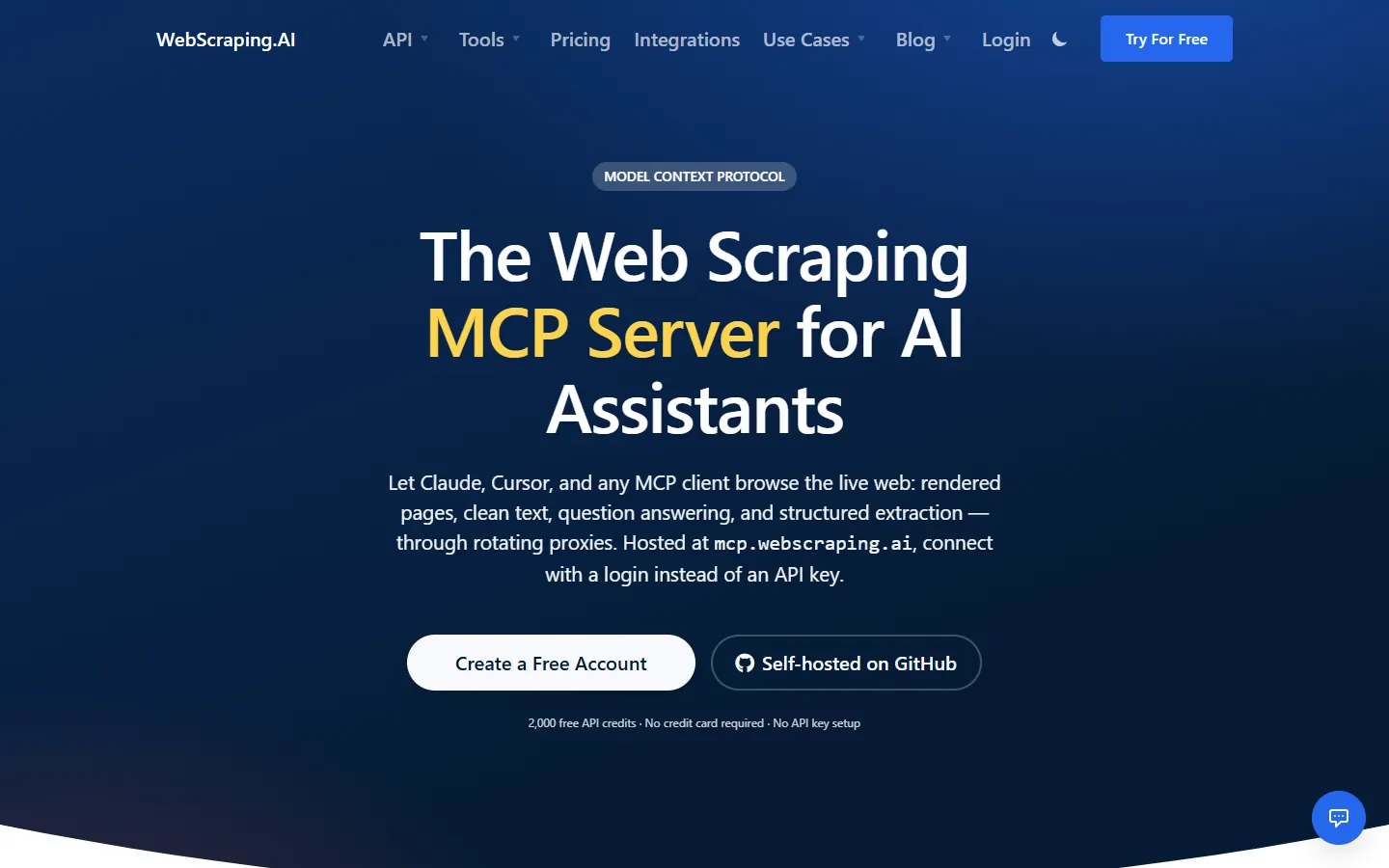
The hosted MCP server: Claude, Cursor or any MCP client signs in with the account instead of an API key; the older open-source server still runs locally.
SDKs, MCP, CLI and no-code. There are seven official SDKs — Python, JavaScript, PHP, Ruby, Go, Java and C#/.NET — plus an n8n node, a CLI (npm install -g webscraping-ai-cli) that “ships an AI agent skill your coding assistant can install” for Claude Code, Cursor, Windsurf, Kiro, OpenCode, Gemini CLI, GitHub Copilot, Augment and Factory, and an OpenAPI specification. The hosted MCP server at mcp.webscraping.ai/mcp uses Streamable HTTP with OAuth sign-in, “no API key needed”; the previous open-source version runs locally over stdio with your key and “exposes the same 10 tools”. The integrations page lists the MCP server, the CLI, Zapier, n8n, Make, Lindy AI, Pipedream, Integrately, Activepieces and viaSocket, and claims “7+ Platforms” and “1000+ App Connections” through those platforms. A browser-based API Request Builder in the dashboard lets you try every example without code. The whole site is also served as Markdown — append .md to any path, or read llms.txt and llms-full.txt — which is how we read most of it.
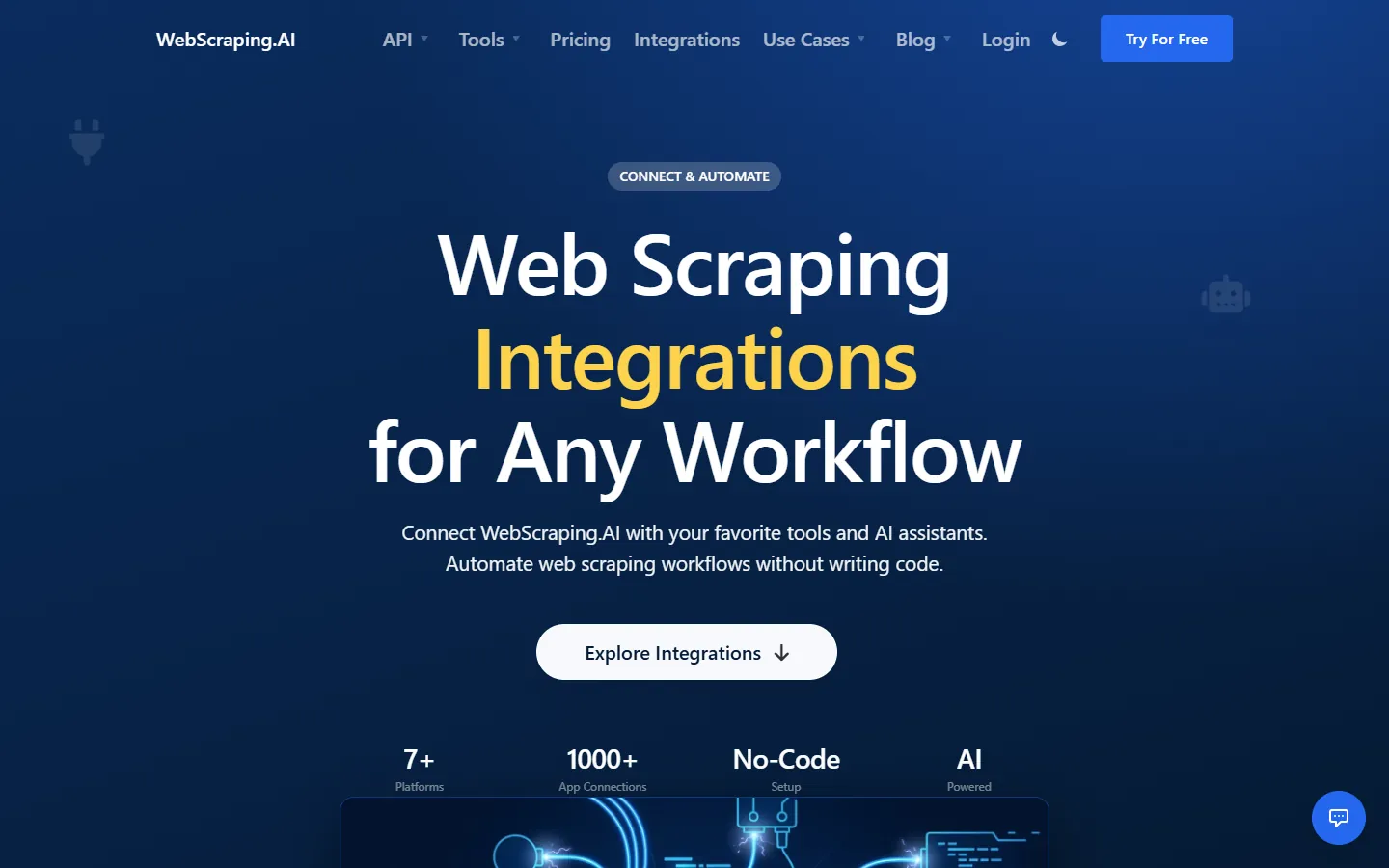
The integrations page. The “1000+ app connections” are Zapier’s and Make’s catalogues, reached through the scraping step, not WebScraping.AI’s own.
What is not there. No screenshots, no PDF, no crawler or sitemap job, no scheduler, no data storage, no webhooks, no sticky sessions, no city-level geotargeting on ordinary pages (the /serp endpoint does take a location), no Bing or other engines, and no published success rate, uptime figure or status page. The “24/7 API Availability” on the homepage is a monitoring claim (“24/7 API availability monitoring” on the about page), not an SLA.
4. Credits: What One Page Really Costs
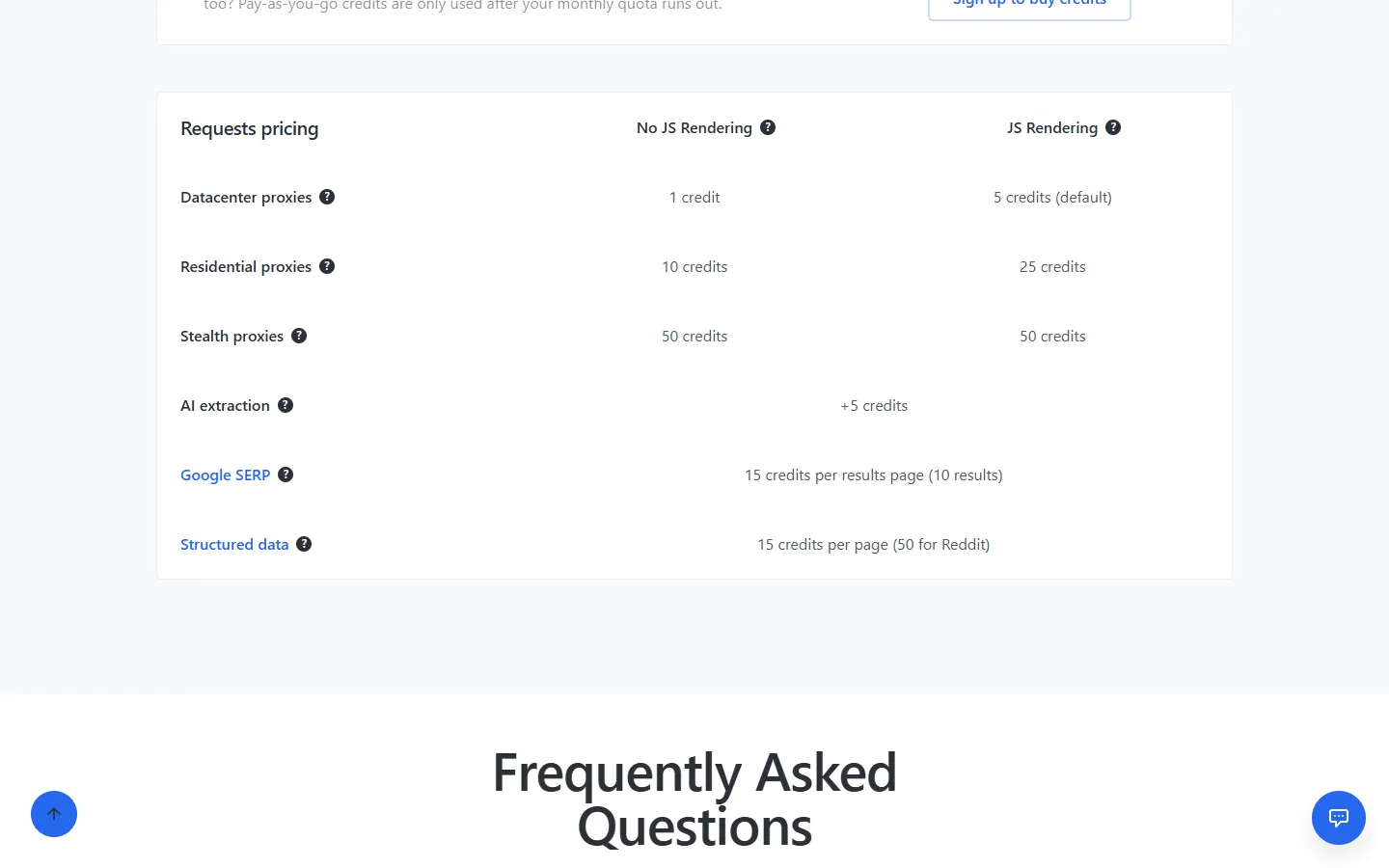
The credit table on the homepage, 19 November 2026. The default request (JavaScript on, datacenter proxy) is 5 credits, not 1.
Every plan is a bucket of credits, and every successful request draws from it according to one table. The cheapest request — no JavaScript, a datacenter proxy — costs 1 credit, but it is not the default: js is on unless you turn it off, so the request most people will send costs 5. Residential proxies cost 10 without JavaScript and 25 with it; stealth proxies cost 50 either way; the two AI endpoints add 5 on top of whatever fetch they ride on; a Google results page is 15; a /data page is 15 on most supported sites and 50 on Reddit, and “Varies depending on the site” elsewhere. The rule that matters most is in the docs: “Failed requests are free. You’re only charged for successful responses. For /data, pages that come back parse_failed or not_found count as successful and are charged; only failed fetches are free.” The Terms add two clauses the pricing page does not. Section 6.6(g) says “requests for geo-restricted or unreachable websites remain chargeable”, which sits awkwardly beside the docs’ promise that failed fetches are free, and section 5.8 says “For certain protected, high-risk, or technically challenging Target Websites, we may apply credit multipliers”, disclosed “in-app where practicable”.
Pages per month, by plan and request type
| Request type | Credits | Free (2,000) | Personal, $29 (250,000) | Plus, $99 (1,000,000) | Startup, $249 (3,000,000) |
|---|---|---|---|---|---|
| Static page, datacenter proxy, no JavaScript | 1 | 2,000 | 250,000 | 1,000,000 | 3,000,000 |
| Rendered page, datacenter proxy (the default) | 5 | 400 | 50,000 | 200,000 | 600,000 |
| Rendered page + AI question or fields | 10 | 200 | 25,000 | 100,000 | 300,000 |
| Residential proxy, no JavaScript | 10 | 200 | 25,000 | 100,000 | 300,000 |
| Residential proxy, rendered | 25 | 80 | 10,000 | 40,000 | 120,000 |
| Residential, rendered + AI | 30 | 66 | 8,333 | 33,333 | 100,000 |
| Stealth proxy (with or without JavaScript) | 50 | 40 | 5,000 | 20,000 | 60,000 |
| Google results page (10 results) | 15 | 133 | 16,666 | 66,666 | 200,000 |
| Structured data page (YouTube, LinkedIn, Indeed…) | 15 | 133 | 16,666 | 66,666 | 200,000 |
| Structured data page, Reddit | 50 | 40 | 5,000 | 20,000 | 60,000 |
What a thousand pages cost
| Request type | Personal ($0.116 per 1,000 credits) | Plus ($0.099) | Startup ($0.083) | Pay-as-you-go ($0.20) |
|---|---|---|---|---|
| 1,000 static pages (1 credit) | $0.12 | $0.10 | $0.08 | $0.20 |
| 1,000 rendered pages (5) | $0.58 | $0.50 | $0.42 | $1.00 |
| 1,000 rendered pages with AI fields (10) | $1.16 | $0.99 | $0.83 | $2.00 |
| 1,000 residential rendered pages (25) | $2.90 | $2.48 | $2.08 | $5.00 |
| 1,000 stealth requests (50) | $5.80 | $4.95 | $4.15 | $10.00 |
| 1,000 Google results pages (15) | $1.74 | $1.49 | $1.25 | $3.00 |
The arithmetic says two things. The plans are cheap for ordinary pages — fifty-eight cents for a thousand rendered pages on Personal — and expensive for protected ones: a site that needs stealth proxies costs ten times a default request and fifty times a static one, and a Personal subscriber gets only 5,000 such requests a month. Pay-as-you-go credits cost $0.0002 each, 72% more than the same credit inside the $29 plan and 2.4 times the Startup rate, which is the price of not having a subscription. The docs’ advice for anyone minding the meter: “Start with datacenter proxies. Switch to residential if you encounter blocks or CAPTCHAs, and use stealth as a last resort for sites with the strongest anti-bot protection”, or let proxy=auto walk the ladder and pay for “The tier that worked”.
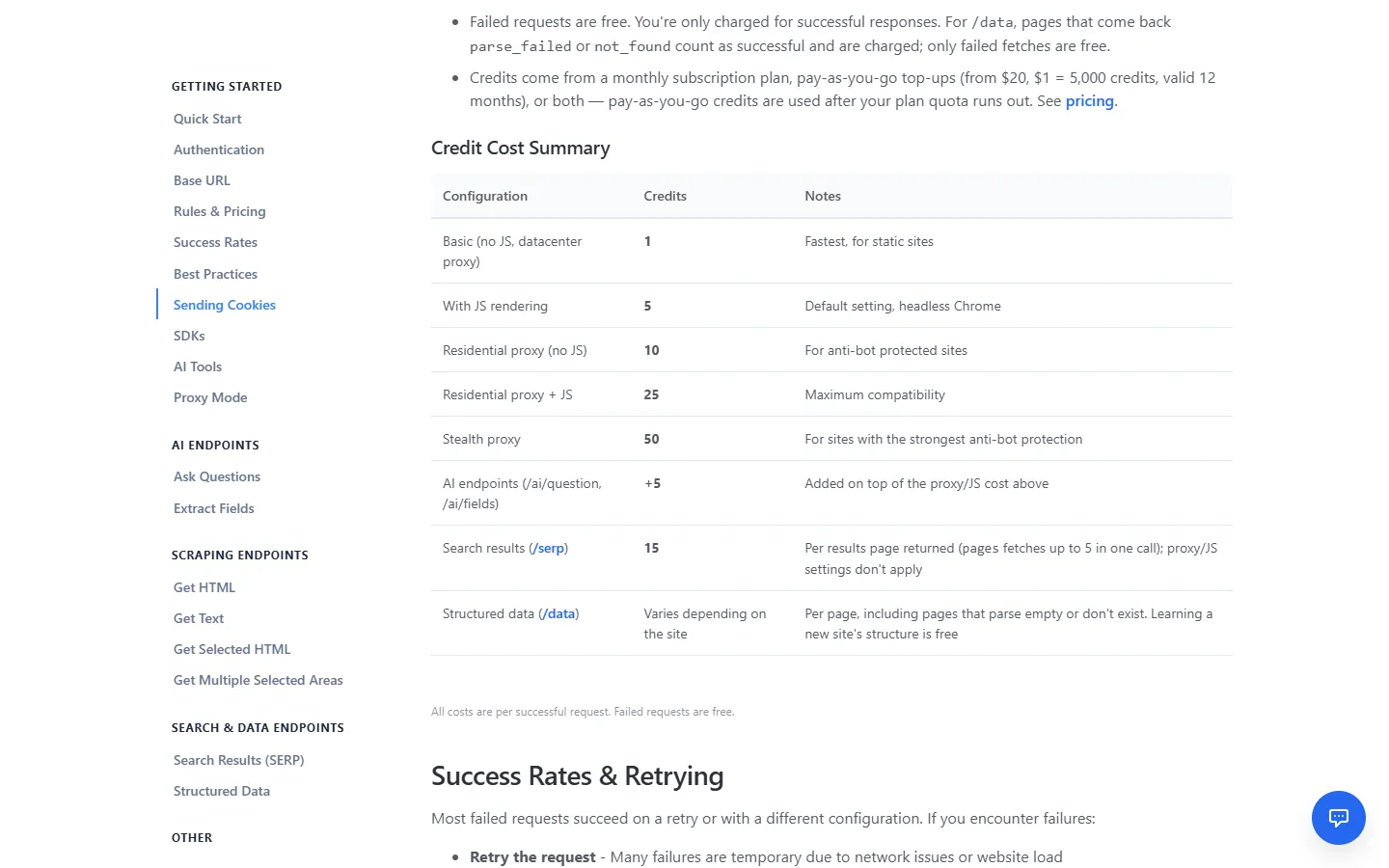
The docs’ Credit Cost Summary. The only guidance on success rates is the retry advice beneath it; no percentage is published.
One more number to keep in view: speed. The homepage claims “<4s” average response, requests can run to the timeout cap of 25 seconds (the docs’ Rules & Pricing section says 30), a /data request on a new kind of page “can take up to about 45 seconds”, and concurrency is capped per plan — 2 requests at a time on the free plan, 10 on Personal, 25 on Plus, 50 on Startup — so a Personal account that needs 50,000 rendered pages a month at four seconds each has about 56 hours of request time to get through, or five and a half hours of wall-clock time at full concurrency.
5. WebScraping.AI Pricing 2026 — Free, Personal, Plus, Startup and Pay-As-You-Go
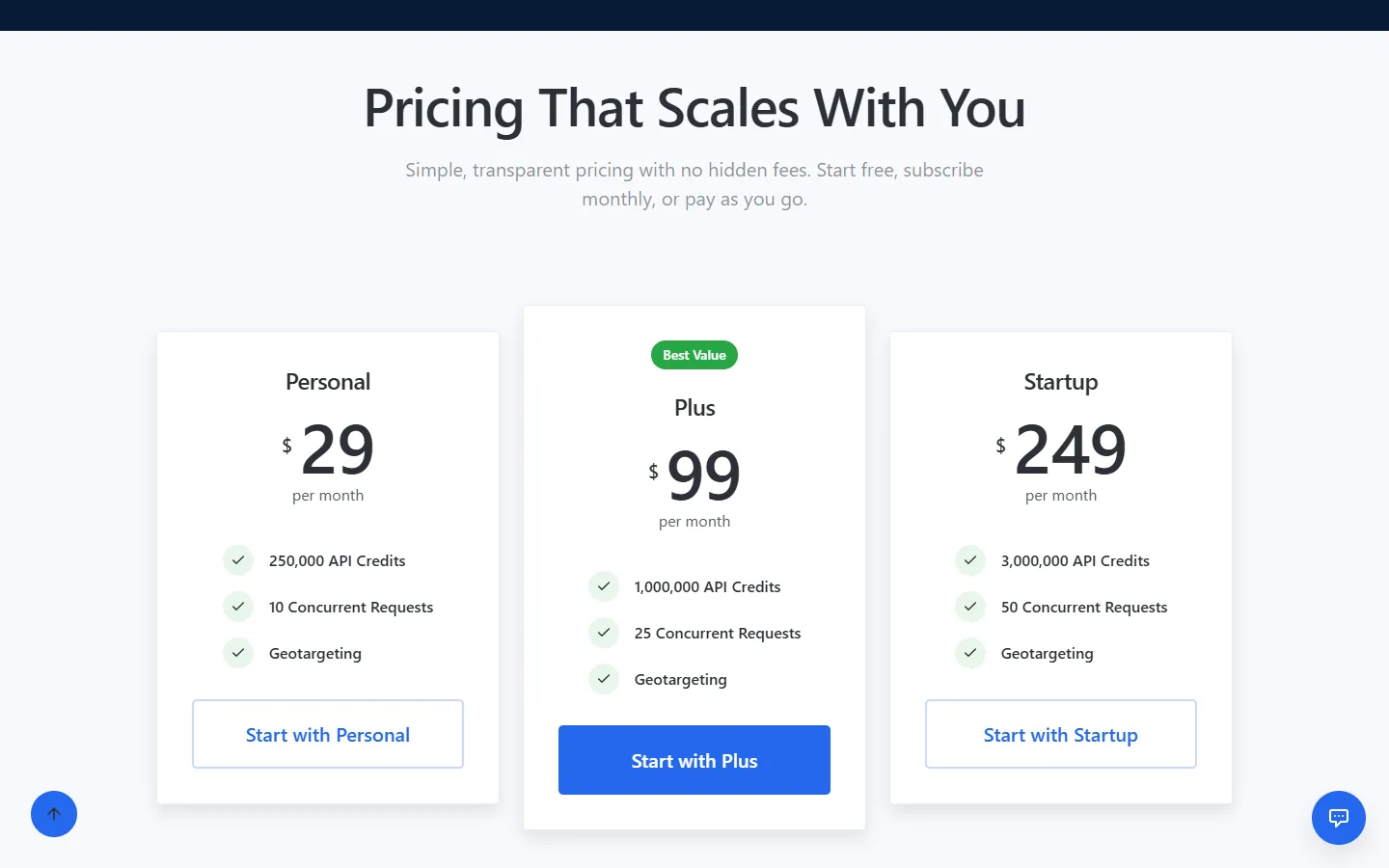
The three subscriptions on 19 November 2026. There is no yearly toggle and no annual discount anywhere on the site.
Prices were read on 19 November 2026 from the pricing section of the homepage (the /pricing URL redirects there), the Markdown copy of the same page, the docs’ Rules & Pricing section and the Terms of Service. Everything is in US dollars, billed monthly, with no yearly plan and no discount for commitment.
Plans
| Plan | Price | Credits a month | Concurrent requests | Notes |
|---|---|---|---|---|
| Free | $0 | 2,000 | 2 | ”No credit card required”; 400 rendered pages or 40 stealth requests a month; renews monthly |
| Personal | $29 a month | 250,000 | 10 | Geotargeting in 13 countries; $0.116 per 1,000 credits |
| Plus | $99 a month | 1,000,000 | 25 | Marked “Best Value”; $0.099 per 1,000 credits |
| Startup | $249 a month | 3,000,000 | 50 | $0.083 per 1,000 credits |
| Enterprise | Custom | 3,000,000+ | Custom | ”Yes, we offer custom enterprise plans. Contact us at hello@WebScraping.AI” |
| Pay-as-you-go | $0.0002 a credit, $20 minimum top-up | 100,000 per $20 | Plan’s limit (2 without a plan) | “Credits stay valid for 12 months, and every top-up extends your whole balance”; used after a plan’s quota runs out |
The plan credits behave like a meter, not a balance. The Terms say subscription credits “are issued at the start of each Billing Period”, “remain usable during that Billing Period only”, “expire and reset at the end of that Billing Period” and “are non-refundable and do not roll over”. Pay-as-you-go credits are the opposite: the Terms say they “expire twelve (12) months from the date of purchase”, and the pricing FAQ adds that every new top-up “extends your entire balance for another 12 months” and that, if you hold both, “pay-as-you-go credits are only consumed after your monthly plan quota runs out”. The extension, though, is a FAQ promise rather than a contractual one: section 5.5 of the same Terms says the unused balance expires “with no extension, carry-over, or refund”, so keep a copy of the FAQ wording if you plan to rely on it. A developer with a bursty workload can therefore buy $20 of credits, use them over a year and never subscribe; a team that scrapes every day is better off on a plan, where a credit costs between 42% and 58% of the pay-as-you-go rate.
Upgrades, downgrades and overage
The FAQ promises a soft landing: “If you downgrade, you’ll stay on your current plan until the end of the billing period. If you upgrade, you’ll be upgraded immediately, and unused credits from your old plan will be added to your new quota.” The Terms spell out what “immediately” costs: on upgrade “you will be charged the full price of the new plan at the time of upgrade, with no proration of, or credit for, fees previously paid for the prior Billing Period”, and “a new Billing Period begins on the date of upgrade”. Carried-over credits then expire with the new period. Overage exists on paper — “certain plans may permit continued use subject to an overage rate at the then-posted in-app rate”, with “clear in-app consent” first — but no overage rate is published; the practical answer when a quota runs out is a pay-as-you-go top-up or the next plan.
How it compares on the vendor’s own terms
WebScraping.AI’s comparison pages, which it calls “honest, side-by-side” and dates to September 2026, make three claims we could check against the rivals’ pricing pages (section 9): that its 250,000-credit plan costs $29 where ScrapingBee’s costs $49; that its stealth proxies cost 50 credits where ScrapingBee’s hardest tier costs 75, and its residential proxies 10 where Scrapfly’s cost 25; and that it sells prepaid credits without a subscription where ScrapingBee has no pay-as-you-go option. All three held on 19 November 2026; the closest Scrapfly offers is pay-as-you-go overflow on its $100-and-up plans, which still needs a subscription. What the pages do not say is that ScrapingBee’s entry plan is $19 with 25 concurrent requests against Personal’s 10, that ScrapingAnt gives 100,000 credits for $19 and 10,000 free every month, that ZenRows and Scrapingdog discount yearly billing where WebScraping.AI has no yearly price at all, and that WebScraping.AI is absent from every independent benchmark that has measured its rivals.
What our link does
WebScraping.AI runs its affiliate programme through Dub.co and pays “25% recurring commission on every payment your referrals make, forever”, with a 60-day cookie, a $50 and two-customer minimum before payout, monthly Stripe payouts, a 30-day pending period for refunds and chargebacks, and a cap of “$62.25 per customer per month (equivalent to 25% of $249/month Startup plan)”. The link in this review carries a via referral tag. Nothing on the affiliate page promises the referred customer anything — no coupon, no extra credits — and the free plan is the same whether you arrive through a link or not. We did not open the link ourselves; we never test affiliate or referral links. The programme’s own rules forbid affiliates from bidding on the brand’s own keywords and ask them to “Write honest reviews and comparisons”, which suits us.
6. Trial, Refunds, Cancelling and the Contract
Trial. The free plan is the trial: “2,000 API credits per month for free (with a maximum of 2 concurrent connections). No credit card required.” That is 2,000 static pages, 400 rendered pages, 200 AI extractions or 40 stealth requests, and it renews every month rather than expiring, so a hobby project can stay on it. The sign-up page sits behind a Cloudflare challenge, which our automated reader could not pass; a browser gets through.
Refunds. Section 5.10 of the Terms, dated 24 May 2026, is specific: “Within seven (7) days of your initial Subscription purchase date (not renewal or upgrade dates) or, in the case of PAYG Credits, within seven (7) days of the PAYG purchase date, you may request a refund. The refund amount will equal the purchase price less the standard PAYG rate equivalent of any API Credits consumed during the seven-day period. After the 7-day window, all Subscription Fees and PAYG Credit purchases are non-refundable.” Two details follow from the wording: credits you burn in the first week are deducted at $0.0002 each, the pay-as-you-go rate, even on a plan where they cost $0.000116; and renewals are never refundable, so a forgotten subscription is a lost month. “Non-usage of the Service does not entitle you to a refund.” Requests go to support@webscraping.ai.
Cancelling. Subscriptions “automatically renew on a monthly or annual basis, as applicable, until canceled”; a downgrade takes effect at the end of the billing period, but neither the FAQ nor the Terms say when a cancellation does: the only mechanism the Terms describe is terminating the account, after which “your right to use the Service ceases immediately” with no refund, and nothing mentions a notice period or a retention step. Disputed charges must be raised within 30 days or are “deemed accepted”; overdue amounts accrue interest, and after 60 days “we may engage debt collection agencies” — standard clauses, but worth knowing for a card that lapses.
Price changes. One of the more customer-friendly clauses we have seen in this market: “We may change Subscription Fees and API Credit prices at any time, but no more than once per calendar year per plan. We will provide at least thirty (30) days’ notice via email or in-app notification”, with a right to terminate during the notice period, and “PAYG Credits already purchased before a price change remain redeemable at the rate in effect at the time of purchase.” Material changes to the Terms themselves also carry an amendment notice period and a right to leave.
The contract. The counterparty is “Urlooker LLC, a Wyoming limited liability company, with a mailing address of 10350 N Vancouver Way #8001, Portland, Oregon 97217, USA” — a Wyoming company with an Oregon mailing address, which is a mail-forwarding arrangement rather than an office. Wyoming law governs and Wyoming courts have exclusive jurisdiction; there is no arbitration clause. Liability is capped at “THE AMOUNTS YOU PAID TO THE COMPANY IN THE SIX (6) MONTHS IMMEDIATELY PRECEDING THE EVENT GIVING RISE TO THE CLAIM”, with the usual carve-outs for your payment and indemnity obligations. Three clauses matter more than the cap. The company “may immediately suspend or limit your access” if a target website complains (“Suspension on Complaint”), may “remove Scraped Content or other data from our systems in response to a complaint or legal demand”, and you “release the Company … from any claims … connected with any dispute you have or may have with any Target Website or its operator”. The support promise is a target, not an SLA: the Terms set no response time at all, and the only uptime language on the site is “24/7 API availability monitoring”. The privacy policy, same date, says account data is deleted or anonymised “no later than sixty (60) days” after a request or termination, that usage logs include “request metadata, timestamps, IP addresses associated with requests”, that the company “is established in the United States” and relies on standard safeguards for EEA, UK and Swiss transfers, and that “A list of our material subprocessors, including AI model providers, is available to enterprise customers upon request under non-disclosure agreement” — so a Personal or Plus subscriber cannot learn which LLM reads their pages.
7. Is WebScraping.AI Safe and Legal? Who Carries the Risk, Where Your Data Goes and What “Handles CAPTCHAs” Means
“Safe” splits into three questions for a scraping API: whether the vendor is reliable, whether your data is protected, and who is liable when a target site objects.
Reliability. The company has run the API since 2019 and says it has done “100M+” successful extractions, but it publishes no uptime figure, no status page and no success-rate benchmark. The homepage’s “24/7 API Availability” resolves, on the about page, to “24/7 API availability monitoring” — they watch it, they do not guarantee it — and the Terms disclaim uninterrupted service as every SaaS contract does. The honest design choices are the ones that limit the damage: failed requests are free, the error body tells you what to retry and what it will cost, proxy=auto escalates for you, and the docs’ only success-rate page is advice — “Most failed requests succeed on a retry or with a different configuration.” For a buyer that means the free plan is the benchmark: run your real targets through 2,000 credits before paying.
Your data. This is where the Terms are better than most. Section 8.2: “We do not use Scraped Content, the prompts and queries you submit, or the outputs generated by the Service to train, fine-tune, or evaluate our machine-learning or AI models”, and section 8.4 extends the promise to “third-party AI model providers”, who are contractually barred from training on your data and chosen “where applicable” for “zero-data-retention or equivalent commitments”. The limits: the company “may store Scraped Content, logs, and Service outputs for as long as reasonably necessary” with no stated period for scraped content or outputs, though the privacy policy does fix one for usage logs — IP addresses and request metadata are “retained for thirty (30) days, after which they are permanently deleted”; and the names of the AI providers are disclosed only “to enterprise customers upon request under non-disclosure agreement”. Section 8.1 is blunt about accuracy: “Outputs are probabilistic and may contain errors, omissions, or inaccuracies”, and 8.5 says “You shall not rely on AI outputs for decisions that require human review, regulatory approval, or that could result in material harm absent independent verification.” The /ai/fields endpoint narrows that risk by design — the site’s own guide argues that “Asking for specific, typed fields dramatically constrains what the model can get wrong” — but no accuracy figure is published anywhere.
Who is liable. Read section 7 of the Terms before you point this API at anything with names in it. You are responsible for “the terms of service of Target Websites”, for “the U.S. Computer Fraud and Abuse Act”, and, where you scrape personal data, “for providing any notices required under GDPR Article 14” and “for establishing a lawful basis for processing”; the company is “NEITHER A DATA CONTROLLER NOR A PROCESSOR” of that data, and “You indemnify us for all losses, fines, penalties, and expenses”. If you use scraped content to train a model, section 8.3 makes you warrant “an independent lawful basis” and indemnify the company again. Logging in is forbidden: you may not “access a Target Website by logging in or authenticating into a user account … unless you are the authorized account holder”. And the company can act on a complaint before any court does: “If we receive a complaint from a Target Website owner … we may immediately suspend or limit your access.” None of this is unusual — ScrapingBee, Zyte and Bright Data allocate risk the same way — but WebScraping.AI writes it in plainer English than most.
What the law says, in the company’s own words. The blog’s legality guide is more candid than the marketing. It summarises the US position as “Scraping publicly accessible pages is not a US computer-crime violation” after Van Buren (2021) and hiQ (2022), then adds the part most vendors leave out: “hiQ still lost. In December 2022 it accepted a $500,000 consent judgment and a permanent injunction, and deleted its scraped data — on breach of contract, not on the public-data CFAA theory it won.” On Meta v. Bright Data (2024): “logged-out scraping of public pages did not breach Meta’s terms.” On Europe: “‘Publicly available’ is not a GDPR defence. Clearview AI scraped only public images and has drawn fines of €20M (France), €20M (Italy), and €30.5M (Netherlands)”, and “robots.txt is not a law in the US, but it is nearly one in the EU for AI training” under Article 4 of the DSM Directive. The guide’s table puts the worst case for personal data at “Regulatory fines up to 4% of global turnover”. That is the frame to use: the API makes the fetch possible; the Terms make the consequences yours.
“Handles CAPTCHAs.” The homepage says the API “handles proxies, headless browsers, and CAPTCHAs”; the feature card is more precise — “Stealth proxies get past anti-bot challenges like Cloudflare’s, and challenge pages aren’t charged” — and the docs more precise still: challenge pages “go straight to proxy=stealth, because they need the hardened browser, not just a better IP”, at 50 credits a request, and “no language model can read a page that Cloudflare refused to serve.” So the promise is a hardened browser on a premium IP, not a CAPTCHA-solving farm, and it costs fifty times the base request. Whether it works on your target is a question only the free plan can answer; whether you should use it is the question in the paragraph above. There is an irony the company seems aware of: its own robots.txt declares “WebScraping.AI welcomes AI crawlers and agents: search indexing, answer engines, user-initiated fetches and training” and serves every page as Markdown for them — a scraper that asks to be scraped.
8. What WebScraping.AI Users Say: Nothing, Anywhere We Could Find
| Source | Rating | Reviews | Note |
|---|---|---|---|
| Trustpilot | — | 0 | An unclaimed profile for webscraping.ai with “This company hasn’t received any reviews yet.”; the address with a www prefix returns a 404 |
| G2 | — | 0 | ”There are not enough reviews for Webscraping AI for G2 to provide buying insight” (search snippet; the page blocks readers); the AI Marketplace listing shows prices only |
| SourceForge / Slashdot | 0.0 | 0 | ”This software hasn’t been reviewed yet” and “No User Reviews” |
| Capterra, GetApp, Product Hunt, AlternativeTo, SaaSHub | — | — | No listing found; the Product Hunt and AlternativeTo entries that come up are for a different product, WebscrapeAI |
| Hacker News, Reddit, Stack Overflow | — | — | Three HN comments, all by the maintainer; no story, no thread, no question on the other two that we could find |
| GitHub / npm / PyPI | — | — | MCP server 45 stars and 1,444 npm downloads a month; Python client 17 stars and 409 downloads a month; the six repositories created in May 2026 (four SDKs, the n8n node and the CLI) have no stars |
| AI-tool directories | 4.5 editorial | 0 | AIChief’s editorial 4.5 rests on “0 verified reviews, based on 0 ratings” and claims “Geotargeting from 195 countries”, which the vendor’s own docs (13) contradict |
| Make Tech Easier | #4 of 6 | — | The one independent write-up, August 2024 |
We looked harder than usual, because the result is unusual. For a service that says it has extracted a hundred million pages since 2019, there is no customer review we could read on any platform that collects them, no complaint, no praise, no bug report from a stranger. The one trace is a search snippet for the directory topai.tools — “based on 2 reviews, 100.0% of users recommend Webscraping.ai” — on a page that blocks readers, as G2’s does; two anonymous recommendations nobody can open do not change the picture. The GitHub issue tracker tells the same story in miniature: the MCP server repository has one feature request, “Add Claude Code Plugin / Marketplace”, open since 11 October 2025, two pull requests sitting unmerged since June and August 2025 plus a Dependabot dependency bump opened on 13 November 2026, and no bug reports; the other nine repositories have two issues between them. Nobody is shouting, and nobody is cheering.
What the independent voices say. The only review by someone with no stake we could find is Make Tech Easier’s August 2024 roundup, which ranked WebScraping.AI fourth of six and liked the thing most people will like: “I was impressed by the ability to ask WebScraping.AI questions about the scraped page and receive AI-generated answers.” Its caution is the one every buyer should carry into section 4: “Just know that the cost of this AI web scraping tool is measured in credits” and “it does consume more API credits than standard scraping requests.” It also made the claim the vendor now makes for itself — “Since the service uses real browsers to render pages, even many traditional anti-scraping measures can’t stop it” — which no one has tested since. AIChief’s directory entry, updated October 2026, awards an editorial 4.5 with percentage sub-scores for accuracy, rendering, proxy handling and speed and no user behind them, and lists the two cons that match our reading: “Higher credit cost for advanced features like AI extraction and residential proxies” and “May require familiarity with API usage and programming for full potential.” A YouTube video surfaced in search claiming WebScraping.AI tops a 2026 benchmark at 85.4 out of 100; we could not retrieve the channel, date or method, so it does not count.
What the benchmarks say. Nothing, because none includes it. Proxyway’s Web Scraping API Report tested 11 providers against 15 protected sites in October 2025 — Zyte led at 93.14% — and did not test WebScraping.AI. Scrapeway’s nightly benchmark for October to November 2026 tested six APIs across eleven targets, including a similarly named but unrelated WebScrapingAPI, and not this one. The ScrapeOps Cloudflare-bypass test, the Zyte, Bright Data, ZenRows and ScrapeGraphAI roundups, AIMultiple’s nine-vendor comparison, the dev.to and MacMyths lists of ten and fifteen providers: absent from all of them. The company’s own comparison pages, by contrast, are careful — they quote rivals’ prices with a “last checked” date and open with “Verify the numbers — this is a market where you should” — and they make no success-rate claim for WebScraping.AI at all.
How to read this. The absence of reviews is not evidence of a bad product, and the absence of complaints is weak evidence of a decent one. It does mean that the usual shortcuts — a Trustpilot score, a Reddit thread, a benchmark table — are not available, and that the free plan’s 2,000 credits a month are the only test that counts. Run your real targets through them before you pay, and run a residential and a stealth request each so you know what the hard tier does for your sites.
9. WebScraping.AI Alternatives: ScrapingBee, ScraperAPI, Scrapfly, Zyte, Firecrawl and More
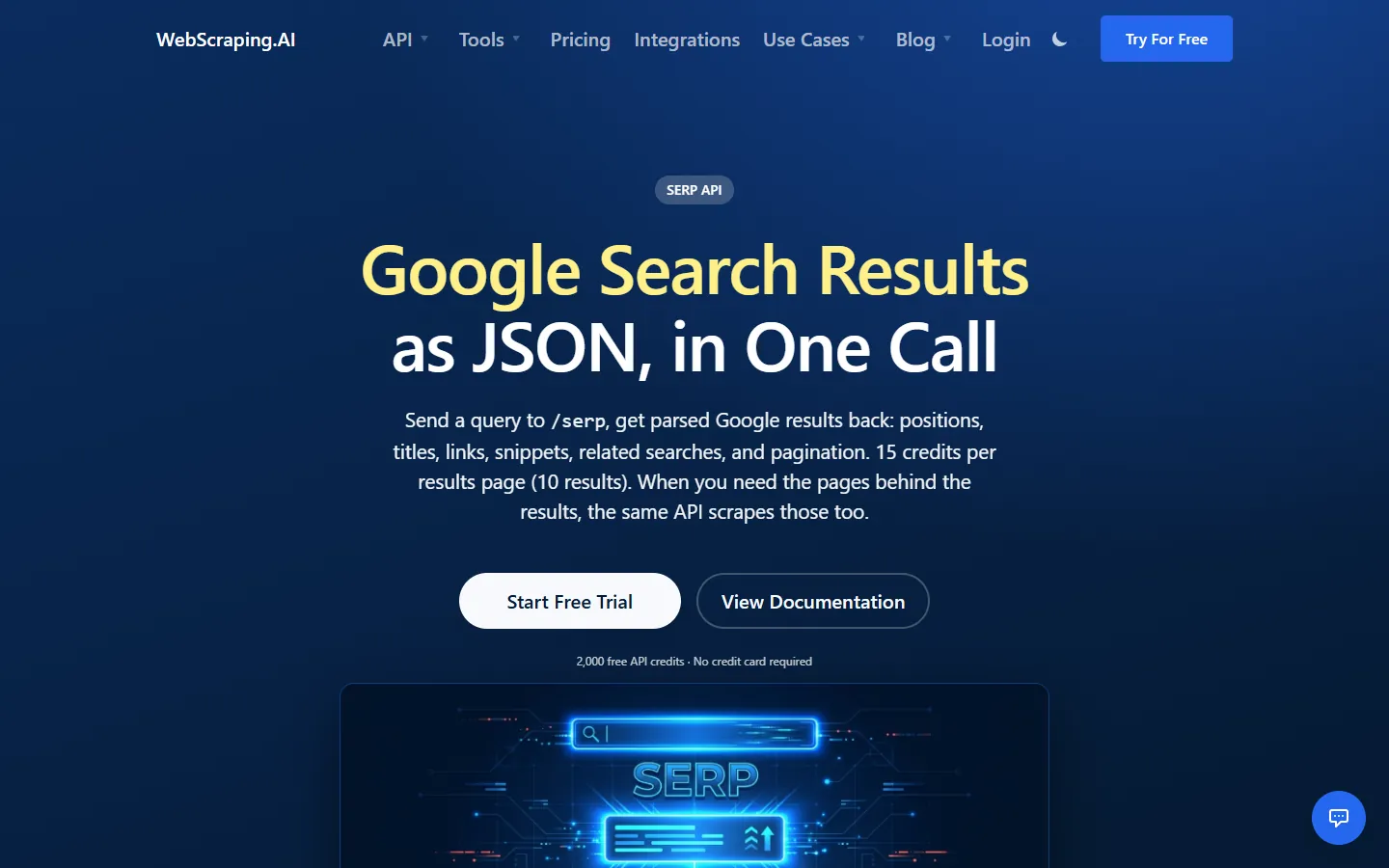
The SERP endpoint, September 2026: parsed Google results for 15 credits a page. Dedicated SERP APIs parse more features; this one shares the key and the bill with ordinary scraping.
Prices are from each vendor’s own pricing page as read on 19 November 2026 unless marked, and were checked a second time by an independent reader. Watch the unit: most of these bill in credits whose per-request cost depends on JavaScript and proxy tier; Zyte, Bright Data, Oxylabs and Decodo bill per thousand successful results; Apify bills platform usage. “Hard-site cost” is each vendor’s own price for its residential, premium or stealth tier with JavaScript, in its own credits, so compare it against that vendor’s credits per dollar rather than across columns.
| Tool | Paid from | Credits or unit | Hard-site cost | AI extraction | Free tier | The catch |
|---|---|---|---|---|---|---|
| WebScraping.AI | $29 a month (250,000 credits, 10 concurrent); $99 (1,000,000, 25); $249 (3,000,000, 50) | 1 plain, 5 with JS, 10 or 25 residential, 50 stealth; pay-as-you-go $0.0002 a credit, 12 months | 25 residential with JS, 50 stealth; “credit multipliers” possible on protected sites | +5 credits for a question or typed fields; model unnamed | 2,000 credits every month, 2 concurrent | No reviews, no benchmark, no success rate, 13 countries, no screenshots, 7-day refund only |
| ScrapingBee | $19 (75,000 credits, 25 concurrent); $49 (250,000, 50); $99 (1,000,000, 100); $249 (3,000,000, 200) | 1 plain, 5 with JS, 10 or 25 premium, 75 stealth with JS | 75 stealth with JS | +5 credits (ai_query, ai_extract_rules) | 1,000 credits once | Credits expire monthly, no pay-as-you-go; screenshots, Google Search API and site APIs it has, WebScraping.AI lacks |
| ScraperAPI | $49 (100,000 credits, 20 threads); $149 (1,000,000, 50); $299 (3,000,000, 100); 10% off yearly | 1 plain, 10 render, 10 premium, 25 both, 30 or 75 ultra premium; per-domain: Amazon 5, Google 25, LinkedIn 30 | 75 ultra premium with JS; +10 per anti-bot bypass | AI parser and structured endpoints on every plan, no separate price | 5,000 credits for 7 days (FAQ says 1,000) | US and EU geotargeting only below $299; 7-day no-questions refund is better than WebScraping.AI’s |
| Scrapfly | $30 (200,000 credits, 5 concurrent); $100 (1,000,000, 20); $250 (2,500,000, 50); 2 months free yearly | 1 datacenter or 25 residential, +5 JS, +5 to 20 captcha | 30 residential with JS | Template 1, LLM prompt 5, auto-extraction 5 credits | 1,000 credits | Low concurrency on the $30 plan; extra credits $5 per 10,000 there; 98% claim on hard sites via Scrapeway |
| ScrapingAnt | $19 (100,000 credits); $49 (500,000); $249 (3,000,000) | 1 plain, 10 browser with JS, 25 to 125 residential | 125 residential browser with JS | 1 credit per 30 characters of Markdown plus output | 10,000 credits every month | Proxies billed per GB on top; the default request costs 10 credits, twice WebScraping.AI’s |
| ScrapeOps | $9 (25,000 credits, 1 thread); $29 (250,000, 5); $99 (1,250,000, 50); prepaid $5 per 10,000, 12 months | 1 plain, 10 render (5 cheap), 10 or 25 residential, 25 or 50 mobile; bypass 10 to 80 | 25 residential with JS; up to 80 for the hardest bypass level | +25 credits LLM extraction | 1,000 credits a month, 1 thread | An aggregator of other providers’ proxies; 7-day refund; account pauses at the limit |
| ZenRows | $19 (45,000 credits, 20 concurrent) or $16 yearly; $69 (250,000, 50); $199 (1,200,000, 100); 17% off yearly | 1 plain, 5 JS, 10 premium, 25 both; residential bandwidth 25,000 credits a GB | 25 premium with JS plus bandwidth | ”Extract” is free on top of a fetch; not described as LLM-based | 5,000 credits a month | Fewer credits per dollar than WebScraping.AI at the entry tier; Proxyway measured 70% success at 2 requests a second |
| Scrapingdog | $40 (200,000 credits, 5 concurrent); $90 (1,000,000, 50); $200 (3,000,000, 100); 2 months free yearly | 1 plain, 5 JS, 10 premium, 25 both; AI parser 10; screenshot 5; SERP 5 to 10; LinkedIn profile 50 | 25 premium with JS | AI parser 10 credits | 100 credits once | Cheaper SERP and screenshot calls; tiny free tier; tenth of twelve in HackerNoon’s sponsored table (57.76%) and 39% on Scrapfly’s chart of hard targets |
| Scrape.do | $29 (250,000 credits, 10 concurrent); $99 (1,250,000, 50); $249 (3,500,000, 100); yearly on request | 1 datacenter, 5 render, 10 super, 25 both; google 10, linkedin 30, amazon 1 | 25 super with JS | None listed | 1,000 credits a month | Charges for 400, 404 and 410 responses too; the closest price match to WebScraping.AI, with more credits at $99 and $249 |
| Crawlbase | Pay-as-you-go from $3 a thousand down to $0.02 at volume, no fee; $99 a month for 200,000 | 1 per success; JS doubles; site multipliers ×1 to ×20 | Up to ×20 on the hardest sites, ×40 with JS | None listed | 1,000 credits (up to 5,000) | Multipliers make hard sites unpredictable; billed in arrears |
| Zyte API | Pay-as-you-go $0.13 to $1.27 per 1,000 HTTP responses by site tier, $1.01 to $16.08 with a browser; $5 free | Per successful response, priced by site difficulty | $16.08 per 1,000 browser responses on tier-5 sites | $0.27 to $1.07 per 1,000 per data type; custom fields token-priced | $5 credit, 30 days | Led Proxyway’s 2025 test at 93.14%; prices vary by site and you learn yours by pasting the URL |
| Bright Data Web Unlocker | $1.50 per 1,000 requests; Scale $499 for 383,000 | Per successful request | Included — one price for every site | None (parsing to JSON or CSV only) | 5,000 requests a month | KYC, sales-led scale; “near 100% success” and 99.99% uptime are its own claims; the dearest of the one-price-for-every-site vendors here |
| Oxylabs Web Scraper API | $15 (30,000 results, $0.50 a thousand); $100 (222,000); $500 (1,430,000) | Per result, by volume | Included | AI parsing $3 per 1,000 pages; LLM-platform scrapers from $1.50 per 1,000 | $5 welcome credit | ”All purchases made through self-service are non-refundable”; credits expire monthly |
| Decodo (ex-Smartproxy) | $19 (38,000 pages); $49 (122,000); $99 (330,000); $249 (1,200,000) | Per page or crawl, by volume | Included | LLM-ready Markdown or JSON output, no extraction endpoint | 10,000 pages a month | 14-day money-back, the best refund here; rate-limited by requests a second rather than concurrency |
| Apify | $19 (Starter, $19 of usage); $199 (Scale); compute units $0.20 each, residential $8 a GB | Platform usage, not per page | Unblocker $1.25 per 1,000, residential by the GB | Via Actors and agents; no flat extraction price | $5 of usage a month | A platform with crawlers, storage and scheduling, which WebScraping.AI is not; harder to predict per page |
| Firecrawl | $19 (5,000 credits, 5 browsers); $99 (100,000, 25); $399 (500,000, 50); about 17% off yearly (20% on the $749 Scale plan) | 1 per page scraped or crawled; +4 for JSON extraction; 2 per 10 search results | Not tiered; no stealth proxy pricing | +4 credits for LLM JSON; its own CrawlBench scored 87.5% exact match on an easy set | 1,000 credits a month | Crawling, mapping and agents it has; 5,000 credits for $19 is 50 times fewer than WebScraping.AI’s 250,000 for $29 |
| Diffbot | $299 (250,000 credits); $899 (1,000,000); overage $0.001 a credit | 1 per page extracted, 2 through a datacenter proxy | 2 | Machine-learning extraction is the product; Knowledge Graph exports 25 to 100 | 10,000 credits a month | A $299 floor; built for entity extraction and knowledge graphs, not cheap fetching |
Where WebScraping.AI wins: on price for ordinary pages — $29 buys 250,000 credits where ScrapingBee charges $49 and Firecrawl’s $19 buys 5,000 — and on the shape of the deal: pay-as-you-go credits that last a year (only ScrapeOps’ prepaid blocks and Zyte’s and Crawlbase’s pure usage billing come close), a free plan that renews, failed requests free (the Terms carve out geo-restricted or unreachable targets, which “remain chargeable”), a stealth tier at 50 credits against ScrapingBee’s 75, published prices for everything, and the best AI-assistant plumbing in the table. If you scrape mostly static or lightly scripted pages, want Google results and social records on the same bill, and would like Claude or Cursor to fetch pages for you, it is as cheap as any sane choice in the table.
Where it loses: on evidence — every rival in this table has been benchmarked by Proxyway, Scrapeway, ScrapeOps or at least reviewed by strangers, and WebScraping.AI has not; on hard targets, where Zyte, Bright Data and Oxylabs sell one price per success with measured results and Scrapfly publishes a 98% claim; on refunds, where ScraperAPI’s 7-day no-questions rule, ScrapeOps’ 7 days and Decodo’s 14-day money-back beat “price minus used credits, first purchase only”; on breadth, where ScrapingBee adds screenshots and richer SERP features, Apify and Firecrawl add crawling and scheduling, and Diffbot adds a knowledge graph; and on reach, with 13 proxy countries and no city-level targeting outside the SERP endpoint. Jina’s Reader, which the vendor lists as an alternative, is free up to ten million tokens but “does not actively circumvent or bypass any website defense mechanisms”, which is the other way of saying what this API is for.
10. WebScraping.AI Pros and Cons
Pros
- Published, fixed credit prices for every request type, and failed requests are free (bar geo-restricted or unreachable targets): 1 credit for a static page, 5 rendered, and a $29 plan buys 50,000 rendered pages
- Pay-as-you-go credits that last 12 months from a $20 top-up, which almost no credit-based rival offers
- A free plan that renews every month — 2,000 credits, no card — instead of a one-off trial
- Errors that teach: a blocked request names the blocker, the retry and its cost, and
proxy=autowalks the ladder for you - The best AI-agent tooling at this price: hosted MCP server with OAuth, CLI with an installable skill,
llms.txt, Markdown for every page, OpenAPI spec, seven SDKs - Customer-friendly Terms on the points that matter: no training on your content, prompts or outputs (extended to model providers), fee rises at most once a year with 30 days’ notice, pay-as-you-go credits honoured at the rate you paid
- Google results and structured social, job and video data at a flat 15 credits a page, on the same key and bill
Cons
- No public user reviews we could read anywhere — Trustpilot, G2, SourceForge, Slashdot all empty, nothing on Capterra, Product Hunt, Reddit or Stack Overflow, and the only Hacker News mentions are the maintainer’s
- Absent from every independent benchmark and roundup we found, with no published success rate, uptime figure or status page
- Hard targets are dear: 25 credits for residential with JavaScript, 50 for stealth, and the Terms reserve credit multipliers on “protected, high-risk” sites that the pricing page does not list, disclosed in-app “where practicable”
- A narrow product: 13 proxy countries, no screenshots, crawler, scheduler, storage or sticky sessions, Google only on the SERP endpoint, a 25-second cap
- A small, quiet company with no named founder, a mail-drop address, a one-member GitHub organisation and a feature request open for a year
- Refunds only within 7 days of a first purchase, minus used credits; plan credits expire monthly; upgrades charged in full; suspension on any target-site complaint and termination for convenience on 30 days’ notice
- An unnamed AI model (the Zapier listing still says “GPT-powered”), a subprocessor list for enterprise customers only, and a blanket disclaimer on AI accuracy
11. Frequently Asked Questions
What is WebScraping.AI?
A web scraping API operated by Urlooker LLC, a Wyoming company with a Portland, Oregon mailing address, launched in 2019. You send a URL with an API key and get back rendered HTML, clean text, a CSS-selected fragment, an AI answer to a question, typed JSON for fields you describe, parsed Google results or structured data for a known kind of page; the service runs headless Chrome, rotates datacenter, residential or stealth proxies in 13 countries and retries, and charges in credits only for requests that succeed. Seven SDKs, a hosted MCP server for Claude and Cursor, a CLI, an n8n node and a proxy mode sit on top.
How much does WebScraping.AI cost in 2026?
Free: 2,000 credits a month with 2 concurrent requests and no card. Personal: $29 a month for 250,000 credits and 10 concurrent requests. Plus: $99 for 1,000,000 credits and 25 concurrent. Startup: $249 for 3,000,000 credits and 50 concurrent. Enterprise above that by email. Pay-as-you-go: $0.0002 a credit from a $20 top-up (100,000 credits), valid 12 months, used after any plan quota. Billing is monthly only; there is no yearly plan or discount.
How many credits does one request cost?
One credit for a page fetched without JavaScript through a datacenter proxy; 5 with JavaScript rendering, which is the default; 10 through a residential proxy without JavaScript and 25 with it; 50 through a stealth proxy either way; 5 more on top of any of those for an AI question or AI fields; 15 per Google results page of 10 results; 15 per structured-data page on supported sites and 50 on Reddit. Failed requests are free. On the $29 plan that is 250,000 static pages, 50,000 rendered pages, 25,000 AI extractions on rendered pages or 5,000 stealth requests a month.
Is there a free plan or trial?
Yes, a free plan rather than a trial: 2,000 credits every month, 2 concurrent requests, no credit card. That is 2,000 static pages, 400 rendered pages, 200 AI extractions or 40 stealth requests, and it renews monthly, so a hobby project can stay on it. The sign-up page sits behind a Cloudflare challenge that automated readers cannot pass; a normal browser can.
Can I get a refund?
Only within 7 days of your first subscription purchase or of a pay-as-you-go top-up, and only for the purchase price minus the pay-as-you-go value ($0.0002 a credit) of the credits you used in that week. Renewals and upgrades are never refundable, nothing is refundable after the seven days, and non-use is not a reason. Requests go to support@webscraping.ai.
Do unused credits roll over?
Plan credits do not: they are issued at the start of each billing period and expire at its end. The one exception is an upgrade, when unused credits are added to the new plan's quota and then expire with the new period; the upgrade itself is charged at the full new price with no proration. Pay-as-you-go credits are the opposite — they last 12 months from purchase, the pricing FAQ says every new top-up extends the whole balance for another 12 months (the Terms, which govern, say the unused balance expires with no extension), and a price rise does not affect credits already bought.
Which countries can I scrape from?
Thirteen: the United States (default), the United Kingdom, Germany, France, Canada, Spain, Italy, Turkey, Russia, Japan, South Korea, India and Hong Kong, chosen with the country parameter; or route through your own proxy with custom_proxy. The SERP endpoint separately takes a location, latitude and longitude or a Google uule code and runs the search from that place.
Does WebScraping.AI solve CAPTCHAs?
Not in the sense of a solving farm. The homepage says the API handles CAPTCHAs; the feature card says stealth proxies get past anti-bot challenges like Cloudflare's and that challenge pages are not charged; the docs say challenge pages are routed straight to proxy=stealth, which costs 50 credits a request, because they need a hardened browser rather than a better IP. Whether that works on your target is something only the free plan can tell you, and the docs are explicit that no language model can read a page Cloudflare refused to serve.
Which AI model does it use, and how accurate is it?
The site does not say. The Terms and privacy policy refer to third-party AI model providers, say the company does not train on your scraped content, prompts or outputs and requires those providers not to either, and offer the subprocessor list only to enterprise customers under NDA; the Zapier listing still calls the service GPT-powered. No accuracy figure is published, and the Terms state that AI outputs are probabilistic and may contain errors and should not be relied on without independent verification. Asking for named, typed fields rather than free-form answers is the vendor's own advice for limiting what the model can get wrong.
Is it legal to use WebScraping.AI?
Using the API is legal; what you scrape, and what you do with it, is on you. The Terms make you responsible for each target site's terms, for the US Computer Fraud and Abuse Act, for GDPR Article 14 notices and a lawful basis if you collect personal data, and for an independent lawful basis if you train models on the results, and you indemnify the company for all of it. The company can suspend you on a complaint from a target site. The vendor's own legality guide summarises the case law honestly: public pages are outside the US computer-crime statute after Van Buren and hiQ, hiQ still lost on contract and accepted a $500,000 consent judgment, Meta v. Bright Data allowed logged-out scraping of public pages, and in Europe public availability is no GDPR defence, as Clearview's fines show.
What is the MCP server, and does it cost extra?
It is a hosted Model Context Protocol endpoint at mcp.webscraping.ai/mcp that lets Claude, Claude Desktop, Claude Code, Cursor, Codex, Windsurf and other MCP clients fetch rendered pages, text, selected HTML, AI answers, typed fields, Google results and structured data through your account; you sign in with OAuth rather than pasting an API key. It is included on every plan, including the free one, and each tool call spends ordinary credits. The previous open-source server still runs locally over stdio with an API key and exposes the same ten tools.
WebScraping.AI vs ScrapingBee: which should I pick?
They sell the same credit model — 1 credit plain, 5 with JavaScript, 10 or 25 for premium or residential proxies, 5 extra for AI — and both charge only for successful requests. WebScraping.AI is cheaper per credit ($29 for 250,000 against ScrapingBee's $49), has a cheaper stealth tier (50 against 75 credits), sells pay-as-you-go credits and renews a free plan monthly. ScrapingBee has more concurrency on its entry plan (25 against 10), a screenshot API, a richer Google Search API, dedicated site APIs, Oxylabs' proxy network behind it since 2025, and public reviews and benchmark results you can read. Price favours WebScraping.AI; evidence favours ScrapingBee.
WebScraping.AI vs Firecrawl or Jina Reader for AI agents?
Firecrawl is a crawler and agent platform: it maps and crawls whole sites, extracts JSON with a language model for 4 extra credits and runs agents, but $19 buys 5,000 credits where WebScraping.AI's $29 buys 250,000, and its pricing page lists no separate stealth or residential proxy tier. Jina's Reader is free up to ten million tokens and returns clean Markdown, but by its own description does not bypass any site defences. WebScraping.AI sits between them: a per-URL fetch with proxies and a stealth tier, an MCP server and Markdown output, and no crawling or scheduling. For single protected pages inside an agent it is the cheapest of the three; for whole-site crawls choose Firecrawl.
Who is behind WebScraping.AI, and is it safe to rely on?
Urlooker LLC, a Wyoming company with a Portland mail-forwarding address and a Houston phone number, which says it has worked in scraping since 2016 and launched the API in 2019. No founder, team or investor is named anywhere; the GitHub organisation's only public member is a developer who described the service as their own project in 2020. The API has shipped continuously for seven years, the Terms and privacy policy were last updated in May 2026, and there are no complaints on record — but also no reviews, no benchmark, no status page and no uptime promise. Treat it as a capable small vendor: keep a second provider's key in your config and test on the free plan first.
Does the link in this review give a discount?
No. The link carries a via referral tag from the WebScraping.AI affiliate programme, which pays the referrer 25% of what you spend for as long as you stay a customer and offers the buyer nothing: no coupon and no extra credits, and the free plan is identical however you arrive. It does not change your price. We did not open the link ourselves, because we never test affiliate or referral links.
12. Final Verdict: Is WebScraping.AI Worth It in 2026?
For a developer or small team that scrapes mostly ordinary pages, wants Google results and social records on the same bill, and would like an AI assistant to fetch live pages, WebScraping.AI is among the cheapest well-made options we found: $29 for 250,000 credits, 1 credit a static page and 5 rendered, pay-as-you-go credits that last a year, a free plan that renews, failed requests free, errors that tell you what to do next, and the most complete MCP, CLI and SDK plumbing in its price class. The Terms are better than the market’s on the things that matter to a customer — no training on your data, price rises capped at once a year with notice, credits honoured at the rate you paid — and the docs are written by someone who expects you to read them.
The reasons to hesitate are all about evidence. Nobody who is not the vendor has published a success rate, an uptime figure or a review we could read; the company has no status page, no named founder, a mail-drop address and a one-member GitHub organisation; and the Terms, for all their clarity, let it suspend you on any complaint and terminate for convenience on a month’s notice. Hard targets are where scraping APIs earn their keep, and here they cost 25 to 50 credits a request with a clause allowing more. The AI endpoints run on a model you are not told the name of. None of that is a reason not to use it; all of it is a reason to use it with a second key in your config.
Use it the smart way. Start on the free plan and spend the 2,000 credits on your real targets, including one residential and one stealth request each, so you know what the ladder costs for your sites. Turn js off wherever the page is static — it is the difference between 1 and 5 credits. Prefer /ai/fields with named fields over /ai/question when you need structure, and verify a sample of AI output before you trust it. If your volume is bursty, buy $20 of pay-as-you-go credits instead of a plan; if it is steady, Plus at $99 is the best credits-per-dollar step before Startup. Decide inside the first seven days, because that is the refund window. Keep personal data, logged-in pages and anything a target site would complain about out of it, and read section 7 of the Terms before you point it at LinkedIn.
Choose something else if you need measured, benchmarked success on heavily protected sites at scale (Zyte, Bright Data, Oxylabs), screenshots and richer SERP parsing (ScrapingBee), whole-site crawling, scheduling and agents (Firecrawl, Apify), a generous money-back guarantee (Decodo’s 14 days, ScraperAPI’s 7 no-questions days), or simply a vendor with reviews you can read.
Disclosure: This review is an independent assessment by TrackerTools and contains a WebScraping.AI affiliate link. If you sign up through it, the WebScraping.AI affiliate programme pays us a recurring commission; the link does not change your price and gives you no discount. All factual claims were checked against webscraping.ai’s homepage and pricing section, about, affiliates, integrations, MCP server, n8n, SERP, AI web scraping, Amazon, LinkedIn, Instagram, Indeed, Reddit, YouTube and social media pages, the full API documentation (rules, parameters, success rates, errors, proxy mode, SDKs, AI tools, cookies and each endpoint), the OpenAPI specification, llms.txt and the Markdown copies of every page, the Terms of Service and the Privacy and Cookies Policy (both last updated 24 May 2026), the vendor’s own comparison pages and legality guide, the GitHub organisation, npm and PyPI download counts and changelogs, Trustpilot, G2, SourceForge, Slashdot, Hacker News, AIChief, ToolMage, SeekTool and Make Tech Easier, the Proxyway, Scrapeway, ScrapeOps and HackerNoon benchmarks, each competitor’s own pricing page, and the legal sources named in section 7 — read and then re-read by an independent checker, as of 19 November 2026. Page counts, response times and availability are the company’s claims; we could not verify them independently, and we found no third party who had.