
Julius AI Review 2026: The Chat Data Analyst That Became an “AI Workspace” — Real Prices, How Credits Run Out and What the Terms Say About Your Data
Every analyst has had the same thought while cleaning a CSV at 11 pm: why can’t I just ask the file what happened? Julius AI was built for that question. You upload a spreadsheet, a PDF or a database connection, ask in plain English, and it writes and runs the Python, R or SQL, hands back the chart and the statistics, and keeps the context for the next question. Harvard Business School tested it against ChatGPT and others for a required MBA course and, professor Iavor Bojinov told TechCrunch, Julius “ended up performing the best”.
Three years after launch the product has changed shape. The pricing page now calls Julius “Your AI Workspace”: the same chat makes PowerPoint decks, websites, images, video and audio, runs browser agents and answers in Slack, with GPT-6, Claude Opus 5.5, Grok 4.7 and Meta’s Muse behind one picker. It also changed how it charges. In March 2026 message limits became credits, the tiers between Pro and Business vanished in October, and the loudest 2026 reviews are about credits draining in days and refunds refused.
This review explains what Julius does in November 2026, which models and connectors you get on which plan, what Free, Plus, Pro and Business cost under both billing toggles, how the credit system works and where it bites, what the refund policy and the Terms actually say, how the company behind it is structured, what users praise and complain about, and how it compares with ChatGPT, Claude, Gemini, Copilot in Excel, Akkio, Powerdrill, Rows and others.

The image Julius uses on its pricing page in November 2026: a deck generated from a one-line prompt. Data analysis is now one of six “things you can make”.
1. What Julius AI Is — and Who Is Behind It
Julius describes itself in its own FAQ as “an AI assistant designed for statistical analysis, data science, and computations” that “uses various large language models, finding the best one for each task, and writes code to analyze your data based on your prompt.” In practice it is a chat window with a cloud sandbox attached: your files and dataframes live in that sandbox for the conversation, every answer can be expanded to show the code that produced it, and the conversation can end in a chart, a report, a deck or a website.
The company. The Terms of Service (updated 20 October 2026) are a contract with Caesar Labs Inc.; the privacy policy (updated 21 October 2026) names Julius AI Inc. at the same address, 149 New Montgomery Street, San Francisco; the App Store seller and the February 2026 JULIUS trademark registration say Caesar Labs. We found no filing confirming a rename, so treat them as one company with two names. The founder and CEO is Rahul Sonwalkar, a former Uber engineer who went through Y Combinator’s summer 2022 batch with a logistics tool, pivoted six times (one attempt, “excelcopilot”, drew a cease-and-desist from Microsoft; another, CensusGPT, went viral for a day) and launched Julius in July 2023. He is a solo founder; Veer Bhatia is the founding engineer. If the name rings a bell, Sonwalkar was the “Rahul Ligma” of the 2022 fake-fired-Twitter-engineer prank, which TechCrunch revisited in May 2025.
Funding and scale. Julius raised about $500,000 of pre-seed money in 2022 and a $10 million seed in July 2025 led by Bessemer Venture Partners (Talia Goldberg), with Horizon VC, 8VC, Y Combinator, AI Grant and angels including Perplexity’s Aravind Srinivas, Vercel’s Guillermo Rauch and Twilio’s Jeff Lawson. We found no later round. The team is small — around ten to twenty people, with six open roles in San Francisco and remote in November 2026. Julius’s own pages say “Loved by 2,000,000+ users” and show logos for Zapier, Nvidia, GUESS, SimpliSafe, PandaDoc, Toast and 11x; the two-million figure dates from mid-2025 and counts registered users. The strongest independent reference is Harvard Business School, whose required “Data Science and AI for Leaders” course put 930 MBA students on Julius in its first run.
The 2026 direction. The changelog tells the story: AI Slides in April, image generation and the Julius 1.2 model family in May, video and a team usage dashboard in June, browser agents and text-to-speech in July, website building and a public affiliate programme in August, and a run of new models through September. In the same period Custom Agents and Notebooks were sunset. Julius is no longer only an AI data analyst, and the review treats it as what it is now.
2. Who Julius Is For — and Who It Is Not For
It fits you if:
- You have data in spreadsheets or a database and questions you would otherwise take to an analyst or write SQL for
- You want to see the code and the intermediate tables, not just an answer — Julius shows the Python, R or SQL for every step
- You are a student or researcher who needs regressions, ANOVAs, clustering and clean charts without learning pandas
- Your team wants shared connections, a Slack agent and scheduled runs — on Business, where seats are pooled under one credit budget
- You like the idea of going from analysis to deck or dashboard in the same conversation
Look elsewhere if:
- You want predictable usage — credit costs are not shown before you send a prompt, and there are no top-ups
- You want a refund safety net — purchases are “generally final” and reviewed case-by-case
- You need files to persist — anything below Enterprise is deleted after seven days
- You need a mobile app that is maintained — iOS last updated May 2025, Android unavailable
- You are on a budget between Pro and Business — the $45 to $450 gap has nothing in it since October 2026
3. Chat With Your Data — the Core Product
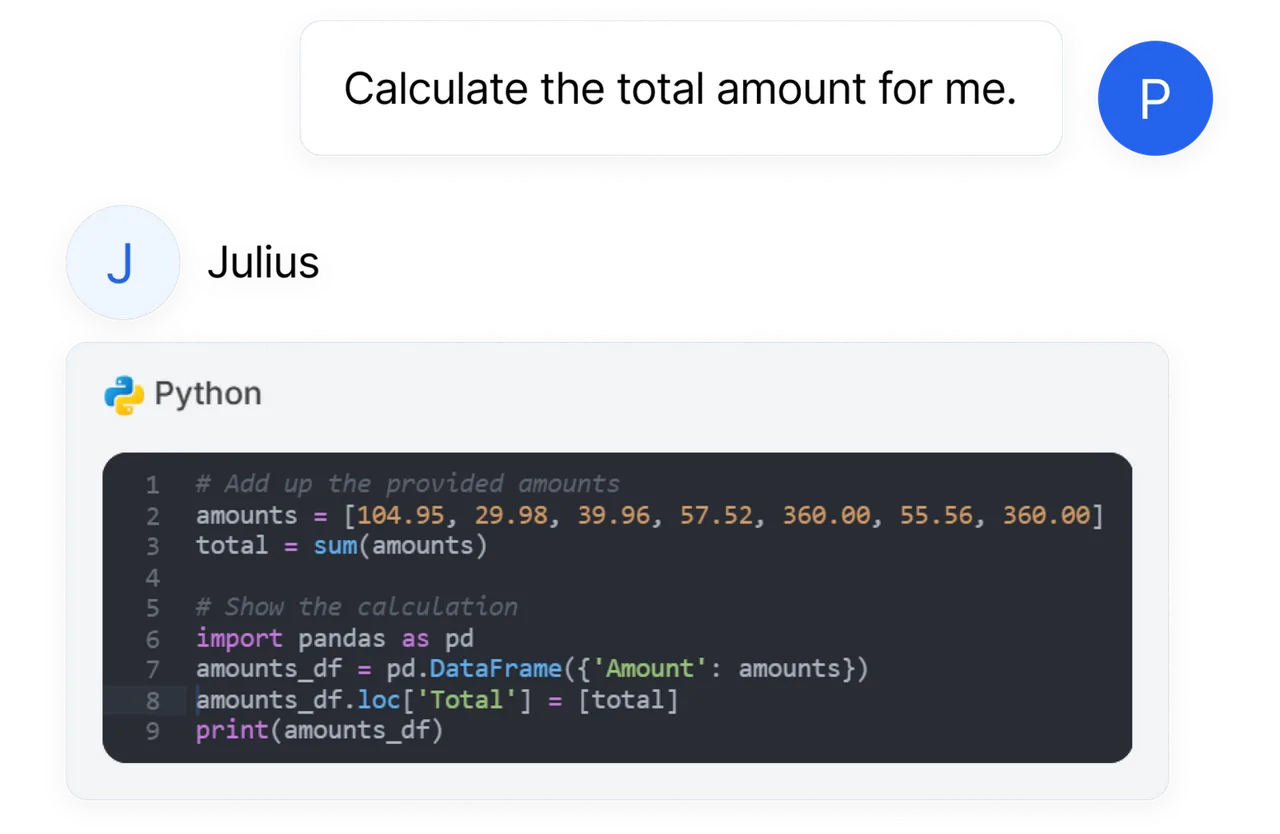
From Julius’s product page: every answer comes with the code that produced it, which is the feature analysts cite most.
Getting data in. Drag in CSV, Excel (multi-tab workbooks included — refer to tabs by name), JSON, Parquet, PDF or images, or pull files from Google Drive, OneDrive and SharePoint. Teams connect Snowflake, BigQuery, PostgreSQL, MySQL, SQL Server, Supabase, a live Google Sheets connection that writes back, plus Google Ads, Meta Ads, Stripe and Zapier. Julius learns a connector’s schema and lets you add a data dictionary, filter which tables and columns it may see, and save queries in a “Query Vault”. The FAQ says there is “no limit enforced by us” on rows; the practical ceiling is what fits in the sandbox — 16 GB of memory on Plus, 32 GB on Pro — and the advice for bigger data is to connect a warehouse instead of uploading.
Asking. You type what you would say to an analyst: “show me average sales by product category”, “run a one-way ANOVA”, “which cohort churned fastest”. Julius plans, writes code, runs it, and shows the result; you can expand the thinking steps, open the Data Explorer to check the dataframe, set a reasoning level from low to extra-high, and keep going. Since April 2026 it asks a clarifying question with preset answers when a prompt is ambiguous. Extended memory across chats and custom instructions (including “skills” written as Markdown files) replace the Custom Agents that were sunset.
Getting results out. Charts can be copied or downloaded, themed to your brand, or made interactive with Plotly; dataframes export to CSV or Excel or straight to Google Drive; a conversation becomes an editable, shareable report, an interactive HTML dashboard, a PowerPoint or Google Slides deck, or a published page with visitor analytics. Public “replay” links let someone watch the analysis without signing in.
What the users who like it say. The praise is consistent across 2024–2026 reviews: the code is visible and usually correct, statistics that would take an afternoon in Excel take minutes, and it handles messy files with patience. The complaints are about scale and reliability rather than ability: containers that crash on long sessions (Julius’s own troubleshooting advice is to start a new thread), looping on ambiguous prompts, and — the 2026 theme — credits.
4. Models, Credits and the “Workspace” Features
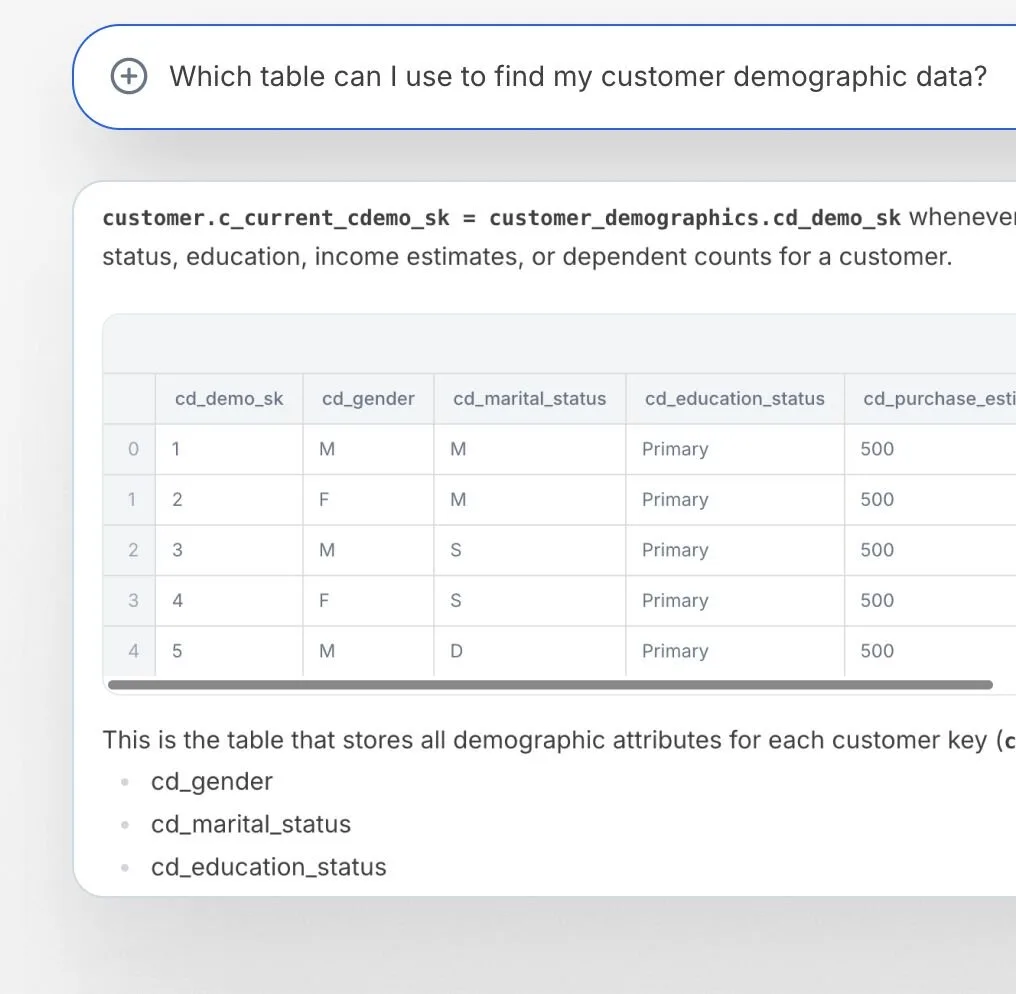
Schema learning on a connected warehouse, from Julius’s product page. On Business there is no table limit; on Plus and Pro there is.
Which models. Julius’s model guide on 3 November 2026 lists fourteen entries: GPT-6 Astra and GPT-5.6 Sol (OpenAI), Claude Opus 5.5, Sonnet 5.5 and Fable 5.1 (Anthropic), Muse Wonder (Meta), Grok 4.7 (xAI), Kimi K3 (Moonshot), and Julius’s own 1.2 Lite, 1.2, 1.2 Max and 1.2 Ultra agents; Claude Haiku 5.5 and Gemini 3.1 Pro are listed as “not available”. The Free plan gets Julius 1.2 Lite only; every other model is marked “Pro, Max, Ultra, and Business”. That contradicts the pricing page, where the Plus card promises “access to frontier AI models like GPT-6.1 Sol and Claude Opus 5.5” — a model name that does not appear in the guide. Our reading: Plus gets some frontier models, Pro gets all of them, and the copy on the two pages was written by different people. Check the picker before you pay.
How credits work. Julius announced the switch from messages to credits on 28 February 2026 and said paid users would be moved by 28 March; Trustpilot reviews suggest some accounts were still on message limits in late April and on credits by late May. The documentation is candid that “there’s no single answer” to what a message costs: it depends on the model, the length of the output, the size of the data and the tools invoked (web search, slides, the financial-data API). Model choice is “one of the biggest drivers”: Julius 1.2 Lite and Claude Sonnet 5.5 are cheap, Julius 1.2 Max, Opus 5.5, Fable 5.1, Grok 4.7, GPT-6 Astra and Muse Spark 1.3 are expensive. The model picker shows relative cost indicators, but the exact credit cost of a prompt is not shown before you send it. Monthly credits are granted on the billing date and expire at the end of the cycle; annual plans get twelve months of credits up front that expire at the end of the year; paid plans also get 100 daily credits that reset at midnight UTC and are spent first. And this is the line that matters: “purchasing additional credits or topping up your balance is not supported” — when you run out, you wait or upgrade. The announcement promised that fewer than 5% of users would ever hit the limit; the Trustpilot reviews below suggest the other 5% write reviews.
Slides, reports, websites, images, video. AI Slides (April 2026) generates a deck from a prompt, a document or an analysis, keeps your brand colours and fonts if you share guidelines, and exports to PPTX, PDF, PNG or Google Slides; a library of 100-plus templates arrived in August. Reports can be edited inline like a document and published. Website building (August 2026) publishes a page or a small web app on a Julius domain with a custom link name and visitor analytics. Images (May), video with Seedance 2.5 at 480p or 720p (June–August) and text-to-speech (July) round it out. On Free these are “limited”; on paid plans they draw from the same credit pool as your analysis.
Agents and automation. Browser agents (July 2026) operate websites on your behalf while showing you the live session — and, Julius says, can “wait through supported CAPTCHA challenges”. Scheduled runs re-execute a saved workflow on a timer: none on Free and Plus, 3 on Pro, unlimited on Business and Enterprise. The Slack agent (October 2025, a Business feature) answers @julius in a channel, reaches your data connections and posts structured scheduled reports. Parallel agents run several research threads at once; Plus allows some, Pro “unlimited”.
What was removed. Workflows became Notebooks in May 2025 and were sunset in August 2026; Custom Agents were sunset in favour of custom instructions and skill files; the outline tab and the disable-code setting went in September 2025. The Chrome extension for Google Sheets has not been updated since April 2024, and the documentation covers Julius calling external APIs, not an API for calling Julius. None of this is unusual for a startup, but if a specific feature is why you are buying, confirm it still exists.
5. Pricing — Free, Plus, Pro, Business and Enterprise
We read the pricing page with both billing toggles on 3 November 2026. The yearly toggle saves 20%, which matches the arithmetic on every plan.
| Plan | Monthly | Billed yearly (per month) | Credits | What you get |
|---|---|---|---|---|
| Free | $0 | — | 75 welcome credits plus 25 a day | Julius 1.2 Lite models; file uploads and charts; Google Drive, OneDrive and SharePoint connectors; “limited” slides, images, video and websites; 7-day file storage; help centre |
| Plus | $20 | $16 ($192 a year) | 2,000 a month (24,000 up front on yearly) plus 100 a day | ”Frontier AI models” per the pricing page; 16 GB sandbox; charts and presentations; publish websites on a Julius domain; browser and parallel agents; 7-day file storage; chat and email support |
| Pro (“Recommended”) | $45 | $37 ($444 a year) | 5,000 a month (60,000 up front on yearly) plus 100 a day | Everything in Plus; all models including Opus 5.5, Fable 5.1 and GPT-6 Astra; 32 GB sandbox; unlimited parallel agents; 3 scheduled runs; priority email support; 2FA |
| Business | $450 | $375 ($4,500 a year) | 60,000 a month pooled across the team (720,000 on yearly) | Everything in Pro; up to 50 members; Postgres, BigQuery, Snowflake and more with no table limit; semantic schema learning; unlimited scheduled runs; Slack agent; shared workspace, files and threads; usage dashboard; centralised billing |
| Enterprise | Custom | Custom | ”Unlimited” | Everything in Business; all models “including the most powerful”; custom connectors; permanent file storage; audit logs; SSO; user roles; tailored onboarding; contact through a Typeform |
What happened to Max and Ultra
Until late October 2026 the page also sold Max ($200 a month or $166 yearly, 25,000 credits) and Ultra ($500 or $416, 70,000 credits), and the credits documentation still lists them alongside Growth tiers up to 850,000 credits as “web-billed products, including legacy products”. A third-party pricing tracker recorded their removal from the public page on 24 October 2026; the model guide still says some models are available on “Max, Ultra” plans. If you are a heavy individual user, the honest position is that there is now nothing to buy between $45 and $450.
The credit numbers have moved
When the credit system was announced in February 2026, Pro was mapped to 4,500 credits and Business to 45,000. The page now says 5,000 and 60,000, and the annual Business grant is 720,000. The documentation’s own worked example still says a Pro annual subscriber gets “all 60,000 purchased credits”, while an older copy of the same page said 50,000. The direction is up, which is good; the point is that allowances are editable and the price is not the whole contract.
Price history
Julius has repriced often. In 2024–2025 the web tiers were Basic/Lite $20, Essential/Standard $45 and Pro $60 with a Team plan at $70 per member; the iOS app’s in-app purchases still carry those names and prices (Basic $20, Essential $45, Pro $60 a month; $200 and $450 a year). A pricing tracker’s captures show Plus at $20 (250 messages) and Pro at $45 from August 2025 onward, Max added in November 2025, the free plan cut from 15 to 5 messages a month in February 2026 along with the annual discount rising from 15% to 20%, Business introduced in January 2026 for teams of up to 10, and the seat cap raised to 50 in August 2026. Several review sites still quote a “$35 Plus with 250 messages”; no capture of the pricing page ever showed that, so treat it as a copied error. If a review you read counts messages at all, it predates March 2026.
Students, teams and the App Store
Julius “does not offer new student or academic discounts” — the 50% education discount that older guides describe survives only for people who already have it. Startups can email for a volume review with no promised rate. Extra seats on individual plans are not sold; teams go to Business. App Store subscriptions use the old tier names and must be cancelled through Apple.
What our link does
Julius’s affiliate programme, run on Dub, says that “new users who sign up through your link get 50% off their first month” and pays the referrer half of the first year’s payments. The link in this review is one of those partner links. We did not open it ourselves (we never test affiliate links), so confirm the discount on the checkout screen before you pay; prices after the first month are the ones above.
Free plan · no card · 50% off the first month via partner link
Try Julius on one of your own spreadsheets first
Upload a real file, ask the questions you actually have, and watch the Usage page to see what your prompts cost in credits before you pick a plan — there are no top-ups, and refunds are case-by-case.
Try Julius free
6. Refunds, Cancelling and the Contract
Refunds. The refund policy says subscription and credit purchases “are generally final” and that Julius “normally decline[s] refund requests based on forgetting to cancel or dissatisfaction with the product.” A recent payment, low usage or unused credits “does not by itself make a purchase refundable.” There is no stated refund window — several third-party guides claim 14 days, and they are wrong. What support will correct: a charge that an earlier cancellation request should have prevented, and verified duplicate payments. Approved refunds go back to the original card within about ten business days. Credits are non-refundable “except where required by applicable law”, and the Terms say they have no cash value.
Cancelling. Subscription settings → Invoices and Payment Methods → Cancel plan. It takes effect at the end of the billing period, access continues until then, remaining purchased credits are forfeited at the end, and your files stay on the Free plan. The documentation adds, twice, that “cancellation does not automatically refund an earlier charge.” Subscriptions bought through Apple or Google must be cancelled there. Support’s first responder is an AI agent called Fin, which the docs say “cannot grant credits or activate a paid trial”; a human follows.
The Terms. They are governed by California law; disputes go to binding arbitration with the American Arbitration Association seated in Los Angeles, with a class-action waiver and a 30-day negotiation step first (the preamble points to “Section 13” for this; it is Section 14). Liability is capped at the lower of six months of fees or $100. Julius may change the Terms “effective with or without prior notice”, may “modify or discontinue” any part of the service, and may delete your data after cancellation “in the normal course of operation”. You must be 18, which sits oddly with the App Store’s 4+ rating. The Terms do not contain the words “auto-renew”; the documentation does: “Your subscription will auto-renew monthly or annually.”
7. Privacy, Security and Your Data
Certifications. Julius is SOC 2 Type II and TX-RAMP compliant, continuously monitored by Oneleet, with a public trust centre that lists its controls and offers the SOC 2 report and a penetration-test letter dated 31 October 2025 on request. The trust centre lists only SOC 2 as a framework; the security page’s older copy described GDPR as “in progress”, and we found no HIPAA business-associate offer. Data is “stored and processed in the United States” in a “regionally isolated” cloud environment; there is no EU residency option.
Who sees your data. The privacy policy names Anthropic, Google and OpenAI as AI providers and the trust centre’s sub-processor list adds the rest: AWS and Google Cloud for storage, E2B for the code sandbox (“may process or store customer-submitted workspace content, including code/files”), Raindrop for “customer prompts, AI responses, agent traces”, Auth0, Stripe, RevenueCat, Intercom, HubSpot, PostHog, Fingerprint, and marketing pixels from Facebook, LinkedIn, Microsoft and X. The marketing site also uses Google Analytics behind a Cookiebot banner.
Training on your data. This is where the pages disagree, and it is worth quoting them. The security page’s FAQ now says: “Julius doesn’t build its own AI models. We may share data with AI technology providers to help improve their models, as described in our Privacy Policy. To opt out, email privacy@julius.ai.” The privacy policy says Julius does not use your personal information to train its own models, and that providers may use shared data “for their use in evaluating, improving, and developing their products and services.” The Terms go furthest: by uploading content you grant Julius “a worldwide, irrevocable, perpetual, non-exclusive, transferable, royalty free license, with the right to sublicense” to use it, “including sharing it with third-party AI technology providers to develop and improve AI models.” An earlier version of the security page, still quoted by review sites, said “Never. Your data is not used to train any models, internally or externally.” If your data is sensitive, send the opt-out email on day one and keep the reply — and know that the Terms’ licence does not say it is withdrawn by the opt-out.
Retention and deletion. Processed data is deleted “as soon as it’s not needed”; uploaded files are retained seven days on every plan below Enterprise and permanently on Enterprise; a Slack marketplace disclosure says customer data is kept up to 30 days after account termination. Deletion requests are honoured within seven business days, with the usual carve-outs for backups and legal retention. You own your outputs; Julius claims no ownership of your uploads beyond the licence above.
Security basics. Encryption in transit and at rest, customer data isolation, role-based access, MFA for staff, SSO through Auth0 (Okta, ADFS, OneLogin) on Enterprise, passkey login for users, a vulnerability disclosure programme at vdp@julius.ai and no bug bounty. We found no public report of a Julius breach; Julius’s own changelog records a Google Cloud outage taking down file and code operations in June 2025.
8. What Users Say
| Source | Rating | Reviews | Note |
|---|---|---|---|
| Apple App Store (US) | 4.8 | 398 ratings | App last updated 30 May 2025; in-app purchases still use the old Basic/Essential/Pro tiers |
| Google Play | ~4.5 | ~2,200 ratings | Tracker data from May 2025; the listing no longer resolves and Julius says the Android app is unavailable |
| Trustpilot | 1.7 | 22 reviews | 82% one-star, no five-star reviews, 19 of 22 posted in the last year; profile unclaimed, no company replies |
| G2 | 4.5 | 4 reviews | Too few to mean much; the “Julius” on Capterra with 107 reviews is an unrelated influencer-marketing product |
| Product Hunt | 5.0 | 1 review | The only launch is the Slack Agent (23 October 2025): about 169 upvotes, number 11 of the day |

The iOS app’s store screenshots still say “300,000+ people” — a 2024 figure. The app itself has not been updated since May 2025.
What people praise. The same three things since 2023: the code is visible and it fixes its own mistakes (“I hate Python coding but this actually debugs its own code”, Reddit, quoted February 2026), the time saved (“reduced the amount of time it took for me to analyze my yearly financial planning by at least 5–6 hours”, App Store), and the charts (“I checked the numbers behind the visuals, and they were spot-on”, a sponsored May 2025 hands-on). Hacker News commenters in 2024 called it “great” and “more powerful” than ChatGPT’s data analysis; a G2 reviewer says “productivity increased four folds.” The Slack Agent launch drew comments from people happy to stop writing SQL for colleagues.
What people criticise. Two themes dominate 2026, and both are about money rather than analysis:
- Credits. “Used around 4,500 credits in just 4 days with only 9 queries” (Trustpilot, 29 May 2026); “credits get sucked up in no time” (28 August 2026); “burned through all my credits” from a reviewer titled “I used to love this platform” (2 September 2026); one Business buyer says “those credits were never applied to my account” (6 September 2026). Independent reviewers agree that per-prompt cost is not shown before you send.
- Refunds and renewals. “They refuse to refund even though it was only 18 minutes later” after an auto-renewal (14 October 2026); a ~$300 annual plan refused after escalation (27 October 2026); earlier reviews describe refund promises that never arrived.
- Accuracy and scale. “Julius tends to just create data out of nowhere and then use it for analysis” (Trustpilot, 1 February 2026); “barely functions, hallucinates” (31 August 2026); a February 2026 review found Julius “may hallucinate summary statistics” and that 50 MB-plus Excel files sometimes time out; another notes that “large datasets (100K+ rows) can hit processing limits.” Julius’s own FAQ advises starting a new thread when the AI loops.
- Support. Chat replies measured in hours; an AI agent answers first.
A note on the numbers. Trustpilot’s sample is small and self-selected, and the profile is unclaimed, so 1.7 is not a verdict on the product; it is a reliable picture of what goes wrong when it goes wrong. Several of the fuller 2026 reviews are affiliate-supported or written by competitors (Coefficient, eesel, Powerdrill’s blog, myclaw), and some still describe the pre-March message-based plans. The App Store and G2 scores are real but stale or tiny. The trend is clear enough: 2024 reviews were about ability; 2026 reviews are about billing.
9. Alternatives Worth Knowing
Prices are from each vendor’s own pricing page as read on 3 November 2026 unless marked otherwise. Rows (shut down 31 May 2026 after its Superhuman acquisition), ChatCSV (free since Flatfile bought it) and Briefer (sunset) are left out.
| Tool | Paid from | Free plan | Best at | The catch |
|---|---|---|---|---|
| Julius AI | $20/mo; $16/mo yearly | Yes, 25 credits a day | Chat analysis with visible code, warehouse connectors, decks and reports | Credits with no top-ups or refund window; files deleted in 7 days |
| ChatGPT Plus | $20/mo (no yearly price) | Yes, limited uploads | General assistant that runs Python on your files | Julius says 512 MB file limit; no database connectors |
| Claude Pro | $20/mo; $17/mo yearly | Yes, with code execution | Analysis, file creation and beta dashboards inside a writing assistant | No database connectors or scheduled runs |
| Google AI Pro | $19.99/mo (US) | Free Gemini without Sheets | Gemini inside Sheets and Docs plus 2 TB storage | Lives in Google’s apps, not a standalone analyst |
| Microsoft 365 Premium | $19.99/mo | Personal and Family get limited credits, no Analyst agent | Copilot inside Excel with Analyst and Researcher agents | Copilot Pro was discontinued; Excel-centric |
| Powerdrill Bloom | $199 a year (~$16.58/mo); $13.27/mo first-year promo until 7 Nov 2026 | Yes, 1,000 daily credits | The closest cheaper rival, with persistent datasets and scheduled tasks | No monthly billing shown; its comparisons with Julius are vendor-written |
| Better Analyst (ex-Formula Bot) | $20/mo, billed yearly ($240) | 10 messages, 100 credits | AI dashboards and scheduled “Data Flows” for business users | Pro is yearly-only |
| Quadratic | $18/user/mo yearly | Yes | AI spreadsheet with Python and SQL cells | Monthly-billed price not shown |
| Hex | $36/editor/mo | Community | Code-first SQL and Python notebooks for data teams | Built for people who already code |
| Deepnote | $39/editor/mo yearly; $49 monthly | 5 agent calls a month | Collaborative notebooks, now open source | AI is credit-metered |
| Vizly | $29/mo | No | Research and statistics analyst that also writes slides | 20 credits a month, no yearly discount since October 2026 |
| Power BI Pro | $14/user/mo yearly | Free account, no sharing | Dashboards for Microsoft shops | Copilot needs paid Fabric capacity on top |
Where Julius wins: nothing else in this table combines frontier-model choice, a 32 GB code sandbox that keeps state, real warehouse connectors with schema learning, scheduled runs, a Slack agent and deck and report generation for $37 a month billed yearly. ChatGPT and Claude are “good enough” for a one-off CSV; they are not analysts with a database behind them.
Where it loses: if you ask a few questions a week, ChatGPT Plus or Claude Pro cost the same and never run out mid-month; Powerdrill does most of the Julius loop for less; Gemini and Copilot are already inside the spreadsheets your company lives in; and Hex or Deepnote give a data team reproducible notebooks rather than a chat log. Every $20 plan in this table has a usage model you can understand before you pay. Julius does not.
10. Pros and Cons
Where Julius is genuinely strong
- The analysis loop works: question → code → chart → follow-up, with the code visible and the sandbox state preserved
- Frontier models in one picker — GPT-6, Opus 5.5, Fable 5.1, Grok 4.7, Kimi K3, Muse — plus Julius’s own cheaper agents
- Real connectors: Snowflake, BigQuery, Postgres, MySQL, SQL Server, Supabase, live Google Sheets, Drive, OneDrive, SharePoint, Google Ads, Stripe, Zapier
- From analysis to deliverable: PPTX and Google Slides decks, editable reports, dashboards, published sites
- Teams get the right things: shared connections, schema semantics, Slack agent, scheduled runs, usage dashboard, audit logs
- Free plan with no card and a 50% first-month discount through partner links
- SOC 2 Type II, a public trust centre and a named sub-processor list — rare at this size
Where Julius falls short
- Credits you cannot predict, top up or get back — and they expire every cycle
- Refunds with no window, auto-renewal, and a 2026 Trustpilot record full of refused refunds
- A $45-to-$450 cliff since Max and Ultra left the pricing page
- Pages that disagree — models on Plus, the legal entity, the arbitration section number, the credit allowances
- A perpetual, sublicensable licence on uploads that explicitly covers improving third-party AI models; opt-out by email
- Seven-day file deletion below Enterprise; a dead mobile strategy (iOS from May 2025, no Android)
- Feature churn and a widening focus — Notebooks and Custom Agents gone, video and websites in
11. Frequently Asked Questions
What is Julius AI?
Julius AI is a chat-based data analyst from Caesar Labs, Inc. (also operating as Julius AI Inc.) in San Francisco, founded by Rahul Sonwalkar and launched in July 2023. You upload spreadsheets, PDFs or images or connect a database, ask questions in plain English, and Julius writes and runs Python, R or SQL in a cloud sandbox, returning tables, charts, statistical tests and the code. In 2026 it expanded into an 'AI workspace' that also generates PowerPoint and Google Slides decks, reports, websites, images, video and audio, runs browser agents and answers in Slack.
How much does Julius AI cost in 2026?
On 3 November 2026 the pricing page listed a Free plan (75 welcome credits plus 25 a day), Plus at $20 a month or $16 a month billed yearly with 2,000 credits a month, Pro at $45 or $37 yearly with 5,000 credits, Business at $450 or $375 yearly with 60,000 pooled credits and up to 50 members, and Enterprise on request. All paid plans add 100 daily credits. The Max ($200) and Ultra ($500) tiers were removed from the public page in late October 2026. New users who sign up through a partner link get 50% off their first month.
How do Julius credits work, and can I buy more?
Since March 2026 every action costs credits that vary with the model, the length of the output, the size of the data and the tools used; Julius does not publish a per-action price and says there is 'no single answer' to what a message costs. Monthly credits expire at the end of the billing cycle, yearly plans get twelve months of credits up front that expire at the end of the year, and daily credits expire at midnight UTC. Buying extra credits or topping up is not supported; when you run out you wait for the daily refresh or upgrade to a bigger plan. Lighter models such as Julius 1.2 Lite and Claude Sonnet 5.5 use far fewer credits than Opus 5.5, Fable 5.1, Grok 4.7 or GPT-6 Astra.
Does Julius offer refunds?
Not as a rule. The refund policy says subscription and credit purchases are 'generally final', that requests based on forgetting to cancel or dissatisfaction are normally declined, and that low usage or unused credits do not make a purchase refundable. There is no stated refund window. Support will correct charges that an earlier cancellation request should have prevented and verified duplicate payments; approved refunds return to the original card within about ten business days. App Store and Google Play purchases follow Apple's and Google's rules. Cancelling stops the next renewal but does not refund the current period.
Which AI models does Julius use?
Julius's model guide in November 2026 lists GPT-6 Astra and GPT-5.6 Sol from OpenAI, Claude Opus 5.5, Sonnet 5.5 and Fable 5.1 from Anthropic, Meta's Muse Wonder, xAI's Grok 4.7, Moonshot's Kimi K3, and Julius's own 1.2 Lite, 1.2, 1.2 Max and 1.2 Ultra agents; Claude Haiku 5.5 and Gemini 3.1 Pro are marked not available. The Free plan uses Julius 1.2 Lite; the guide puts the other models on Pro and above, while the pricing page advertises frontier models on Plus as well. Check the model picker on your plan before relying on a specific model.
What file sizes and data sources does Julius support?
Uploads include CSV, Excel (multi-tab), JSON, PDF and images, and files from Google Drive, OneDrive and SharePoint. Connectors cover Snowflake, BigQuery, PostgreSQL, MySQL, SQL Server, Supabase, live Google Sheets, Google Ads, Stripe and Zapier. Julius enforces no row limit; the practical ceiling is the sandbox memory, 16 GB on Plus and 32 GB on Pro, and it recommends connecting a warehouse for larger data. Uploaded files are deleted after seven days on every plan below Enterprise.
Does Julius train AI models on my data?
Julius says it does not build its own models and does not use your personal information to train models. Its security page says it 'may share data with AI technology providers to help improve their models' and offers an opt-out by emailing privacy@julius.ai; the privacy policy says providers may use shared data to evaluate, improve and develop their products; and the Terms grant Julius a perpetual, irrevocable, sublicensable licence over uploaded content 'including sharing it with third-party AI technology providers to develop and improve AI models'. If that matters, send the opt-out email before uploading sensitive data.
Is Julius AI safe and legitimate?
Yes, in the sense that it is a real company with a public trust centre: SOC 2 Type II and TX-RAMP monitored by Oneleet, a penetration-test attestation dated October 2025, encryption in transit and at rest, US-only processing, a named sub-processor list and a vulnerability disclosure programme. It raised a $10 million seed led by Bessemer in July 2025 and is used in a required Harvard Business School MBA course. The risks are commercial: unpredictable credit consumption with no top-ups, a no-window refund policy, auto-renewal, and a 2026 Trustpilot score of 1.7 driven by those two issues.
Is there a Julius mobile app?
There is an iOS app, 'Julius AI: Data & Math Helper', rated 4.8 from 398 ratings, but its last update was version 1.0.45 on 30 May 2025 and its in-app purchases still use the old Basic, Essential and Pro tier names and prices. Julius's FAQ says the Android app 'is currently unavailable in Google Play'. The web app at julius.ai is the maintained product.
Does the link in this review give a discount?
According to Julius's affiliate programme page, new users who sign up through a partner link get 50% off their first month, and the link in this review is a partner link. We did not open it ourselves, so confirm the discount on the checkout screen; after the first month the standard prices apply. If you subscribe through our link, Julius pays us a commission on your payments for up to a year.
12. Final Verdict: Is Julius AI Worth It in 2026?
For the job it was built for — asking questions of a spreadsheet or a database and getting a chart, a test and the code back — Julius is still one of the best tools a non-engineer can buy, and the free plan lets you prove that on your own data in an afternoon. Pro at $37 a month billed yearly buys every frontier model in one picker, a 32 GB sandbox, scheduled runs and priority support; Business turns it into a team tool with shared warehouses, a Slack agent and an admin dashboard, and the deck and report generators mean the analysis does not stop at a PNG.
The reasons to hesitate are the money mechanics and the fine print. Credits replaced messages in March 2026 and the documentation cannot tell you what a prompt will cost; the daily refresh helps light users, but there is no top-up for anyone else and nothing between $45 and $450 since Max and Ultra disappeared. Refunds are case-by-case with no window and subscriptions auto-renew, which is why the 2026 Trustpilot page reads the way it does. The Terms give Julius a perpetual licence over your uploads that explicitly contemplates improving third-party AI models, with an email opt-out. Files vanish after seven days below Enterprise. And the product is now spreading into slides, websites and video, which is good news if you want one tool and less good if you want the analyst to get deeper.
Use it the smart way. Start free with a real file and open the Usage page after each session so you learn what your prompts cost. Pick the cheaper models for routine questions and save Opus, Fable and GPT-6 for the hard ones. If you upgrade, buy monthly first; switch to yearly only when your monthly credit use is comfortably inside the grant, because the yearly grant is non-refundable. Send the privacy opt-out email before uploading anything sensitive, and download anything you need to keep within seven days.
Choose something else if you need predictable, unlimited-feeling usage (ChatGPT, Claude or Gemini’s own data tools on a $20 plan), if your data must never leave Excel (Copilot in Excel), if you are a team of three with a $150 budget, or if you need a refund policy with a number in it.
Disclosure: This review is an independent assessment by TrackerTools and contains a Julius AI partner link. If you subscribe through it, Julius’s affiliate programme pays us a commission on your payments for up to a year; Julius’s programme page says the link gives new users 50% off their first month, which we have not tested. All factual claims were checked against julius.ai’s pricing page (both billing toggles), models guide, security page, Terms of Service (20 October 2026), privacy policy (21 October 2026), affiliate page, changelog, documentation (credits, refund policy, cancellation, subscription management, discounts, FAQs, quickstart), the Oneleet trust centre including its sub-processor list, the Apple App Store listing, the Dub partner page, TechCrunch’s 2025 coverage, Y Combinator’s company page, Trustpilot, G2 and Capterra, and each competitor’s own pricing page where it could be read, as of 3 November 2026. User counts, customer logos, the Harvard results and funding figures are attributed to Julius or the cited sources; we could not verify them independently.